
In the complex symphony of automotive engineering, where thousands of components collaborate to deliver performance, safety, and comfort, the control arm often operates as an unsung hero. Far from being a mere static link, control arms are dynamic, load-bearing elements crucial to a vehicle’s suspension system. They are the pivotal connections that bridge the gap between the vehicle’s chassis and its wheels, facilitating controlled movement while maintaining critical geometry. Understanding their function is key to appreciating how a car handles, rides, and reacts to the road beneath its tires.
The Foundation of Automotive Suspension and Steering
At its core, a car’s suspension system serves a dual purpose: to support the vehicle’s weight and keep the tires in firm contact with the road, while also absorbing shocks and vibrations from uneven surfaces to ensure a comfortable ride. The control arm, sometimes referred to as a wishbone, is a fundamental component within this intricate system, acting as a movable lever that permits the vertical motion of the wheels while resisting lateral and longitudinal forces.
Connecting the Chassis to the Wheels
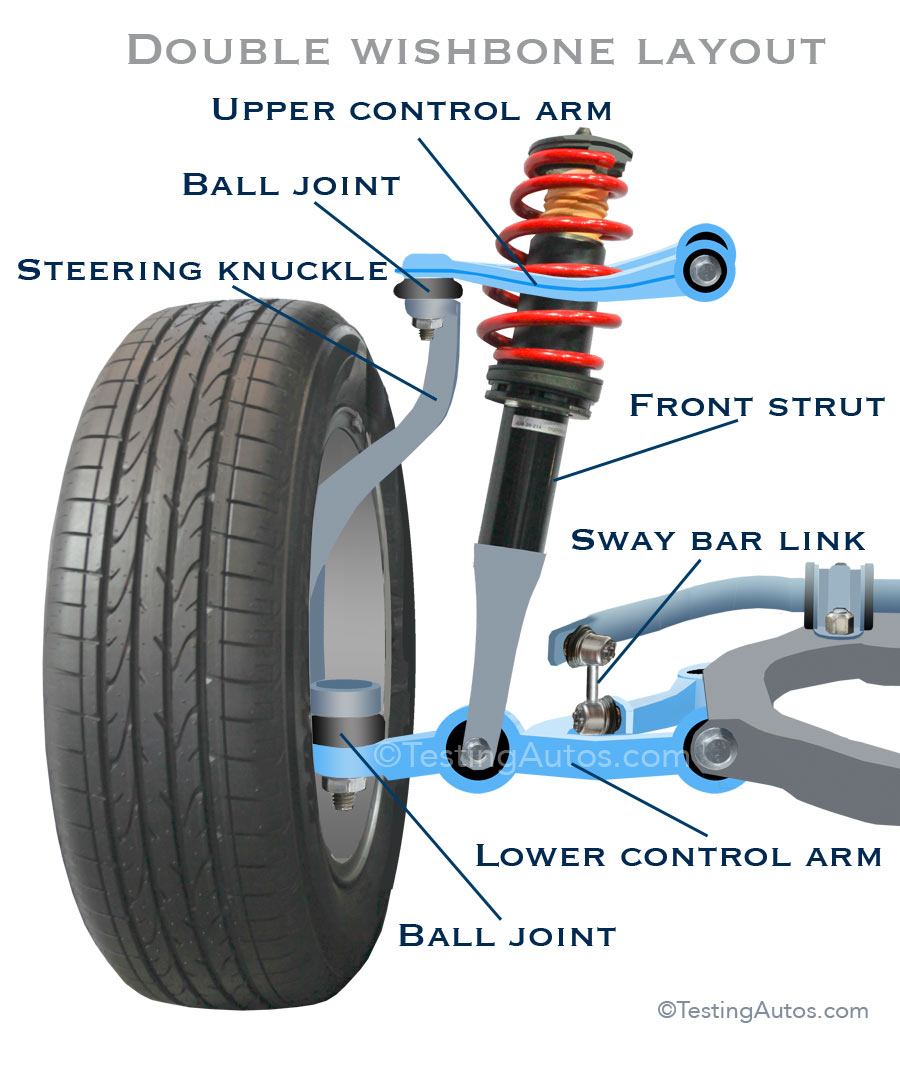
The primary role of a control arm is to connect the wheel hub or knuckle to the vehicle’s frame or subframe. This connection is not rigid; instead, it incorporates bushings at the frame attachment point and usually a ball joint at the wheel end. These flexible interfaces are critical. The bushings allow for controlled pivoting movement, enabling the wheel to travel up and down as the suspension compresses and rebounds. Simultaneously, the ball joint provides a pivot point that allows the wheel to turn left and right for steering, as well as tilt for camber changes. Without control arms, the wheels would simply be rigidly bolted to the chassis, resulting in an utterly unmanageable and uncomfortable ride, devoid of any steering capability.
Managing Vertical, Lateral, and Longitudinal Forces
Control arms are engineered to withstand significant forces from multiple directions.
- Vertical Forces: As the vehicle encounters bumps or dips, the suspension compresses or extends. Control arms facilitate this vertical movement, allowing the wheels to follow the contour of the road surface while the chassis remains relatively stable. They work in conjunction with springs and shock absorbers to manage this motion, ensuring the tires maintain optimal contact for traction.
- Lateral Forces: During cornering, a vehicle experiences centrifugal force that pushes it outwards. Control arms, especially in independent suspension systems, are designed to resist these lateral forces, preventing excessive body roll and maintaining the wheel’s alignment relative to the road. This resistance is vital for stable handling and precise steering response.
- Longitudinal Forces: When accelerating or braking, significant longitudinal forces are exerted on the wheels. Control arms help to transfer these forces from the wheels to the chassis. During acceleration, they resist the forward thrust, while under braking, they counteract the deceleration forces. This resistance is crucial for maintaining the wheel’s position within the wheel well and preventing unwanted wheel hop or dive.
Design Variations and Their Strategic Deployment
Control arms are not monolithic in design; their configuration varies significantly depending on the vehicle type, suspension architecture, and desired performance characteristics. From simple, single-arm setups to complex multi-link designs, each iteration is a testament to sophisticated engineering.
Upper vs. Lower Control Arms
Many independent suspension systems, particularly double wishbone or A-arm designs, utilize both upper and lower control arms.
- Lower Control Arm: Typically longer and more robust, the lower control arm usually bears the brunt of the vehicle’s weight and the primary impact forces from the road. It plays a significant role in determining the vehicle’s ride height and absorbing larger shocks.
- Upper Control Arm: Generally shorter, the upper control arm primarily influences camber angle changes as the wheel moves through its travel. The difference in length between the upper and lower arms (often with the upper being shorter) is a deliberate design choice known as “short-long arm” (SLA) suspension, which helps maintain a more favorable camber curve, improving tire contact patch and grip during cornering.
A-Arm (Wishbone) and L-Arm Designs
The “A-arm” or “wishbone” design is one of the most common configurations, characterized by its triangular or A-shaped structure. This shape provides excellent strength and rigidity, resisting forces from multiple directions effectively. L-arms are a variation, often used as lower control arms, where the ‘L’ shape allows for better packaging around other components like drive shafts and improves handling of specific lateral loads. These designs offer a good balance of ride comfort, handling precision, and durability.
Multi-Link Suspension Systems
Modern vehicles, especially those prioritizing refined ride quality and precise handling, often employ multi-link suspension systems. These systems replace the single upper and lower control arms with a series of multiple individual links (often 3 to 5 per wheel). Each link is carefully positioned and tuned to control a specific aspect of wheel movement. This allows engineers to independently adjust various geometric parameters, such as camber, toe, and caster, throughout the suspension’s travel. The result is a highly sophisticated system that can optimize tire contact patch, enhance stability, and provide superior ride comfort and handling characteristics across a wider range of driving conditions. Each of these individual links effectively functions as a specialized control arm, managing specific vectors of force.
Critical Components and Their Wear Patterns
While the control arm itself is a robust metal component, its functionality hinges on the integrity of its associated flexible parts. These components are wear items, and their degradation significantly impacts vehicle performance and safety.
Bushings: The Silent Workhorses
Control arm bushings are flexible inserts, typically made of rubber, polyurethane, or a combination of materials, located where the control arm attaches to the chassis or subframe. Their purpose is threefold:
- Allow Pivoting Movement: They permit the necessary articulation of the control arm as the suspension moves vertically.
- Absorb Vibrations: They isolate the chassis from road harshness, dampening vibrations and noise before they reach the cabin, contributing significantly to ride comfort.
- Prevent Metal-on-Metal Contact: They prevent wear between the control arm and the mounting points.
Over time, due to constant stress, exposure to elements, and the inherent properties of their materials, bushings can wear out. Rubber bushings can crack, tear, or harden, leading to excessive play. Worn bushings manifest as clunking noises over bumps, imprecise steering, vibrations, and uneven tire wear.
Ball Joints: Pivoting Under Pressure
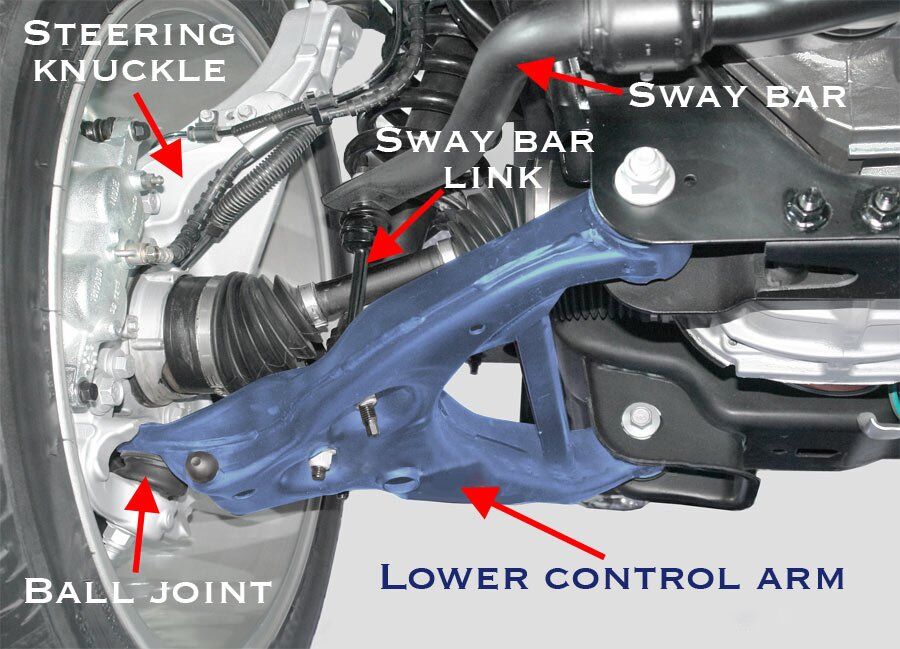
A ball joint is a spherical bearing that connects the control arm to the steering knuckle, allowing for multi-directional articulation (up-down and side-to-side). This articulation is essential for steering and allowing the wheel to move through its suspension travel. Ball joints consist of a ball stud encased in a lubricated housing, often sealed with a rubber boot to keep contaminants out and grease in.
Like bushings, ball joints are subject to wear. The constant motion and forces exerted on them cause the internal components to wear down, creating excessive play. When a ball joint wears out, it can lead to clunking or popping noises, especially when turning or going over bumps. More critically, it can result in loose, wandering steering, poor alignment, and in severe cases, catastrophic failure where the ball joint separates, causing the wheel to disconnect from the suspension and potentially leading to loss of control.
Structural Integrity and Material Science
The control arm itself is typically forged, stamped, or cast from steel or aluminum alloys. The choice of material and manufacturing process is critical for balancing strength, weight, and cost.
- Steel: Offers high strength and durability, often used in heavier vehicles or those requiring robust off-road capability. It’s cost-effective but heavier.
- Aluminum: Provides a significant weight reduction, contributing to improved fuel efficiency and reduced unsprung weight, which enhances handling and ride quality. Aluminum control arms are common in performance vehicles and those prioritizing lightweight construction, though they can be more expensive to manufacture.
The structural design also incorporates features to dissipate stress and prevent fatigue fractures. A control arm isn’t merely a piece of metal; it’s an engineered structure designed to withstand cyclic loading for hundreds of thousands of miles.
Impact on Driving Dynamics and Safety
The health of a vehicle’s control arms directly translates to its driving characteristics and overall safety. Their precise function ensures predictable handling, stable braking, and a comfortable experience.
Steering Precision and Stability
Healthy control arms maintain the correct alignment of the wheels relative to the chassis and the road. This precise geometry is fundamental to accurate steering. When bushings or ball joints wear, they introduce play into the system. This slack means that steering inputs are not translated directly to the wheels, leading to a feeling of looseness, vagueness, or excessive play in the steering wheel. The vehicle may wander on straight roads or feel unstable during turns, requiring constant steering corrections. This significantly compromises driving confidence and safety.
Ride Comfort and Noise Reduction
The primary role of bushings within the control arm assembly is to act as vibration dampers. They absorb much of the road harshness and noise, preventing it from being transmitted directly to the chassis and into the passenger cabin. When these bushings deteriorate, their ability to dampen vibrations is severely reduced. This results in a harsher ride, increased road noise, and potentially noticeable clunking or knocking sounds when driving over imperfections. A comfortable ride relies heavily on the intact function of these humble components.
Alignment and Tire Wear
Control arms are integral to maintaining proper wheel alignment (camber, caster, and toe). Worn control arm components allow for unwanted movement, which throws off these critical alignment angles.
- Camber: The inward or outward tilt of the wheel. Incorrect camber leads to uneven tire wear on one edge of the tire.
- Toe: The angle at which the wheels point inward or outward relative to each other. Incorrect toe causes tires to “scrub” across the road surface, leading to rapid and uneven feathering wear.
Beyond tire wear, misaligned wheels due to worn control arms can cause the vehicle to pull to one side, requiring constant steering correction and increasing driver fatigue. Timely replacement of worn control arm components is crucial for extending tire life and maintaining optimal vehicle performance.
Maintenance and Future Technological Advancements
Understanding the control arm’s role also underscores the importance of periodic inspection and maintenance. These components are not meant to last forever and their degradation impacts multiple aspects of vehicle operation.
Recognizing Signs of Wear
Drivers should be attuned to several warning signs that indicate potential control arm issues:
- Unusual Noises: Clunking, knocking, or popping sounds, especially over bumps, during turns, or under braking/acceleration.
- Vague or Loose Steering: Excessive play in the steering wheel, difficulty keeping the car straight, or a feeling of wandering.
- Vibrations: Shaking in the steering wheel or through the vehicle floor.
- Uneven Tire Wear: Scalloping, feathering, or excessive wear on one side of the tire.
- Visual Inspection: Cracks or tears in rubber bushings, corrosion, or deformation of the control arm itself can often be spotted during a routine inspection.
Inspection and Replacement
Professional technicians typically inspect control arms and their components during routine maintenance, checking for play in ball joints and bushings. Diagnostic checks often involve lifting the vehicle and manipulating the wheel to detect excessive movement. Due to the critical safety aspect, worn control arms or their components should be replaced promptly. In many modern vehicles, the control arm and its bushings/ball joints are sold as a single, non-serviceable assembly, necessitating replacement of the entire unit.

Innovations in Materials and Design
The evolution of control arm technology continues to focus on enhancing durability, reducing weight, and improving performance. Advancements include:
- High-Strength, Lightweight Alloys: Greater use of aluminum, magnesium, and even composite materials to reduce unsprung weight, which improves suspension responsiveness and fuel efficiency.
- Improved Bushing Materials: Development of more durable rubber compounds and synthetic polymers that offer extended lifespan and better NVH (Noise, Vibration, and Harshness) isolation.
- Modular Designs: Easier replacement of individual components (like bushings or ball joints) rather than the entire control arm in some applications, potentially reducing repair costs.
- Active Suspension Integration: In advanced active suspension systems, control arm designs might be optimized to work in concert with electronically controlled dampers and air springs, further refining ride and handling dynamics.
In conclusion, the control arm is far more than a simple metal link; it is a meticulously engineered component that fundamentally dictates how a car interacts with the road. Its precise function enables accurate steering, stable handling, and a comfortable ride, making it an indispensable element of modern automotive technology. Its ongoing evolution reflects the continuous drive for safer, more efficient, and more engaging driving experiences.
aViewFromTheCave is a participant in the Amazon Services LLC Associates Program, an affiliate advertising program designed to provide a means for sites to earn advertising fees by advertising and linking to Amazon.com. Amazon, the Amazon logo, AmazonSupply, and the AmazonSupply logo are trademarks of Amazon.com, Inc. or its affiliates. As an Amazon Associate we earn affiliate commissions from qualifying purchases.