
Mood rings have captivated wearers for decades with their enigmatic ability to seemingly reflect emotional states through a spectrum of shifting colors. Far from being mystical artifacts, these charming gadgets operate on principles of simple, yet ingenious, material science. Understanding the “technology” behind these chromatic transformations reveals a fascinating interplay between body temperature, thermochromic materials, and our own interpretations.
The Thermochromic Engine: How Simple Gadgets Sense Temperature
At the heart of every mood ring lies a remarkable, yet understated, technological marvel: thermochromic liquid crystals. These specialized materials are the true engines of the ring’s display, making it an early, albeit primitive, form of wearable sensor technology.

The Science Behind the Shifting Hues
Thermochromic liquid crystals are organic compounds designed to react to changes in temperature by altering their molecular structure. As their structure shifts, they absorb and reflect different wavelengths of light, resulting in a visible change in color. This phenomenon is not unlike the way certain digital displays or even some advanced smart windows operate, albeit on a much simpler scale.
The specific type of liquid crystal used in mood rings is temperature-sensitive within a narrow range, typically corresponding to human body temperature fluctuations. These crystals are usually encapsulated under a protective dome or within a sealed compartment on the ring’s surface. As the ring comes into contact with the wearer’s skin, it absorbs or dissipates heat, causing the liquid crystals to respond. This direct interaction makes the mood ring a passive thermal sensor, constantly reacting to its immediate environment. The technology is elegant in its simplicity: no batteries, no complex circuits, just the inherent properties of specially engineered materials responding to a physical stimulus.
From Body Heat to Visual Output
The process is straightforward:
- Heat Transfer: The base of the mood ring, often metallic, conducts heat from the wearer’s skin to the encapsulated liquid crystals.
- Molecular Reconfiguration: As the temperature of the liquid crystals changes, their molecular arrangement undergoes subtle but critical shifts.
- Light Interaction: This new molecular structure alters how the crystals interact with ambient light. They selectively reflect certain colors while absorbing others.
- Visible Color Change: The reflected light is what we perceive as the mood ring’s color.
For instance, at warmer temperatures, the liquid crystals might reflect blue light. As the temperature cools, their structure might change to reflect green, then amber, and eventually black or gray. This sequence is carefully calibrated by the ring’s manufacturers to present a consistent, if simplified, visual output based on temperature input. It’s a fascinating example of how material science can be leveraged to create a dynamic, responsive display in a compact, self-sufficient gadget.
Deciphering the Color Code: A Primitive Biofeedback Interface
While the mechanics of a mood ring are purely physical, the “meaning” of its colors delves into the realm of traditional interpretations, linking observed temperature changes to perceived emotional states. It functions as a rudimentary biofeedback interface, where a physiological response (body temperature) is given an emotional translation.
The Standard Mood Ring Color Palette and Its Interpretations
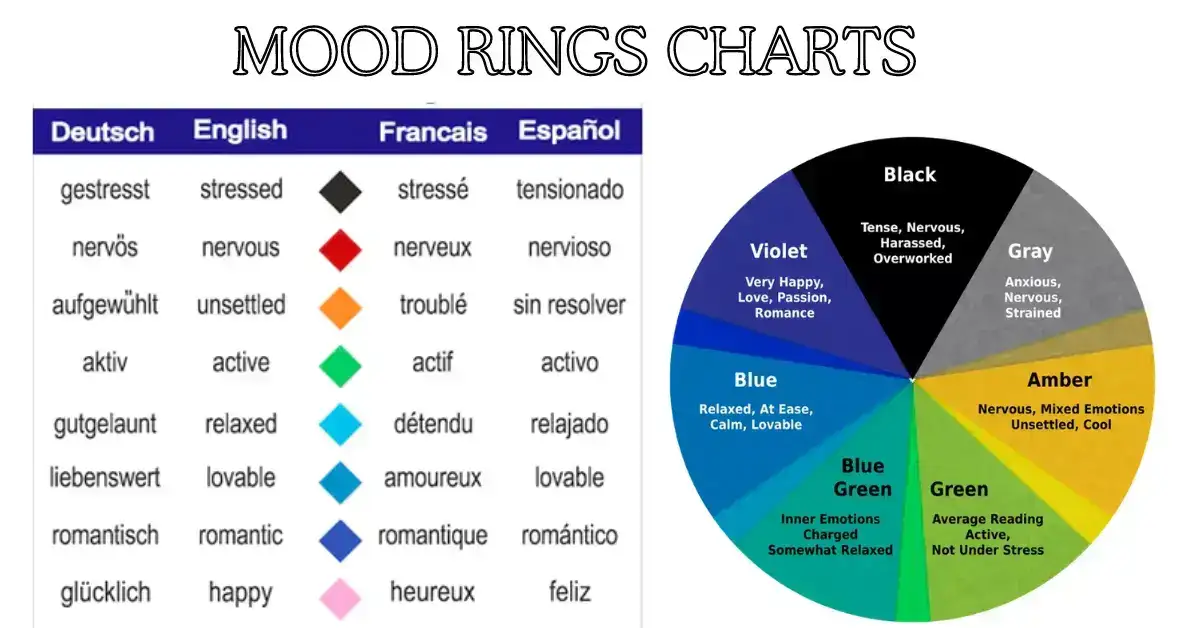
Over time, a widely accepted set of color-to-mood associations has emerged for mood rings. These interpretations are largely cultural and anecdotal rather than scientific diagnoses, yet they form the core of the ring’s appeal as a “mood detector.”
- Blue: Often associated with calmness, serenity, and relaxation. A cool, steady blue might suggest a tranquil state.
- Dark Blue/Indigo: Can signify deep thought, introspection, or a more profound sense of peace.
- Green: Commonly linked to a neutral, average, or stable mood. A “normal” body temperature often results in a green hue. It can also imply a feeling of balance or alertness.
- Amber/Yellow: Frequently indicates feelings of happiness, excitement, or a slightly heightened state of arousal.
- Orange: Often associated with stress, anxiety, or nervousness. A slightly warmer body temperature might trigger this color.
- Red: Typically suggests strong emotions like passion, anger, or high excitement. This usually corresponds to a significantly elevated body temperature.
- Black/Gray: These colors usually appear when the ring is cold. Traditionally, they are interpreted as meaning stressed, anxious, upset, or even experiencing fear or sadness. In reality, it often just means the ring (and perhaps the wearer’s finger) is cool.
These interpretations, while charming, highlight the gap between a simple temperature sensor and a true emotional barometer. The “meaning” is assigned, not intrinsically present in the temperature reading itself.
The Link Between Temperature and Emotional States
The rationale behind these color interpretations stems from a loose correlation between emotional arousal and physiological responses, including subtle changes in body temperature. When a person experiences strong emotions such as excitement, anger, or stress, their autonomic nervous system can trigger responses like increased blood flow to the skin, changes in heart rate, and perspiration. These reactions can indeed cause slight fluctuations in peripheral body temperature, particularly in extremities like the fingers.
For example, stress or anxiety can sometimes lead to vasoconstriction, reducing blood flow to the extremities and making fingers cooler, potentially causing the ring to turn darker. Conversely, excitement or passion might increase blood flow, warming the fingers and leading to brighter colors like amber or red.

However, it’s crucial to understand that these temperature shifts are often minor and can be influenced by numerous factors unrelated to mood. A mood ring acts more as a basic thermal indicator for the area it’s worn on, rather than a sophisticated emotional scanner. The “biofeedback” it offers is extremely limited, providing only a very indirect and often misleading window into internal states.
Beyond the Hype: The Limitations of a Basic Temperature Sensor
Despite their whimsical appeal, mood rings are fundamentally simple thermal sensors. Their interpretation as accurate mood detectors quickly falters when examined through a technical lens, highlighting the inherent limitations of their design.
External Factors and Inaccurate Readings
The primary challenge for a mood ring’s accuracy lies in the multitude of external factors that can influence its temperature, entirely independent of the wearer’s emotional state. These variables make any precise “mood reading” highly unreliable:
- Ambient Temperature: A cold room will naturally cool the ring, regardless of the wearer’s mood. Conversely, a warm environment will heat it up.
- Physical Activity: Exercise or strenuous activity increases overall body temperature, causing the ring to display warmer colors, which might be misinterpreted as excitement or anger rather than physical exertion.
- Body Part Placement: A ring worn on a finger will react differently to one held in a warm palm or placed in a cool pocket. Peripheral temperatures fluctuate more than core body temperature.
- Physiological Conditions: Illness, fever, or even medications can alter body temperature. Conditions like poor circulation can also make fingers consistently cooler.
- Contact with Objects: Touching a hot or cold beverage, or even simply holding something that is a different temperature than the skin, will directly affect the ring’s display.
These factors underscore that a mood ring is responding to the local temperature of the skin surface it touches, which is a composite of internal and external thermal influences, not solely an indicator of core emotional states. Modern wearable tech, like smartwatches with advanced biometric sensors, employ sophisticated algorithms and multiple data points (heart rate variability, skin conductance, movement) to attempt to infer emotional states, and even they struggle with definitive accuracy. The mood ring, with its single input, cannot compete.
Mood Rings as Novelty: Entertainment, Not Diagnostic Tech
Ultimately, the mood ring’s place in the pantheon of gadgets is firmly in the realm of novelty and entertainment. It was never designed as a serious diagnostic tool for mental health or emotional states, nor does its simple thermochromic technology possess the capability to function as one.
Its value lies in its ability to spark conversation, provide a moment of playful introspection, and tap into a universal human curiosity about self-understanding. For children, it’s a magical toy; for adults, a nostalgic callback to a simpler era of tech. The shifting colors offer a tangible, albeit imprecise, visual representation of an internal process, encouraging wearers to pause and consider how they might be feeling.
In an age of hyper-advanced biometric wearables and AI-driven emotional analytics, the mood ring stands as a charming reminder of how low-tech innovations can still capture our imagination. It’s a testament to the fact that sometimes, the simplest “gadgets” offer the most enduring appeal, not for their scientific accuracy, but for the delightful human interaction they inspire.
The Enduring Appeal of Analog “Wearable Tech”
Despite their technological simplicity and interpretive inaccuracies, mood rings have maintained a consistent presence in popular culture since their inception in the 1970s. Their longevity speaks to an intrinsic human desire for personal insight and the enduring charm of simple, responsive gadgets.
Nostalgia and the Quest for Self-Understanding
A significant part of the mood ring’s lasting appeal is nostalgia. For many, it represents a tangible link to childhood or a past era, evoking memories of disco, pop culture trends, and a time when technology was often more about wonder than utility. This nostalgic factor positions the mood ring as a vintage piece of “wearable tech,” reminding us of earlier forms of personal adornment that attempted to connect with our inner selves.
Beyond nostalgia, there’s a primal human desire for self-understanding. People are inherently curious about their emotions and internal states. The mood ring, even with its flaws, provides a tangible, real-time “reading” that feeds this curiosity. It offers a playful, non-committal way to engage with the concept of emotions, without the complexity or invasiveness of modern psychological tools. It’s a fun, low-stakes experiment in self-observation.
Simple Innovations and Their Cultural Footprint
The mood ring’s journey from a scientific curiosity (thermochromic liquid crystals were developed long before the ring) to a mass-market phenomenon highlights how accessible innovation can leave a significant cultural footprint. It demonstrates that not all impactful “tech” needs to be cutting-edge or complex. Sometimes, a clever application of existing material science, combined with a compelling narrative (the “mood” aspect), is enough to create an iconic product.
As an analog wearable, the mood ring stands in stark contrast to the digital complexities of smartwatches and fitness trackers. It operates without algorithms, data processing, or internet connectivity. Yet, it serves a similar, albeit vastly simplified, purpose: to provide the wearer with a visual representation of an internal state. This blend of simple mechanics and engaging interpretation ensures that mood rings will likely continue to fascinate and entertain for generations to come, reminding us that sometimes the most profound “gadgets” are the ones that simply reflect a little bit of ourselves, even if it’s just our finger temperature.
aViewFromTheCave is a participant in the Amazon Services LLC Associates Program, an affiliate advertising program designed to provide a means for sites to earn advertising fees by advertising and linking to Amazon.com. Amazon, the Amazon logo, AmazonSupply, and the AmazonSupply logo are trademarks of Amazon.com, Inc. or its affiliates. As an Amazon Associate we earn affiliate commissions from qualifying purchases.