
In the landscape of modern sandbox gaming, few titles demonstrate the iterative technical prowess of Mojang Studios’ flagship title, Minecraft. With the rollout of the 1.21 update and its preceding snapshots, the introduction of the armadillo has provided more than just aesthetic variety to the Savanna biome; it has introduced a sophisticated set of interaction mechanics that redefine how players engage with the game’s ecological engine. At the heart of this update is a specific item drop: the Armadillo Scute. Understanding what armadillos drop, how they drop it, and the underlying software logic governing these interactions is essential for both high-level players and those interested in the technical architecture of game design.

The Evolution of Mob Interaction: From Combat Loot to Sustainable Harvesting
Historically, the loot tables in Minecraft were relatively binary. To obtain a resource from a mob, a player generally had to engage in combat, resulting in the entity’s “death” and the subsequent spawning of an item entity. This “kill-to-loot” pipeline served the game well for a decade, but as the software evolved, Mojang began exploring more complex, non-lethal interaction models. The armadillo represents the pinnacle of this shift.
The Technical Shift in Resource Acquisition
The armadillo does not primarily “drop” its most valuable resource, the scute, upon death. In fact, killing an armadillo is technically inefficient, as it yields no unique items and only a small amount of experience points. Instead, the developers implemented a “harvesting” mechanic. By using a Brush—a tool introduced during the Archeology update—players can interact with the armadillo to receive a scute. From a programming perspective, this requires the game to track specific tool-use events and trigger a localized item-spawn command without changing the entity’s health state.
The Logic of the Brush Mechanic
The Brush interaction is governed by a cooldown and durability logic. Each time a player brushes an armadillo, the tool loses durability, and the armadillo emits an “Armadillo Scute” item. Unlike the chicken’s egg-laying mechanic, which is based on a random “tick” timer, or the sheep’s shearing mechanic, which requires a “regrowth” state (eating grass), the armadillo can be brushed repeatedly. This allows for the automation of scute collection through technical “farms” that utilize dispensers equipped with brushes, showcasing how Minecraft’s Redstone logic can interface with new entity behaviors.
Armadillo Scutes: Data Structures and Crafting Utility
The primary item dropped by the armadillo is the Armadillo Scute. In the game’s code, this item is a distinct data object with specific tags that allow it to be used in crafting recipes. While many players focus on the visual aspect of the item, the technical significance lies in its integration with the existing “Wolf” entity.
The Crafting Pipeline for Wolf Armor
The sole purpose of the Armadillo Scute is the creation and repair of Wolf Armor. This is a significant addition to the game’s technical repertoire because it introduces a new layer of entity-based equipment. Crafting a piece of Wolf Armor requires six scutes arranged in a specific pattern. Once crafted, the item becomes an equippable “armor” data tag for a tamed wolf.
Technically, this required Mojang to update the wolf entity’s NBT (Named Binary Tag) structure. Previously, wolves only had states for “tamed,” “health,” and “collar color.” Now, they possess a “BodyArmorItem” slot, similar to a player’s armor slots. This allows the game to calculate damage reduction for the pet, adding a defensive layer that was previously only available through modifications or external plugins.
Repair and Maintenance Logic
Furthermore, the Armadillo Scute serves as the primary repair material for Wolf Armor. Rather than requiring a crafting table, players can use scutes directly on a wolf wearing damaged armor. This “on-entity” interaction triggers a repair function that restores the armor’s durability points. This reflects a trend in Minecraft’s software development toward contextual interactions—where the game identifies the state of an entity (damaged armor) and allows a specific item (scute) to modify that state through a simple right-click event.
AI Behavior and State Machines: The “Rolled Up” Mechanic
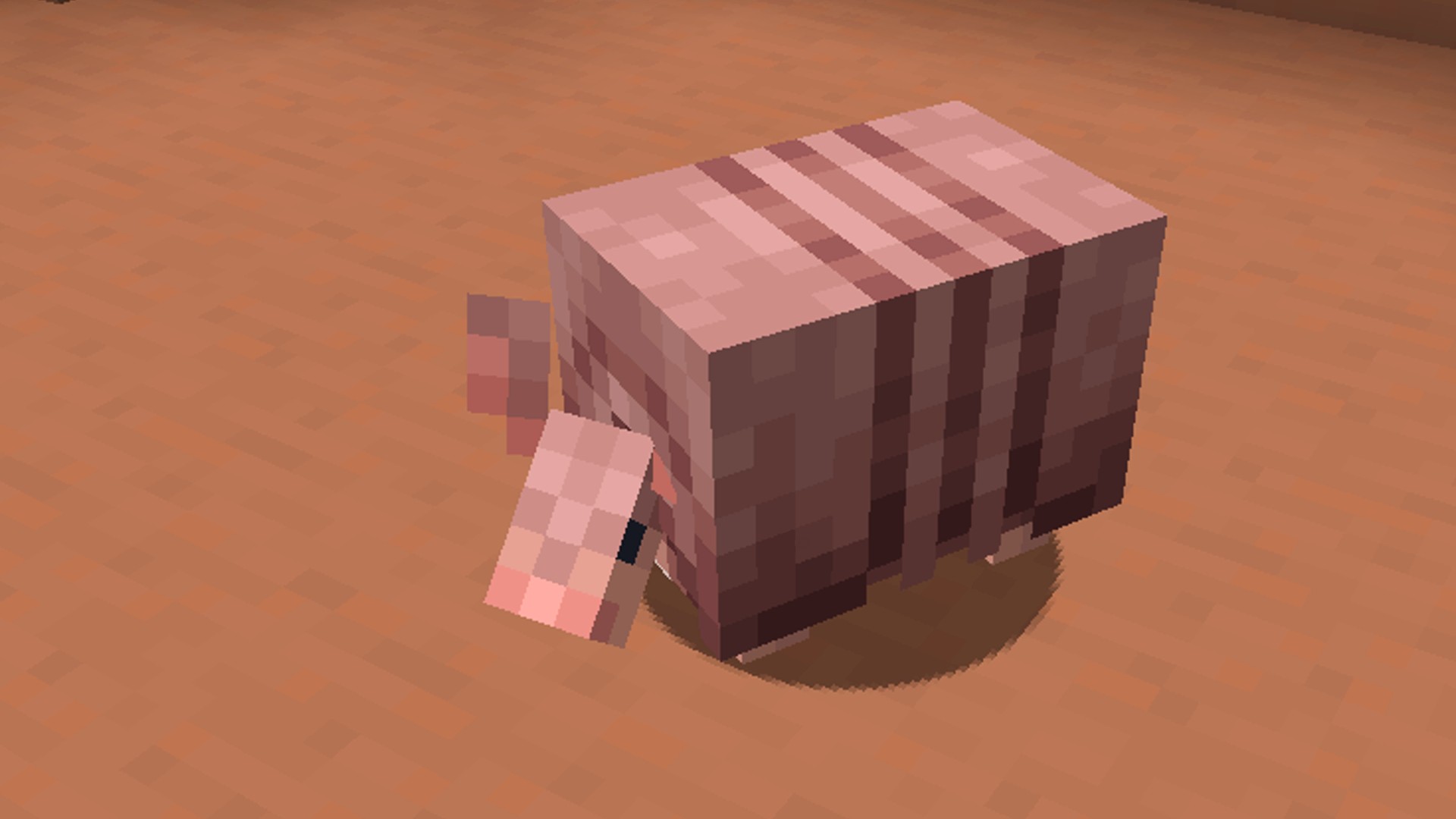
The armadillo is not just a passive loot source; it is a complex AI entity with multiple states that affect its drops and interactions. Developers utilize a “state machine” to manage how the armadillo reacts to its environment, which in turn dictates how a player can harvest scutes.
The Defensive State Trigger
The armadillo features a unique “rolled up” state. When the software detects a “threat” nearby—such as a sprinting player, a player on a mount, or an undead mob—the armadillo’s AI switches from its “wandering” state to its “rolled up” state. In this configuration, its collision box changes. From a technical standpoint, the game must adjust the entity’s hitbox in real-time to reflect its new visual model.
While rolled up, the armadillo takes reduced damage, but more importantly, it can still be brushed for scutes. This allows technical players to design “AFK” (Away From Keyboard) farms that keep armadillos in a constant state of threat or security to optimize the harvesting process.
Sensory Inputs and Pathfinding
The armadillo’s AI is also programmed to detect specific ambient sounds and movements. It is particularly sensitive to vibrations, a mechanic shared with the Warden and Sculk sensors. If an armadillo detects a “non-stealthy” movement, it will retract. This integration of the “vibration” system into a passive mob demonstrates the cohesive nature of Minecraft’s modern codebase, where different technical systems (vibration detection, state changes, and item drops) overlap to create a realistic simulation.
Technical Optimization: Java vs. Bedrock Implementation
A critical aspect of any new feature in Minecraft is how it is implemented across the two primary versions of the software: Java Edition and Bedrock Edition. Although the armadillo drops the same scutes in both, the underlying code that handles these events differs slightly due to the different programming languages (Java vs. C++).
Consistency in the Loot Table
Mojang has prioritized “Parity,” ensuring that the drop rates and interaction methods are identical across platforms. In both versions, the scute is handled as a standard item drop, but the way the Brush interacts with the entity’s “interaction box” can vary. In Bedrock Edition, the interaction is often more streamlined for touchscreens and controllers, whereas Java Edition allows for more precise “tick-based” interactions that technical players exploit for high-efficiency resource gathering.
Impact on Server Performance
From a server administration perspective, the introduction of the armadillo and its scute drops requires careful consideration of entity counts. Each armadillo is a “ticking entity,” meaning the server must calculate its AI and state every 1/20th of a second. Large-scale armadillo farms, designed to maximize scute drops, can impact server TPS (Ticks Per Second). Professional server hosts and technical communities often look at the “entity brain” complexity of new mobs to determine how they will affect performance in a multiplayer environment. The armadillo, with its state-switching logic, is moderately complex but optimized enough to prevent significant lag in standard quantities.
The Future of Interactive Entities in Sandbox Tech
The armadillo and its scute drops are more than just a minor update; they represent a roadmap for the future of Minecraft’s technical development. By focusing on interactive drops rather than simple combat loot, Mojang is moving toward a more sophisticated ecological simulation.
Expanding the Interaction Framework
The success of the Armadillo Scute mechanic suggests that we may see more “tool-to-entity” interactions in future updates. Just as the Brush is used for armadillos and Archeology, new tools could be developed to harvest resources from other mobs without harming them. This expands the game’s depth without cluttering the inventory with useless items, as each new drop (like the scute) has a dedicated, high-value purpose (like Wolf Armor).
Bridging the Gap Between Design and Function
In conclusion, when asking “what do armadillos drop in Minecraft,” the answer—Armadillo Scutes—is only the surface of a deep technical well. These drops are the output of a complex system of AI states, tool-interaction events, and NBT data management. For the technical community, the armadillo is a testament to how far Minecraft has come as a software platform, evolving from a simple block-building game into a complex engine capable of nuanced entity behaviors and intricate resource lifecycles. As we look toward future versions, the armadillo serves as a blueprint for how technology and creativity can merge to create engaging, sustainable, and technically sound gameplay mechanics.
aViewFromTheCave is a participant in the Amazon Services LLC Associates Program, an affiliate advertising program designed to provide a means for sites to earn advertising fees by advertising and linking to Amazon.com. Amazon, the Amazon logo, AmazonSupply, and the AmazonSupply logo are trademarks of Amazon.com, Inc. or its affiliates. As an Amazon Associate we earn affiliate commissions from qualifying purchases.