
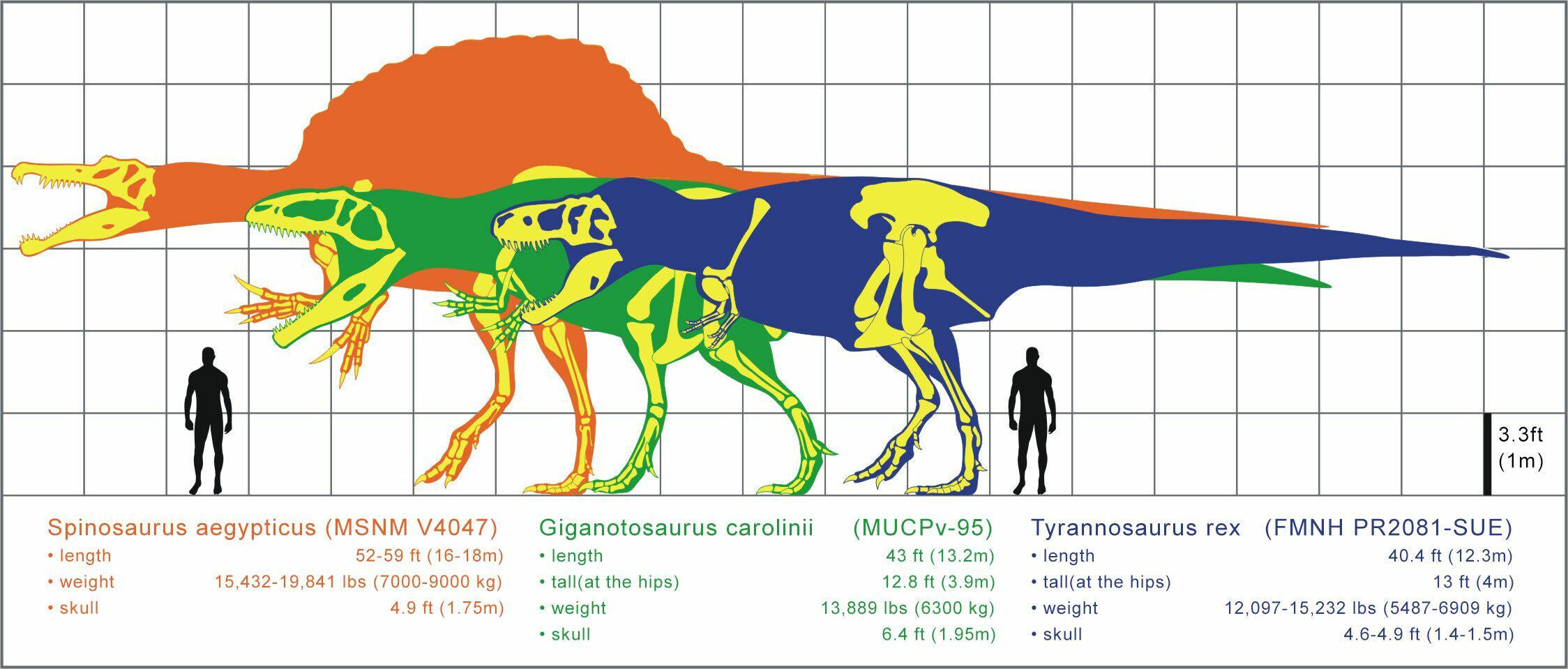
The Tyrannosaurus Rex, a name that evokes primal fear and fascination, has long held the crown as the undisputed king of the dinosaurs. Its formidable size, terrifying jaws, and legendary status in popular culture have cemented its place in our collective imagination. However, the question “what dinosaur is bigger than T. Rex?” opens a thrilling door into the vast and awe-inspiring world of prehistoric giants. While T. Rex was undoubtedly a titan, its reign as the largest predator isn’t as absolute as often believed. This exploration delves into the sauropods, a group of long-necked, herbivorous dinosaurs that dwarfed even the mighty T. Rex, and examines the scientific endeavors and technological advancements that allow us to uncover and understand these colossal creatures.
The Reign of the Sauropods: Giants That Outstretched T. Rex
When we talk about dinosaurs that are “bigger” than T. Rex, we’re generally referring to mass and length, not necessarily predatory prowess. T. Rex, a theropod dinosaur, was a carnivore, and its bulk was optimized for speed and power in hunting. However, the sauropods, a group of herbivorous dinosaurs, represent an entirely different evolutionary strategy – one of sheer, overwhelming scale. These magnificent creatures, with their incredibly long necks and tails, and massive, pillar-like legs, were the true giants of the Mesozoic Era.
Argentinosaurus: The Unrivaled Colossus
Among the contenders for the title of “biggest dinosaur,” Argentinosaurus huinculensis stands out as a prime candidate. Discovered in Argentina, this titanosaurian sauropod is estimated to have reached staggering lengths of up to 100-115 feet (30-35 meters) and weighed an astonishing 70-100 tons (63-90 metric tons). To put this into perspective, T. Rex, while massive at an estimated 40 feet (12 meters) long and weighing around 8-10 tons, is dwarfed by Argentinosaurus. Imagine a creature so large that its bones alone, when discovered, were initially mistaken for parts of a giant tortoise.
The sheer size of Argentinosaurus presents incredible challenges for paleontologists. We have only found partial remains, making precise estimations a complex scientific puzzle. However, the sheer scale of the discovered vertebrae, femurs, and ribs leaves no doubt about its colossal stature. Its immense weight would have required a revolutionary biological system to support it. Scientists theorize that Argentinosaurus, like other large sauropods, possessed a highly efficient respiratory system, possibly including air sacs similar to birds, which would have helped lighten its skeletal structure and facilitate oxygen intake.
Other Contenders for the Largest Dinosaur Title
While Argentinosaurus is often cited as the largest, other sauropods also command immense respect for their size. Patagotitan mayorum, another titanosaur from Argentina, is a strong contender, with estimates suggesting a length of around 122 feet (37 meters) and a weight of up to 70 tons. The discovery of multiple individuals of Patagotitan in a single quarry has provided invaluable data for understanding these giants.
Further afield, Supersaurus vivianae, a diplodocid from North America, is another behemoth. While its weight is debated, its length is estimated to be around 110 feet (34 meters), making it one of the longest dinosaurs ever discovered. Its incredibly elongated neck allowed it to reach vegetation far above the ground, an adaptation that likely helped it secure enough food to sustain its enormous body.
These sauropods weren’t just long; they were incredibly broad and muscular. Their long necks and tails served as counterbalances, allowing them to maneuver their massive bodies with surprising grace. Their diets, consisting of vast quantities of plant matter, fueled their growth to sizes that modern animals can only dream of.
The Science Behind Sizing Up Giants: Technology and Discovery
Unraveling the mysteries of these colossal dinosaurs is a testament to the power of scientific inquiry, constantly being amplified by technological advancements. The process of dinosaur discovery and analysis is a sophisticated field that blends traditional paleontology with cutting-edge tools and methodologies.
Fossil Hunting and Excavation: The Groundbreaking Work
The initial discovery of dinosaur fossils is often a painstaking process, requiring geological expertise to identify promising dig sites and meticulous excavation techniques to unearth fragile specimens. Paleontologists, often working in remote and challenging environments, employ tools ranging from hammers and chisels to sophisticated geological mapping equipment and even drone technology for aerial surveying of potential fossil-bearing regions.
Once a fossil is located, the excavation process is critical. Delicate bones need to be carefully exposed, often using dental picks and brushes, and then encased in plaster jackets for safe transport back to laboratories. This initial fieldwork is the foundation upon which all subsequent scientific understanding is built. The sheer effort involved in extracting a single, massive bone from an Argentinosaurus fossil underscores the dedication of these scientists.
Digital Reconstruction and AI in Paleontology
The digital age has revolutionized how paleontologists analyze and interpret fossil evidence. 3D scanning technologies allow for the creation of highly accurate digital models of bones, enabling researchers to study their morphology and reconstruct the complete skeleton without physically handling fragile originals. These digital models can then be used to create virtual skeletons, allowing for simulations of how the animal moved and interacted with its environment.
Furthermore, Artificial Intelligence (AI) is beginning to play a significant role. AI algorithms can be trained to identify potential fossil fragments in large datasets of geological imagery, accelerating the discovery process. In the analysis phase, AI can assist in comparing fossil features to known species, helping to identify new discoveries or refine existing classifications. For example, AI could analyze the intricate patterns of bone structure to infer muscle attachments and biomechanical capabilities with unprecedented detail.
Beyond physical reconstruction, AI and advanced computing power are used in biomechanical modeling. By inputting data from fossilized bones, researchers can create simulations of how these massive creatures walked, ran, and even breathed. This allows us to understand the incredible physiological adaptations necessary for such immense size, such as the likely distribution of weight and the strength of their skeletal structure.
The Role of Data Analysis and Computational Biology
The sheer volume of data generated by fossil discoveries and modern imaging techniques requires sophisticated data analysis tools. Paleontologists are increasingly relying on computational biology and statistical modeling to make sense of their findings. By analyzing large datasets of fossil measurements, environmental data from the time period, and comparative anatomy, researchers can build more robust estimates of dinosaur size, diet, and behavior.
When it comes to comparing T. Rex with giants like Argentinosaurus, computational biology is key. By analyzing the estimated mass of various dinosaur species, paleontologists can use statistical models to account for the incompleteness of fossil records and provide ranges of probable weights and lengths. This data-driven approach allows for more objective comparisons than were possible in the past.
T. Rex vs. The Giants: A Tale of Different Niches and Successes
It’s important to understand that comparing T. Rex to sauropods like Argentinosaurus isn’t a simple “who’s bigger” contest in terms of ecological roles. They occupied vastly different niches in their respective ecosystems and at different times in prehistory.
Evolutionary Strategies: Predator vs. Herbivore
T. Rex, a theropod, was an apex predator. Its evolutionary pressures were geared towards speed, agility, sharp teeth, and powerful jaws to hunt and consume other large animals. Its relatively compact, muscular build was optimized for aggression and predatory efficiency.
Sauropods, on the other hand, were herbivores. Their immense size was an evolutionary strategy to deter predators (even a T. Rex would likely hesitate to attack a fully grown Argentinosaurus), to digest vast quantities of low-nutrient vegetation efficiently, and perhaps even for thermoregulation. Their sheer scale meant that they were less susceptible to predation once they reached maturity.
When Did They Live? A Temporal Divide
A crucial factor in understanding their comparison is their temporal separation. T. Rex lived during the Late Cretaceous period, approximately 68 to 66 million years ago. Many of the largest sauropods, like Argentinosaurus and Patagotitan, lived much earlier, during the Mid to Late Cretaceous period and even the Early Cretaceous period. This means they never coexisted, so a direct confrontation between a T. Rex and an adult Argentinosaurus is purely the realm of imagination.
However, the existence of these gargantuan herbivores predating T. Rex highlights the incredible diversity and evolutionary potential of dinosaur life. It demonstrates that the path to immense size wasn’t limited to carnivores, but was also a highly successful strategy for plant-eaters.
The Legacy of Giants
The question “what dinosaur is bigger than T. Rex?” ultimately leads us to the sauropods, creatures that redefined our understanding of scale in the animal kingdom. Their existence, pieced together through the tireless work of paleontologists and amplified by modern technology, offers a profound glimpse into the ancient world. While T. Rex remains a symbol of predatory might, the sauropods stand as silent, colossal testaments to the diverse and awe-inspiring evolutionary journeys that unfolded millions of years ago. Their study continues to push the boundaries of scientific understanding, revealing the incredible possibilities of life on Earth, both past and present.
aViewFromTheCave is a participant in the Amazon Services LLC Associates Program, an affiliate advertising program designed to provide a means for sites to earn advertising fees by advertising and linking to Amazon.com. Amazon, the Amazon logo, AmazonSupply, and the AmazonSupply logo are trademarks of Amazon.com, Inc. or its affiliates. As an Amazon Associate we earn affiliate commissions from qualifying purchases.