
In the high-stakes world of personal branding, few relationships have been as influential, lucrative, or volatile as the one between Kanye West (now known as Ye) and Shawn “Jay-Z” Carter. For decades, their partnership—symbolized by the Watch the Throne era—represented the pinnacle of cultural and commercial synergy. However, the most significant rupture in their professional and personal alliance occurred when the boundaries between private family life and public brand identity were crossed. The moment Kanye West publicly addressed the relationship between their children during a 2016 concert became a watershed moment in the study of personal brand management and the ethics of celebrity influence.

This article explores the strategic implications of that fallout, examining how personal outbursts impact high-level brand equity, the dangers of blurring personal grievances with professional personas, and the lessons modern entrepreneurs can learn from the “Watch the Throne” brand breakdown.
The Intersection of Personal Life and Personal Brand
In the contemporary media landscape, a celebrity’s personal life is often their most valuable brand asset. For Kanye West and Jay-Z, their families are not merely private entities; they are extensions of a sophisticated lifestyle brand. When Kanye took to the stage during his Saint Pablo Tour in 2016, his comments about Jay-Z’s children—specifically Blue Ivy Carter—represented a violation of the “unspoken code” of elite personal branding.
When the Private Sphere Becomes Public Intellectual Property
The core of Kanye’s 2016 rant involved the lack of interaction between his children (North West) and Jay-Z’s children (Blue Ivy). He famously shouted, “Our kids ain’t never even played together!” This statement was more than a personal complaint; it was a public deconstruction of a brand narrative. For years, fans had bought into the “Throne” brand, imagining a unified dynasty where the next generation would continue the legacy.
By revealing that their children had no relationship, Kanye effectively dismantled the “brotherhood” brand that had been a major selling point for their collaborative work. From a branding perspective, this illustrates the risk of “Narrative Dissonance.” When the public-facing story of a brand (unity and brotherhood) is contradicted by a key stakeholder (Kanye), the brand equity of the partnership suffers.
The “Saint Pablo” Incident: A Case Study in Brand Friction
Kanye’s choice of medium—a live concert—is a crucial element of this brand study. In personal branding, the medium often dictates the reception. By using a professional platform to air a personal grievance, Kanye shifted the perception of his brand from “Artistic Genius” to “Unpredictable Liability.”
For Jay-Z, whose brand is built on the pillars of “The Corporate Mogul” and “The Stoic Strategist,” Kanye’s outburst was a direct threat to the curated privacy that protects the Carter brand. This incident highlights a fundamental rule in brand strategy: when your personal brand is inextricably linked to another person’s, their public volatility becomes your brand’s financial risk.
Navigating the Dynamics of Influence and Association
To understand why the mention of children was so damaging, one must look at the corporate entities behind the individuals. The tension between Kanye and Jay-Z wasn’t just about playdates; it was about the collision of two massive tech-integrated brands: Tidal and Apple Music.
The Tidal vs. Apple Music Proxy War
Kanye West’s frustration stemmed largely from the “streaming wars” of the mid-2010s. Jay-Z, as the face of Tidal, was competing directly with Apple Music, with whom Kanye had a complex relationship. Kanye mentioned that the “political” maneuvers between the two platforms were preventing music collaborations.
In the world of brand strategy, this is known as “Intersystem Conflict.” When two partners have competing interests in third-party platforms, the friction eventually bleeds into their personal interactions. Kanye’s comments about the children were an emotional manifestation of a commercial bottleneck. He was essentially arguing that the “Money” brand (Tidal vs. Apple) was destroying the “Legacy” brand (the family connection).
Protecting the Next Generation: The Luxury of Privacy in Branding
Jay-Z’s brand response to Kanye’s comments was a masterclass in “Silent Branding.” Unlike Kanye, who utilizes transparency and chaos as a brand tool, Jay-Z utilizes exclusivity and silence. In a rare interview following the incident, Jay-Z noted that bringing his family into the public discourse was a “line in the sand.”
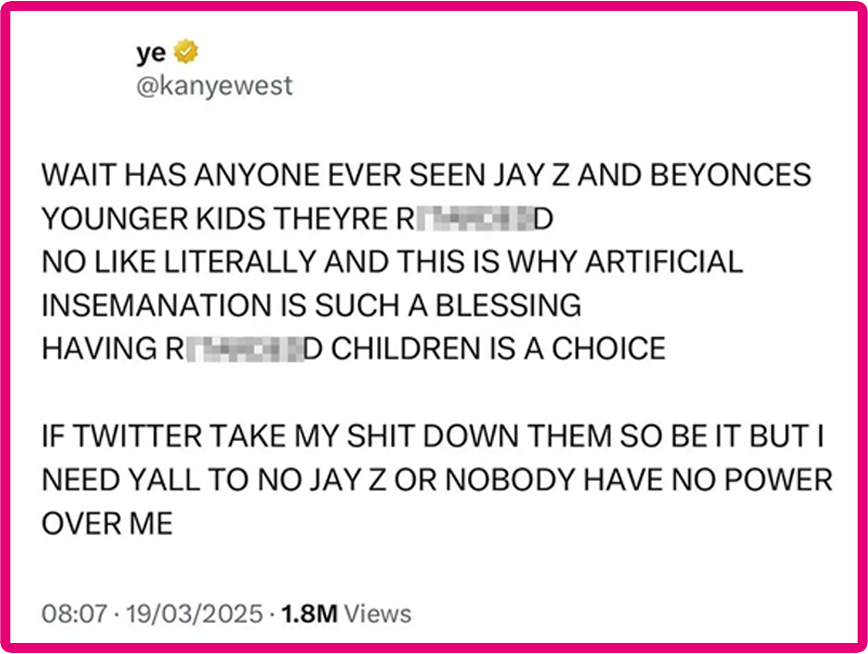
From a personal branding standpoint, Jay-Z’s reaction reinforced his identity as a protective, high-value patriarch. He signaled to the market that while business disputes are acceptable, the “Family Brand” is off-limits. This created a strategic distance between the two, effectively ending the Watch the Throne era and forcing Kanye to pivot his brand toward a more isolated, “lone wolf” persona.
Crisis Management in the Age of Viral Outbursts
When a personal brand undergoes a crisis due to public outbursts, the recovery strategy determines the brand’s long-term viability. Kanye West’s approach to brand management is often described as “disruptive,” but his 2016 comments provided a blueprint for what happens when disruption turns into brand erosion.
Authenticity vs. Professionalism: The Kanye West Branding Paradox
Kanye’s brand is built on “The Unfiltered Truth.” His followers value him because he says what others won’t. However, the 2016 rant demonstrated the limits of this strategy. Authenticity is a powerful brand tool until it compromises the privacy of others—especially children.
When a brand loses the ability to discern between “honest” and “harmful,” it loses the trust of its collaborators. For months following the rant, Kanye’s brand was seen as “unmarketable” by high-level corporate partners who feared being caught in his next public grievance. This serves as a warning to influencers and CEOs: your personal “authenticity” must still be governed by professional boundaries if you wish to maintain institutional partnerships.
The Jay-Z Approach: Silence as a Sophisticated Brand Statement
Conversely, Jay-Z’s brand benefited from the contrast. By not engaging in a public back-and-forth, he maintained the “luxury” status of his brand. In luxury branding, responsiveness is often viewed as a sign of weakness. By remaining silent, Jay-Z forced Kanye to exist in a vacuum, eventually leading Kanye to issue public apologies.
This tactical silence is a powerful form of crisis management. It allows the “aggressor” brand to exhaust itself while the “receiver” brand maintains its dignity and market value. For entrepreneurs, the lesson is clear: you do not have to respond to every brand threat; sometimes, the lack of a response is the most powerful statement of brand stability.
Lessons in Long-Term Brand Equity and Relationship Management
The fallout from the “kids and playdates” comment provides several key takeaways for anyone managing a high-profile personal brand or a corporate identity.
Rebuilding Trust in High-Stakes Professional Networks
Years after the 2016 incident, the two have shared occasional public moments of reconciliation, such as Kanye’s appearance at Jay-Z’s 50th birthday party or their collaboration on the track “Jail” in 2021. However, the brand “The Throne” has never fully recovered its original luster.
The lesson here is that brand trust is easier to break than to rebuild. Once a collaborator feels that their personal life (and by extension, their family’s brand) is not safe with you, the nature of the partnership changes fundamentally. It moves from a “High-Trust/High-Synergy” relationship to a “Transaction-Based” relationship. For long-term brand equity, maintaining high-trust relationships is more valuable than any temporary viral moment gained from a public outburst.

Conclusion: The Future of Celebrity Brand Dynasties
What Kanye West said about Jay-Z’s kids was more than a momentary lapse in judgment; it was a significant event in the evolution of personal branding. It highlighted the tension between the “Always-On” demand of social media and the “Exclusive-Access” nature of traditional stardom.
As the children of these icons—North West and Blue Ivy Carter—grow into their own brands, they are inheriting the remnants of this public history. Blue Ivy’s brand is being carefully cultivated through professional appearances and curated excellence, mirroring her father’s stoicism. North West’s brand is emerging as more experimental and vocal, mirroring her father’s disruption.
Ultimately, the Kanye/Jay-Z saga teaches us that a brand is not just what you sell; it is how you protect your ecosystem. In the world of high-level branding, the most valuable assets aren’t the products or the music—they are the relationships and the reputations that allow those products to exist in the first place. When you speak about your partner’s family, you aren’t just sharing an opinion; you are altering the valuation of a multi-billion dollar legacy. In the end, silence and respect remain the most powerful tools in a brand strategist’s arsenal.
aViewFromTheCave is a participant in the Amazon Services LLC Associates Program, an affiliate advertising program designed to provide a means for sites to earn advertising fees by advertising and linking to Amazon.com. Amazon, the Amazon logo, AmazonSupply, and the AmazonSupply logo are trademarks of Amazon.com, Inc. or its affiliates. As an Amazon Associate we earn affiliate commissions from qualifying purchases.