
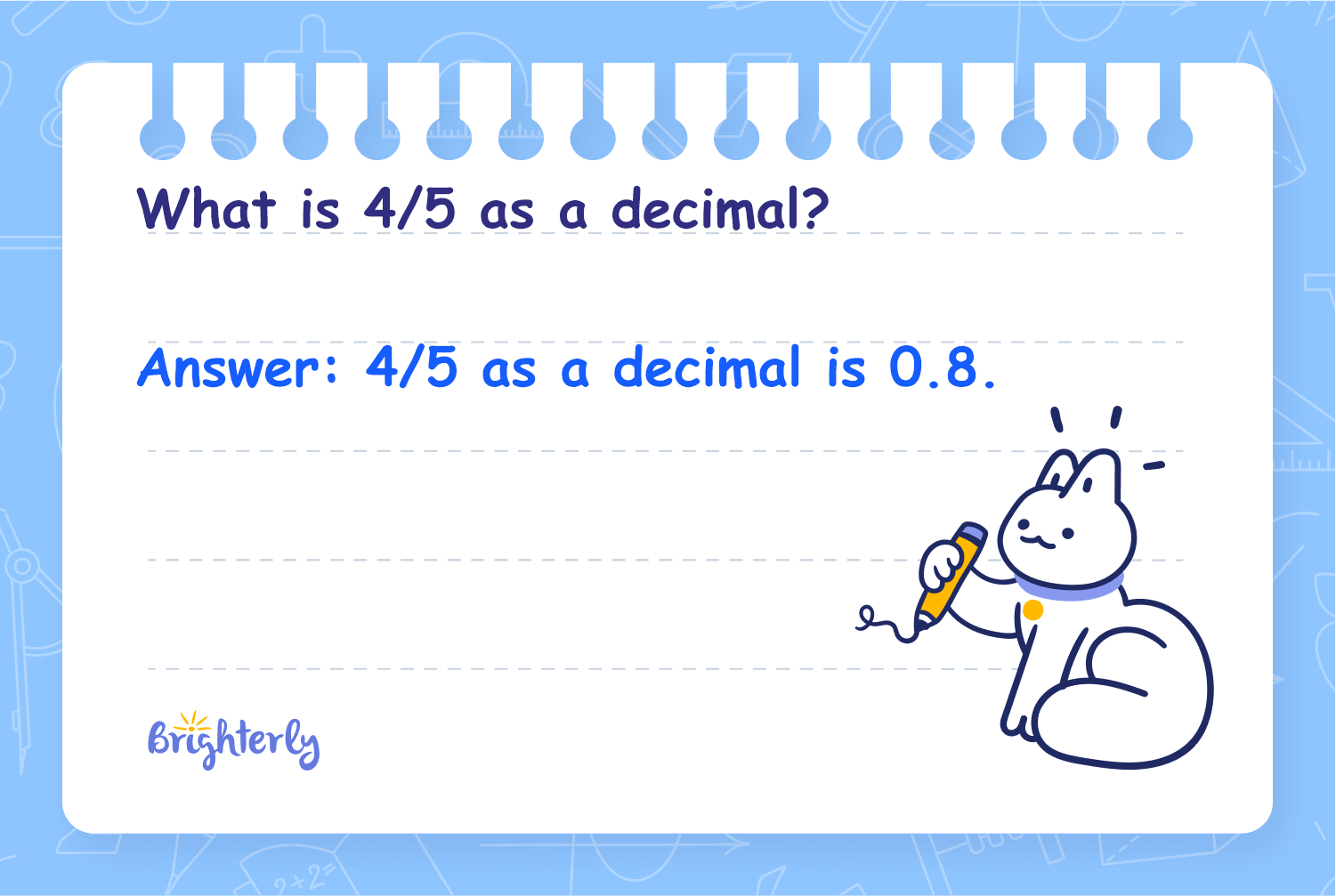
In the world of personal finance and investment analysis, the ability to pivot between different numerical representations is more than a basic arithmetic skill; it is a fundamental requirement for precision. When asking “what decimal is 4/5,” the immediate mathematical answer is 0.8. However, in the context of money management, wealth building, and corporate finance, this conversion represents a critical threshold—80%.
Understanding how 4/5 translates into 0.8 allows investors and professionals to quickly evaluate interest rates, asset allocations, and profit margins. Whether you are calculating a loan-to-value ratio for a new real estate investment or determining the percentage of your portfolio dedicated to equities, the movement from fractions to decimals is the bridge between raw data and actionable insight.
The Mechanics of the Conversion: From 4/5 to 0.8
To understand the financial implications of the 4/5 ratio, one must first be comfortable with the conversion process. Mathematics serves as the bedrock of all financial tools, and the transition from a fraction to a decimal is the most common operation performed by analysts.
The Division Method
The most direct way to find the decimal equivalent of any fraction is through simple division. In the fraction 4/5, 4 is the numerator and 5 is the denominator. By dividing the numerator by the denominator (4 ÷ 5), we arrive at 0.8. In a financial context, this represents a “factor.” If you are calculating the return on an investment or a cost-sharing agreement, seeing the figure as 0.8 allows for immediate multiplication against a principal sum. For instance, 0.8 of a $100,000 investment is $80,000.
The Power of Ten Shortcut
Another professional shortcut involves converting the denominator to a power of ten. Since 5 multiplied by 2 equals 10, we must also multiply the numerator by 2 to maintain the ratio. This gives us 8/10. In decimal notation, any number over ten is written as a single digit in the tenths place, resulting in 0.8. This mental math is invaluable during high-stakes negotiations or quick market assessments where a calculator might not be immediately available.
The Financial Significance of 0.8: Understanding Percentages and Ratios
Once the conversion to 0.8 is established, its utility in personal finance becomes apparent when viewed as 80%. This specific percentage is a recurring benchmark in various financial sectors, from insurance to lending and wealth distribution.
The Pareto Principle in Wealth Management
Perhaps the most famous application of the 4/5 ratio is the Pareto Principle, also known as the 80/20 rule. In finance, this often manifests as the observation that 80% of a company’s revenue comes from 20% of its clients, or 80% of investment returns are generated by 20% of the assets in a portfolio.
For the individual investor, recognizing the 0.8 factor helps in identifying which assets are the “heavy lifters.” If 4/5 of your wealth is being generated by a small segment of your investments, a decimal-based analysis allows you to reallocate capital more efficiently. By quantifying performance as 0.8 rather than the vaguer “most,” you can apply precise growth formulas to project future wealth.
Loan-to-Value (LTV) Ratios in Real Estate
In the real estate and mortgage industry, 0.8 is a “magic number.” Most conventional lenders require a down payment of 20%, which means the Loan-to-Value (LTV) ratio is 0.8 (or 80%). When the decimal representation of your loan exceeds 0.8, lenders typically view the investment as higher risk, often requiring the borrower to pay Private Mortgage Insurance (PMI).
Understanding that 4/5 of the home’s value is the maximum threshold for a standard loan helps prospective homeowners and real estate investors plan their cash flow. If you are analyzing a property worth $500,000, knowing that the 0.8 threshold is $400,000 allows you to immediately identify your required liquidity.
Fractional Ratios in Investment Strategy: Portfolio Optimization
Strategic asset allocation is the process of dividing an investment portfolio among different asset categories, such as stocks, bonds, and cash. The 4/5 ratio frequently appears in “aggressive growth” or “balanced” strategies.

The 80/20 Equity-to-Bond Split
For investors with a long-term horizon and a moderate to high risk tolerance, an 80/20 (0.8 to 0.2) split between equities and fixed-income securities is a classic model. In this scenario, 4/5 of the total capital is exposed to the stock market to capture growth, while the remaining 1/5 acts as a buffer against volatility.
Converting these fractions to decimals is essential when using automated financial tools or spreadsheets. If an investor wants to rebalance a $250,000 portfolio to maintain this 0.8 equity exposure, they must multiply the total balance by 0.8 to find the target dollar amount ($200,000). The precision of the decimal ensures that the rebalancing is accurate down to the cent, preventing “portfolio drift” which can expose the investor to unintended risk.
Dividend Payout Ratios
For income-focused investors, the decimal 0.8 is a critical indicator of a company’s financial health. The dividend payout ratio measures the percentage of net income a company pays out to shareholders. A payout ratio of 4/5 (0.8) indicates that the company is returning 80% of its earnings to investors.
While a 0.8 ratio might seem attractive for those seeking immediate income, seasoned financial analysts often view it with caution. If a company is paying out 4/5 of its profit, it leaves only 1/5 (0.2) for reinvestment, research, and debt repayment. By seeing the fraction as a decimal, an investor can more easily compare it against industry averages—for instance, comparing a 0.8 ratio in a utility company (where high payouts are common) versus a 0.8 ratio in a tech firm (where it might signal a lack of growth opportunities).
Corporate Finance and the Decimal: Analyzing Performance Multiples
In the corporate world, decimal accuracy is the standard for reporting and analysis. Converting 4/5 to 0.8 is a common step when assessing efficiency and liquidity.
Operating Expense Ratios
Businesses often track their efficiency through the operating expense ratio (OER). If a company’s expenses are 4/5 of its total revenue, its OER is 0.8. This means for every dollar earned, 80 cents are consumed by the costs of staying in business, leaving only 20 cents in operating profit.
Financial managers use the decimal 0.8 to perform year-over-year comparisons. A shift from 0.8 to 0.78 might seem small, but in a multi-million dollar corporation, that 0.02 difference represents a significant increase in profitability. Converting the fraction to a decimal allows for this level of granular tracking that fractions simply cannot provide.
Liquidity and the Acid-Test Ratio
While the “Current Ratio” is a popular measure of liquidity, the “Acid-Test” or “Quick Ratio” provides a more stringent look at a company’s ability to meet short-term obligations. If a company has $4 in quick assets for every $5 in current liabilities, its ratio is 0.8. Because this figure is less than 1.0, it suggests the company might struggle to pay off its immediate debts without selling off inventory or securing more financing. Professionals use the 0.8 decimal to quickly flag companies that may be facing a liquidity crunch.
Navigating the Digital Economy: Tools for High-Precision Finance
As we move further into a digital-first economy, the reliance on decimals over fractions has become institutionalized. Modern financial software, AI-driven trading bots, and tax preparation tools all operate in a decimal-based environment.
Spreadsheets and Financial Modeling
Whether you are using Microsoft Excel, Google Sheets, or specialized fintech software, these platforms do not inherently “think” in fractions like 4/5. They process values as 0.8. When building a financial model to project the future value of an investment, using the decimal form is mandatory for the application of compound interest formulas.
For example, if you are calculating a 4/5 of a percent monthly interest rate, you must convert that to 0.008 in your formula. Misidentifying the decimal placement can lead to catastrophic errors in financial planning, underscoring the importance of mastering these conversions.
The Impact of Rounding Errors
In high-frequency trading or large-scale institutional investing, the difference between 4/5 (exactly 0.8) and a rounded figure can involve millions of dollars. While 4/5 is a “clean” fraction that results in a terminating decimal, many other financial fractions result in repeating decimals. Understanding that 4/5 is exactly 0.8—with no hidden remainders—provides a level of certainty in financial calculations.
Precision in decimals ensures that when you are calculating tax liabilities or interest accruals, you are not losing money to “rounding drift.” For a side hustle or a small business owner, tracking income to the second decimal place (the cent) is the difference between a balanced ledger and a financial headache at the end of the fiscal year.

Conclusion: The Power of 0.8 in Your Pocket
While “what decimal is 4/5” may originate as a simple mathematical query, its application is a cornerstone of financial literacy. By recognizing 4/5 as 0.8, you unlock the ability to see the world in percentages, ratios, and factors. This 80% benchmark guides our most important financial decisions, from the homes we buy to the way we balance our retirement portfolios. In the pursuit of financial independence, precision is your greatest ally, and the humble decimal is the tool that provides it.
aViewFromTheCave is a participant in the Amazon Services LLC Associates Program, an affiliate advertising program designed to provide a means for sites to earn advertising fees by advertising and linking to Amazon.com. Amazon, the Amazon logo, AmazonSupply, and the AmazonSupply logo are trademarks of Amazon.com, Inc. or its affiliates. As an Amazon Associate we earn affiliate commissions from qualifying purchases.