
The return of collegiate football to the digital landscape marks one of the most significant milestones in the history of sports simulation software. After an eleven-year hiatus, EA Sports College Football 25—frequently referred to by fans as NCAA 25—represents more than just a roster update; it is a complete ground-up rebuild designed for the current era of computing power. For gamers and tech enthusiasts alike, the question of “what consoles will NCAA 25 be on” serves as the gateway to understanding a broader shift in the gaming industry: the definitive move away from legacy hardware in favor of high-fidelity, high-throughput environments.

EA Sports College Football 25 is available exclusively on the PlayStation 5 and the Xbox Series X|S. This decision to bypass the PlayStation 4, Xbox One, and even the PC platform is a strategic technical choice. By narrowing the scope of development to ninth-generation consoles, EA Sports has prioritized architectural homogeneity, allowing for a level of atmospheric detail and physics-based gameplay that would be impossible to scale down to the aging hardware of the early 2010s.
The Transition to Next-Gen Exclusivity: Why Legacy Hardware Was Left Behind
In the world of software development, “cross-gen” titles often suffer from technical debt. When a game must run on both a PlayStation 4 (released in 2013) and a PlayStation 5 (2020), the developers are forced to design for the lowest common denominator. For EA Sports College Football 25, the developers made the executive technical decision to cut ties with the past to fully embrace the capabilities of modern silicon.
Leveraging the Power of the Zen 2 Architecture
The PlayStation 5 and Xbox Series X|S are powered by custom AMD Ryzen Zen 2 processors. Unlike the Jaguar CPUs found in the PS4 and Xbox One—which were essentially low-power mobile processors even at launch—the Zen 2 architecture allows for significantly more complex logic calculations. In a college football game, this translates to improved AI logic. With 22 players on the field, each requiring individual pathfinding, decision-making cycles, and physics interactions, the CPU overhead is immense. By targeting only the Zen 2 architecture, the developers can ensure that “trench play” and secondary coverage reactions happen with millisecond precision, free from the bottlenecks of older hardware.
SSD Integration and the Elimination of Load Times
Perhaps the most transformative piece of tech in the current console generation is the transition from Mechanical Hard Disk Drives (HDD) to Ultra-High-Speed Solid State Drives (SSD). The I/O throughput of the PS5 and Xbox Series X|S allows for data streaming at rates exceeding 5GB/s. This is critical for NCAA 25 because of the sheer volume of unique assets. College football thrives on variety—hundreds of unique stadiums, thousands of uniform combinations, and complex crowd animations. On legacy consoles, loading these assets would result in multi-minute wait times. On current-gen hardware, the game utilizes hardware-accelerated decompression to transition from the “Road to Glory” menus to the kickoff in a matter of seconds.
Hardware Breakdown: PlayStation 5 vs. Xbox Series X|S Performance
While both platforms share a similar architectural DNA, the technical implementation of College Football 25 nuances itself across the different SKUs. The game utilizes a highly optimized version of the Frostbite Engine, tailored to extract maximum performance from the RDNA 2-based GPUs found in these machines.
Ray Tracing and Visual Fidelity in the Frostbite Engine
The visual centerpiece of NCAA 25 is its lighting engine. College football games are often played under shifting sunlight or harsh stadium floodlights. Using the Frostbite Engine, the game employs advanced Global Illumination techniques. While full path-tracing is still out of reach for sports titles targeting 60 frames per second (FPS), the game uses hardware-accelerated ray tracing for ambient occlusion and reflections. This ensures that the metallic sheen on a Chrome Oregon Ducks helmet or the reflections on the rain-slicked turf of a night game at LSU’s Death Valley are rendered with physical accuracy.
4K Resolution and Variable Refresh Rates (VRR)
On the PlayStation 5 and Xbox Series X, the target is a native or reconstructed 4K resolution at a locked 60 FPS. The Xbox Series S, while still a “next-gen” machine, features a less powerful GPU and less RAM. Consequently, the technical compromise for the Series S involves a lower internal rendering resolution (typically 1080p or 1440p) and reduced texture filtering. However, all three consoles support Variable Refresh Rate (VRR). For users with HDMI 2.1 compatible displays, this technology synchronizes the monitor’s refresh rate with the console’s frame output, eliminating screen tearing and reducing input lag—a vital technical requirement for timing-based gameplay like kicking and precision passing.
The PC Omission and Technical Security Challenges
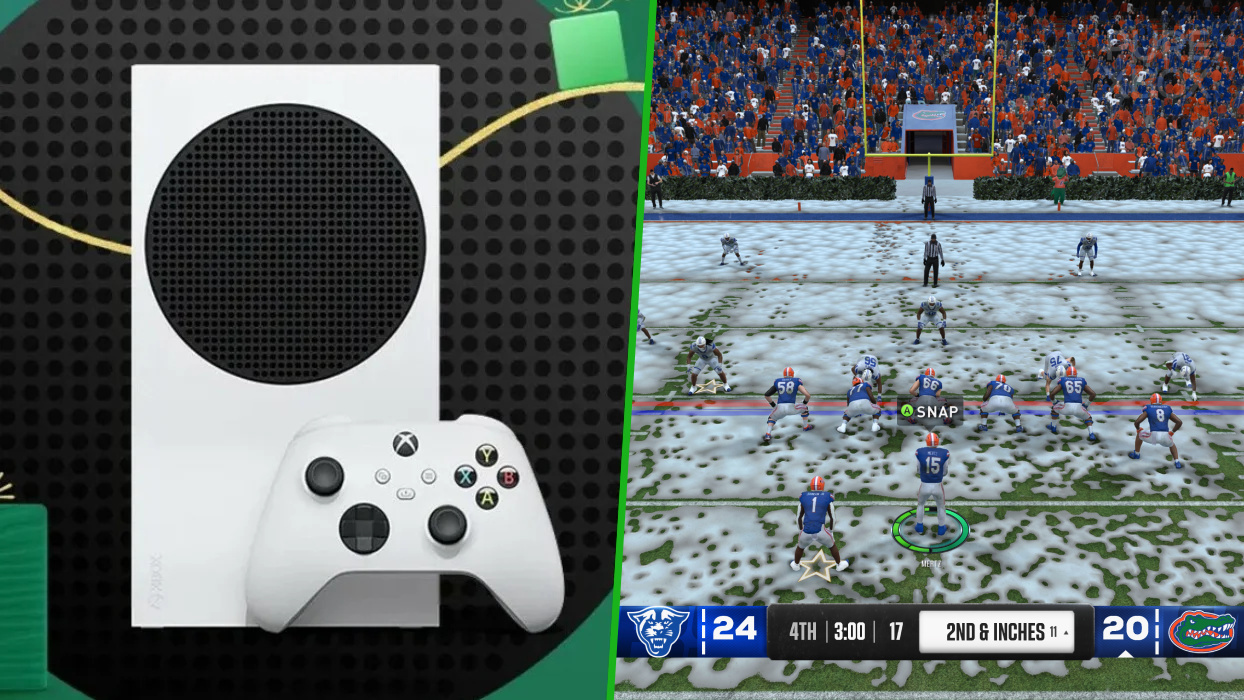
One of the most discussed aspects of the NCAA 25 launch is its absence from the PC platform. While EA Sports’ other flagship titles, like Madden and FC, have made their way to PC, the college football revival remains a console exclusive. This decision is rooted in two primary technical areas: security and optimization.
Anti-Cheat Protocols and Modding Challenges
The college football ecosystem is uniquely sensitive due to the integration of Name, Image, and Likeness (NIL) rights. Over 11,000 real-world athletes are licensed within the game. From a technical and legal standpoint, EA Sports must maintain a “closed” ecosystem to prevent the unauthorized modification of player likenesses or the insertion of non-licensed individuals through community-made mods. The closed-box environment of the PlayStation 5 and Xbox Series X|S provides a robust layer of Digital Rights Management (DRM) and anti-tamper security that is significantly more difficult to maintain on an open platform like Windows.
Optimization for Standardized Hardware Environments
Developing for PC requires optimizing for thousands of different hardware configurations, ranging from budget laptops to high-end RTX 4090 rigs. By focusing exclusively on three specific hardware sets (PS5, Series X, and Series S), the engineering team could spend more time refining the “CampusIQ” gameplay system. This system involves complex player physics and “Wear and Tear” mechanics that track the physical degradation of players over a game. Implementing this consistently across varying PC CPU speeds and RAM latencies would have extended the development cycle and potentially compromised the game’s stability at launch.
Software Innovations: Sights, Sounds, and Simulation AI
The tech behind NCAA 25 isn’t just about the hardware it sits on; it’s about the sophisticated software systems designed to simulate the “Saturday atmosphere.” The complexity of a college football game exceeds that of a professional NFL game due to the sheer scale of the environment.
The Technical Complexity of Crowd Simulation
In a standard sports game, the crowd is often a repeating texture or a low-polygon background element. In College Football 25, the “Sights and Sounds” package utilizes dynamic crowd rendering. This technology allows for thousands of individual 3D models to react independently to the action on the field. The technical challenge here is “draw calls”—the CPU telling the GPU what to render. By utilizing the primitive shaders of the RDNA 2 architecture, the game can render high-density crowds with unique school-specific traditions (like “The Wave” at Iowa or the “White Out” at Penn State) without dropping the frame rate.
Artificial Intelligence and Player Logic Enhancements
Beyond the visuals, the “CampusIQ” suite introduces a new level of AI sophistication. College football is defined by “option” offenses and complex defensive schemes that aren’t found in the NFL. To simulate this, EA Sports developed a new logic layer that governs “read” keys for quarterbacks. The AI must process the defensive end’s positioning and the linebacker’s momentum in real-time. This requires a high-polling rate for input and logic checks, ensuring that the software feels responsive and “smart.”
Scaling the Ecosystem: Cloud Gaming and Cross-Play Capabilities
As we look at the infrastructure supporting NCAA 25, it is clear that the game is built for a connected, platform-agnostic future, even if it is currently limited to two console families. The technical backend of the game is deeply integrated into EA’s proprietary server architecture.
Cross-Play and Unified Data Structures
College Football 25 supports cross-platform play, allowing PlayStation 5 users to compete against Xbox Series X|S users. This is made possible through a unified data structure on the EA servers. Instead of the consoles communicating directly with each other, they send packet data to a central hub that standardizes the game state. This minimizes “desync” errors where one player sees a touchdown while the other sees a fumble. From a networking perspective, this requires a low-latency netcode capable of handling the high-speed inputs of a sports simulation.

The Future of the Infrastructure
While the game is currently a “next-gen” exclusive, the underlying tech is built to be scalable. The move to a purely digital and high-performance architecture ensures that as cloud gaming platforms (like Xbox Cloud Gaming) become more robust, the game is already optimized for high-bandwidth, low-latency streaming. By choosing to build exclusively for the PS5 and Xbox Series X|S, EA Sports has not only delivered a game for the present but has established a technical foundation that will support the evolution of the college football franchise for the next decade.
In conclusion, the decision regarding which consoles NCAA 25 would occupy was never just a marketing choice—it was a technical necessity. To deliver the most authentic, visually stunning, and computationally dense football simulation ever made, the developers had to embrace the future and leave the hardware of the past behind.
aViewFromTheCave is a participant in the Amazon Services LLC Associates Program, an affiliate advertising program designed to provide a means for sites to earn advertising fees by advertising and linking to Amazon.com. Amazon, the Amazon logo, AmazonSupply, and the AmazonSupply logo are trademarks of Amazon.com, Inc. or its affiliates. As an Amazon Associate we earn affiliate commissions from qualifying purchases.