
The Dow Jones Industrial Average (DJIA), often referred to simply as “the Dow,” is perhaps the most recognizable stock market index in the world. Established in 1896 by Charles Dow and Edward Jones, it serves as a price-weighted measure of 30 significant, “blue-chip” companies traded on the New York Stock Exchange (NYSE) and the Nasdaq. While the term “industrial” remains in its name, the index has evolved far beyond its roots in heavy manufacturing, railroad, and energy sectors. Today, it represents a cross-section of the American economy, spanning technology, healthcare, finance, and consumer discretionary sectors.

To understand the Dow is to understand the heartbeat of the U.S. equity market. Because it contains only 30 stocks, every addition or removal is a major financial event, signaling shifts in the global economic landscape.
The 30 Components of the Dow Jones Industrial Average
As of the most recent rebalancing, the Dow is comprised of a diverse group of corporate giants. These companies are selected because they possess excellent reputations, demonstrate sustained growth, and command interest from a broad range of investors.
Technology and Communications
In the modern era, technology has become the dominant force within the Dow. The inclusion of these firms reflects the transition from a manufacturing-based economy to a digital and service-based one.
-
Microsoft (MSFT): A cornerstone of the software and cloud computing industry.
-
Apple (AAPL): The world’s leading consumer electronics brand and a massive driver of index movement.
-
Salesforce (CRM): A leader in cloud-based customer relationship management software.
-
Amazon (AMZN): A recent and significant addition, representing the massive shift toward e-commerce and cloud infrastructure.
-
Intel (INTC): A long-standing semiconductor giant, though its influence fluctuates with the hardware market.
-
Cisco Systems (CSCO): The backbone of global networking and internet infrastructure.
-
IBM (IBM): The “International Business Machines” legacy, now focused on hybrid cloud and AI.
Financial Services
The financial sector is heavily weighted in the Dow, providing insight into the health of global lending, investment, and consumer spending.
-
Goldman Sachs (GS): A premier global investment banking and management firm.
-
JPMorgan Chase (JPM): The largest bank in the United States by assets.
-
American Express (AXP): A leader in premium credit services and global travel.
-
Visa (V): A dominant force in global digital payments and transaction processing.
-
The Travelers Companies (TRV): A major provider of property and casualty insurance.
Healthcare
Healthcare companies provide stability to the index, as their services are often viewed as “recession-proof” necessities.
-
UnitedHealth Group (UNH): A diversified healthcare and insurance giant, often the highest-weighted stock in the index due to its high share price.
-
Johnson & Johnson (JNJ): A massive conglomerate specializing in medical devices and pharmaceuticals.
-
Merck & Co. (MRK): A global leader in pharmaceutical research and life sciences.
-
Amgen (AMGN): A pioneer in biotechnology and innovative medicine.
Consumer Goods and Services
These companies represent the spending power of the American consumer, from retail to entertainment.
-
Walmart (WMT): The world’s largest retailer and a bellwether for consumer spending.
-
The Home Depot (HD): The leading home improvement retailer in the U.S.
-
McDonald’s (MCD): The global standard for the fast-food industry.
-
Coca-Cola (KO): A quintessential “blue-chip” dividend stock with a massive global footprint.
-
Procter & Gamble (PG): The consumer staples giant behind brands like Tide and Gillette.
-
The Walt Disney Company (DIS): A leader in global entertainment, media, and theme parks.
-
Nike (NKE): The world’s largest supplier of athletic shoes and apparel.
Industrials, Energy, and Materials
These firms carry the torch for the Dow’s original purpose: tracking the industrial capacity of the nation.
-
Boeing (BA): A critical aerospace and defense contractor.
-
Caterpillar (CAT): The leading manufacturer of construction and mining equipment.
-
Honeywell International (HON): A diversified technology and manufacturing company.
-
3M (MMM): A multinational conglomerate known for industrial, worker safety, and consumer goods.
-
Chevron (CVX): The sole energy representative currently in the index, following the removal of ExxonMobil.
-
Dow Inc. (DOW): A leader in materials science and chemical manufacturing.
-
Verizon (VZ): Representing the telecommunications infrastructure required for modern business.
The Price-Weighting Methodology: A Unique Financial Model
Unlike the S&P 500 or the Nasdaq Composite, which are market-capitalization-weighted, the Dow Jones Industrial Average is a price-weighted index. This is a fundamental concept for any investor to understand when analyzing how the Dow moves.
How Price-Weighting Works
In a market-cap-weighted index, the larger the company’s total market value, the more influence it has on the index. However, in the Dow, the price of a single share determines its influence. A company with a share price of $500 will have ten times the impact on the index as a company with a share price of $50, regardless of the companies’ actual sizes.

This methodology often leads to “stock split” complications. When a company like Apple or Walmart splits its stock to make shares more affordable for retail investors, its weighting in the Dow automatically decreases. This unique quirk is why the selection committee often favors companies with higher share prices to maintain the index’s “level.”
The Dow Divisor
To ensure that the index remains consistent over time despite stock splits, spin-offs, and company replacements, the Dow uses a mathematical constant known as the “Dow Divisor.” Instead of simply dividing the sum of the 30 stock prices by 30, the total is divided by this ever-changing number. This ensures that a 2-for-1 stock split doesn’t cause the entire index to “drop” value overnight.
The Selection Process: How the 30 are Chosen
One of the most frequent questions regarding the Dow is who decides which companies belong. Unlike other indices that use strict quantitative rules (such as being in the top 500 companies by market cap), the Dow is managed by a selection committee.
The Averages Committee
The components are selected by the Averages Committee, which includes the Editor-in-Chief of The Wall Street Journal and representatives from S&P Dow Jones Indices. There are no hard-and-fast rules for inclusion, but the committee generally looks for:
-
Sustainable Growth: The company must be a leader in its industry.
-
Reputation: The company must have an excellent reputation and a history of successful operations.
-
Investor Interest: The company must be a significant point of interest for the investing public.
-
Sector Balance: The committee strives to maintain a balance that reflects the broader U.S. economy.
Why Companies are Removed
Companies are removed from the Dow when they no longer represent the “prime” of the American economy. A classic example is the removal of General Electric (GE) in 2018. GE was an original member of the index, but as its market influence waned and its business model struggled, it was replaced by Walgreens Boots Alliance (which was recently replaced by Amazon). Similarly, companies that face bankruptcy or significant financial distress are quickly removed to maintain the integrity of the “blue-chip” designation.
Investing in the Dow: Strategies for Individual Investors
For the average investor, the Dow Jones Industrial Average represents a “steady hands” approach to the market. Because these companies are established leaders with massive cash flows, they are often less volatile than small-cap or pure-growth tech stocks.
The “Dogs of the Dow” Strategy
A popular investment strategy involving this index is the “Dogs of the Dow.” This approach involves identifying the 10 companies in the Dow with the highest dividend yields at the beginning of the year. The theory is that these companies are temporarily out of favor (which is why their yield is high) but are fundamentally strong enough to rebound. Investors buy these 10 stocks, hold them for a year, and rebalance annually. Historically, this strategy has often outperformed the broader index while providing a steady stream of passive income.
Index Funds and ETFs
Most investors do not buy all 30 stocks individually. Instead, they utilize Exchange-Traded Funds (ETFs) that track the index. The most famous is the SPDR Dow Jones Industrial Average ETF Trust (Ticker: DIA), often called “Diamonds.” By purchasing shares of DIA, an investor gains proportional exposure to all 30 blue-chip companies in a single transaction.
The Dow as a Global Financial Barometer
While critics argue that 30 stocks are too few to represent the vast U.S. economy, the Dow continues to hold immense psychological power in the financial world. When news anchors report that “the market is up,” they are almost always referring to the Dow.
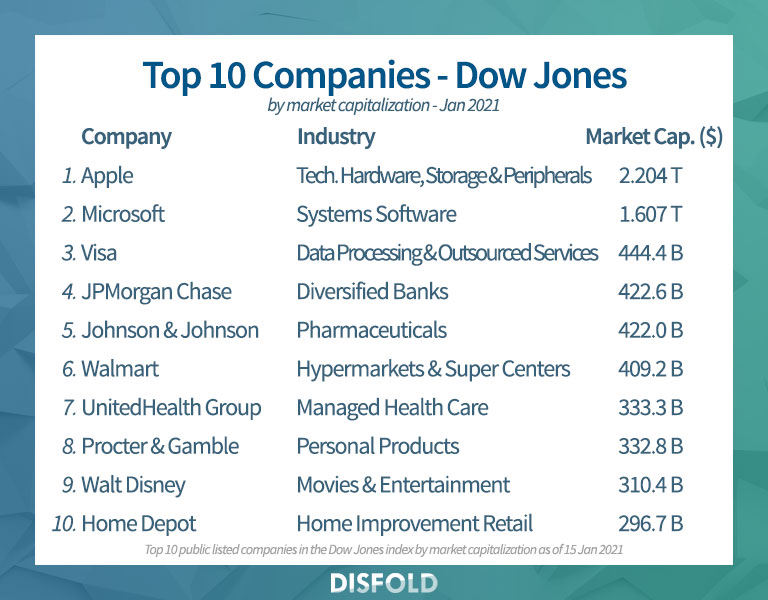
Its focus on “Blue Chip” companies—firms that are reliable, profitable, and globally recognized—makes it a unique lens through which to view economic health. For the personal investor, understanding the components of the Dow is more than just a history lesson; it is an exercise in identifying the pillars of global commerce. Whether it is the technological dominance of Microsoft, the consumer reach of Walmart, or the financial infrastructure of JPMorgan, the companies that make up the Dow Jones Industrial Average are the engines that drive the modern financial world.
aViewFromTheCave is a participant in the Amazon Services LLC Associates Program, an affiliate advertising program designed to provide a means for sites to earn advertising fees by advertising and linking to Amazon.com. Amazon, the Amazon logo, AmazonSupply, and the AmazonSupply logo are trademarks of Amazon.com, Inc. or its affiliates. As an Amazon Associate we earn affiliate commissions from qualifying purchases.