
Understanding the Dow Jones Industrial Average (DJIA)
The Dow Jones Industrial Average (DJIA), often simply referred to as “the Dow,” stands as one of the oldest and most widely recognized stock market indices globally. Established in 1896 by Charles Dow and Edward Jones, its original intent was to serve as a straightforward barometer of the health of the U.S. industrial sector. Over its long history, the Dow has evolved significantly, transitioning from a pure industrial gauge to a representation of 30 large, publicly owned companies considered leaders in their respective industries, collectively reflecting a broad swathe of the American economy. While its methodology and limited number of components often draw criticism, its psychological impact and historical significance as an indicator of market sentiment remain undeniable for investors, economists, and the general public alike.

A Historical Perspective
Initially comprising just 12 companies, predominantly railroads and industrial manufacturers, the DJIA’s early days were marked by direct reflection of the industrial might of the late 19th century. Its expansion to 20 stocks in 1916 and then to its current 30 companies in 1928 mirrored the growing complexity and diversification of the U.S. economy. Throughout the 20th and 21st centuries, the index has undergone numerous changes, with companies being added and removed to maintain its relevance as the American economic landscape shifted from heavy industry to technology, healthcare, and finance. This dynamic adaptation ensures the Dow, while historically rooted, attempts to stay contemporary in its representation, despite its inherent limitations.
Price-Weighted vs. Market-Cap Weighted
A crucial characteristic distinguishing the DJIA from many other modern indices, such as the S&P 500 or the Nasdaq Composite, is its price-weighted methodology. In a price-weighted index, stocks with higher share prices exert a greater influence on the index’s movement than stocks with lower share prices, regardless of their total market capitalization. This contrasts sharply with market-capitalization-weighted indices, where a company’s influence is proportional to its total market value (share price multiplied by the number of outstanding shares).
This price-weighted approach means that a one-dollar change in the share price of a high-priced component will have a more significant impact on the Dow’s overall value than a one-dollar change in a lower-priced component, even if the lower-priced company has a much larger market cap. For instance, if a stock trading at $300 moves up $10, it contributes more to the index’s rise than a stock trading at $50 moving up $10, despite both representing a 3.33% and 20% gain respectively for their individual stocks. This methodology can sometimes lead to the index movements being disproportionately influenced by a few high-priced stocks, which some critics argue can distort its true representation of the broader market’s health.
The Role of the “Dow Divisor”
To ensure the historical continuity and comparability of the DJIA despite changes in its component stocks or corporate actions like stock splits and special dividends, a crucial mechanism known as the “Dow Divisor” is employed. The index itself is calculated by summing the prices of the 30 component stocks and then dividing that sum by the Dow Divisor.
When a company is added or removed, or when a stock split occurs, the sum of the prices of the 30 stocks changes. Without adjustment, this would inaccurately alter the index’s value, making historical comparisons meaningless. The Dow Divisor is adjusted to compensate for these changes, ensuring that the index value remains consistent before and after such events. For example, if a company’s stock splits 2-for-1, its price halves. To prevent an artificial drop in the index, the divisor is reduced proportionally, maintaining the index level as if the split had not occurred in the context of the overall index value. This continuous adjustment is fundamental to the DJIA’s integrity as a historical benchmark.
The Current Landscape: Key Components of the DJIA
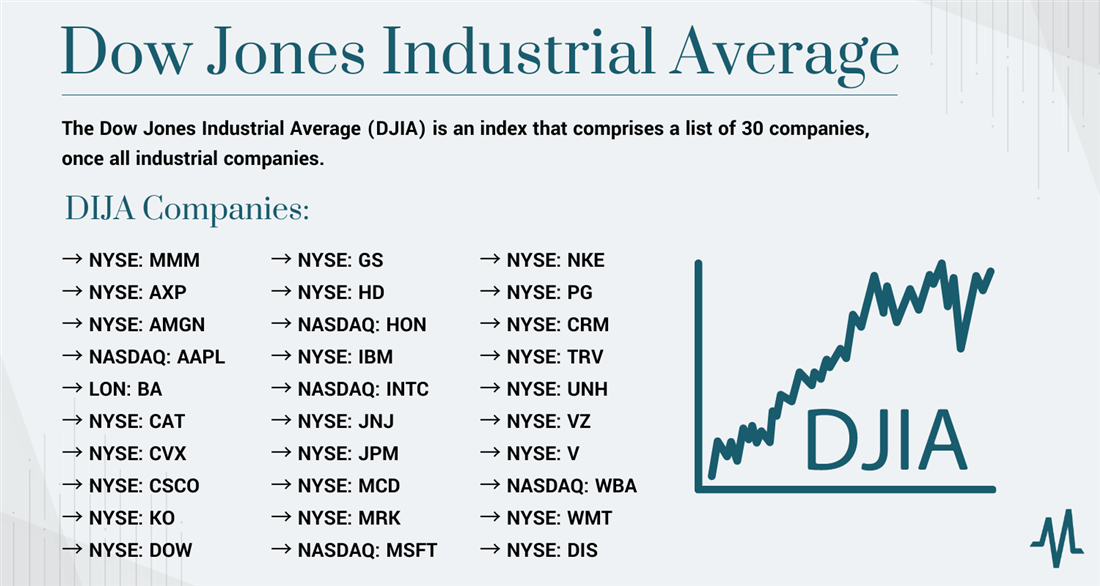
The 30 companies that comprise the Dow Jones Industrial Average are not static; they are periodically reviewed and updated to ensure the index remains relevant to the evolving structure of the U.S. economy. While historically rooted in heavy industries, the modern Dow reflects a diverse array of sectors, including technology, healthcare, finance, consumer goods, and industrials, though the “Industrial” in its name is largely an anachronism for its current composition. These companies are typically large-cap, well-established entities with long histories of profitability and investor interest, often considered “blue-chip” stocks.
Sectoral Diversity (and Lack Thereof)
The selection committee for the DJIA aims for a reasonable representation of various economic sectors within its 30 components. This means investors will find titans from diverse industries. For instance, tech giants like Apple and Microsoft, healthcare leaders such as Johnson & Johnson and UnitedHealth Group, financial powerhouses like JPMorgan Chase and Goldman Sachs, and consumer staples stalwarts like Coca-Cola and Procter & Gamble are often part of the mix. Industrials, though less dominant than in the past, are still represented by companies like Boeing and Caterpillar.
However, a recurring criticism of the DJIA is its limited number of components compared to broader indices like the S&P 500 (which tracks 500 companies). This limited scope means that while it offers some sectoral diversity, it cannot capture the full breadth and depth of the U.S. economy. Entire burgeoning sectors, smaller innovative companies, or highly niche industries may be underrepresented or entirely absent. This makes the Dow a good snapshot of large-cap leaders but a less comprehensive gauge of the overall market or specific emerging trends.
Influence of Individual Stocks
Given its price-weighted methodology, the influence of individual stocks within the DJIA is directly tied to their share price. Companies with higher stock prices, even if they have smaller market capitalizations than other lower-priced Dow components, will have a greater impact on the index’s daily fluctuations. This can lead to situations where a significant move in one or two high-priced stocks can disproportionately sway the entire index, potentially masking the performance of other components or giving a skewed view of overall market sentiment. For example, a company with a share price of $400 will influence the Dow four times as much as a company with a $100 share price, assuming all else is equal. This feature requires investors to look beyond the headline Dow number and understand the contributions of its individual components.
Recent Additions and Removals
The composition of the DJIA is not immutable. The S&P Dow Jones Indices Committee reviews the components periodically, making changes as necessary to reflect significant shifts in the economy or corporate landscape. Additions typically occur when a company’s industry becomes more central to the U.S. economy, or when a company grows substantially in size and influence. Removals often happen due to declining market relevance, industry shifts, or corporate actions such as mergers and acquisitions that alter a company’s independence or focus.
Recent examples illustrate this dynamic process. For instance, Salesforce.com, Amgen, and Honeywell International were added in 2020, replacing Exxon Mobil, Pfizer, and Raytheon Technologies. This move reflected the increasing importance of cloud computing, biotechnology, and advanced industrials, while reducing the index’s exposure to traditional oil and gas. Such changes are vital to ensuring the Dow maintains some level of representativeness, even within its limited structure.
Why the DJIA Matters to Investors and the Economy
Despite its methodological quirks and limited component count, the DJIA holds a significant place in financial discourse. Its long history, coupled with the prominence of its constituent companies, grants it a unique status as a widely followed benchmark for both investors and the broader economy. It serves as an accessible reference point, often cited in news reports and daily conversations about market performance.
A Barometer of Economic Health
The Dow is frequently referenced as a key barometer of U.S. economic health. When the Dow is performing well, it’s often interpreted as a sign of a strong economy, robust corporate earnings, and positive investor confidence. Conversely, a declining Dow can signal economic headwinds, market uncertainty, or a downturn in corporate profitability. This perception, while an oversimplification given its limited scope, holds considerable psychological sway. For many, the movement of the Dow translates directly into how they perceive the financial well-being of the nation. It represents the performance of some of America’s largest and most established businesses, whose success often correlates with broader economic stability.
Investment Implications

For investors, the DJIA offers several implications. While few actively manage portfolios directly mirroring the precise price-weighted structure of the Dow, many exchange-traded funds (ETFs) and mutual funds track the index, allowing investors to gain exposure to its 30 components without purchasing each stock individually. These funds provide a relatively straightforward way to invest in a basket of blue-chip American companies, appealing to those seeking exposure to established market leaders.
However, investors must be mindful of the inherent lack of diversification within a 30-stock index. While the companies are large and diverse in their primary operations, a portfolio solely comprising Dow stocks might lack exposure to smaller-cap companies, emerging growth sectors, or international markets, which can be crucial for comprehensive diversification and risk management. Astute investors often view the Dow as a component of a broader, more diversified investment strategy rather than the sole focus.
Complementing Broader Market Indices
Experienced investors and analysts typically do not rely solely on the DJIA to gauge the overall market or economic condition. Instead, they view it in conjunction with other, more comprehensive indices. The S&P 500, a market-capitalization-weighted index of 500 large U.S. companies, is often considered a more accurate representation of the broader U.S. stock market due to its larger number of components and weighting methodology. The Nasdaq Composite, heavily skewed towards technology and growth stocks, provides insight into the performance of that specific, often volatile, sector.
Therefore, while the Dow offers a quick and historically significant snapshot, its true value in investment analysis comes when its movements are compared and contrasted with these other indices. For example, if the Dow is up but the S&P 500 and Nasdaq are down, it might suggest that a few high-priced Dow components are driving the increase, while the broader market is experiencing a decline, offering a more nuanced understanding than the Dow alone.
The Selection Process and Criteria
The selection of companies for the Dow Jones Industrial Average is not governed by a rigid quantitative formula but rather by a committee with considerable discretion. This qualitative approach allows for flexibility in ensuring the index remains relevant to the U.S. economic narrative.
The S&P Dow Jones Indices Committee
The responsibility for selecting and maintaining the components of the DJIA rests with the Averages Committee, which is part of S&P Dow Jones Indices. This committee comprises representatives from S&P Dow Jones Indices and The Wall Street Journal. They meet periodically to review the index’s composition and make changes when deemed appropriate. Unlike some other indices that have strict rules for inclusion (e.g., market capitalization, liquidity, profitability metrics), the Dow’s committee-based approach provides a qualitative overlay, allowing them to consider broader economic representation and corporate significance.
Qualities of a Dow Component
While there are no immutable quantitative criteria, several guiding principles influence the committee’s decisions. Dow components are typically:
- Large, Reputable U.S. Companies: They are generally established, “blue-chip” firms that are leaders in their respective industries, often with a significant brand presence and a long track record.
- Sustained Growth and Investor Interest: Companies chosen usually exhibit consistent growth, financial health, and generate considerable investor interest.
- Representation of the U.S. Economy: The committee aims for the index to broadly reflect the structure of the U.S. economy, encompassing various key sectors. However, given only 30 slots, this representation is necessarily selective.
- High Liquidity: The stocks must be highly liquid, ensuring that large trades can be executed without significantly impacting the stock price, which is crucial for index-tracking financial products.
Changes are typically made when a component company undergoes a significant transformation (e.g., bankruptcy, major merger, or divestiture), or when an economic sector represented by a new candidate becomes more prominent, making the new company a better representative of the evolving economy.
Adapting to Economic Evolution
The history of the Dow is a narrative of adaptation. Originally dominated by railroads and heavy manufacturing, its composition has steadily shifted to reflect the changing tides of economic leadership. The removal of U.S. Steel, General Motors, and more recently Exxon Mobil, alongside the inclusion of technology and healthcare giants like Apple, Microsoft, UnitedHealth Group, and Amgen, underscores this continuous evolution. This dynamic process ensures that the index, despite its age, attempts to capture the essence of modern American corporate power and innovation. The committee strives to strike a balance between maintaining the historical integrity of the index and keeping it relevant as a gauge for contemporary economic activity, even if that means shedding traditional “industrial” names for new industry leaders.
Investing in the Dow: Strategies and Considerations
For individual and institutional investors, the Dow Jones Industrial Average offers a distinct investment proposition. While its price-weighted nature and limited components distinguish it from broader benchmarks, it remains a relevant target for certain investment strategies.
Direct Stock Ownership vs. Index Funds/ETFs
Investors interested in the Dow’s constituent companies have a few primary avenues. One approach is to invest directly in the individual stocks that make up the index. This allows for selective exposure, where an investor can pick and choose which Dow components align with their personal investment thesis, rather than owning all 30. However, this strategy requires more active management, research into individual companies, and can involve higher transaction costs depending on the broker.
A more common and often more practical approach is investing through Dow-tracking index funds or Exchange Traded Funds (ETFs). These financial products are designed to replicate the performance of the DJIA by holding all 30 component stocks in proportions that mimic the index’s price-weighted methodology. The most well-known ETF tracking the Dow is the SPDR Dow Jones Industrial Average ETF Trust (ticker: DIA), often referred to as “Diamonds.” Investing in DIA or similar funds provides instant diversification across the 30 companies with a single trade, typically at lower expense ratios compared to actively managed funds, and eliminates the need to manage individual stock purchases and rebalancing.
Diversification within the Dow
While investing in a Dow-tracking fund provides diversification across 30 large companies, it is crucial for investors to understand the limitations of this diversification. The Dow, by its very nature, is concentrated in a relatively small number of companies, albeit prominent ones. It also tends to be heavily weighted towards U.S.-centric large-cap companies. This means that an investor relying solely on a Dow fund might lack exposure to:
- Mid-cap and Small-cap companies: These segments of the market can offer different growth profiles and diversification benefits.
- International markets: The Dow is exclusively U.S.-focused, omitting the vast investment opportunities and diversification benefits of global equities.
- Emerging sectors: While the committee aims to include new leaders, the Dow typically lags in capturing very nascent or highly specialized emerging industries due to its focus on established giants.
Therefore, for comprehensive portfolio diversification, most financial advisors recommend combining a Dow-focused investment with other asset classes, broader market indices (like the S&P 500 or total market funds), international equities, and fixed income.
Long-Term Performance and Volatility
Historically, the Dow Jones Industrial Average has delivered substantial long-term returns, reflecting the growth and resilience of America’s leading corporations. However, like any equity index, it is subject to significant volatility in the short to medium term, reacting to economic news, corporate earnings, geopolitical events, and shifts in investor sentiment. Its performance is often viewed as a proxy for the health of mature, blue-chip segments of the U.S. economy. While it has generally performed well over extended periods, its returns may not always perfectly align with broader market indices due to its unique composition and weighting methodology. Investors should view the Dow as one piece of the investment puzzle, understanding its specific characteristics and how it fits into a well-rounded financial strategy tailored to their individual goals and risk tolerance.
aViewFromTheCave is a participant in the Amazon Services LLC Associates Program, an affiliate advertising program designed to provide a means for sites to earn advertising fees by advertising and linking to Amazon.com. Amazon, the Amazon logo, AmazonSupply, and the AmazonSupply logo are trademarks of Amazon.com, Inc. or its affiliates. As an Amazon Associate we earn affiliate commissions from qualifying purchases.