
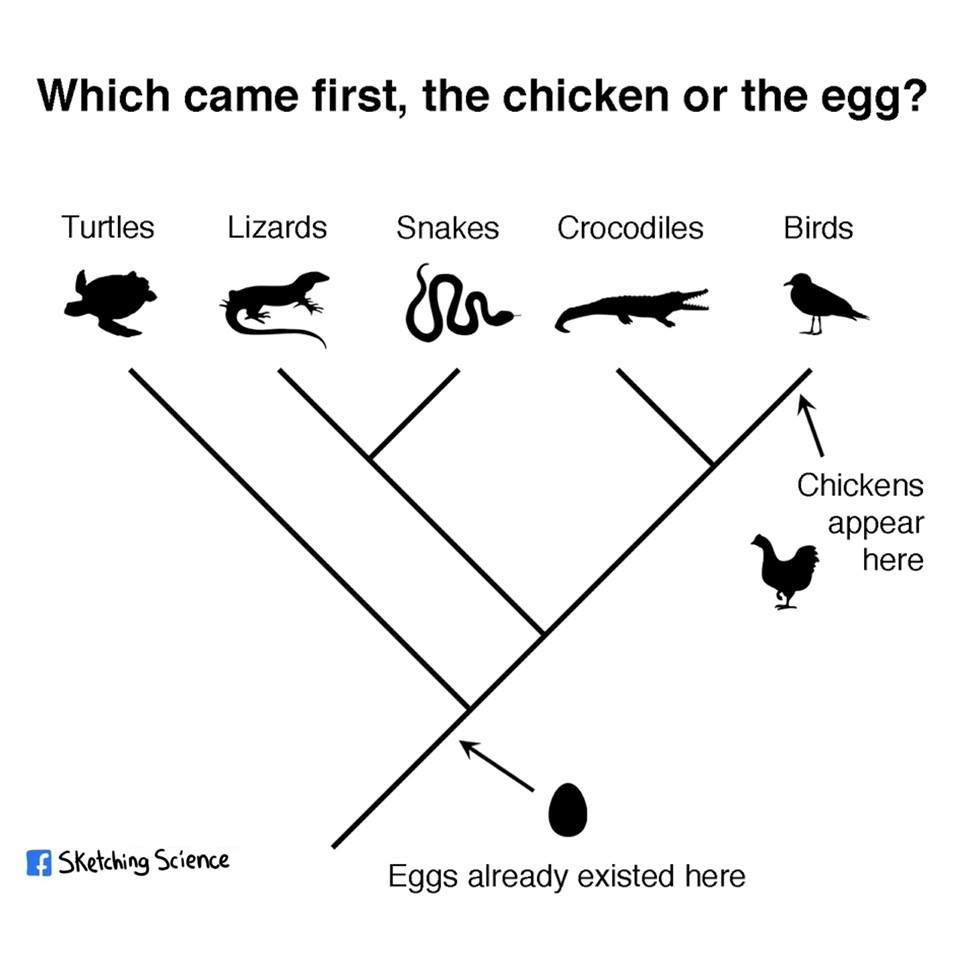
The classic “chicken or egg” paradox, a philosophical conundrum about causality and origin, transcends its biological roots to illuminate some of the most profound dilemmas in the technology landscape. In an industry defined by rapid evolution, complex dependencies, and interconnected ecosystems, tech leaders and innovators frequently encounter situations where two essential components seem to mutually require each other for existence or success. From the foundational layers of infrastructure to the bleeding edge of artificial intelligence, understanding and navigating these “chicken and egg” scenarios is crucial for strategic planning, development, and market penetration. This article delves into how this ancient paradox manifests in modern tech, offering insights into how to approach these intertwined challenges effectively.
The Foundational Paradox in Tech Development
At its core, the tech industry is built upon layers of interconnected components, each often dependent on another that theoretically should follow it. This creates inherent “chicken and egg” paradoxes right from the initial stages of conceptualization and development.
Defining the “Chicken and Egg” in Tech Contexts
In tech, the “chicken and egg” often refers to a situation where two elements are mutually dependent, and it’s unclear which one should be prioritized or developed first. Consider the relationship between an innovative software application and the hardware it runs on. Does one build the groundbreaking software and then design bespoke hardware to maximize its potential, or does one develop powerful hardware first, hoping it will inspire new software applications? Similarly, within software development, should the foundational API and backend infrastructure be fully robust before frontend development begins, or should a prototype UI guide the backend’s capabilities?
These are not trivial questions. The answer often dictates project timelines, resource allocation, and ultimately, market success. A common example is the launch of a new digital platform: you need users to attract content creators, but you need compelling content to attract users. This dynamic is a perpetual challenge for startups and established giants alike, manifesting across various domains, from operating systems and developer tools to social networks and marketplaces.
The Peril of Premature Optimization
One significant risk stemming from the “chicken and egg” dilemma is the temptation of premature optimization. If a team rigidly decides that the “chicken” must come first and invests heavily in perfecting it, they might find that the “egg” (the dependent component) evolves in an unexpected direction, rendering their initial efforts less effective or even obsolete. For instance, developing a highly optimized, custom-built database solution before fully understanding the application’s data access patterns or scalability requirements can lead to wasted resources. The database might be perfectly engineered for an anticipated load that never materializes or might lack features essential for new application functionalities.
Conversely, focusing solely on the “egg” without considering the “chicken’s” limitations can lead to an unexecutable vision. An application designed with cutting-edge features might be entirely impractical or too expensive to run on available hardware or infrastructure. The key insight here is that excessive focus on one side of the paradox, without parallel consideration or iterative feedback from the other, often leads to inefficiencies, delays, or outright failure.
Strategic Prioritization in Interdependent Systems
Navigating these interdependent systems requires a nuanced approach to strategic prioritization. Instead of viewing it as a linear “A then B” problem, it’s often more productive to think in terms of parallel development, rapid prototyping, and iterative loops. For example, when building a new platform, a minimal viable product (MVP) approach can be employed to create a rudimentary “chicken” (e.g., core platform features) that is just functional enough to attract initial “eggs” (e.g., early content creators or users). Feedback from these early adopters then informs the subsequent, more robust development of both the chicken and the egg.
Prioritization also involves understanding which component has a higher barrier to entry or a longer development cycle. If building the core infrastructure (the “chicken”) is a monumental engineering task, it might necessitate starting there, albeit with flexible architectural designs to accommodate future “egg” requirements. Conversely, if the “egg” (e.g., user interface design) is critical for validation and user engagement, a lightweight “chicken” might be adequate initially to get feedback and iterate rapidly. The “chicken or egg” question isn’t about finding a definitive first step, but rather about orchestrating a symphony of intertwined development efforts.
Hardware vs. Software: A Timeless Tech Dilemma
Perhaps one of the oldest and most persistent “chicken and egg” paradoxes in tech history is the relationship between hardware and software. Each requires the other to deliver value, and their co-evolution has shaped the entire digital landscape.
The Early Days: From Bare Metal to Operating Systems
In the very early days of computing, the dilemma was stark. Custom hardware was built, and then specific software was coded to run on it. There was little abstraction. As computers became more general-purpose, the need for standardized software interfaces arose. This led to the development of operating systems (OS). Was the OS the “chicken” enabling applications, or were the potential applications the “egg” driving the need for a more accessible OS?
The reality was a dynamic interplay. Innovations in hardware, like more powerful processors or larger memory capacities, enabled more complex operating systems. These OS, in turn, provided richer environments for software developers to create applications that were previously impossible. This symbiotic relationship laid the groundwork for the modern computing era, proving that sometimes, both elements need to develop concurrently, influencing each other’s direction.
Co-evolution and Specialized Optimization
As technology matured, the co-evolution of hardware and software became even more sophisticated. Think of graphic processing units (GPUs). Initially designed for rendering graphics, their parallel processing capabilities became the “chicken” for an entirely new “egg”: high-performance computing and, more recently, artificial intelligence. Software frameworks like CUDA from NVIDIA allowed developers to harness GPU power for general-purpose computing, spurring an explosion of AI and machine learning applications that, in turn, drove demand for even more specialized and powerful GPUs.
This pattern repeats across various domains: custom silicon for mobile devices enabling specific apps, specialized network hardware optimizing data flow for cloud services, and IoT devices designed to run specific embedded software. In these scenarios, the “chicken” and “egg” don’t just exist; they actively drive each other towards highly optimized, specialized solutions, each iteration pushing the boundaries of the other.
The Modern Convergence: Integrated Solutions and Cloud Computing
Today, the line between hardware and software often blurs, especially with the rise of integrated solutions and cloud computing. Cloud providers offer “hardware as a service,” abstracting away the underlying physical machines. Developers simply deploy their software, and the cloud infrastructure scales resources as needed. Here, the “chicken” (server infrastructure) and “egg” (deployed applications) are managed by different entities, yet their success is deeply intertwined.
The rise of System-on-a-Chip (SoC) designs in mobile and embedded systems further exemplifies this convergence. Hardware and software are often designed in lockstep, with custom chipsets tailored to execute specific software operations with maximum efficiency. The future increasingly points towards a world where hardware and software are not distinct entities but two sides of the same coin, with design and optimization occurring holistically to deliver integrated, performant experiences.
Data vs. AI Model: The Contemporary Chicken and Egg
In the age of artificial intelligence, a new and particularly potent “chicken and egg” paradox has emerged: the relationship between data and AI models. High-quality data is essential to train effective AI models, but robust AI models are often needed to efficiently collect, process, and label vast amounts of data.
The Cold Start Problem: Acquiring the Initial Dataset
One of the biggest hurdles in AI development is the “cold start problem” for data. To build a predictive model, you need a substantial, clean, and relevant dataset. However, obtaining this initial dataset can be incredibly challenging. Consider a new recommendation engine. To recommend products, it needs historical user interaction data. But without a functional recommendation engine, how do you attract users to generate that data in the first place?
This often necessitates manual data collection, human labeling efforts, or leveraging proxy datasets. Companies might start with smaller, painstakingly curated datasets, or even purchase existing data, to train an initial, rudimentary model. This initial “egg” (model) then becomes a tool to help gather more “chicken” (data), setting off an iterative cycle.
Iterative Refinement Loops: Data-Driven Model Improvement
Once an initial model is deployed, even if imperfect, it can begin to generate or process data. This is where the iterative refinement loop kicks in. The model’s predictions and interactions create new data. This newly generated data, often combined with human feedback (e.g., correcting misclassifications), is then used to retrain and improve the model. The improved model can then process even more data, with higher accuracy, leading to further data insights, and so on.
This continuous feedback loop is fundamental to the advancement of most modern AI systems. The “chicken” (data) continuously feeds the “egg” (model), and the “egg” (model) continuously improves the quality and quantity of the “chicken” (data) it processes or helps to acquire. This symbiotic relationship highlights that neither element is truly static; they are in a constant state of mutual growth and evolution.
Synthetic Data and Transfer Learning: Breaking the Cycle
Recognizing the challenges of the data-model paradox, innovators are developing strategies to “cheat” the cycle. Synthetic data generation involves creating artificial data that mimics the properties of real-world data, allowing models to be trained without relying solely on scarce actual data. This can be particularly useful in domains where real data is sensitive, rare, or expensive to collect (e.g., medical imaging, autonomous driving simulations).
Another powerful technique is transfer learning. Instead of training a model from scratch with a brand-new dataset, developers can take a pre-trained model (an “egg” already incubated on a massive, general-purpose “chicken” dataset) and fine-tune it with a smaller, domain-specific dataset. This allows for rapid development of specialized models without needing to amass colossal amounts of proprietary data initially, effectively leveraging existing “eggs” to help incubate new ones.
Platform vs. Users: Building Network Effects
The “chicken and egg” dilemma takes on a particularly challenging form in the context of two-sided (or multi-sided) platforms, where the value for one group of participants is directly dependent on the presence of another.
Solving the Two-Sided Market Challenge
Marketplace platforms, social networks, and app stores are prime examples. A marketplace needs sellers to attract buyers, and buyers to attract sellers. A social network needs users to create content to attract more users. An app store needs developers to build apps to attract users, and users to download apps to attract developers. This fundamental interdependency makes the initial stages of platform development incredibly difficult.
The challenge lies in simultaneously bootstrapping both sides of the market. Waiting for one side to organically appear before the other is often a recipe for failure. The platform must find a way to create sufficient initial value for both “chickens” and “eggs” to encourage their adoption.
Strategies for Early Adoption: Incentives and Value Propositions
Successful platforms employ various strategies to tackle this paradox. One common approach is to subsidize or incentivize one side of the market. For instance, ride-sharing apps offered incentives to drivers to build initial supply, knowing that a critical mass of drivers would attract riders. Conversely, e-commerce platforms might offer discounts to early buyers to stimulate demand, which then attracts sellers.
Another strategy is to focus on a “single-player mode” or an initial killer feature that provides value even without the other side fully developed. Google’s search engine provided immense value to users even before advertisers fully embraced the platform. Similarly, some social networks might offer compelling content curation tools initially to attract creators, or unique communication features to attract early users, before the full network effect takes hold. The goal is to solve a pressing need for one side first, then leverage that initial success to attract the other.
The Tipping Point and Sustained Growth
Once a platform manages to attract a critical mass on both sides, it can reach a “tipping point.” At this stage, the network effects kick in: more users attract more content/services, which in turn attracts even more users. The platform’s growth becomes self-sustaining, and the “chicken and egg” problem largely resolves itself into a virtuous cycle.
Maintaining this equilibrium, however, requires continuous effort. Platforms must evolve their value propositions, introduce new features, and ensure fair dynamics between all participant groups to prevent one side from feeling undervalued or exploited. The ongoing balance ensures that both “chickens” and “eggs” continue to thrive within the ecosystem, driving sustained growth and innovation.
Innovation vs. Adoption: The Cycle of Progress
Beyond development and platform dynamics, the “chicken and egg” paradox also defines the broader cycle of technological progress, particularly the relationship between groundbreaking innovation and its widespread market adoption.
Bridging the Chasm: From Early Adopters to Mainstream
The journey of any truly innovative technology often begins with a fundamental paradox: a revolutionary product or service (the “egg”) is created, but it needs widespread adoption (the “chicken”) to become a dominant force. Yet, mainstream users are often hesitant to adopt new technologies unless they see clear benefits, reliability, and social proof, which only comes with widespread adoption. This gap is famously known as “crossing the chasm.”
Innovators and early adopters might embrace a new technology for its inherent potential, but convincing the pragmatists and late majority requires more. It requires a mature product, an established ecosystem, clear use cases, and robust support – all things that are difficult to achieve without significant market traction. This makes the initial phase of any disruptive technology a delicate dance between refining the innovation and nurturing its early user base.
The Role of Ecosystems and Standards in Market Acceptance
Often, the solution to the innovation-adoption paradox lies not just within the product itself, but in the surrounding ecosystem and the establishment of industry standards. A new piece of hardware (innovation) might struggle for adoption if there isn’t accompanying software or compatible accessories. Conversely, a revolutionary software platform might languish without widespread hardware support or robust developer tools.
Ecosystems, built through partnerships, open APIs, and developer programs, provide the necessary infrastructure for both the “chicken” and “egg” to flourish. Industry standards, whether formal or de facto, reduce fragmentation and risk for potential adopters, making it safer for them to invest time and resources into a new technology. By fostering a rich environment where multiple “chickens” and “eggs” can interact, the path to mainstream adoption becomes significantly smoother.
Sustaining the Cycle: Constant Evolution and User Feedback
Once a technology achieves widespread adoption, the “chicken and egg” paradox doesn’t disappear; it simply transforms. Now, the adopted technology (the “chicken”) becomes the foundation upon which new innovations (the “eggs”) are built. User feedback from the vast installed base drives further iterative improvements and new features, leading to the next generation of innovations.
This continuous cycle of innovation driving adoption, and adoption fueling further innovation, is the engine of technological progress. Companies that successfully navigate this cycle are those that maintain a keen ear to their user base, adapt their innovations to evolving needs, and aren’t afraid to disrupt their own successes with the next “egg” before a competitor does.

Conclusion
The timeless “what comes first: chicken or egg” paradox is not merely a philosophical curiosity but a practical, recurring challenge at every level of the technology industry. From the fundamental architecture of systems to the market dynamics of platforms and the broader adoption of innovations, tech leaders are constantly grappling with mutually dependent elements that demand simultaneous attention and strategic foresight.
The key takeaway is that in the tech world, there is rarely a definitive “first.” Instead, success hinges on understanding the inherent interdependencies, embracing iterative development, fostering ecosystems, and leveraging feedback loops. Whether it’s balancing hardware with software, data with AI models, platforms with users, or innovation with adoption, the most effective approach is to orchestrate a continuous, symbiotic evolution where “chickens” and “eggs” nurture and propel each other forward, driving progress and shaping the future of technology.
aViewFromTheCave is a participant in the Amazon Services LLC Associates Program, an affiliate advertising program designed to provide a means for sites to earn advertising fees by advertising and linking to Amazon.com. Amazon, the Amazon logo, AmazonSupply, and the AmazonSupply logo are trademarks of Amazon.com, Inc. or its affiliates. As an Amazon Associate we earn affiliate commissions from qualifying purchases.