
The universe is a kaleidoscope of celestial bodies, each radiating a unique signature of light and heat. Among the myriad questions astronomers seek to answer, one fundamental query stands out: what color of stars are the hottest? The scientific answer points definitively to blue and blue-white stars as the most intensely hot. However, arriving at this understanding isn’t a simple matter of visual observation; it’s a testament to centuries of scientific inquiry amplified by cutting-edge technology. From sophisticated optical instruments to advanced data analytics and artificial intelligence, technology has been the indispensable engine driving our ability to measure, categorize, and ultimately comprehend the thermal dynamics of stars. This exploration delves into the technological frameworks that allow us to precisely determine stellar temperatures, transforming astronomical questions into solvable puzzles.

Unveiling Stellar Temperatures Through Advanced Optics and Sensors
The journey to ascertain a star’s temperature begins with capturing its light, a seemingly straightforward task that, in practice, demands extraordinary technological prowess. Our ability to discern the subtle nuances of stellar radiation, which directly correlate to temperature, has been revolutionized by advancements in optical design and sensor technology.
The Spectroscopic Revolution: Decoding Starlight
At the heart of measuring stellar temperatures lies spectroscopy, a technique that analyzes the spectrum of light emitted by a star. While stars might appear as single points of light to the unaided eye, their light is a composite of many different wavelengths. A spectrograph, a critical piece of astronomical instrumentation, works by dispersing a star’s light into its constituent colors, much like a prism. Each element in a star’s atmosphere absorbs specific wavelengths of light, creating dark lines in its spectrum. The precise pattern and intensity of these absorption lines, along with the overall distribution of light across different wavelengths (known as the blackbody curve), provide a wealth of information about the star’s chemical composition, density, and crucially, its surface temperature.
Early spectrographs were bulky and relied on photographic plates, requiring laborious manual analysis. Modern spectrographs, however, integrate highly sensitive digital detectors, often Charge-Coupled Devices (CCDs) similar to those found in high-end digital cameras but optimized for extreme low-light conditions and broad spectral ranges. These digital systems offer unparalleled sensitivity, resolution, and dynamic range, allowing astronomers to capture faint spectral details from distant stars. Furthermore, advancements in optical grating technology and fiber optics have enabled spectrographs to be more compact, efficient, and capable of simultaneously analyzing light from multiple objects, significantly increasing data throughput. The precision of these instruments allows for the detection of subtle shifts in spectral lines (Doppler shifts), revealing not only a star’s temperature but also its motion, rotation rate, and even the presence of exoplanets.
Digital Imaging: Capturing the Cosmos in Detail
Beyond spectroscopy, direct digital imaging plays a crucial role in understanding stellar colors and, by extension, temperatures. Modern telescopes are equipped with highly advanced digital cameras that utilize specialized filters. These filters allow astronomers to isolate specific bands of light—for instance, blue, visual (green-yellow), and red—to measure a star’s brightness in each. The ratio of a star’s brightness in different color filters (its “color index”) provides a direct indicator of its surface temperature. Hotter stars emit more blue light relative to red light, while cooler stars emit more red light.
The advent of large-format, high-quantum-efficiency CCDs and, more recently, sCMOS (scientific Complementary Metal-Oxide-Semiconductor) sensors has transformed stellar imaging. These sensors boast extremely low noise, high linearity, and wide spectral response, allowing telescopes to capture incredibly precise photometric data across vast areas of the sky. This technological leap enables astronomers to conduct large-scale surveys, measuring the colors and luminosities of millions of stars simultaneously. Such massive datasets are invaluable for statistical studies of stellar populations, helping to map the distribution of different star types and their evolutionary stages, all rooted in their measured temperatures. The ability to collect such vast quantities of high-fidelity data is a testament to the ongoing innovation in digital sensor technology.
Data Science and Software: The Analytical Engine of Astrophysics
Capturing stellar light is only the first step; the true insights are unlocked through sophisticated data processing and analytical software. The sheer volume and complexity of astronomical data demand powerful computational tools to extract meaningful information.
Processing Raw Astronomical Data
Raw data from telescopes and spectrographs are far from ready for scientific analysis. They are typically corrupted by various forms of noise, instrumental artifacts, and atmospheric distortions. This is where advanced data processing software becomes indispensable. Tools and pipelines built on robust algorithms are used for:
- Calibration: Correcting for instrument biases, such as dark current, flat-field variations (pixel-to-pixel sensitivity differences), and cosmic ray hits.
- Noise Reduction: Employing statistical methods and filtering algorithms to remove random noise and enhance signal-to-noise ratio.
- Atmospheric Correction: For ground-based telescopes, software models and real-time measurements are used to compensate for atmospheric seeing, turbulence, and absorption. Adaptive optics systems, driven by sophisticated control software, actively deform telescope mirrors to counteract atmospheric distortions, yielding images and spectra of unprecedented sharpness.
- Data Extraction: Specialized software extracts one-dimensional spectra from two-dimensional images or performs aperture photometry to precisely measure the brightness of stars in different filter bands.
These processing steps are often automated, running on high-performance computing clusters, transforming terabytes of raw observational data into clean, calibrated scientific products suitable for in-depth analysis.

Stellar Classification Algorithms
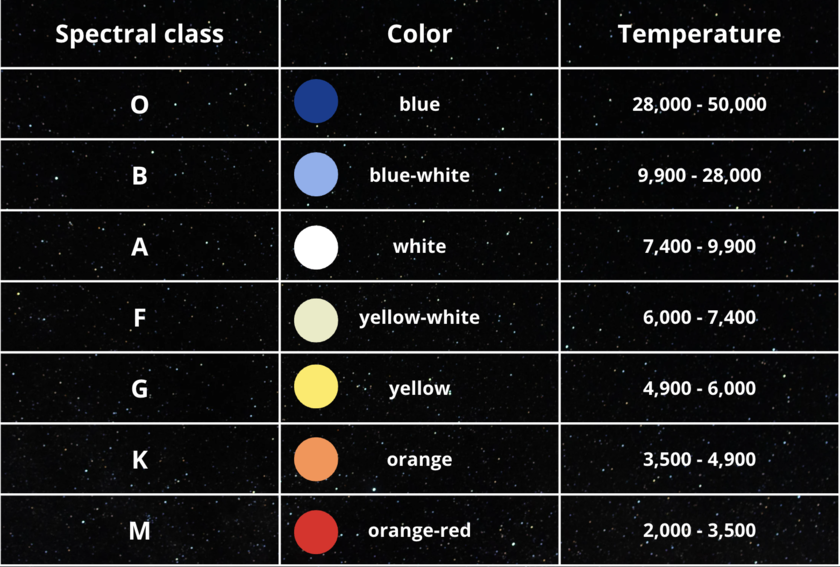
Once the data is processed, classification algorithms come into play. These software routines compare observed stellar spectra and photometric measurements against theoretical models and empirical databases of known star types. Pioneering astronomers developed the Harvard Spectral Classification system (O, B, A, F, G, K, M) based on spectral lines, which directly correlates to temperature. O-type stars are the hottest (blue), M-type stars are the coolest (red), with a smooth progression in between.
Modern software uses sophisticated algorithms to automatically classify stars based on their full spectral profiles, beyond just a few key absorption lines. Machine learning techniques, particularly supervised learning, are trained on vast datasets of well-characterized stars to accurately assign spectral types and derive precise temperature estimates. These algorithms can also identify peculiar stars, binary systems, or stars in unusual evolutionary stages that deviate from standard classifications. Furthermore, software visualizes these classifications on tools like the Hertzsprung-Russell (HR) diagram, a fundamental plot in astronomy that relates a star’s luminosity to its surface temperature (or spectral type), providing a powerful graphical representation of stellar evolution and characteristics.
AI and Machine Learning in Stellar Research
The deluge of astronomical data from modern observatories has opened new frontiers for artificial intelligence and machine learning. AI tools are no longer just aids but integral components in accelerating discovery and extracting subtle patterns that might elude human analysis.
Automated Spectral Analysis
One of the most impactful applications of AI in understanding stellar temperatures is automated spectral analysis. Traditional spectral classification can be time-consuming and relies on expert interpretation. AI algorithms, particularly deep learning models like Convolutional Neural Networks (CNNs), can be trained on massive libraries of stellar spectra to automatically classify stars, determine their spectral type, and derive parameters like temperature, surface gravity, and metallicity with high accuracy and speed. These models can process millions of stellar spectra from surveys like SDSS (Sloan Digital Sky Survey) or Gaia, identifying subtle features and variations indicative of different temperatures and stellar characteristics far more efficiently than human experts. This automated approach is crucial for handling the unprecedented data rates from new observatories and enabling large-scale population studies.
Predictive Modeling of Stellar Evolution
Beyond classification, machine learning excels at predictive modeling. Astrophysicists use AI to simulate the complex processes of stellar evolution, predicting how a star’s temperature, luminosity, and chemical composition will change over its lifetime. By feeding observational data into these models, AI can refine theoretical predictions, identify discrepancies, and even uncover entirely new physical processes. For instance, ML models can predict the surface temperature of a star given its mass, age, and metallicity, or conversely, infer these properties from observed temperatures. These predictive capabilities are essential for understanding the lifecycle of stars, from their birth in nebulae to their eventual demise as white dwarfs, neutron stars, or black holes, with temperature being a constant, crucial parameter throughout.
Future Tech Trends in Stellar Observation
The quest to understand stars, including their temperatures, is an ongoing journey propelled by continuous technological innovation. The next generation of astronomical instruments and computational paradigms promises even deeper insights.
Next-Generation Telescopes and Instrumentation
Future observatories will push the boundaries of sensitivity, resolution, and spectral coverage. The James Webb Space Telescope (JWST) is already providing unprecedented infrared views, allowing us to probe through cosmic dust to observe cooler, earlier stars and processes. Upcoming ground-based mega-telescopes like the Extremely Large Telescope (ELT), the Thirty Meter Telescope (TMT), and the Giant Magellan Telescope (GMT) will feature primary mirrors orders of magnitude larger than current instruments. These behemoths will be equipped with highly advanced adaptive optics systems and cutting-edge spectrographs and imagers, enabling the study of stars in distant galaxies with exquisite detail and sensitivity. Their sheer light-gathering power and resolution will allow us to measure the temperatures of fainter, more distant, and more exotic stars, extending our understanding to the very edges of the observable universe.
Quantum Computing and Big Data Astronomy
Looking further ahead, quantum computing holds the potential to revolutionize astronomical data analysis. While still in its nascent stages, quantum algorithms could process massive datasets from future sky surveys orders of magnitude faster than classical supercomputers. This could unlock capabilities for real-time analysis of transient stellar phenomena, more accurate simulations of stellar interiors and atmospheres, and deeper insights into the complex physics governing stellar temperatures. Furthermore, the explosion of “Big Data” in astronomy demands advanced distributed computing architectures and cloud-based platforms to store, manage, and analyze information. Innovations in data storage, transfer protocols, and secure cloud environments will be critical infrastructure for the next era of stellar discovery, allowing global collaborations to seamlessly share and process petabytes of information to solve the universe’s biggest mysteries, including what makes some stars burn hotter than others.
In conclusion, the simple question “what color of stars are the hottest?” opens a window into the complex interplay of physics and technology. Blue stars, by virtue of their immense mass and rapid nuclear fusion, burn at the highest temperatures. Our ability to confidently state this fact, and to continue refining our understanding of stellar thermal properties, is a direct result of relentless innovation in telescope design, sensor technology, data science, and artificial intelligence. These technological advancements not only answer fundamental questions but also continuously inspire new ones, propelling humanity’s endless fascination with the luminous celestial spheres.
aViewFromTheCave is a participant in the Amazon Services LLC Associates Program, an affiliate advertising program designed to provide a means for sites to earn advertising fees by advertising and linking to Amazon.com. Amazon, the Amazon logo, AmazonSupply, and the AmazonSupply logo are trademarks of Amazon.com, Inc. or its affiliates. As an Amazon Associate we earn affiliate commissions from qualifying purchases.