
For decades, the appearance of Pluto was a matter of artistic impression and low-resolution speculation. Before 2015, the best images available to the scientific community were captured by the Hubble Space Telescope, rendering the distant world as a pixelated smudge of grays and muted oranges. The question of “what color is Pluto” was not merely a curiosity for schoolchildren but a significant technical challenge for astrophysicists and engineers. The answer eventually arrived not through a standard camera lens, but through a sophisticated suite of remote sensing technologies, data processing algorithms, and deep-space communication hardware.
Pluto is not a uniform gray rock, nor is it a simple icy white sphere. It is a complex, multi-hued world featuring a palette of reddish-browns, pale creams, and stark whites. Understanding these colors requires a deep dive into the technology that captured them and the digital reconstruction processes that translate raw data from the edge of our solar system into the high-definition images we see today.
The Technological Evolution of Celestial Observation
To understand how we determined Pluto’s color, we must first look at the hardware limitations that preceded the New Horizons mission. Until the mid-2010s, our digital security and imaging technologies were far ahead of our ability to physically reach the Kuiper Belt. Hubble, while revolutionary, operated from Earth’s orbit, thousands of millions of miles away from the target.
From Pixelated Blobs to High-Definition Clarity
The early digital images of Pluto were composed of just a few dozen pixels. Scientists used “sub-pixel” dithering—a software technique where multiple shots are offset by fractions of a pixel—to sharpen the image. This allowed for the identification of bright and dark patches, but it could not provide “true color.” The transition from these rudimentary digital footprints to the 2015 flyby represented a massive leap in imaging software and sensor sensitivity.
The New Horizons Payload: RALPH and LORRI
The primary “eyes” of the New Horizons spacecraft were two specific instruments: the Long Range Reconnaissance Imager (LORRI) and Ralph. LORRI is essentially a digital telescope consisting of a 20.8-centimeter aperture that focuses light onto a charge-coupled device (CCD). It was designed for high-resolution, black-and-white mapping.
Ralph, on the other hand, is the color specialist. It consists of the Multispectral Visible Imaging Camera (MVIC) and the Linear Etalon Imaging Spectral Array (LEISA). Unlike a consumer-grade DSLR that uses a Bayer filter to capture color in a single shot, Ralph uses specific filters to capture data in different wavelengths—including near-infrared. The “color” of Pluto is a composite product of these two gadgets working in tandem: LORRI provides the sharp texture, while Ralph provides the chromatic data.
Spectral Analysis and the Science of True Color
When we ask about the color of a planet, we are essentially asking about the reflectance of its surface materials. On Pluto, this is a complex chemical story told through spectral analysis. The “redness” of Pluto is not caused by iron oxide, like Mars, but by a much more complex organic process involving methane and nitrogen.
The Multispectral Visible Imaging Camera (MVIC)
The MVIC instrument on Ralph captures light in four specific bands: blue, red, near-infrared, and a narrow methane band. By analyzing the intensity of light reflected in these specific channels, scientists can reconstruct what the human eye would see if it were floating alongside the spacecraft. This process is similar to how high-end photo editing software reconstructs “True Tone” displays, but it operates on a scale of raw electromagnetic data.
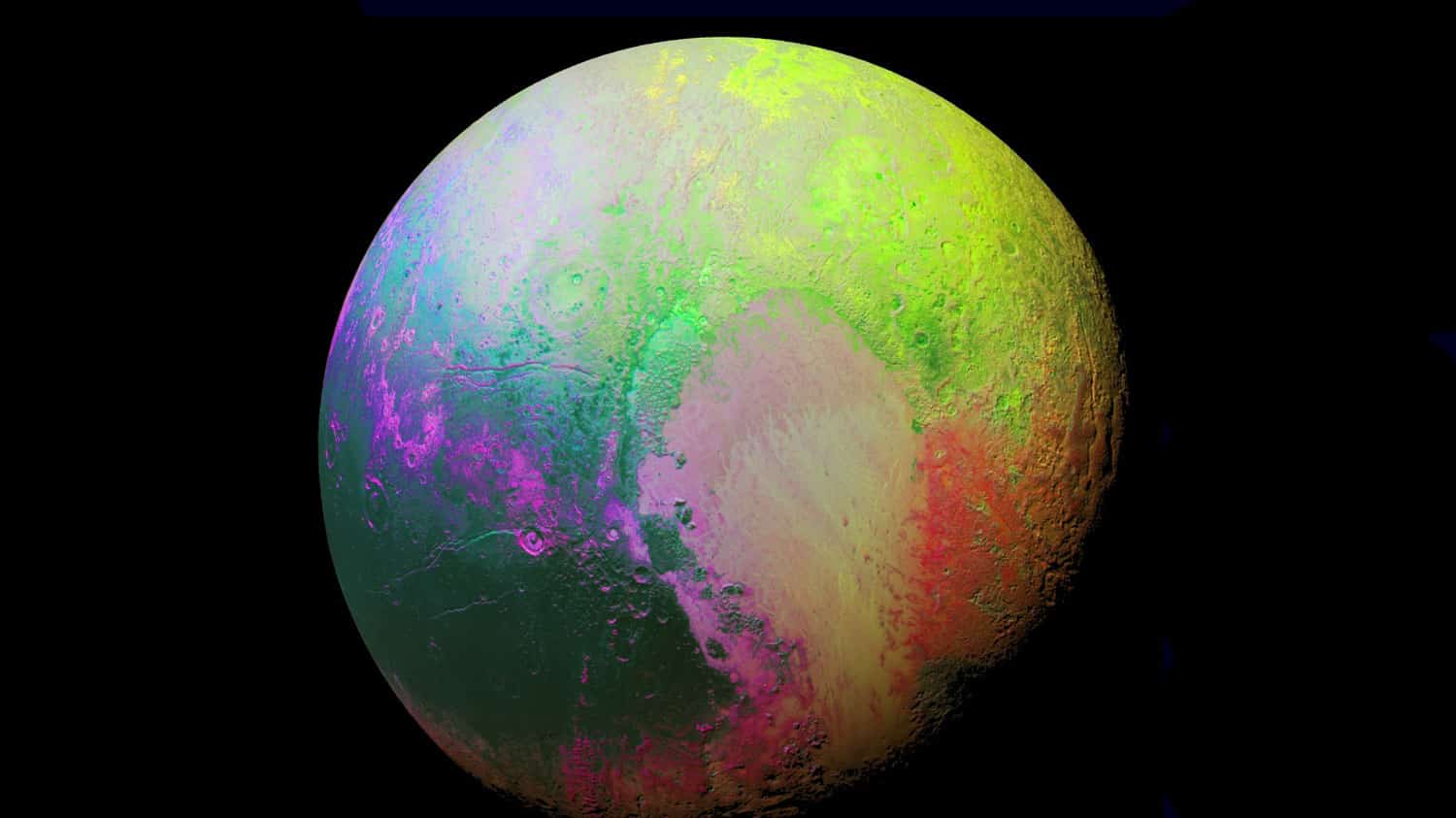
The “true color” of Pluto is often described as a pale, creamy tan with significant regions of dark, reddish-brown. The most iconic feature, the heart-shaped Tombaugh Regio, is a brilliant white. This color variation is a direct result of the surface’s chemical composition.
The Chemical Composition of Pluto’s Palette: Tholins
The dominant reddish-brown hue is caused by tholins. These are complex organic molecules formed when ultraviolet light and cosmic rays strike methane and nitrogen in Pluto’s atmosphere or on its surface. From a digital imaging perspective, capturing tholins is difficult because they reflect light primarily in the red and infrared spectrum.

Without the infrared sensors on New Horizons, Pluto might have appeared much flatter and more monochromatic. The technology allowed us to see that the “dark” areas are actually “red” areas. This distinction is vital for understanding the planet’s weather patterns and geological activity.
Computational Photography and Data Reconstruction
One of the greatest triumphs of the New Horizons mission was not just the hardware, but the software used to transmit and process the data. Pluto is roughly 3 billion miles away, creating a significant digital security and transmission challenge.
Stacking and Stitching: Processing Billions of Miles of Data
The spacecraft did not send back a single “JPEG” of Pluto. Instead, it sent back thousands of narrow strips of data and spectral readings. Back on Earth, NASA engineers used sophisticated image-stitching software to align these strips. Because the spacecraft was moving at over 30,000 miles per hour, each frame had to be corrected for “motion blur” and perspective shifts using computational geometry algorithms.
This process is similar to the panoramic stitching features found in modern smartphone apps, but with a much higher requirement for precision. Any error in the software alignment would result in a “ghosting” effect that could lead to false scientific conclusions about the planet’s topography.
Overcoming Low-Light Environments
At Pluto’s distance, the sun is 1,000 times dimmer than it is on Earth. This creates a low-light environment that would make traditional photography nearly impossible. The sensors on New Horizons had to be incredibly sensitive, utilizing long exposure times and advanced noise-reduction algorithms to distinguish the planet’s surface from the background “noise” of deep space. Digital signal processing (DSP) played a crucial role here, filtering out cosmic ray interference that would otherwise pepper the images with white artifacts.
The Role of Artificial Intelligence and Machine Learning in Modern Astronomy
While the initial images of Pluto were processed using traditional algorithmic methods, the ongoing analysis of Pluto’s surface and its moon, Charon, increasingly relies on Artificial Intelligence (AI) and Machine Learning (ML).
Enhancing Resolution through Deep Learning
As we move further into the decade, data scientists are applying Super-Resolution (SR) neural networks to the original New Horizons datasets. These AI tools are trained on high-resolution imagery of Earth and Mars to recognize patterns in shadows and textures. By applying these models to the Pluto data, researchers can “upscale” the images, revealing finer details in the nitrogen ice plains and craggy mountains that were previously hidden in the grain of the original sensor data.
Predictive Modeling of Surface Dynamics
AI is also being used to model how Pluto’s color might change over time. By feeding color data and atmospheric composition into predictive models, scientists can simulate how the reddish tholins migrate across the surface during Pluto’s 248-year orbit. This digital “time-lapse” allows us to understand the dwarf planet as a living, changing system rather than a static photo.
The Future of Space Imaging Technology
The quest to define the color of Pluto has pushed the boundaries of what is possible in remote sensing and digital communication. The lessons learned from the Ralph and LORRI instruments are now being applied to the next generation of space gadgets, such as those aboard the James Webb Space Telescope (JWST) and upcoming missions to the moons of Jupiter and Saturn.
Future missions will likely utilize “on-board” AI, allowing the spacecraft to decide which images are the most scientifically valuable to send back first. Given the low bandwidth of deep-space communication (often slower than 1990s dial-up speeds), this software-driven prioritization is essential.
In conclusion, Pluto is a world of surprising vibrancy. Its color—a mix of nitrogen-white, methane-cream, and tholin-red—is a testament to the power of modern technology. We no longer have to rely on the limited capabilities of the human eye; instead, we use a sophisticated stack of hardware sensors, data transmission protocols, and AI-driven processing to bring the edge of our solar system into sharp, colorful focus. The color of Pluto is not just a visual fact; it is a digital achievement.
aViewFromTheCave is a participant in the Amazon Services LLC Associates Program, an affiliate advertising program designed to provide a means for sites to earn advertising fees by advertising and linking to Amazon.com. Amazon, the Amazon logo, AmazonSupply, and the AmazonSupply logo are trademarks of Amazon.com, Inc. or its affiliates. As an Amazon Associate we earn affiliate commissions from qualifying purchases.