
The mesmerising dance of flames, from the gentle flicker of a candle to the roaring inferno of a furnace, has captivated humanity for millennia. Beyond its aesthetic appeal, fire is a fundamental force, harnessed for everything from cooking to industrial processes. A common, yet often misunderstood, aspect of fire is its colour. The question “What color fire is the hottest?” is more than just a curiosity; it’s a gateway to understanding the physics of combustion and has significant implications in various technological fields. This article delves into the science behind flame colouration, the relationship between colour and temperature, and how this knowledge is applied in cutting-edge technologies.

The Physics of Flame Colour: From Incandescence to Emission
The colour of a flame is a direct visual indicator of the temperature and composition of the burning material. It’s not a simple case of one colour always being hotter than another, but rather a complex interplay of physical phenomena. Understanding these phenomena is crucial for accurately interpreting flame behaviour and harnessing its energy efficiently and safely.
Incandescence: The Glow of Heated Particles
The most prominent contributor to flame colour, especially in common fires like wood or gas, is incandescence. This is the phenomenon where matter emits light when it is heated to a high temperature. Think of a blacksmith heating a piece of metal until it glows red, then orange, yellow, and eventually white. The same principle applies to flames.
When organic materials, such as wood or hydrocarbons, burn, they produce tiny solid particles, primarily soot (carbon). These soot particles are heated to incredibly high temperatures within the flame. As they get hotter, they emit electromagnetic radiation across a spectrum of wavelengths. Our eyes perceive this emitted light as colour.
- Lower Temperatures (Around 400-600°C): At these temperatures, the soot particles emit primarily in the red and infrared parts of the spectrum. This results in a dull red glow. This is the colour we often associate with dying embers or very low-temperature fires.
- Medium Temperatures (Around 700-1000°C): As the temperature increases, the emitted radiation shifts towards longer wavelengths. The soot particles now glow orange and then yellow. This is the typical colour of a common campfire or a gas stove flame. The brighter the yellow, generally the hotter the flame.
- High Temperatures (Above 1100°C): At the highest temperatures, the emitted radiation extends into the blue and even ultraviolet parts of the spectrum. While the human eye perceives the combination of all these colours as white, a truly white-hot object is emitting a very broad spectrum of light. Extremely hot flames, like those from a Bunsen burner with the air hole fully open, can appear white or even bluish-white.
It’s important to note that incandescence is most prominent in flames containing solid particles, such as soot. Flames that burn very cleanly, with minimal soot production, will exhibit different colour characteristics.
Emission Spectroscopy: The Fingerprint of Chemical Elements
While incandescence explains the glowing of hot particles, another crucial factor in flame colour, particularly for specific gases or elements, is emission spectroscopy. This phenomenon occurs when atoms or molecules are excited by the heat of combustion and then return to their lower energy states by emitting photons of specific wavelengths, corresponding to their characteristic spectral lines.
- Pure Gas Flames: For example, when methane (natural gas) burns cleanly, it produces a blue flame. This blue colour is not due to soot incandescence but rather to the emission of light by excited molecules like CH (methylidyne) and C2 (dicarbon) radicals formed during the combustion process. These molecules emit strongly in the blue and violet parts of the spectrum.
- Element-Specific Colours: When certain metal salts are introduced into a flame, they can produce vibrant and distinct colours. This is the principle behind fireworks and flame tests in chemistry labs. For instance:
- Sodium: Produces an intense yellow flame.
- Potassium: Produces a lilac or pale purple flame.
- Lithium: Produces a bright red flame.
- Copper: Can produce blue or green flames depending on the compound.
- Strontium: Produces a brilliant red.
These colours are determined by the unique electron configurations of the specific elements, and their emission spectra are like a chemical fingerprint. While these element-specific colours can indicate the presence of certain substances, they don’t necessarily correlate with the hottest temperature of the flame in the same way as soot incandescence does. A vibrant red lithium flame, for example, is not hotter than a clean blue gas flame.
Correlating Colour with Temperature: A Visual Guide to Heat
The relationship between flame colour and temperature is not always straightforward and can be influenced by a multitude of factors, including the fuel source, the amount of oxygen available, and the presence of impurities. However, for common combustion processes, a general colour-temperature correlation can be established, providing a valuable visual tool for estimation.
The Spectrum of Heat: From Red to White-Blue
As discussed earlier, the most common and readily observable colour-temperature gradient is seen in flames rich in incandescent soot particles.
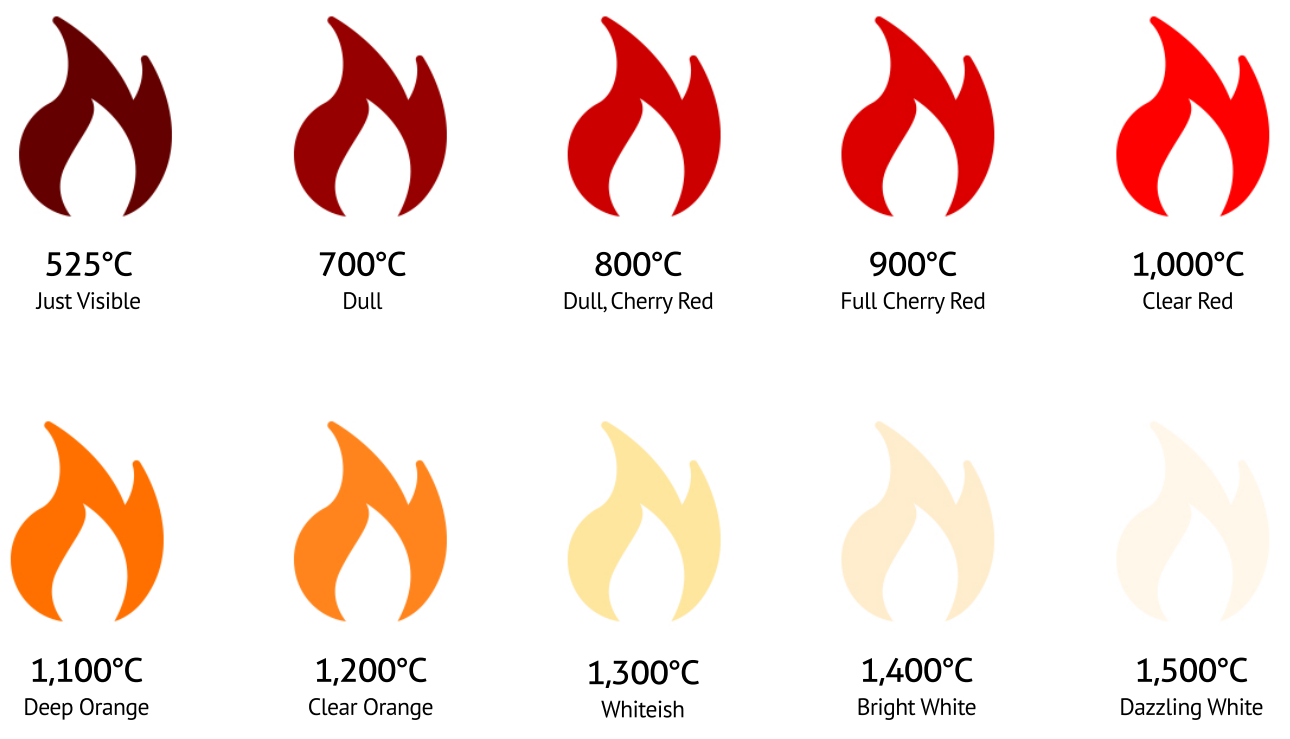
- Red (Dull to Bright): This typically indicates temperatures ranging from approximately 400°C to 600°C. The red colour signifies that the emitted light is primarily in the longer wavelengths of the visible spectrum.
- Orange: As the temperature rises to around 600°C to 800°C, the flame takes on an orange hue. This suggests an increase in the intensity of emitted light across a broader range of wavelengths, with a significant contribution from orange light.
- Yellow: A bright yellow flame, often seen in wood fires or standard gas flames, indicates temperatures between roughly 800°C and 1100°C. The yellow colour is a result of intense incandescence from soot particles, with a good distribution of emitted light.
- White: White flames are indicative of very high temperatures, typically exceeding 1100°C, and can reach well over 1500°C. A truly white flame suggests that the incandescent particles are emitting across a significant portion of the visible spectrum, appearing white to our eyes. This is often seen in welding arcs or industrial furnaces.
- Blue and Blue-White: Pure blue flames, as seen in a well-adjusted Bunsen burner, often indicate efficient combustion of gases with minimal soot. While they appear cooler than a bright yellow or white flame, the gas itself can be extremely hot, often reaching temperatures of 1000°C to 1500°C or even higher, depending on the gas and oxygen supply. The blue is due to molecular emission rather than soot incandescence. A blue-white flame indicates exceptionally high temperatures.
It is crucial to remember that this is a generalization. Factors like the specific fuel composition and the availability of oxygen can significantly alter the observed colour for a given temperature. For instance, a fuel with high soot-producing potential might appear yellow even if it’s not as hot as a clean blue flame from a different fuel. Conversely, a lean flame (with excess oxygen) can burn hotter and with less visible soot, potentially appearing bluer than a fuel-rich flame of the same temperature.
The Impact of Oxygen: Fueling the Heat
The availability of oxygen (or another oxidizer) plays a paramount role in the temperature of a flame. Combustion is an exothermic chemical reaction that releases energy in the form of heat and light. The more efficient the reaction, the more energy is released.
- Fuel-Rich Flames: In a fuel-rich environment, there isn’t enough oxygen to completely burn all the fuel. This leads to incomplete combustion, the formation of soot particles, and a less efficient release of energy. These flames tend to be larger, less intense, and often appear yellow or orange due to the glowing soot.
- Stoichiometric Flames: When the fuel and oxygen are present in the ideal ratio for complete combustion, the flame is most efficient. This typically results in a hotter flame. For hydrocarbon fuels, this can lead to a brighter yellow or even a white flame, depending on the temperature.
- Fuel-Lean Flames (Excess Oxygen): With an excess of oxygen, the combustion process can become even more intense and hotter. In some cases, especially with specific fuels, this can lead to a flame that appears bluer or even invisible if the visible light emission is minimal. Think of a blacksmith’s forge, where a blast of air (oxygen) is crucial for achieving extremely high temperatures.
The presence of impurities can also affect flame colour and temperature. For example, if the fuel contains metallic elements, they can contribute their characteristic emission colours, potentially masking the incandescence colour and making temperature estimation more complex.
Technological Applications: Harnessing Flame Colour for Innovation
The scientific understanding of flame colour and its correlation with temperature is not merely academic; it underpins a wide range of critical technologies and safety protocols across various industries. From ensuring efficient industrial processes to detecting hazardous conditions, the visual cues of fire are invaluable.
Industrial Combustion Control and Monitoring
In industries that rely heavily on combustion, such as power generation, metallurgy, and chemical processing, precise control of flame temperature is paramount for efficiency, product quality, and safety.
- Boiler and Furnace Optimization: Operators in power plants and industrial furnaces often use visual inspection of flame colour as a primary indicator of combustion efficiency. A flame that is too yellow might indicate incomplete combustion and wasted fuel, while a flame that is too lean might suggest the risk of flame instability or overheating. Adjusting fuel and air intake based on observed flame colour helps to achieve optimal burn rates, maximizing energy output and minimizing emissions. Modern systems often incorporate optical pyrometers and spectrometers to provide more precise temperature measurements, but visual cues remain a crucial part of operator training and initial assessment.
- Metalworking and Welding: In processes like welding, the colour of the arc and the molten metal is a direct indicator of temperature. Welders use this visual feedback to control heat input, prevent material defects, and ensure the integrity of the weld. Different welding processes utilize different flame colours, from the bright white arc of TIG welding to the yellow-orange hues of some gas welding.
- Process Safety: Understanding flame colour is vital for detecting abnormal combustion events. For instance, a sudden shift to a yellow or orange flame in a normally blue gas flame could indicate a problem with the fuel-air mixture or a malfunction in the burner, prompting immediate investigation and intervention to prevent potential hazards like explosions or fires.
Advanced Materials and Energy Technologies
The quest for higher temperatures and more efficient energy conversion has led to technologies that leverage or meticulously control flame characteristics.
- Plasma Technologies: Plasma, often described as the fourth state of matter, is essentially an extremely hot, ionized gas. The colour of a plasma discharge can provide insights into its temperature and composition, ranging from the brilliant white of plasma torches used for cutting and spraying materials to the specific colours emitted by plasma used in lighting or research. Understanding the emission spectra of plasma is crucial for controlling its properties and applications.
- Laser Technology: While not directly flame colour, the principles of light emission from excited states are fundamental to laser technology. Lasers emit coherent light at specific wavelengths, which are determined by the material and the excitation mechanism, much like element-specific colours in flames. The precise control of light emission is key to laser applications in communication, manufacturing, and medicine.
- Combustion Engines: While not directly observed by the driver, the combustion process within an internal combustion engine is a complex interplay of flame colours and temperatures. Advanced engine management systems aim to optimize this process for fuel efficiency and reduced emissions, and understanding the underlying physics of combustion, including flame behaviour, is critical for their design and calibration.

Forensic Science and Fire Investigation
In the unfortunate event of a fire, understanding the visual characteristics of flames can provide crucial clues for investigators.
- Origin and Cause Determination: The colour and intensity of residual char, soot patterns, and melted materials can help investigators determine the origin and potential cause of a fire. For example, a prolonged period of a very hot, white flame might indicate the presence of accelerants or a specific type of fuel that burned with extreme intensity.
- Material Identification: The specific colours produced when certain materials burn can sometimes aid in identifying what was involved in the fire, even after the event. While not as precise as laboratory analysis, these visual cues can guide further investigation.
In conclusion, the seemingly simple question of “what color fire is the hottest?” opens a window into the sophisticated physics of combustion. From the incandescent glow of soot particles to the spectral fingerprints of excited atoms, flame colour is a powerful visual diagnostic tool. This understanding is not just for admiring a campfire; it is a cornerstone for optimizing industrial processes, developing advanced energy technologies, and ensuring safety in countless applications, making the science of flame colour a vital component of modern technological innovation.
aViewFromTheCave is a participant in the Amazon Services LLC Associates Program, an affiliate advertising program designed to provide a means for sites to earn advertising fees by advertising and linking to Amazon.com. Amazon, the Amazon logo, AmazonSupply, and the AmazonSupply logo are trademarks of Amazon.com, Inc. or its affiliates. As an Amazon Associate we earn affiliate commissions from qualifying purchases.