
To the casual observer standing on a tropical pier, a sea turtle might appear as a fleeting, dark silhouette against the turquoise expanse of the Caribbean. To a marine biologist equipped with a multispectral camera, however, that same turtle is a complex map of spectral signatures, ranging from deep olive drabs and amber scutes to the bio-fluorescent glows visible only under specific ultraviolet wavelengths. The question of what color sea turtles are is no longer merely a matter of visual description; it has become a sophisticated data point in the realms of marine technology, computer vision, and ecological surveillance.

In the modern technological landscape, identifying the true coloration of these ancient mariners involves overcoming the physical limitations of light transmission in water and leveraging the power of machine learning. Understanding the hues of the seven extant species—Green, Loggerhead, Kemp’s Ridley, Olive Ridley, Hawksbill, Flatback, and Leatherback—requires a deep dive into the intersection of hardware engineering and biological data science.
The Optics of the Ocean: How Underwater Imaging Redefines Our Perception
The primary challenge in determining the “true” color of a sea turtle is the medium of the ocean itself. Water acts as a powerful filter, selectively absorbing longer wavelengths of light (reds and oranges) while scattering shorter wavelengths (blues and greens). To a diver at thirty feet, a Green sea turtle may look monochromatic grey or brown because the red light necessary to reveal its warmer tones has been filtered out.
Spectral Correction and Image Processing
To solve this, marine tech developers have created advanced color-correction algorithms. Using “Sea-thru” technology—a computational method developed by oceanographers and software engineers—researchers can now “remove” the water from underwater images. This process involves physically modeling the light attenuation and backscatter for every pixel in a frame. When these algorithms are applied, the true pigmentation of the sea turtle is revealed: the vibrant, radiating patterns of the Hawksbill’s amber and mahogany shell or the subtle, pinkish-grey undertones of a Leatherback’s skin.
Hyperspectral Imaging in Marine Research
Beyond standard RGB (Red, Green, Blue) cameras, scientists are increasingly deploying hyperspectral sensors. These tools capture hundreds of narrow wavelength bands, reaching into the ultraviolet and infrared spectrums. This technology allows researchers to differentiate between species based on “spectral fingerprints” that are invisible to the human eye. For instance, the Olive Ridley’s carapace has a distinct spectral reflectance that can be used to track individual health, as changes in shell color—often caused by epibionts (organisms like barnacles) or disease—can be detected by AI long before they are visible to a human observer.
Machine Learning and Computer Vision: Turning Patterns into Data
The unique coloration and patterns on a sea turtle’s face and shell are as distinct as a human fingerprint. In the tech sector, this has led to the development of sophisticated biometric software designed for non-invasive tracking. The “color” of a turtle is essentially a biological barcode that machine learning algorithms can now read with over 95% accuracy.
Convolutional Neural Networks (CNNs) for Shell Identification
Software platforms like HotSpotter and various bespoke CNN-based applications are trained to recognize the specific geometric arrangements of scutes (the plates on a shell) and the unique color gradients within them. By analyzing high-resolution digital photographs, these AI tools can identify individual turtles across years of sightings. This eliminates the need for physical tagging, which can be invasive. The “color” data extracted—such as the specific ratio of black to yellow pigment in a Hawksbill’s shell—serves as a primary key in global databases, enabling real-time population monitoring.
Automated Species Classification
Deep learning models are also being used to classify species in low-visibility environments. By training models on thousands of images of different sea turtle species under varying light conditions, AI can identify a Kemp’s Ridley (typically a pale grey-green) versus a Loggerhead (reddish-brown) even when the video feed is grainy or obscured by silt. This technological capability is crucial for “smart” fishing gear and autonomous underwater vehicles (AUVs) that need to detect and avoid turtles in industrial shipping lanes or during dredging operations.
Bio-Photonic Engineering: Learning from the Leatherback’s Palette
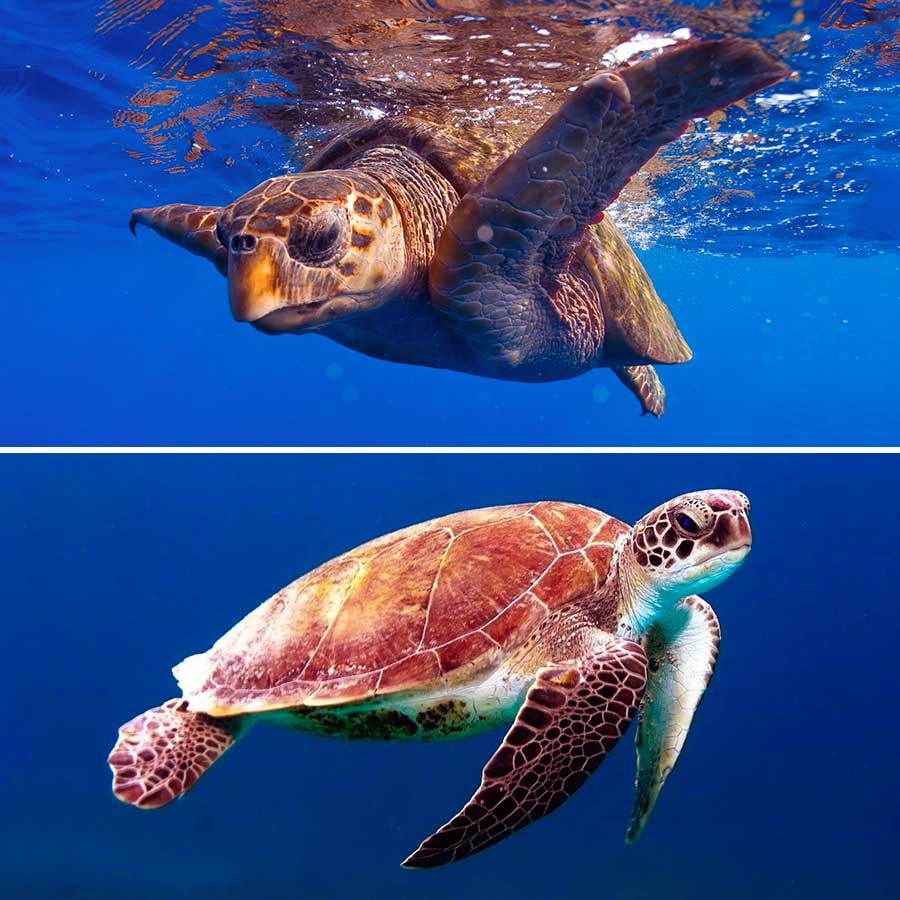
The coloration of sea turtles is not merely for aesthetics; it is a masterclass in evolutionary engineering. The tech industry is currently looking toward these biological traits to innovate in the fields of material science and camouflage technology.
Structural Color vs. Pigmentation
Unlike many birds or insects that rely on structural color (microscopic surfaces that reflect light), sea turtle color is primarily derived from melanin and diet-based pigments. However, the Leatherback turtle presents a unique case. It is the only sea turtle without a hard shell, possessing a leathery skin that is dark grey to black with white spotting. This coloration is a functional thermal tech: the dark pigment absorbs solar radiation when the turtle surfaces, helping a cold-blooded animal maintain its body temperature in frigid, deep-ocean dives. Engineers are studying these thermoregulatory properties to develop more efficient solar-absorbing materials and coatings for marine equipment.
Countershading and Stealth Tech
Sea turtles utilize “countershading”—a dark dorsal (top) side and a light ventral (bottom) side. This is a natural form of stealth technology. From above, the dark shell blends with the deep ocean; from below, the light underside blends with the sunlit surface. This concept is being mimicked in the design of AUVs and surveillance drones. By applying bio-inspired gradient coatings to underwater hardware, tech firms can reduce the visual signature of their equipment, allowing for more naturalistic observation of marine life without triggering flight responses in the animals being studied.
Satellite Remote Sensing and the Infrastructure of Conservation Tech
To truly answer “what color are sea turtles” on a global scale, we must look from the sky. Satellite technology has revolutionized our ability to monitor nesting beaches and migration corridors, using color-based data to protect habitats.
LiDAR and Thermal Mapping
Modern conservation efforts employ LiDAR (Light Detection and Ranging) and thermal imaging to map nesting sites. While we perceive the turtles as green or brown, thermal sensors “see” them as heat signatures against the cooler sand. In the Kemp’s Ridley—the most endangered sea turtle—nesting often occurs in “arribadas” (mass arrivals). Using high-resolution satellite imagery, AI can detect the color contrast between the pale sand and the dark shells of thousands of turtles, providing accurate counts that were previously impossible to obtain manually.
IoT and Smart Tags
The “color” of a turtle’s journey is tracked via the Internet of Things (IoT). Advanced GPS tags attached to the carapace collect data on water temperature, depth, and light levels. These sensors help researchers understand how light (and therefore color) changes as a turtle moves through different ecological zones. This data is transmitted via the Argos satellite system, creating a digital twin of the turtle’s movement. This allows tech-driven conservation groups to create “dynamic protected areas,” where shipping lanes are temporarily shifted based on the real-time location data of these tracked individuals.
The Role of VR and AR in Public Engagement and Marine Data Visualization
The final frontier of turtle coloration lies in how we communicate this data to the world. Virtual Reality (VR) and Augmented Reality (AR) are being used to translate complex spectral data into immersive educational experiences.
Digital Twins and Immersive Learning
By using 3D scanning and photogrammetry, tech companies are creating “digital twins” of sea turtles. These models capture the exact color and texture of an individual animal with sub-millimeter precision. In VR environments, users can examine a Green sea turtle and see the vibrant green fat (from which the species gets its name) rendered through transparent anatomical overlays. This level of detail, powered by high-end GPUs and real-time rendering engines, fosters a deeper connection between the public and marine conservation.

AR for Field Research
Field researchers are beginning to use AR glasses that overlay data onto their field of vision. When looking at a turtle on a beach, the AR system can highlight specific scute patterns, identify the species, and even estimate the age based on color saturation and shell wear. This integration of computer vision and wearable tech represents the future of field biology, where the “color” of the animal is instantly translated into a comprehensive biographical profile.
Through the lens of modern technology, the question “what color are sea turtles?” opens a door to a vast ecosystem of innovation. From the AI that recognizes their faces to the satellites that track their shadows across the globe, our ability to perceive and protect these creatures is fundamentally tied to our mastery of light, data, and digital interpretation. As imaging tech continues to evolve, our understanding of the sea turtle’s palette will only grow more vivid, transforming biological beauty into actionable conservation intelligence.
aViewFromTheCave is a participant in the Amazon Services LLC Associates Program, an affiliate advertising program designed to provide a means for sites to earn advertising fees by advertising and linking to Amazon.com. Amazon, the Amazon logo, AmazonSupply, and the AmazonSupply logo are trademarks of Amazon.com, Inc. or its affiliates. As an Amazon Associate we earn affiliate commissions from qualifying purchases.