
In the rapidly evolving landscape of distributed ledger technology, newcomers often ask a fundamental question: “What chain is Cardano on?” To the uninitiated, it might seem like a token that exists on a parent network, similar to how thousands of assets reside on the Ethereum or Solana blockchains. However, the answer is foundational to understanding the ecosystem: Cardano is its own independent, third-generation Layer 1 blockchain. It does not run on another network; it is the infrastructure itself.
Unlike tokens that are built using the ERC-20 standard on Ethereum, Cardano was built from the ground up using a unique dual-layer architecture and a peer-reviewed development methodology. To understand the “chain” that Cardano operates on, one must look into the sophisticated engineering that separates it from its predecessors, Bitcoin and Ethereum, focusing on its consensus mechanism, its programming languages, and its multi-layered approach to data processing.

The Dual-Layer Architecture: CSL and CCL
One of the most significant technical distinctions of the Cardano blockchain is its separation of the ledger’s value from its logic. While most blockchains handle transactions and smart contract executions on a single layer, Cardano utilizes a bifurcated structure consisting of the Cardano Settlement Layer (CSL) and the Cardano Computation Layer (CCL).
The Cardano Settlement Layer (CSL)
The CSL acts as the balance sheet of the network. This is the “chain” in its most literal sense—where the native currency, ADA, is moved from one address to another. By dedicating a specific layer solely to settlements, Cardano ensures that the basic movement of value remains fast, secure, and uncluttered by the heavy data requirements of complex smart contracts. This layer utilizes an Extended Unspent Transaction Output (EUTXO) model, which is an evolution of the model used by Bitcoin. The EUTXO model allows for greater parallelism in transaction processing and provides a more predictable environment for fees and execution outcomes.
The Cardano Computation Layer (CCL)
While the CSL handles the “who” and “how much,” the CCL handles the “why.” This is where the smart contract logic resides. By separating the computation layer from the settlement layer, Cardano offers a level of flexibility that is rare in the blockchain space. If a specific industry requires a different set of rules for its smart contracts—such as specific regulatory compliance or a different programming language—the CCL can be adjusted without compromising the security or integrity of the base settlement layer. This modularity is a core component of Cardano’s long-term technical sustainability.
Ouroboros: The Scientific Approach to Consensus
At the heart of the Cardano chain is Ouroboros, the first Proof-of-Stake (PoS) protocol proven to be mathematically secure through rigorous peer-reviewed research. In the tech world, consensus is the mechanism by which a decentralized network agrees on the state of the ledger. While Bitcoin uses Proof-of-Work (PoW), which requires massive computational energy, Cardano’s Ouroboros protocol achieves security through a more efficient, stake-based system.
How Ouroboros Ensures Security and Decentralization
Ouroboros divides time into “epochs,” which are further subdivided into “slots.” For every slot, the network elects a slot leader who is responsible for adding a block to the chain. The probability of being elected as a slot leader is proportional to the amount of ADA a node or a stake pool holds. This system eliminates the “arms race” of hardware seen in PoW mining. From a technical standpoint, Ouroboros is designed to be resilient against 51% attacks and other common vectors of exploitation by using a verifiable random function (VRF) to select leaders, ensuring that the selection process is both fair and unpredictable.
Energy Efficiency and Scalability
Because Ouroboros does not require miners to solve complex mathematical puzzles, the Cardano chain operates at a fraction of the energy cost of older blockchains. This efficiency is not just an environmental benefit; it is a technical necessity for scaling. As the network grows, the protocol can implement “Input Endorsers,” a technical upgrade that separates the process of transaction selection from block production. This allows for a much higher throughput of data, positioning Cardano as a high-performance infrastructure capable of supporting global-scale applications.
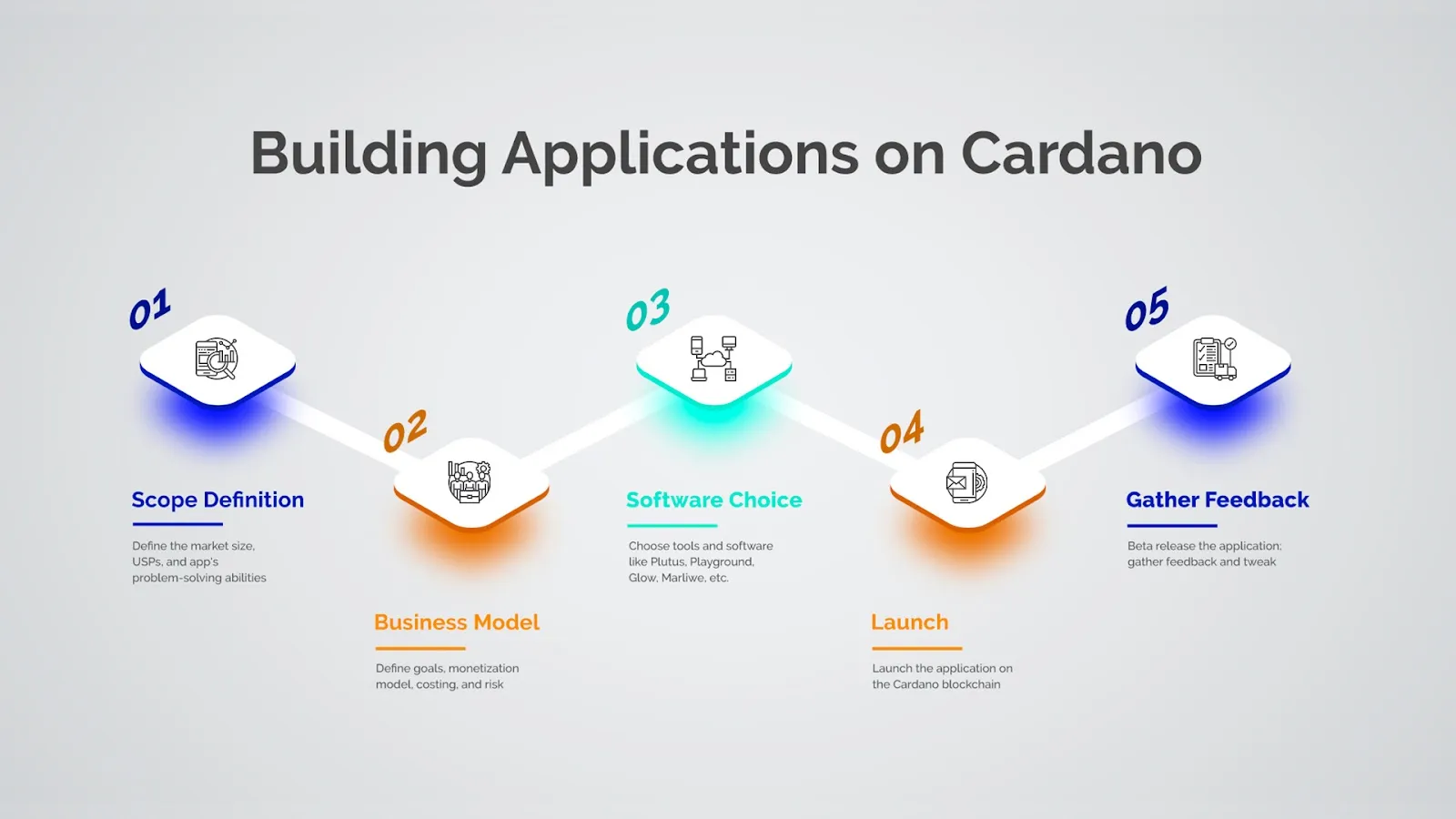
The Evolution of the Chain: A Roadmap of Technical Milestones
Cardano’s development is famously structured into five distinct “eras,” each named after a significant figure in literature or science. This roadmap represents the progressive rollout of technical features that define what the Cardano chain is capable of at any given time.
Shelley and the Shift to Decentralization
The Shelley era was a pivotal technical transition for the Cardano chain. It moved the network from a federated system, where nodes were managed by the founding entities (IOG, Emurgo, and the Cardano Foundation), to a fully decentralized state where the community operates the nodes. This transition involved the implementation of advanced networking protocols that allow thousands of independent stake pools to communicate and reach consensus without a central authority. This makes Cardano one of the most decentralized chains in the industry in terms of block production.
Goguen and the Integration of Smart Contracts
The Goguen era brought smart contract functionality to the Cardano chain through the introduction of Plutus. Plutus is a purpose-built smart contract development platform based on Haskell, a functional programming language known for its high degree of precision and security. Unlike Ethereum’s Solidity, which is an imperative language, Haskell’s functional nature allows developers to mathematically verify that their code will behave exactly as intended. For tech sectors where security is paramount—such as decentralized finance (DeFi) or supply chain management—this technical choice reduces the risk of bugs and exploits that have plagued other chains.
Interoperability, Sidechains, and the Future of the Ecosystem
As the blockchain industry moves toward a multi-chain future, Cardano is not designed to be an isolated silo. The technical roadmap includes extensive work on interoperability and sidechains, which extend the utility of the main Cardano chain without compromising its core security.
Bridging to Other Ecosystems
Cardano utilizes “Sidechain Toolkits” that allow developers to build custom blockchains that are “hooked” into the Cardano mainnet. These sidechains can use different consensus mechanisms or virtual machines (like the Ethereum Virtual Machine or EVM) while relying on the Cardano Settlement Layer for finality and security. This allows for “wrapped” assets and cross-chain communication, effectively making Cardano a “hub” for various technical experiments and niche-specific blockchains.
Midnight and Privacy-Centric Tech
One of the most anticipated technical developments on the Cardano chain is the introduction of Midnight, a data-protection sidechain. Midnight utilizes Zero-Knowledge (ZK) proofs to allow users and companies to share data selectively. In a world where data privacy is becoming a primary tech concern, this sidechain will allow the Cardano ecosystem to handle sensitive information—such as medical records or private financial data—without exposing it on a public ledger. This highlights Cardano’s evolution from a simple value-transfer chain to a comprehensive suite of privacy-preserving technical tools.

Conclusion: A Chain Built for Longevity
When we ask “what chain is Cardano on,” we find that it is on a chain built with a unique “measure twice, cut once” philosophy. Its technical foundation is built on the pillars of functional programming, formal verification, and a layered architecture that separates value from complex logic. By choosing the EUTXO model over the traditional account-based model and Ouroboros over Proof-of-Work, Cardano has positioned itself as a sophisticated piece of digital infrastructure.
From the developer’s perspective, the Cardano chain offers a stable, predictable, and highly secure environment. While it may have a steeper learning curve due to its reliance on Haskell and Plutus, the technical rewards are a network that is inherently more resistant to the “flash crashes” and smart contract vulnerabilities that have affected more hurried projects. As Cardano continues to roll out its scaling solutions like Hydra and its governance framework under the Voltaire era, the chain remains a premier example of how rigorous engineering and academic research can create a robust foundation for the decentralized future.
aViewFromTheCave is a participant in the Amazon Services LLC Associates Program, an affiliate advertising program designed to provide a means for sites to earn advertising fees by advertising and linking to Amazon.com. Amazon, the Amazon logo, AmazonSupply, and the AmazonSupply logo are trademarks of Amazon.com, Inc. or its affiliates. As an Amazon Associate we earn affiliate commissions from qualifying purchases.