
The sky, a canvas of ever-shifting hues, presents one of nature’s most breathtaking spectacles during sunset. As the sun dips below the horizon, a symphony of oranges, reds, purples, and pinks erupts, painting the atmosphere in a way that science can meticulously explain, yet artistry can endlessly marvel at. While the aesthetic is undeniable, the underlying principles that orchestrate this daily masterpiece are rooted in physics, specifically how light interacts with our planet’s atmosphere. Understanding this phenomenon not only deepens our appreciation for the natural world but also offers a fascinating glimpse into the science that underpins visual perception, a concept deeply relevant to the fields of technology, branding, and even how we communicate value.

The Science of Light and Scattering
At its core, the vibrant display of a sunset is a consequence of Rayleigh scattering. This principle, named after the 19th-century British physicist Lord Rayleigh, describes how light interacts with particles much smaller than the wavelength of the light itself. Earth’s atmosphere is comprised of various gases, primarily nitrogen and oxygen molecules, along with trace amounts of other gases and tiny dust particles. These molecules are far smaller than the wavelengths of visible light.
Visible light, as we perceive it, is a spectrum of colors, each with a different wavelength. The order of colors in the visible spectrum, from longest wavelength to shortest, is Red, Orange, Yellow, Green, Blue, Indigo, and Violet (ROYGBIV). Rayleigh scattering dictates that shorter wavelengths of light (blue and violet) are scattered more effectively by these atmospheric particles than longer wavelengths (red and orange).
How Wavelengths Dictate Scattering Intensity
Imagine shining a flashlight through a room filled with microscopic dust motes. If you could control the color of the flashlight beam, you’d notice that a blue beam would seem to spread out and illuminate more of the room’s surfaces than a red beam. This is analogous to what happens in our atmosphere.
When sunlight enters the Earth’s atmosphere, it encounters these tiny molecules. The blue and violet light, with their shorter wavelengths, are scattered in all directions. This is why, during the day, the sky appears blue. The scattered blue light reaches our eyes from all parts of the sky, making it seem as if the entire sky is blue. Violet light, even though scattered more than blue, is less perceptible to the human eye, and the sun emits slightly less violet light to begin with.
The Journey of Sunlight at Sunset
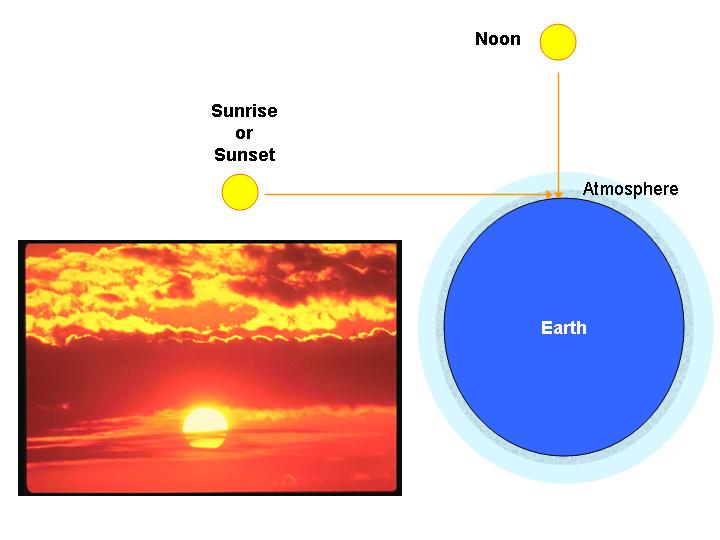
The magic of sunset colors arises from the extended path that sunlight must travel through the atmosphere to reach our eyes. As the sun sets, it is positioned lower on the horizon. This means that its rays have to traverse a significantly greater volume of atmosphere compared to when the sun is directly overhead at noon.
Increased Atmospheric Travel and Wavelength Filtration
With this extended journey comes an amplified effect of Rayleigh scattering. As sunlight travels through this thicker layer of atmosphere, the shorter, bluer wavelengths are scattered away so effectively that they are mostly removed from the direct path of light reaching the observer. By the time the sunlight reaches us, the remaining light has been heavily filtered, leaving behind predominantly the longer wavelengths.
- Blue and Violet: These wavelengths are scattered so profusely that they are essentially filtered out of the direct beam.
- Green and Yellow: These wavelengths are scattered to a lesser extent but still contribute less to the direct light at sunset.
- Orange and Red: These longer wavelengths are scattered the least, meaning they are more likely to survive the atmospheric obstacle course and reach our eyes directly from the setting sun.
This is why sunsets are characterized by warm hues – oranges, reds, and often deep pinks. The longer wavelengths, less susceptible to scattering, are the ones that dominate the light reaching us from the sun as it descends.
The Role of Atmospheric Conditions and Particles
While Rayleigh scattering is the primary driver of sunset colors, other atmospheric conditions and particles can further enhance and diversify the spectacle. The presence of aerosols – larger particles like dust, smoke, and water droplets – can also play a significant role.
- Dust and Smoke: Particles from volcanic eruptions, wildfires, or even industrial pollution can be suspended in the atmosphere. These larger particles are more effective at scattering light across a broader range of wavelengths, including the longer ones. This can lead to more intense and vibrant reds and oranges. For instance, after a major volcanic eruption, sunsets can become exceptionally vivid for weeks or months due to the widespread distribution of ash particles.
- Water Droplets: Clouds, which are composed of water droplets, can also influence sunset colors. Clouds can reflect and refract sunlight, creating a variety of hues depending on their density, altitude, and the angle of the sunlight. A sky filled with scattered clouds can lead to dramatic contrasts and a more layered visual experience during sunset, with pockets of intense color appearing between shadowed areas.
The phenomenon of sunsets, therefore, is a dynamic interplay between the fundamental physics of light scattering and the ever-changing composition of our atmosphere. It’s a daily reminder of the invisible forces that shape our visual perception.
The Impact of Sunset Colors: Beyond the Phenomenon
The profound impact of sunset colors extends far beyond the purely scientific. This visual spectacle has captivated humanity for millennia, influencing art, culture, and even our psychological well-being. In the context of the domains explored by this website – Tech, Brand, and Money – the principles behind sunset colors offer intriguing parallels and applications.
Echoes in Technology and Digital Design
The human eye’s perception of color is a fundamental aspect of our interaction with the world, and this is heavily leveraged in technology. The way our brains process the scattering of light to perceive a sunset has direct correlations to how we design user interfaces, digital advertisements, and even virtual reality experiences.
- Color Theory in UI/UX: Designers meticulously choose color palettes for apps, websites, and software to evoke specific emotions and guide user behavior. Understanding how colors are perceived, and how they interact with each other, is crucial. While a sunset’s colors are generated by physical scattering, the psychological impact of those colors – warmth, tranquility, beauty – can be deliberately recreated in digital interfaces to enhance user experience.
- Visual Branding and Digital Marketing: A brand’s identity is inextricably linked to its visual presentation. Just as the sunset’s colors are memorable and evocative, a strong brand uses color to create recognition and elicit specific feelings. The use of warm tones in branding can suggest passion, energy, or approachability, much like the oranges and reds of a sunset. The careful selection and application of color in digital marketing campaigns, from social media graphics to video ads, are designed to capture attention and convey a message, leveraging our innate attraction to visually appealing palettes.
Branding and Emotional Resonance
The power of a sunset lies not just in its visual beauty, but in the emotions it evokes. For brands, tapping into this emotional resonance is a cornerstone of effective communication.
- Creating a Brand Narrative: Sunsets often symbolize endings, transitions, and moments of reflection. Brands that want to convey a sense of calm, sophistication, or aspiration might subtly incorporate these themes and associated colors into their messaging. For example, a travel company might use sunset imagery to evoke feelings of escape and relaxation.
- Personal Branding: On a personal level, understanding how colors influence perception can be a valuable tool for self-presentation. The colors we choose to wear, the aesthetics we curate in our online profiles, or the visual style of our personal projects all contribute to our personal brand. Just as a sunset commands attention with its vibrant hues, individuals can use color strategically to make a memorable and positive impression.

The “Value” of a Sunset and Financial Metaphors
While seemingly disparate, the concept of “value” associated with a sunset can be metaphorically linked to financial principles. The rarity and beauty of a spectacular sunset make it a sought-after experience, a form of natural wealth that cannot be replicated or bought.
- The Uniqueness of Experience: In a world often driven by tangible assets, the intrinsic value of an experience like a sunset serves as a reminder that not all wealth is financial. This resonates with the idea of seeking fulfillment beyond monetary gain, a concept explored in personal finance and the pursuit of online income or side hustles that offer more than just financial rewards.
- Investing in Moments: Just as one invests time and effort into financial planning for future security, investing time in appreciating natural beauty like a sunset can be seen as an investment in one’s well-being and mental capital. These are the intangible assets that contribute to a richer, more fulfilling life, a perspective that can enrich discussions on financial tools and strategies by highlighting the importance of balance and holistic wealth.
- The “Premium” of Visual Appeal: In the business world, visually appealing products and marketing materials often command a premium. The design choices made by companies, from product packaging to website aesthetics, are informed by an understanding of how visual elements, like color, influence consumer perception and willingness to pay. This mirrors how the vibrant, unique colors of a sunset can evoke a sense of wonder and value, prompting us to pause, observe, and appreciate.
In conclusion, the captivating colors of a sunset are a testament to the elegant interplay of light and atmosphere. This natural phenomenon, explained by the principles of Rayleigh scattering and amplified by atmospheric particles, serves as a powerful reminder of the beauty that surrounds us. Furthermore, by drawing parallels to the domains of technology, branding, and finance, we can see how the understanding and appreciation of such natural spectacles can inform and enrich our approach to innovation, communication, and the very definition of value in our modern world.
aViewFromTheCave is a participant in the Amazon Services LLC Associates Program, an affiliate advertising program designed to provide a means for sites to earn advertising fees by advertising and linking to Amazon.com. Amazon, the Amazon logo, AmazonSupply, and the AmazonSupply logo are trademarks of Amazon.com, Inc. or its affiliates. As an Amazon Associate we earn affiliate commissions from qualifying purchases.