
The Earth’s surface isn’t a single, solid shell. Instead, it’s fragmented into colossal pieces of rock called tectonic plates. These plates are constantly on the move, albeit at a snail’s pace, driven by the immense heat generated deep within our planet. It’s at the boundaries where these tectonic plates meet and interact that the most dramatic geological events occur, including the powerful tremors we know as earthquakes. Understanding these plate boundaries is key to comprehending the seismic activity that shapes our world.
The science behind earthquakes, particularly those originating at plate boundaries, is a fascinating blend of geology, physics, and even a touch of engineering when considering how we build and protect ourselves from their impact. While we can’t predict when or where a major earthquake will strike with absolute certainty, the scientific community has made significant strides in understanding the underlying mechanisms. This knowledge is crucial not only for scientific curiosity but also for developing better preparedness strategies, advancing seismic monitoring technologies, and even informing urban planning and construction to mitigate damage.
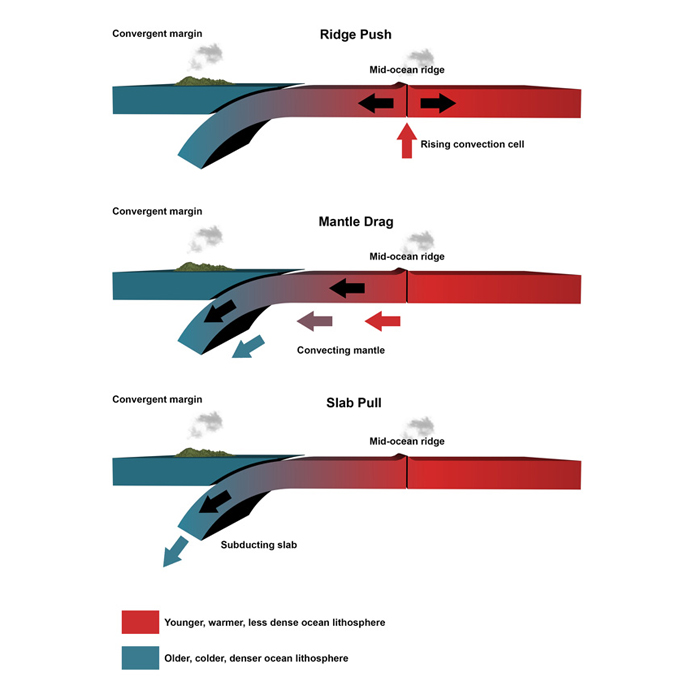
This exploration will delve into the fundamental forces at play at plate boundaries, how these forces lead to the buildup and release of energy that causes earthquakes, and the diverse types of boundaries and their associated seismic phenomena. We’ll also touch upon how advancements in technology are revolutionizing our understanding and response to these natural disasters.
The Dynamic Dance of Tectonic Plates
The Earth’s lithosphere, the rigid outer layer encompassing the crust and upper mantle, is broken into about a dozen major tectonic plates and numerous smaller ones. These plates “float” on the semi-fluid asthenosphere below, a zone of hotter, more ductile rock. The movement of these plates is not random; it’s a consequence of convection currents within the Earth’s mantle. Hotter, less dense material rises from the core, spreads out beneath the lithosphere, cools, and then sinks back down. This slow, continuous circulation acts like a conveyor belt, dragging the tectonic plates along with it.
The speed at which these plates move varies, typically ranging from a few millimeters to several centimeters per year, comparable to the rate at which fingernails grow. While this might seem imperceptible over human timescales, over millions of years, these plate movements have sculpted the Earth’s surface, creating continents, oceans, mountain ranges, and volcanic arcs. The forces involved are colossal, and the interactions at their edges are the primary drivers of geological activity.
Types of Plate Boundaries and Their Seismic Signatures
The nature of the interaction between tectonic plates dictates the type of geological features and seismic activity observed at their boundaries. Geologists classify these boundaries into three main categories: divergent, convergent, and transform. Each type presents a unique set of challenges and phenomena.
Divergent Boundaries: Where Plates Pull Apart
At divergent boundaries, tectonic plates are moving away from each other. This often occurs at the mid-ocean ridges, vast underwater mountain chains where new oceanic crust is continuously being generated. As the plates separate, molten rock (magma) from the mantle rises to fill the gap, cools, and solidifies. This process is known as seafloor spreading.
While significant geological activity, including volcanic eruptions and hydrothermal vents, is common at divergent boundaries, the earthquakes that occur here are typically shallow and relatively small in magnitude. This is because the crust is thin and the rocks are under tension, allowing for relatively easy fracturing and release of stress. However, these zones are still seismically active, contributing to the overall seismic budget of the planet.
Convergent Boundaries: Where Plates Collide
Convergent boundaries are where tectonic plates move towards each other. The outcome of this collision depends on the types of plates involved.
Subduction Zones: Oceanic Plate Encounters Continental or Oceanic Plate
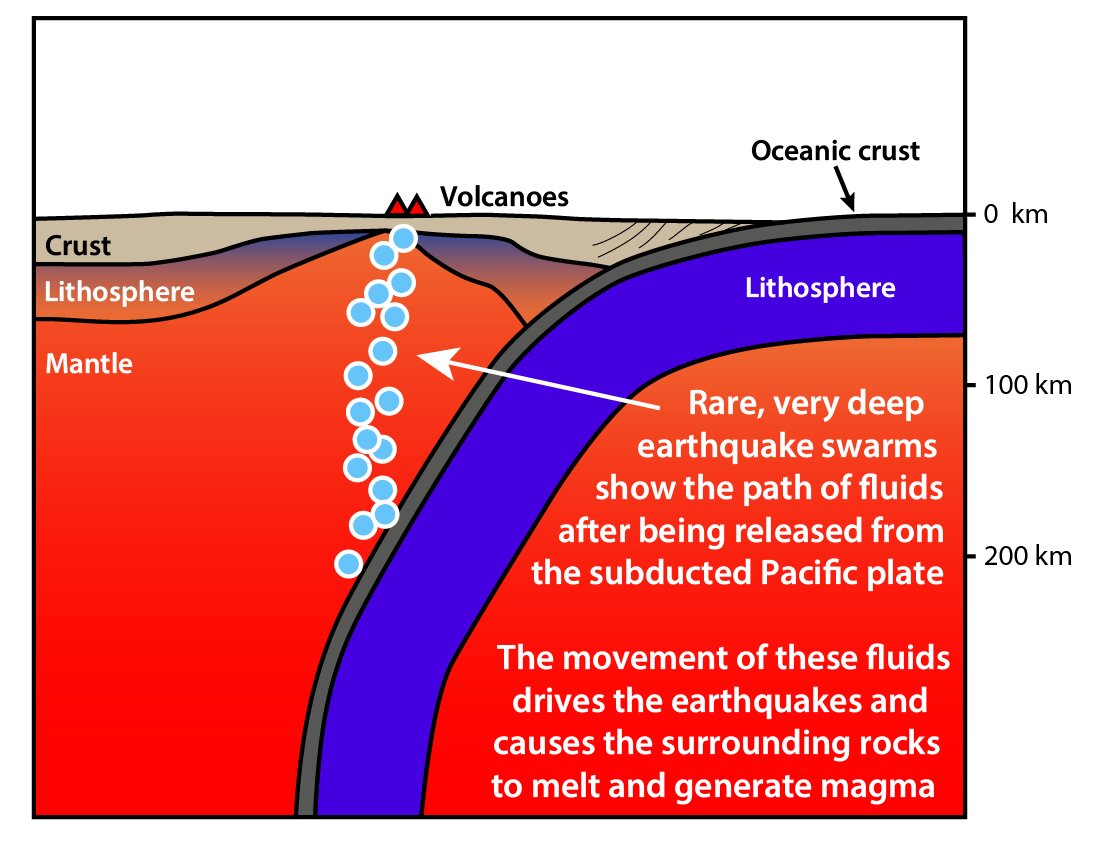
When an oceanic plate collides with a continental plate, the denser oceanic plate is forced beneath the lighter continental plate in a process called subduction. This creates deep ocean trenches at the boundary and volcanic mountain ranges on the overriding continental plate, such as the Andes Mountains. The friction and immense pressure generated as the oceanic plate grinds its way down into the mantle are responsible for some of the most powerful and devastating earthquakes on Earth. These earthquakes can originate at shallow depths and extend deep into the mantle, reaching magnitudes well over 7.0 and even 8.0. The immense energy released can trigger devastating tsunamis if the earthquake occurs beneath the ocean.
When two oceanic plates converge, one plate subducts beneath the other, forming deep ocean trenches and volcanic island arcs, like Japan or the Aleutian Islands. Similar to oceanic-continental convergence, these zones are highly seismically active, producing powerful earthquakes.
Continental Collision: Two Continents Collide
When two continental plates collide, neither is dense enough to subduct significantly. Instead, the crust crumples and folds, pushing upwards to form massive mountain ranges, such as the Himalayas. While subduction-related earthquakes are less common here, the immense compression leads to widespread faulting and significant seismic activity, though generally shallower and less frequent than in subduction zones.
Transform Boundaries: Where Plates Slide Past Each Other
At transform boundaries, tectonic plates slide horizontally past one another. The San Andreas Fault in California is a classic example of a transform boundary. As the plates grind along, the rough edges of the plates get stuck, causing stress to build up over time. When the accumulated stress exceeds the strength of the rocks, they rupture suddenly, releasing energy in the form of an earthquake.
Earthquakes at transform boundaries can be shallow and very powerful. The friction along these faults is immense, and the sudden release of stored elastic energy can create significant ground shaking over a wide area. The frequency and magnitude of earthquakes at transform boundaries vary depending on the rate of plate movement and the characteristics of the fault zone.
The Mechanics of Earthquake Generation
Regardless of the type of plate boundary, the fundamental process of earthquake generation involves the buildup and sudden release of stress. The Earth’s crust and upper mantle are not perfectly elastic; they deform under stress but can also fracture.
Stress Accumulation and Elastic Rebound
As tectonic plates move, they exert forces on each other at their boundaries. These forces cause the rocks on either side of the fault (a fracture in the Earth’s crust where movement occurs) to deform. Imagine bending a stick; it deforms, storing potential energy. If you bend it too far, it will snap. Similarly, rocks deform, storing elastic energy.
When the stress on the rocks builds up to a point where it overcomes the friction holding the rocks together along the fault, the rocks rupture. This rupture propagates along the fault, releasing the stored elastic energy in the form of seismic waves, which travel through the Earth and cause the ground to shake. This sudden release of stress and subsequent snapping back of deformed rock is known as the elastic rebound theory.
Seismic Waves: The Shaking of the Earth
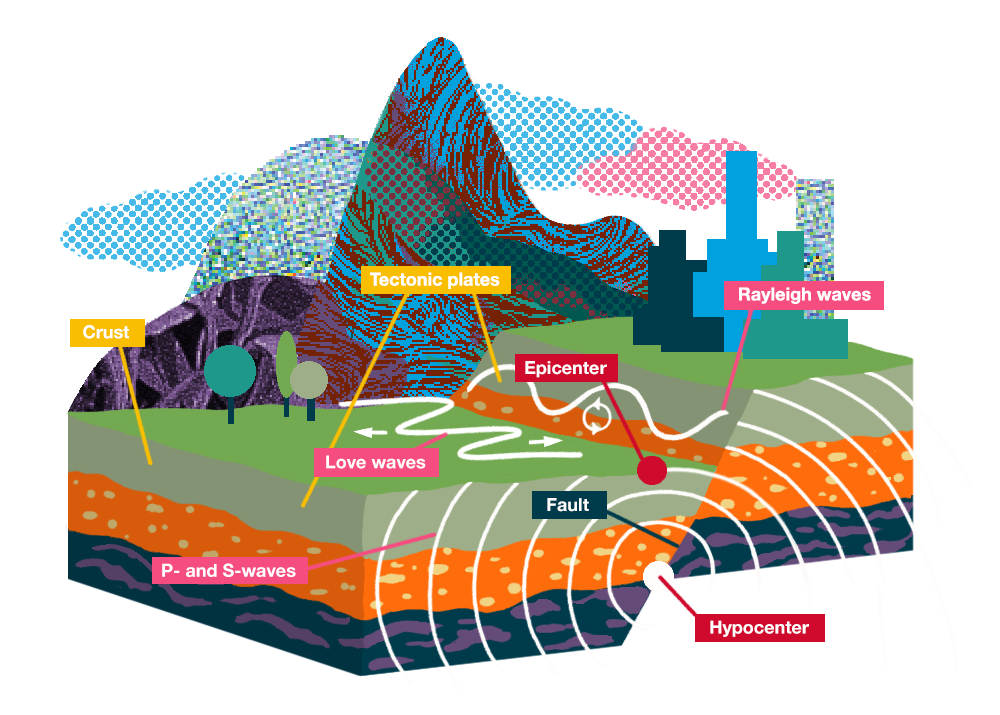
The energy released during an earthquake travels outwards from the point of rupture (the focus) in the form of seismic waves. These waves are what we feel as ground shaking. There are several types of seismic waves, each with different characteristics and effects:
-
Body Waves: These travel through the Earth’s interior.
- P-waves (Primary Waves): These are the fastest seismic waves and compress and expand the rock they travel through, like a sound wave. They arrive first at seismic stations.
- S-waves (Secondary Waves): These are slower than P-waves and move rock particles at right angles to the direction of wave travel, causing a shearing motion. They arrive after P-waves and can only travel through solid material.
-
Surface Waves: These travel along the Earth’s surface and are responsible for most of the damage during an earthquake.
- Love Waves: These are the fastest surface waves and cause horizontal shearing motion.
- Rayleigh Waves: These waves cause particles to move in an elliptical path, both up-and-down and side-to-side, resembling ocean waves.
The intensity and duration of shaking depend on the magnitude of the earthquake, the depth of the focus, the distance from the epicenter ( the point on the Earth’s surface directly above the focus), and the local geological conditions.
Technological Advancements in Earthquake Science and Preparedness
The study of earthquakes has been significantly advanced by modern technology. From sophisticated seismic networks to cutting-edge data analysis and modeling, technology plays a crucial role in our understanding and response to seismic events.
Enhanced Seismic Monitoring and Data Analysis
Modern seismological observatories are equipped with highly sensitive seismometers capable of detecting even the faintest tremors. These instruments are deployed globally, forming dense networks that can precisely pinpoint the location and magnitude of earthquakes. The data collected from these networks is immense, and sophisticated algorithms and Artificial Intelligence (AI) tools are now being employed to analyze this vast dataset in real-time.
AI, in particular, is proving invaluable in tasks such as distinguishing between natural earthquakes and human-induced seismic events (like those from fracking), identifying subtle precursory patterns (though still a highly debated area), and improving the accuracy of earthquake early warning systems. These systems, powered by rapid data processing, can provide a few precious seconds to minutes of warning before seismic waves arrive, allowing for immediate protective actions like shutting down critical infrastructure and encouraging people to take cover.
Predictive Modeling and Risk Assessment
While predicting the exact timing and magnitude of earthquakes remains an elusive goal, advancements in computational power and geological modeling have allowed for more sophisticated risk assessments. Scientists can now create detailed hazard maps that identify areas with the highest likelihood of experiencing damaging earthquakes based on historical seismicity, fault locations, and geological characteristics.
These models are crucial for informing urban planning, building codes, and disaster preparedness strategies. For instance, understanding the seismic vulnerability of different soil types and building structures allows engineers to design more resilient infrastructure. Financial institutions and insurance companies also utilize this data for risk assessment and setting premiums.
The Role of Digital Security and Infrastructure Resilience
In an era of increasing interconnectedness, the digital infrastructure supporting earthquake monitoring and warning systems must be robust. Ensuring the integrity and security of this data is paramount, especially when real-time alerts are critical. Furthermore, the resilience of our physical infrastructure – power grids, communication networks, transportation systems, and of course, our buildings – is directly impacted by earthquake activity. Technologies that improve structural integrity, such as advanced materials and seismic dampers, are becoming increasingly important in mitigating earthquake damage.
In conclusion, earthquakes at plate boundaries are a natural and inevitable consequence of our dynamic planet. By understanding the intricate dance of tectonic plates, the mechanisms of stress buildup and release, and the continuous advancements in scientific research and technological innovation, we can better comprehend these powerful events and strive to minimize their impact on human lives and our built environment.
aViewFromTheCave is a participant in the Amazon Services LLC Associates Program, an affiliate advertising program designed to provide a means for sites to earn advertising fees by advertising and linking to Amazon.com. Amazon, the Amazon logo, AmazonSupply, and the AmazonSupply logo are trademarks of Amazon.com, Inc. or its affiliates. As an Amazon Associate we earn affiliate commissions from qualifying purchases.