
The rapid evolution of Artificial Intelligence (AI) has shifted the technology from the realm of science fiction into the core of modern digital infrastructure. No longer confined to academic research labs, AI has become a foundational layer for software development, cybersecurity, and consumer electronics. As we stand at the precipice of the “AI-first” era, understanding the practical applications of this technology is essential for anyone navigating the current tech landscape.
From the generative models that assist in writing code to the sophisticated neural networks that protect our digital identities, AI is no longer just a feature—it is the engine driving innovation. This guide explores the multifaceted uses of AI, categorized by its impact on creative workflows, data science, security, and the future of autonomous systems.

1. Generative AI and the Evolution of Creative Workflows
The most visible breakthrough in recent years has been the rise of Generative AI. By utilizing Large Language Models (LLMs) and diffusion models, AI has transformed how we create digital content, shifting the human role from “creator” to “editor” or “director.”
Large Language Models (LLMs) and Content Generation
LLMs like GPT-4, Claude, and Gemini have redefined natural language processing. These tools are used to automate the drafting of technical documentation, create marketing copy, and summarize vast amounts of unstructured data. In a professional tech environment, AI-driven writing tools help bridge the gap between complex technical specifications and user-friendly guides, ensuring that information is accessible and accurately formatted.
AI-Driven Visual Arts and Design
The integration of AI into design software has revolutionized UI/UX workflows. Tools like Midjourney, DALL-E 3, and Adobe Firefly allow designers to generate high-fidelity prototypes and visual assets from simple text prompts. Beyond mere image generation, AI is used for “outpainting” (extending an image’s borders) and “inpainting” (removing or replacing specific elements within a frame), significantly reducing the time required for manual photo manipulation and digital asset creation.
Code Generation and Software Development
Perhaps the most significant impact of AI within the tech sector is in software engineering. AI coding assistants, such as GitHub Copilot and Cursor, use machine learning to suggest code snippets, debug errors in real-time, and even translate legacy code into modern programming languages. This does not replace the developer but rather acts as a “force multiplier,” allowing engineers to focus on high-level architecture while the AI handles boilerplate code and syntax optimization.
2. Machine Learning in Data Analytics and Predictive Modeling
At its core, AI excels at recognizing patterns within massive datasets that are too large or complex for human analysis. This capability is harnessed through machine learning (ML) to provide actionable insights across various industries.
Predictive Analytics for Business Intelligence
Tech companies utilize AI to forecast market trends and user behavior. By analyzing historical data, predictive models can identify potential “churn” (when a user stops using a service) before it happens, allowing companies to intervene with targeted improvements. In retail tech, AI predicts inventory needs, ensuring that supply chains remain lean and responsive to fluctuating consumer demand.
Healthcare Diagnostics and Personalized Medicine
The intersection of AI and biotech is one of the most promising frontiers of technology. AI algorithms are now used to analyze medical imagery—such as X-rays, MRIs, and CT scans—with a level of precision that often surpasses human experts. These systems can identify early-stage tumors or cardiovascular irregularities by comparing a patient’s scans against a global database of millions of clinical cases. Furthermore, AI is accelerating drug discovery by simulating how different chemical compounds interact with human proteins, potentially shortening the timeline for developing new life-saving medications.
Logistics and Supply Chain Optimization
Modern logistics rely on AI to solve the “last-mile” delivery problem. Companies like Amazon and UPS use AI-driven route optimization software to account for traffic, weather, and fuel efficiency in real-time. Within warehouses, AI-managed systems coordinate the movement of thousands of robots, ensuring that sorting and packing processes are executed with mathematical precision, minimizing downtime and maximizing throughput.
3. AI for Digital Security and Cybersecurity Infrastructure
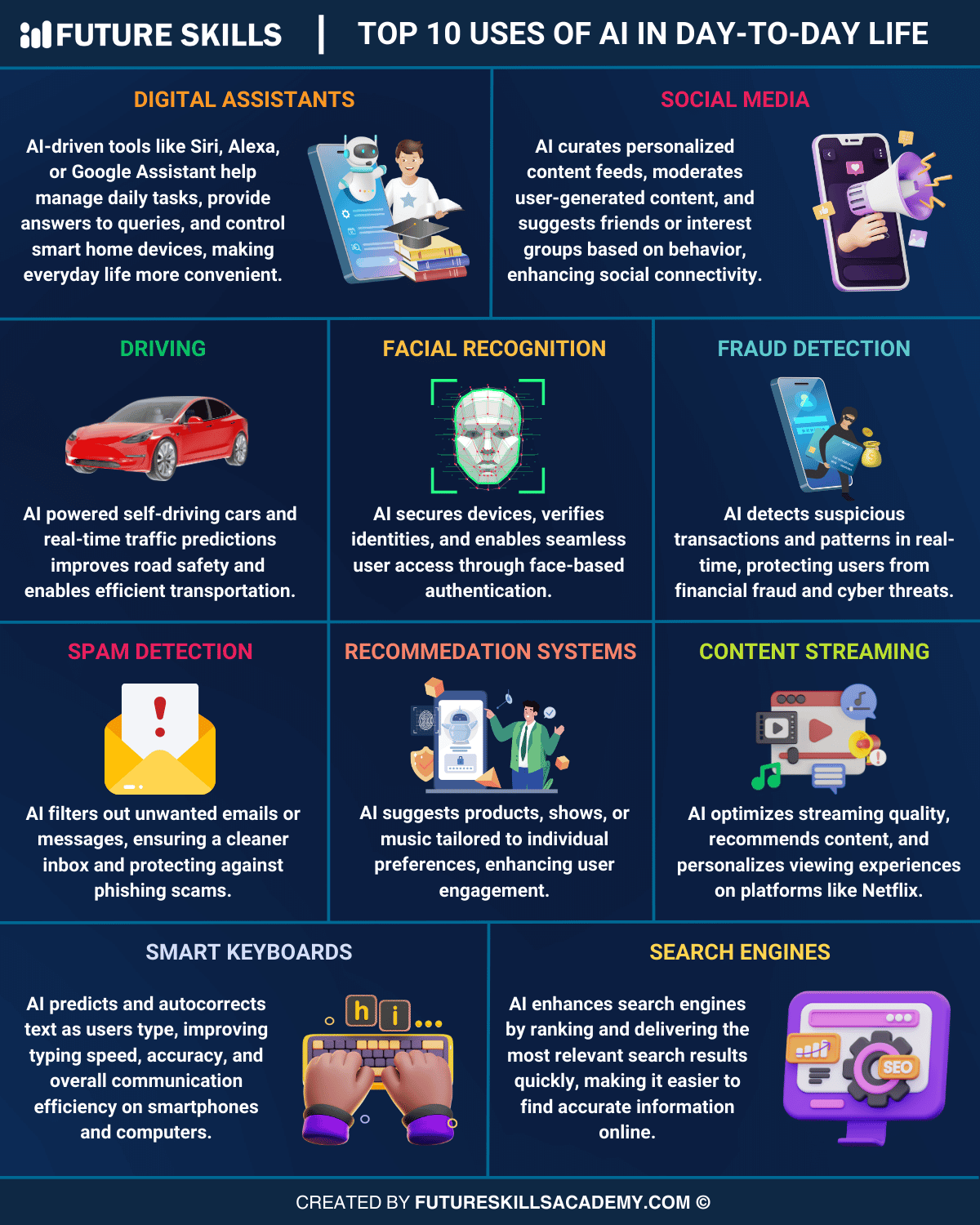
As digital threats become more sophisticated, traditional rule-based security systems are no longer sufficient. AI has become an indispensable component of modern cybersecurity, providing a proactive rather than reactive defense mechanism.
Real-time Threat Detection and Pattern Recognition
AI security tools monitor network traffic 24/7 to identify anomalies that might indicate a cyberattack. Unlike traditional antivirus software that looks for known “signatures” of malware, AI uses behavioral analysis. If a user account suddenly accesses sensitive files at 3:00 AM from an unusual IP address, the AI can automatically flag the activity as a potential breach and lock the account until a human administrator can verify the identity.
Biometric Authentication and Access Control
Artificial Intelligence is the technology behind the secure biometric systems we use daily. FaceID, fingerprint recognition, and voice authentication all rely on deep learning to create a mathematical map of a user’s unique physical traits. These systems are designed to distinguish between a real person and a high-resolution photograph or a voice recording, providing a level of hardware-level security that makes traditional passwords increasingly obsolete.
Automated Incident Response and Recovery
In the event of a successful breach, time is the most critical factor. AI-driven Security Orchestration, Automation, and Response (SOAR) platforms can instantly isolate infected servers, prevent the lateral movement of ransomware, and begin the process of restoring data from backups. This automated response happens in milliseconds—far faster than any human IT team could react—mitigating the damage and reducing the cost of digital recovery.
4. The Impact of AI on Personal Productivity and Smart Gadgets
The consumer tech market has been flooded with “AI-powered” devices, but the true value lies in how these tools enhance our daily productivity and interact with our environment.
Virtual Assistants and Natural Language Processing
The evolution from basic voice commands (like “set a timer”) to sophisticated virtual assistants marks a significant shift in human-computer interaction. Modern AI assistants can now understand context, maintain a conversational thread, and integrate with third-party apps to perform complex tasks—such as scheduling a multi-person meeting or drafting an email based on a brief voice memo.
Edge AI in Consumer Electronics
“Edge AI” refers to artificial intelligence that is processed locally on a device rather than in the cloud. This is seen in modern smartphones that use dedicated “Neural Engines” to improve photography in low light, provide real-time language translation without an internet connection, and optimize battery life by learning the user’s daily habits. By processing data on-device, manufacturers also enhance user privacy, as sensitive information does not need to be transmitted to external servers.
Personalized Learning and Educational Software
Adaptive learning platforms use AI to tailor educational content to the individual student. If a user is struggling with a particular concept in a coding tutorial or a language app, the AI identifies the knowledge gap and adjusts the curriculum to provide more practice in that specific area. This personalized approach ensures that learners remain engaged and move through material at an optimal pace, democratizing access to high-quality, specialized education.
5. Future Horizons: Autonomous Systems and Robotics
The ultimate manifestation of AI is its ability to interact with the physical world through autonomous systems. This represents the pinnacle of current engineering and software integration.
Self-Driving Vehicles and Transportation
Autonomous driving technology relies on a “sensor fusion” of cameras, LiDAR, and radar, all processed through a central AI brain. These systems must make split-second decisions in unpredictable environments. Beyond passenger cars, AI is being integrated into autonomous trucking fleets and delivery drones, which have the potential to reshape the global movement of goods by operating more safely and efficiently than human-operated vehicles.
Robotic Process Automation (RPA) and Industrial AI
In manufacturing, AI-powered robots are moving beyond simple repetitive tasks. Equipped with “computer vision,” these robots can sort irregular items, perform complex assemblies, and conduct quality control by spotting microscopic defects that the human eye might miss. This synergy between software intelligence and physical robotics is driving “Industry 4.0,” characterized by smart factories that can self-correct and optimize their production cycles.

Ethical Considerations and the Future of AI Development
As AI becomes more integrated into the fabric of technology, the tech community is increasingly focused on the “Alignment Problem”—ensuring that AI systems act in accordance with human values and safety standards. This includes addressing algorithmic bias, ensuring transparency in how AI makes decisions (“Explainable AI”), and establishing frameworks for digital security that prevent the misuse of AI by bad actors.
The journey of artificial intelligence is just beginning. As hardware becomes more powerful and algorithms more refined, the list of what AI can be used for will continue to expand. For the tech-savvy individual, the goal is not just to use AI, but to understand its underlying principles to better navigate a world where intelligence is no longer exclusively human.
aViewFromTheCave is a participant in the Amazon Services LLC Associates Program, an affiliate advertising program designed to provide a means for sites to earn advertising fees by advertising and linking to Amazon.com. Amazon, the Amazon logo, AmazonSupply, and the AmazonSupply logo are trademarks of Amazon.com, Inc. or its affiliates. As an Amazon Associate we earn affiliate commissions from qualifying purchases.