
In the era of digital finance, the geographical boundaries of banking have blurred significantly. However, for many consumers, the question of which banks maintain a physical presence in all 50 states remains a critical factor in their financial decision-making. Whether you are a frequent traveler, a digital nomad, or someone planning a cross-country relocation, the assurance that your bank “follows” you is a cornerstone of financial peace of mind.
While the concept of a truly national bank seems straightforward, the reality is dictated by a complex web of historical regulations, acquisition strategies, and the aggressive shift toward digital-first banking models. To understand which banks operate in all 50 states, one must distinguish between physical branch availability and digital service accessibility.
The Landscape of Modern American Banking
Historically, the American banking system was highly fragmented. Until the late 20th century, federal and state laws, such as the Glass-Steagall Act and the McFadden Act, restricted banks from opening branches across state lines. It wasn’t until the Riegle-Neal Interstate Banking and Branching Efficiency Act of 1994 that banks were truly empowered to create nationwide branch networks.
Even with legal barriers removed, the logistical and financial cost of maintaining a physical storefront in every state is immense. Consequently, very few institutions have achieved a 50-state physical footprint. Instead, the industry has evolved into a two-tiered system: the “Big Four” national banks with massive regional clusters and the “Digital Disrupters” that serve all 50 states through the cloud.
The Significance of Physical Presence
For some, a physical branch is an outdated relic. For others, it is a vital service hub. Physical locations offer services that digital platforms struggle to replicate, such as:
-
Cash Intensive Operations: Depositing large amounts of paper currency or obtaining cashier’s checks.
-
Safe Deposit Boxes: Storing physical valuables and original legal documents.
-
Notary Services: Accessing immediate witnessing for legal and real estate transactions.
-
Complex Problem Solving: Face-to-face consultations for mortgages, business loans, or fraud resolution.
The Shift to Digital Accessibility
Today, the definition of being “in” a state has shifted. If you can deposit a check via a smartphone app, withdraw cash from a networked ATM, and speak to a representative via secure chat while standing in a remote town in Wyoming, that bank is effectively serving you in that state. This distinction is vital for modern personal finance management.
The “Big Four” and Their Physical Reach
When consumers ask about banks in all 50 states, they are usually looking for the heavyweights. Among the thousands of financial institutions in the U.S., four giants dominate the landscape. However, even these titans have different approaches to geographical coverage.
JPMorgan Chase: The Leader in Coverage
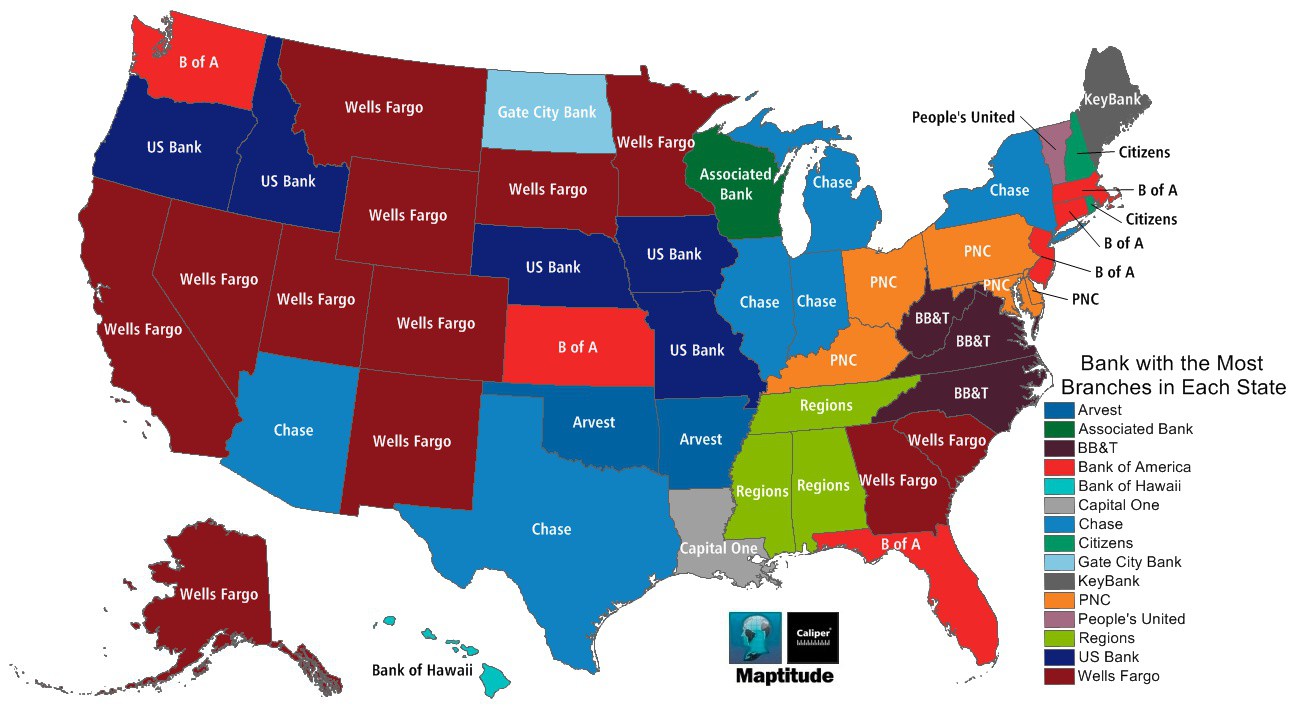
As of late 2021, JPMorgan Chase achieved a significant milestone by becoming the first bank to have a physical branch presence in all of the lower 48 contiguous states. While they may still have limited or no physical branches in Alaska and Hawaii, their expansion strategy has been the most aggressive in the industry. Chase’s “branch-lite” strategy allows them to enter new markets with fewer, high-tech locations while relying on their robust mobile app to bridge the gaps. For a consumer seeking the most comprehensive physical network in the U.S., Chase is currently the closest answer to a “50-state bank.”
Bank of America
Bank of America maintains a staggering presence with thousands of financial centers, yet it does not cover all 50 states physically. It is most concentrated in high-population coastal areas and major metropolitan hubs. While you can find a Bank of America in most states, there are several “banking deserts” in the Midwest and Great Plains where their physical presence is non-existent. However, their digital platform is consistently ranked among the best, ensuring that customers in “missing” states can still manage their money effectively.
Wells Fargo
Wells Fargo once held the crown for the most extensive branch network in the United States. While they have a presence in approximately 36 to 40 states, their footprint is particularly strong in the West and the South. In recent years, like many of its competitors, Wells Fargo has consolidated branches to focus on digital efficiency. If you live in the Northeast, you may find their physical presence significantly thinner than that of Chase or Bank of America.
Citibank
Citibank is an interesting outlier. While it is undeniably a global powerhouse, its domestic physical footprint is surprisingly small, concentrated primarily in a handful of major metropolitan areas like New York, Los Angeles, Chicago, and Miami. Despite this, Citibank offers robust national service through its digital tools and an expansive ATM network (often through partnerships with retail locations like 7-Eleven).
The Rise of the 50-State Digital Banks
If physical buildings are not a requirement, the list of banks available in all 50 states expands dramatically. Neobanks and online-only divisions of traditional banks have revolutionized the “all-state” concept by utilizing the internet as their primary storefront.
Capital One: The Hybrid Model
Capital One is a unique entity in this discussion. While it has physical branches and “Capital One Cafés” in many major cities, it operates primarily as a high-yield online bank for the majority of the country. Because of its hybrid nature, Capital One is legally and operationally available in all 50 states, offering one of the most seamless transitions between digital convenience and physical service where available.
Ally Bank and SoFi
Online-only institutions like Ally Bank and SoFi are designed from the ground up to serve every U.S. resident regardless of their ZIP code. These institutions do not have physical branches, which allows them to save on overhead costs and pass those savings to consumers in the form of higher Annual Percentage Yields (APY) on savings accounts and lower fees.
-
Ally Bank: Known for its customer service and user-friendly interface, Ally provides 50-state coverage through a vast ATM network (Allpoint) and mobile check deposits.
-
SoFi: Positioned as a “one-stop-shop” for personal finance, SoFi offers banking, investing, and lending across all states, making it a favorite for the digitally native generation.
High-Yield Savings Leaders: Marcus and American Express
Other major players, such as Marcus by Goldman Sachs and American Express National Bank, operate exclusively online. They provide consumers in all 50 states with access to competitive interest rates that local regional banks rarely match. While they lack checking account features in some cases, they are essential components of a 50-state financial strategy for those focused on wealth accumulation.
Why State-by-State Presence Still Matters
Even in a digital world, the “where” of a bank matters due to state-specific regulations and the nuances of the American legal system.
Community Reinvestment and Local Lending
Banks with a physical presence in a state are often more integrated into the local economy. They are subject to the Community Reinvestment Act (CRA), which encourages them to meet the credit needs of the communities in which they operate, including low- and moderate-income neighborhoods. If you are a small business owner, having a bank with a physical presence in your state can be beneficial for accessing state-specific small business grants or localized lending expertise.
Legal Jurisdictions and Protections
While FDIC insurance protects your deposits up to $250,000 regardless of which state you or your bank is in, other legal matters—such as power of attorney, estate settlements, and account garnishments—can be influenced by state law. A bank with a physical and legal “nexus” in your state may have more streamlined processes for handling these localized legal requirements.
The “ATM Gap”
For many, the biggest hurdle of using a bank without local branches is accessing cash. Banks that operate in all 50 states without branches usually solve this through ATM networks like MoneyPass or Allpoint. These networks allow customers to use ATMs in pharmacies, grocery stores, and gas stations without paying a fee. Some online banks even offer ATM fee reimbursements, effectively making every ATM in all 50 states “their” ATM.
Choosing the Right Bank for Your Lifestyle
When deciding on a bank that covers all 50 states, you must weigh the value of a physical branch against the financial benefits of an online-only model.
For the “Global Citizen”
If you travel frequently across the U.S., a bank like Chase offers the best of both worlds: a physical branch for emergencies in almost any major city and a top-tier mobile app. The ability to walk into a branch in New York, Chicago, or Seattle and receive the same level of service is a premium convenience.
For the “Wealth Builder”
If your goal is to maximize your interest income, the lack of physical branches is actually an advantage. Online banks available in all 50 states typically offer interest rates on savings that are 10 to 20 times higher than the national average offered by the Big Four. In this case, “accessibility” means having a high-functioning app and a 24/7 customer service line.
The Multi-Bank Strategy
Many savvy consumers have moved toward a “hybrid” approach to solve the 50-state dilemma. They maintain a checking account with a large national bank (like Chase or Bank of America) to ensure they have access to physical branches and ATMs wherever they go. Simultaneously, they keep their primary savings in an online-only bank (like Ally or Marcus) to take advantage of higher yields. This strategy ensures total 50-state coverage, combining the reliability of traditional infrastructure with the efficiency of modern fintech.
In conclusion, while few banks offer a brick-and-mortar building in every single state, the industry has reached a point where “national banking” is a reality for everyone. Whether through the massive physical expansion of firms like JPMorgan Chase or the borderless innovation of digital-first banks, consumers now have more power than ever to manage their finances across state lines without friction. The key is identifying which form of “presence” matters most to your unique financial journey.
aViewFromTheCave is a participant in the Amazon Services LLC Associates Program, an affiliate advertising program designed to provide a means for sites to earn advertising fees by advertising and linking to Amazon.com. Amazon, the Amazon logo, AmazonSupply, and the AmazonSupply logo are trademarks of Amazon.com, Inc. or its affiliates. As an Amazon Associate we earn affiliate commissions from qualifying purchases.