
When users search for “what area code is Canada,” they are often met with a multifaceted answer. Unlike many nations that possess a single unique country code followed by a localized numbering system, Canada is an integral part of the North American Numbering Plan (NANP). From a technological perspective, Canada’s telecommunications identity is defined by the +1 country code, shared with the United States and several Caribbean nations. However, beneath this simple prefix lies a sophisticated digital architecture designed to manage millions of connections across one of the world’s largest geographical landmasses.

In the modern era, an area code is no longer just a physical location marker; it is a critical data point in global routing tables, a layer of digital security, and a fundamental component of Voice over IP (VoIP) logic. This article explores the technical framework of Canada’s area codes, the evolution of telecommunications infrastructure, and the digital security measures protecting these vital communication lines.
The Architecture of the North American Numbering Plan (NANP)
To understand Canada’s area codes, one must first understand the NANP. Established in the 1940s by AT&T and Bell Labs, this system was designed to automate the routing of long-distance calls, removing the need for human operators to manually patch connections.
How Canada Fits into the +1 Global Prefix
In the international E.164 numbering standard, Canada is assigned the country code +1. This shared space with the U.S. is a relic of early 20th-century hardware limitations and economic cooperation. For the technology that routes these calls, the “1” serves as the Country Code (CC), while the subsequent three digits—the area code—are known technically as the Numbering Plan Area (NPA).
When a digital switch receives a request starting with +1, it immediately looks at the NPA to determine the destination network. For Canada, these NPAs are meticulously managed to ensure that packets of data (voice or text) find their way through a complex web of fiber-optic cables and satellite links to the correct provincial gateway.
The Technical Hierarchy: NPA-NXX-XXXX
The structure of a Canadian phone number is a masterpiece of logical engineering. It follows a 10-digit format:
- NPA (Numbering Plan Area): The 3-digit area code.
- NXX (Central Office Code): The 3 digits following the area code, which historically identified a specific exchange or hardware switch in a local neighborhood.
- XXXX (Line Number): The final 4 digits identifying the specific subscriber line.
In the early days of mechanical switching, certain numbers were restricted. For example, an area code could not start with a 0 or 1 to avoid confusion with operator signals or long-distance prefixes. As technology shifted from analog pulses to digital signals (SS7 protocols), these restrictions eased, allowing for the massive expansion of available numbers we see today.
Why Canada and the U.S. Share the Same Dialing System
The integration of the two nations’ numbering plans was a strategic technological decision. By sharing a system, the two countries created a seamless continental network. This allows for high-speed data interoperability and simplifies the hardware requirements for telecommunications providers operating on both sides of the border. From a network engineering standpoint, calling from Toronto to New York is technically identical to calling from Toronto to Vancouver.
Regional Digital Mapping: The Evolution of Canadian Area Codes
As Canada’s population grew and the “Internet of Things” (IoT) exploded, the demand for unique identifiers skyrocketed. This led to a significant shift in how area codes are deployed and managed.
The Evolution of Overlays in Densely Populated Tech Hubs
Historically, when an area code ran out of numbers, the region was “split,” and half the customers were forced to change their numbers. Today, telecommunications technology utilizes “overlays.” An overlay occurs when a new area code is added to the exact same geographic region as an existing one.
For example, Toronto’s iconic 416 area code was eventually supplemented by 647 and 437. Technically, this requires “10-digit dialing,” where the switch no longer assumes a local call within the same area code. This transition required a massive software update across all carrier networks to ensure that local calls were not billed as long-distance, despite having different area codes.
Managing Scarcity: How the CRTC Allocates Resources
The Canadian Radio-television and Telecommunications Commission (CRTC) and the Canadian Numbering Administrator (CNA) manage the technical allocation of area codes. They monitor the “exhaustion” rates of existing codes. When a code reaches a certain threshold of use, the CNA triggers the implementation of a new NPA.
This process is data-driven. With the rise of mobile devices, tablets with LTE, and smart meters, the consumption of numbers is faster than ever. The CRTC must ensure that the digital routing tables globally are updated months in advance before a new Canadian area code goes live.
Mapping Major Provinces: From Ontario to British Columbia
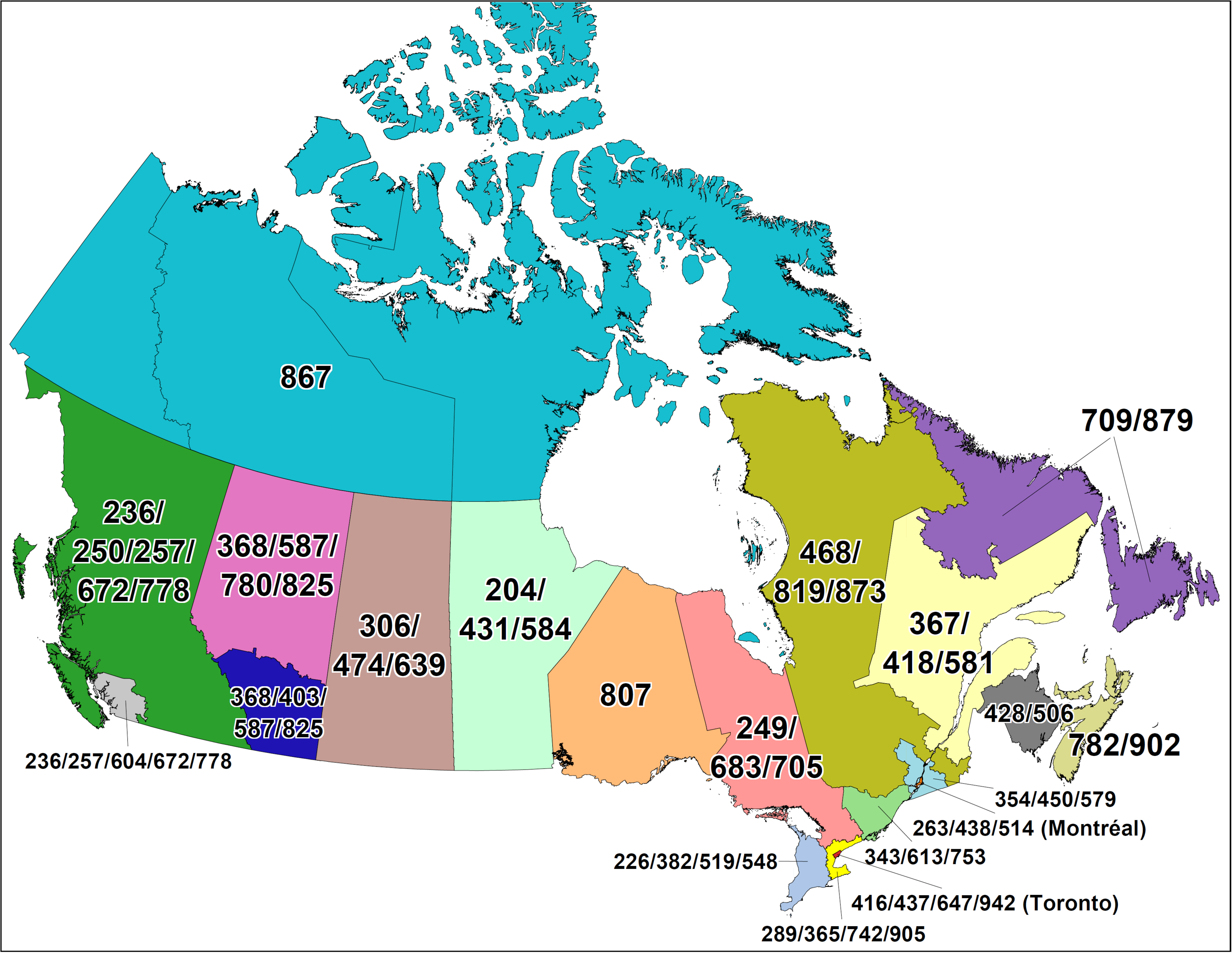
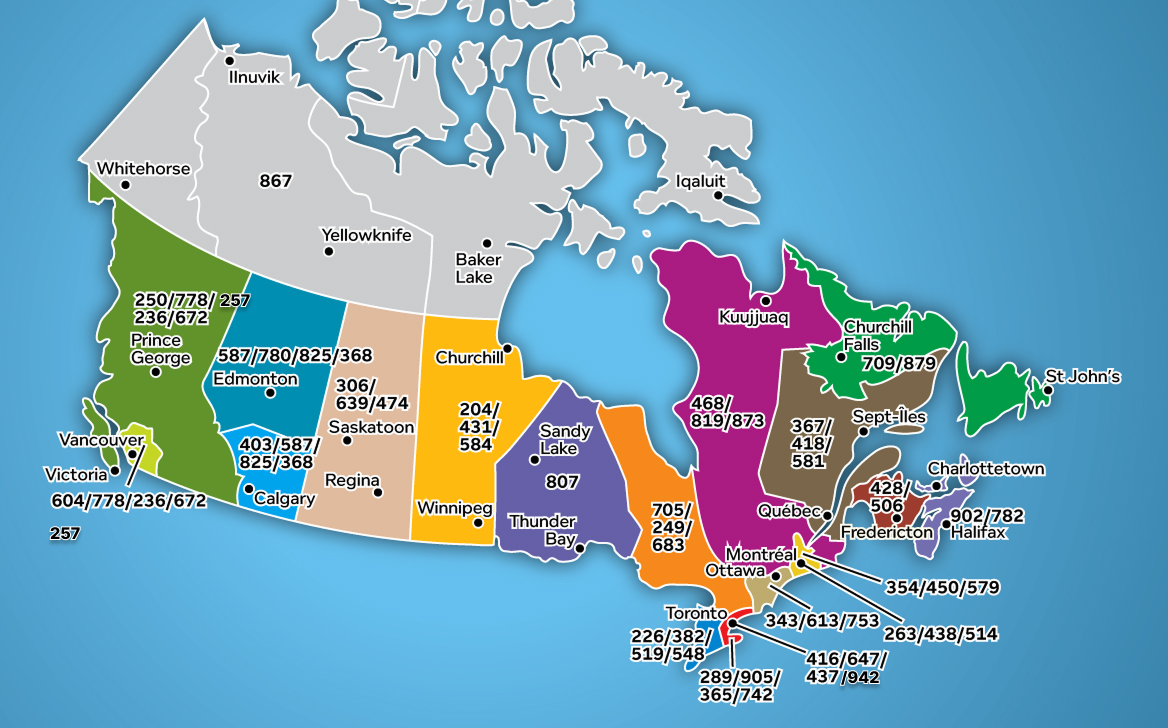
Canada currently utilizes dozens of area codes. Some of the most notable include:
- Ontario: 416, 647, 437 (Toronto); 905, 289, 365 (Golden Horseshoe); 613, 343 (Ottawa).
- Quebec: 514, 438, 263 (Montreal); 418, 581, 367 (Quebec City).
- British Columbia: 604, 778, 236 (Vancouver/Lower Mainland); 250 (Vancouver Island).
- Alberta: 403, 587, 825 (Calgary); 780 (Edmonton).
Each of these represents a node in the national network, allowing for precise geographical load balancing of telecommunications traffic.
The Technology of Modern Connectivity: VoIP and Virtual Numbers
The concept of a “Canadian area code” has been disrupted by the advent of Voice over IP (VoIP). In the traditional PSTN (Public Switched Telephone Network), an area code was tied to a physical copper wire entering a building. Today, it is an entry in a cloud database.
How Cloud-Based PBX Systems Revolutionize Geographic Location
Cloud-based Private Branch Exchange (PBX) systems allow a company located in Singapore to own and operate a 416 (Toronto) area code. When a customer dials that number, the call is converted into data packets and routed over the internet to the company’s actual location.
This decoupling of “area code” from “physical location” is a major technological milestone. It relies on SIP (Session Initiation Protocol) trunking, which manages the setup, teardown, and signaling of voice calls over data networks. For the user, the experience is seamless, but behind the scenes, the data may be traversing multiple undersea cables in milliseconds.
Number Portability: Keeping Identity Across Borders
One of the most complex technical achievements in modern Canadian telecoms is Wireless Number Portability (WNP). This allows a user to move from a provider like Rogers to Bell, or move from Vancouver to Halifax, while keeping their original area code.
The technology behind this involves a centralized database (the Local Number Portability Administration) that redirects calls to the correct current provider. This database must be queried in real-time every time a call is placed to ensure the routing logic is accurate.
The Role of 5G and IoT in Area Code Consumption
As Canada rolls out 5G networks, the density of connected devices per square kilometer is increasing exponentially. From smart traffic lights to connected vending machines, every device needs an identifier. While many IoT devices use IP addresses, many still rely on traditional numbering structures for SMS-based signaling and legacy compatibility. This is placing unprecedented pressure on the NANP to provide more NPAs to the Canadian market.
Digital Security and Area Code Spoofing
The accessibility of Canadian area codes via VoIP has unfortunately led to a rise in digital fraud. Area code spoofing—the practice of masking a caller’s true identity with a familiar local area code—is a major challenge for the tech industry.
The Tech Behind STIR/SHAKEN Protocols
To combat this, Canada has been a leader in implementing the STIR/SHAKEN framework.
- STIR (Secure Telephone Identity Revisited): A protocol used to create a digital signature for a call.
- SHAKEN (Signature-based Handling of Asserted information using toKENs): The set of guidelines for how carriers should implement STIR.
When a call originates from a Canadian area code, the carrier “signs” the call with a certificate. If the call is redirected or spoofed by a scammer, the certificate will not match, and the receiving carrier can flag the call as “Likely Scam” or block it entirely. This is a massive leap forward in digital security, moving from a system of trust to a system of cryptographic verification.
Identifying “Neighbor Spoofing”
Neighbor spoofing is a psychological tactic powered by automation. Software programs generate calls that match the first six digits (NPA-NXX) of the victim’s own phone number. The tech industry is currently developing AI-driven filters that analyze call patterns—such as a single source hitting thousands of numbers in numerical order—to block these attempts at the gateway level before they ever reach the consumer’s handset.
Future-Proofing Telecommunications Against AI Scams
As AI voice synthesis becomes more advanced, the “Canadian area code” will serve as the first line of defense. Future security layers will likely involve multi-factor authentication for voice, where the area code is just one of many metadata points used to verify a caller’s intent and identity.
Conclusion
The question “what area code is Canada” opens a door into a vast technological ecosystem. While +1 is the simple answer, the reality is a complex, high-speed network of NPAs that facilitate millions of digital interactions every second. From the legacy of the North American Numbering Plan to the cutting-edge implementation of STIR/SHAKEN security protocols, Canada’s area codes are a testament to the country’s advanced telecommunications infrastructure. As we move deeper into the era of 5G and cloud-integrated communication, these three-digit codes will continue to evolve, bridging the gap between physical geography and the borderless digital world.
aViewFromTheCave is a participant in the Amazon Services LLC Associates Program, an affiliate advertising program designed to provide a means for sites to earn advertising fees by advertising and linking to Amazon.com. Amazon, the Amazon logo, AmazonSupply, and the AmazonSupply logo are trademarks of Amazon.com, Inc. or its affiliates. As an Amazon Associate we earn affiliate commissions from qualifying purchases.