
In the competitive landscape of modern business, a brand is far more than a name or a product; it is a psychological experience. At the heart of this experience lies color—the most immediate and influential tool in a brand strategist’s arsenal. However, professional branding goes beyond choosing a single “hero” color like blue or red. To build a sophisticated, versatile, and resonant visual identity, designers and brand managers must master the nuances of color theory, specifically the concepts of tints and shades.
Understanding the difference between a tint and a shade is the secret to creating depth, establishing visual hierarchy, and ensuring brand consistency across diverse media. This guide explores the technical foundations of these variations and their strategic application in building world-class brand identities.

Understanding the Fundamentals: Defining Tints, Shades, and Tones
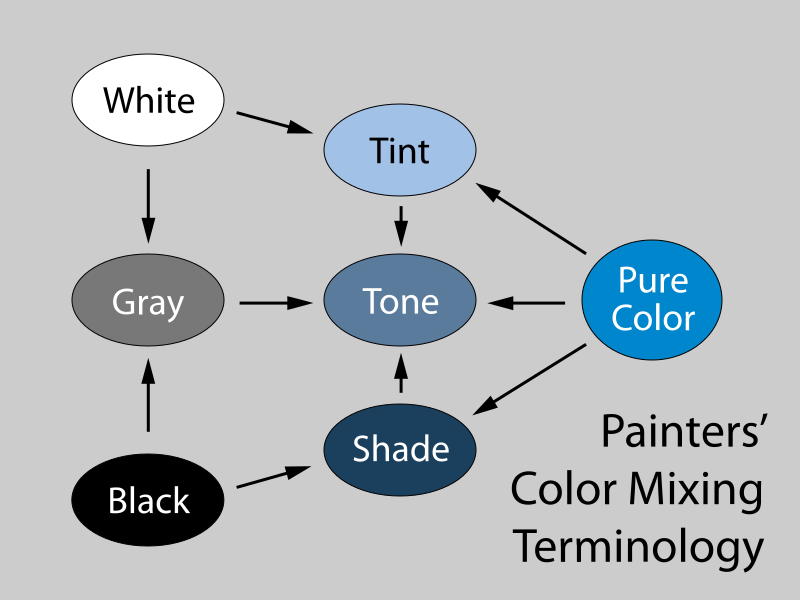
Before a brand can deploy a color palette across its digital and physical assets, it must understand the anatomy of a hue. In the world of color science, every color we see on a brand’s website or packaging starts with a “pure hue”—the saturated color found on the traditional color wheel. Tints and shades are simply variations of that pure hue created by altering its lightness or darkness.
The Science of Adding White (Tints)
A tint is created when you add white to a pure hue. This process increases the color’s lightness while reducing its saturation. In brand strategy, tints are often referred to as “pastels.” They are frequently used to communicate approachability, softness, and modernity. For instance, a brand using a tint of red becomes a soft pink, shifting the brand’s energy from aggressive and urgent to nurturing and gentle. Tints are essential for creating backgrounds and secondary elements that do not overwhelm the viewer’s eye.
The Depth of Adding Black (Shades)
A shade is the opposite of a tint; it is created by adding black to a pure hue. This results in a darker, richer, and often more intense version of the original color. Shades are used to evoke feelings of mystery, sophistication, luxury, and authority. A deep navy (a shade of blue) or a forest green (a shade of green) carries a weight and “seriousness” that pure hues often lack. In corporate identity, shades are frequently used for typography and structural elements to provide a sense of stability and grounding.
The Sophistication of Gray (Tones)
While the primary focus is often on tints and shades, a professional brand strategist must also understand “tones.” A tone is created by adding gray (a mix of both black and white) to a hue. Tones are vital for brand palettes because they are “muted.” They lack the stark brightness of a tint or the heavy darkness of a shade, making them highly versatile for complex illustrations and professional UI/UX design where eye strain must be minimized.
The Role of Color Variation in Brand Strategy
Why does a brand need more than one version of its signature color? The answer lies in the strategic need for flexibility. A brand that relies solely on one flat, pure hue often appears “cheap” or visually fatiguing. By utilizing a spectrum of tints and shades, a brand can communicate complex messages and navigate different consumer environments.
Evoking Emotional Responses
Color psychology is not a one-size-fits-all discipline. The emotional impact of a color changes significantly based on its value. A pure blue might represent “trust,” but a light tint of that blue evokes “tranquility” and “cleanliness” (often used in healthcare branding). Conversely, a dark shade of that same blue represents “intelligence” and “tradition” (often used in legal or financial services). By strategically choosing between tints and shades, a brand can fine-tune the specific emotional frequency it wants to broadcast to its target audience.
Establishing Visual Hierarchy
In marketing collateral—whether it’s a landing page or a physical brochure—you need to guide the customer’s eye. This is where the contrast between tints and shades becomes a functional tool. High-contrast areas (dark shades against light tints) naturally draw the eye first. Brand strategists use shades for Call-to-Action (CTA) buttons or headlines to demand attention, while using subtle tints for secondary information. This “visual pathing” ensures that the most important brand messages are consumed first.
Ensuring Brand Consistency Across Media
One of the greatest challenges in corporate identity is maintaining consistency across different platforms. A color that looks vibrant on a backlit smartphone screen may look muddy when printed on a cardboard shipping box. By developing a comprehensive “Brand Style Guide” that includes approved tints and shades, a company ensures that its identity remains recognizable. If a pure brand color is too dark for a specific application, the guide provides a pre-approved tint that maintains the “DNA” of the brand without sacrificing legibility or aesthetic appeal.
Practical Applications in Design and Marketing
Transitioning from theory to practice requires a systematic approach to palette construction. A brand’s primary color is the “anchor,” but the tints and shades are the “supporting cast” that make the brand workable in the real world.
Developing an Expanded Brand Palette
Modern brands rarely use just two colors. Instead, they utilize a “monochromatic expanded palette.” This involves taking the primary brand hue and generating 3–5 tints and 3–5 shades. This gives designers a toolkit to work with. For example, a tech company might use its pure primary blue for the logo, a very light tint of that blue for website section backgrounds, and a very dark shade of that blue for body text. This creates a cohesive, professional look that feels unified rather than cluttered.
Creating Depth in Logos and Icons
Flat design was a major trend for years, but the industry is moving back toward “tactile” and “skeuomorphic” elements that suggest depth. Tints and shades are the primary tools for creating 3D effects. By placing a tint on the “top” of an object and a shade on the “bottom,” a designer creates a highlight and a shadow. This gives brand icons and logos a sense of physical presence and quality, suggesting that the brand is multifaceted and well-established.
Enhancing User Experience (UX) and Accessibility
In the digital age, brand strategy is inextricably linked to accessibility. Web Content Accessibility Guidelines (WCAG) require specific contrast ratios between text and background to ensure content is readable for people with visual impairments. Brand managers must use shades of their primary colors to ensure that text on buttons or banners is dark enough against lighter backgrounds. Conversely, using tints for “hover states” (when a mouse moves over a link) provides essential feedback to the user, making the digital brand experience intuitive and inclusive.
Case Studies: Tints and Shades in Iconic Branding
Looking at global leaders reveals how the intentional use of color variations builds brand equity. These companies don’t just use color; they own a specific spectrum of light and dark.
Tech Giants and Monochrome Schemes
Consider a company like Facebook (Meta). Their primary color is a specific blue. However, if you look closely at their interface, you will see dozens of variations. The “Like” button, the notification bar, and the background containers are all varying tints and shades of that core blue. This creates a “branded environment” where the user feels immersed in the brand identity without being overwhelmed by a single high-saturation color. This use of tints allows for a complex UI that remains clean and functional.
Luxury Brands and Deep Tones
Luxury branding often leans heavily into shades. Brands like Rolex or Porsche frequently use deep hunter greens, maroons, or charcoals. These shades communicate a “weighted” history and premium quality. By avoiding bright tints, these brands distance themselves from the “loudness” of discount retail. When they do use tints, they are often metallic (like silver or champagne), which are essentially tints of grey and yellow that imply rarity and value.

Conclusion: Leveraging Color for Competitive Advantage
In the realm of brand strategy, the mastery of tints and shades is what separates amateur design from professional corporate identity. Tints provide the breath and space a brand needs to be approachable and legible, while shades provide the authority and structure required to build trust.
By understanding how to manipulate a pure hue through the addition of white and black, brand managers can create a visual language that is both flexible and consistent. Whether you are designing a high-conversion website, a luxury product packaging, or a global marketing campaign, the strategic use of tints and shades ensures that your brand speaks with a clear, nuanced, and powerful voice. In a world of visual noise, the brand that understands the subtle art of color variation is the one that truly stands out.
aViewFromTheCave is a participant in the Amazon Services LLC Associates Program, an affiliate advertising program designed to provide a means for sites to earn advertising fees by advertising and linking to Amazon.com. Amazon, the Amazon logo, AmazonSupply, and the AmazonSupply logo are trademarks of Amazon.com, Inc. or its affiliates. As an Amazon Associate we earn affiliate commissions from qualifying purchases.