
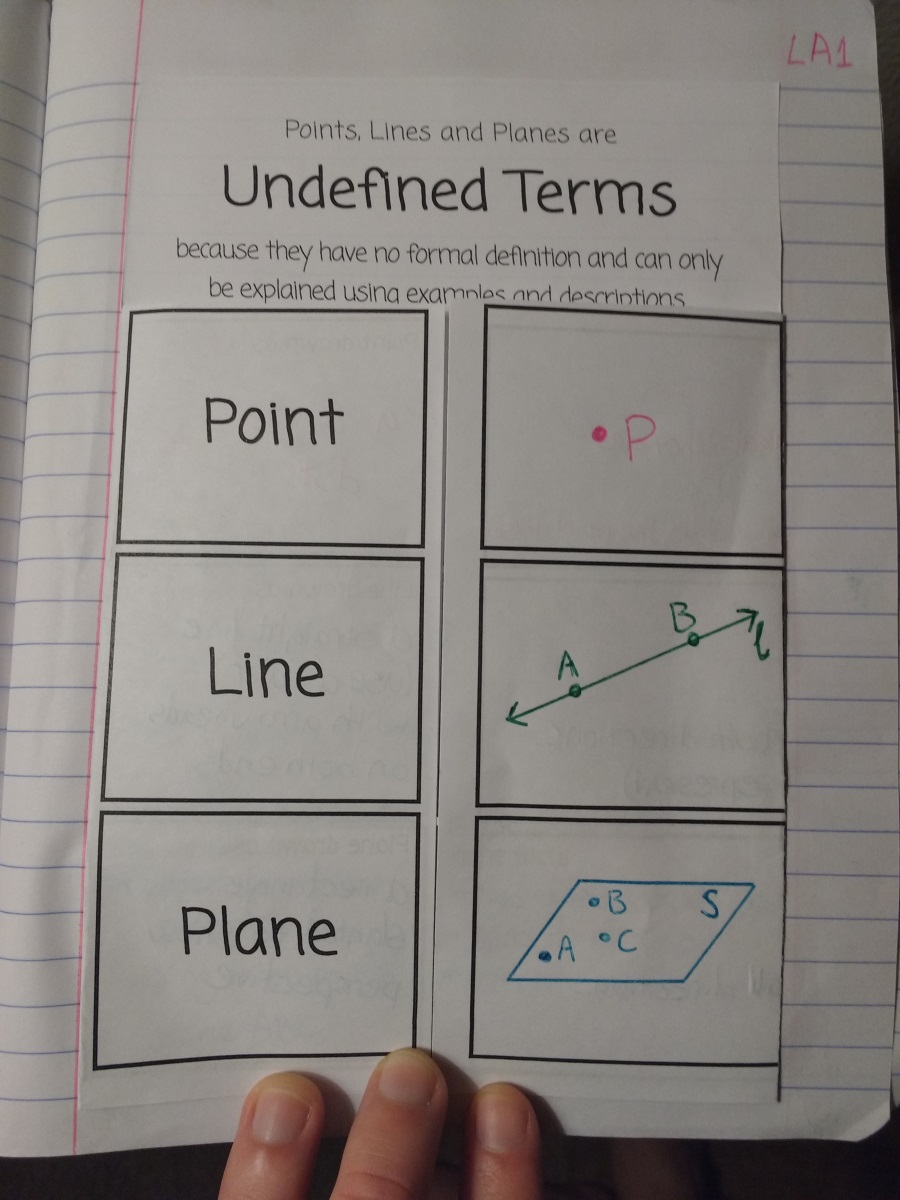
In the vast and intricate landscape of technology, innovation often seems to spring from complex algorithms and cutting-edge hardware. Yet, the very bedrock of many digital advancements—from computer graphics to artificial intelligence—rests upon a foundation laid millennia ago: geometry. At the heart of this ancient mathematical discipline lie its “undefined terms.” These are not concepts awaiting definition, but rather fundamental notions accepted without formal explanation, serving as the starting points for all further geometric reasoning. Understanding these elemental ideas—the point, the line, and the plane—is not merely an academic exercise; it provides critical insight into the intrinsic structure of the digital world we build and inhabit.
The Foundational Language of Digital Worlds
Undefined terms in geometry are the absolute primitives, ideas so basic that they are best understood intuitively rather than through formal definition. They are the initial vocabulary from which all other geometric terms and theorems are derived. In the realm of technology, these abstract concepts translate directly into the most granular components and overarching structures of software and hardware. They are the universal grammar that allows systems to understand, represent, and interact with space, dimension, and form.
The Point: Precision in Pixels, Coordinates, and Data Nodes
The geometric point is an abstract concept representing a precise location in space, devoid of dimension, size, or shape. It is simply “where.” In the digital domain, the significance of the point cannot be overstated. It is the quintessential unit of location and precision.
Consider the ubiquitous pixel on a screen: a single, addressable point that, when combined with millions of others, forms images and interfaces. In a 2D graphics environment, every pixel is a discrete point defined by its (x, y) coordinates. Extending this to 3D modeling, a point becomes a vertex, defined by (x, y, z) coordinates, forming the corners of polygons that construct complex objects. These vertices are the fundamental building blocks of digital sculpts, architectural designs, and virtual reality assets.
Beyond visual representation, points are critical in data structures and algorithms. In a graph database, data nodes can be conceptualized as points, connected by lines representing relationships. GPS systems pinpoint precise locations on Earth as geographic points, while sensors record environmental data as points in a multi-dimensional data space. The precision inherent in the geometric point underscores its vital role in any technology requiring exact positioning, tracking, or data representation.
The Line: Vectors, Pathways, and Algorithmic Trajectories
A geometric line is a one-dimensional, straight path that extends infinitely in two directions, containing an infinite number of points. It possesses length but no width or depth. In the technological sphere, the line is the embodiment of direction, connection, and movement.
In computer graphics, lines are often represented as vectors, which have both magnitude (length) and direction. Vectors are fundamental for describing movement, forces, and relative positions. From animating characters to rendering camera movements, vectors dictate trajectories and transformations. In CAD (Computer-Aided Design), lines form the edges of objects, define boundaries, and create paths for machining operations.
Navigation systems rely heavily on the concept of lines to represent roads, flight paths, and pedestrian routes, guiding users from one point to another. In robotics, a robot’s movement planning involves calculating precise lines (trajectories) to move its manipulators or navigate its environment, avoiding obstacles and reaching target points. Furthermore, abstractly, a “line” can represent a connection in a network, a communication channel, or even the flow of logic in a programming sequence. The infinite nature of a geometric line reminds us of the continuous data streams and endless computational possibilities that define our digital interactions.
The Plane: Surfaces, Rendered Environments, and Abstract Interfaces
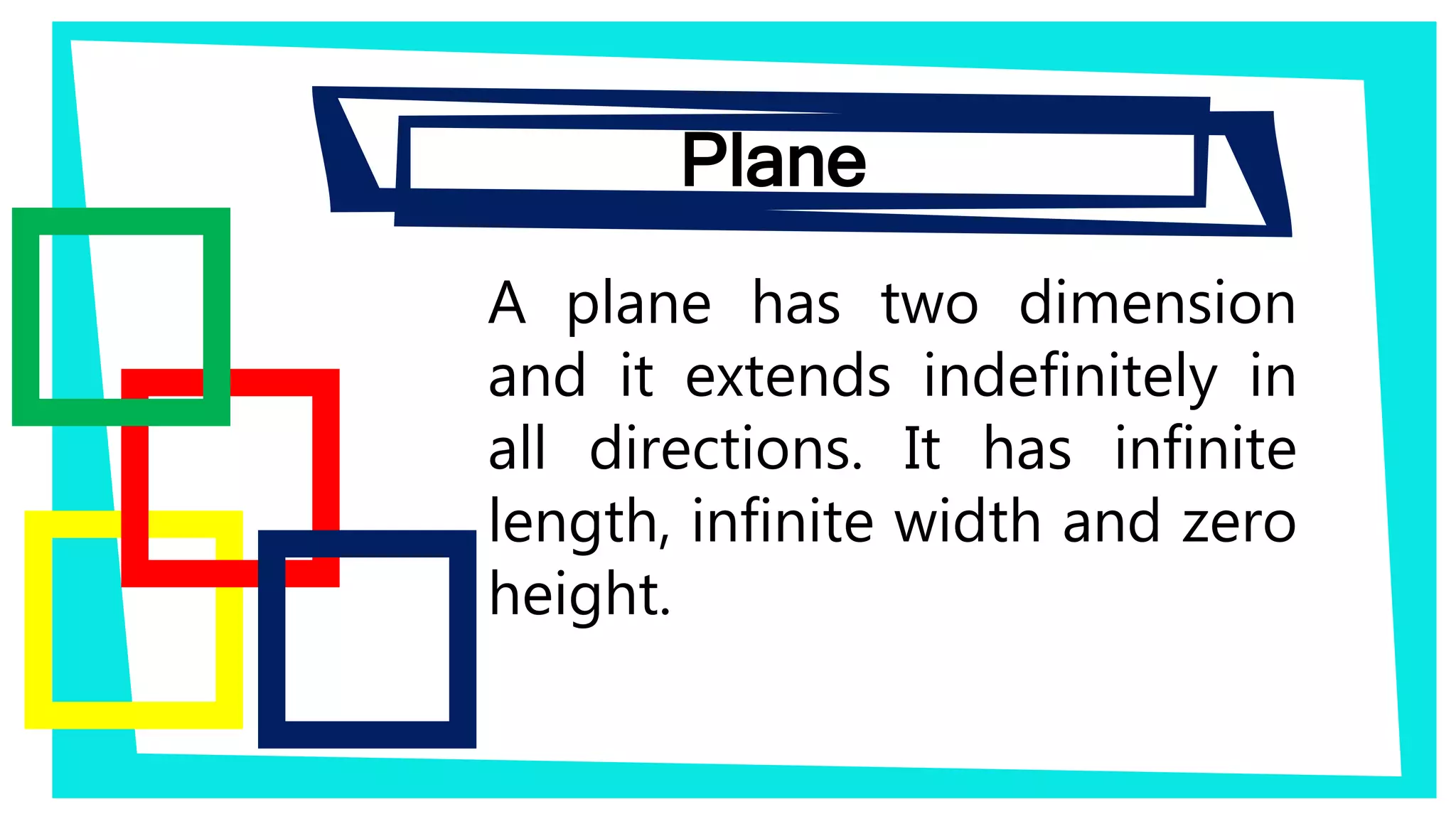
A geometric plane is a two-dimensional, flat surface that extends infinitely in all directions, without thickness. It contains an infinite number of points and lines. In technology, the plane serves as the canvas, the boundary, and the conceptual surface for interaction and representation.
The most immediate technological manifestation of a plane is the display screen itself—a 2D surface where all pixels reside. From a user interface perspective, every application window, every desktop, and every interactive element exists on or within a conceptual plane. In 3D modeling and rendering, planes are the fundamental units that compose the surfaces of objects. A model’s mesh is often made of numerous interconnected triangular or quadrangular planes (polygons) that define its form and allow for complex lighting and texturing.
In virtual reality (VR) and augmented reality (AR), planes become the “floors,” “walls,” and “tables” of immersive digital environments, serving as reference points for spatial tracking and interaction. For instance, AR applications detect real-world planes to overlay virtual objects convincingly. Beyond visual representations, the plane can also represent abstract spaces, such as the data planes used in machine learning for classification, where a hyperplane separates different categories of data points. The concept of a plane provides the necessary framework for organizing, interacting with, and perceiving digital content in a spatial context.
Geometry’s Abstract Core Driving Practical Tech Applications
The abstract nature of points, lines, and planes might seem far removed from the tangible outputs of technology. Yet, it is precisely their simplicity and universality that make them indispensable as the foundational elements for countless complex systems.

Computer Graphics, CAD, and Virtual Reality
Every pixel rendered on a screen, every polygon in a 3D model, and every immersive environment in VR/AR owes its existence to the principles derived from these undefined terms. In computer graphics, sophisticated algorithms calculate the positions of points, the paths of lines, and the orientations of planes to create realistic lighting, shadows, and textures. CAD software empowers engineers and designers to construct intricate mechanical parts or architectural blueprints by precisely manipulating points, drawing lines, and defining planes, translating conceptual ideas into tangible digital designs. In virtual reality, the user’s perception of a believable world hinges on the accurate spatial arrangement of virtual points, lines, and planes that mimic real-world physics and perspective.
Robotics, Automation, and Spatial Computing
For a robot to navigate a factory floor, pick up an object, or perform complex surgical procedures, it must have a robust understanding of its own position (points), its movement paths (lines), and the surrounding environment (planes). Robotics relies on geometric algorithms for collision detection, path planning, and object recognition. Sensors like LiDAR or depth cameras capture spatial data, which is then processed into point clouds or mesh representations (collections of planes) to build a digital map of the robot’s surroundings. This geometric understanding allows automated systems to interact intelligently and safely with the physical world.
Geospatial Systems, Data Visualization, and Mapping
Geographic Information Systems (GIS) and GPS technology are prime examples of geometry’s application. Every location on Earth is represented as a point with specific coordinates. Roads, rivers, and boundaries are represented as lines, while land parcels, countries, and topological features are defined by planes. Data visualization, whether presenting complex financial trends or scientific measurements, often projects multi-dimensional data onto 2D or 3D planes to make it comprehensible, using points to mark specific events and lines to show correlations or progressions.
The Imperative of Conceptual Clarity in Software Engineering
For software engineers and developers, a strong grasp of these fundamental geometric concepts is not just beneficial—it is imperative. It underpins the ability to design efficient algorithms, build robust systems, and ensure interoperability across diverse platforms.
Building Robust Algorithms and Data Structures
Many core algorithms in computer science have a geometric basis. Pathfinding algorithms (like A*), collision detection routines in games, rendering pipelines, and even machine learning clustering techniques inherently deal with spatial relationships and distances. Data structures like quadtrees and octrees, used for efficient spatial partitioning, are direct applications of how planes divide space. Understanding the geometric primitives allows developers to conceptualize and implement these algorithms more effectively, leading to more performant and reliable software.
Ensuring Interoperability and Digital Standards
A universal understanding of geometric concepts is crucial for establishing standards that allow different software applications and hardware devices to communicate seamlessly. Whether it’s the exchange of CAD files between different engineering platforms, the interpretation of sensor data from various IoT devices, or the consistent display of graphics across different operating systems, adherence to common geometric principles ensures compatibility and reduces friction in complex digital ecosystems. This foundational agreement on how to represent points, lines, and planes underpins the very possibility of a connected technological world.
From Ancient Axioms to Modern AI: The Enduring Relevance
The concepts of points, lines, and planes, first formalized by ancient Greek mathematicians, have traversed millennia to remain critically relevant in the cutting-edge fields of today. Their enduring utility speaks to their fundamental nature.
Machine Learning and High-Dimensional Spaces
Even in the abstract world of machine learning, the spirit of these geometric concepts persists. Data points in high-dimensional feature spaces, the concept of “distance” between data points (e.g., Euclidean distance), and the “hyperplanes” used by algorithms like Support Vector Machines (SVMs) to classify data, all draw conceptual parallels to their simpler geometric counterparts. The ability to visualize and reason about these abstract spaces, even if beyond human sensory perception, is enhanced by an intuitive understanding of basic geometry.
The Future of Spatial Computing and Mixed Realities
As technology moves towards more immersive and spatially aware experiences—like the metaverse, advanced augmented reality, and digital twin technologies—the importance of precisely defining and manipulating points, lines, and planes will only grow. These future computing paradigms are built on a bedrock of spatial geometry, where every virtual object, every interaction, and every seamless blend of digital and physical realities hinges on the accurate application of these fundamental, undefined terms. From the earliest human attempts to map the world to the creation of boundless digital universes, the point, the line, and the plane remain the silent, indispensable architects of our spatial understanding.
aViewFromTheCave is a participant in the Amazon Services LLC Associates Program, an affiliate advertising program designed to provide a means for sites to earn advertising fees by advertising and linking to Amazon.com. Amazon, the Amazon logo, AmazonSupply, and the AmazonSupply logo are trademarks of Amazon.com, Inc. or its affiliates. As an Amazon Associate we earn affiliate commissions from qualifying purchases.