
In the intricate machinery of life, neurons stand as the fundamental units responsible for transmitting information throughout the nervous system. These remarkable cells are the biological substratum of thought, sensation, movement, and memory. Yet, their significance extends far beyond biology, serving as the profound and enduring inspiration for one of the most transformative technological advancements of our era: Artificial Intelligence (AI). Specifically, the architecture and operational principles of biological neurons laid the groundwork for Artificial Neural Networks (ANNs), the backbone of modern machine learning and deep learning.
To truly grasp the essence and potential of AI, particularly in its quest to mimic human-like intelligence, one must first understand the elementary components of its biological muse. Just as understanding the basic circuit components is vital for electronics engineers, comprehending the fundamental parts of a neuron is essential for anyone delving into the theoretical underpinnings and practical applications of AI.
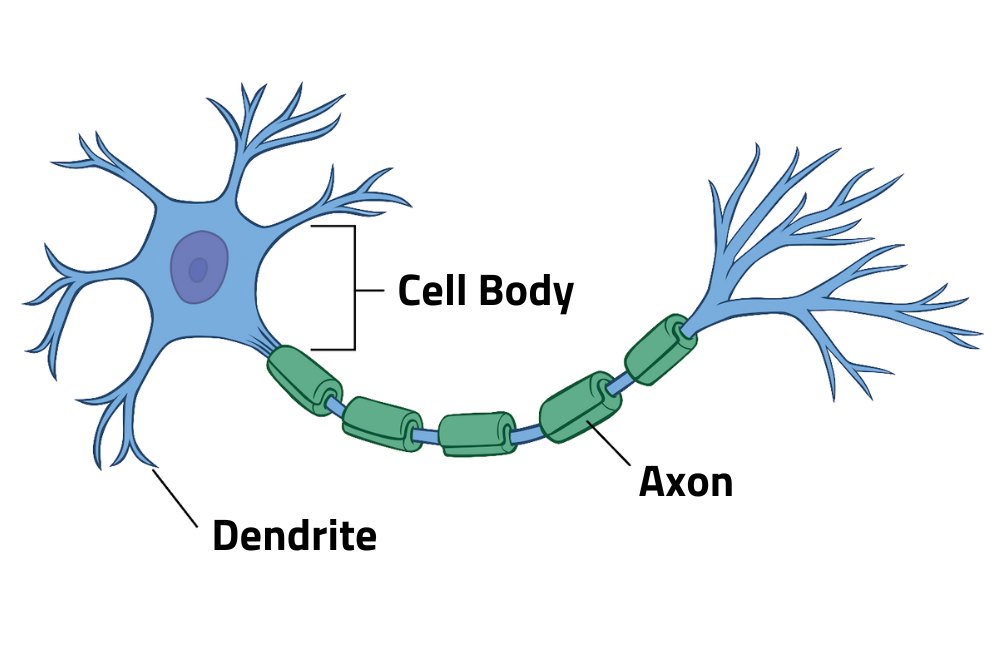
The Biological Blueprint: Core Components of a Neuron
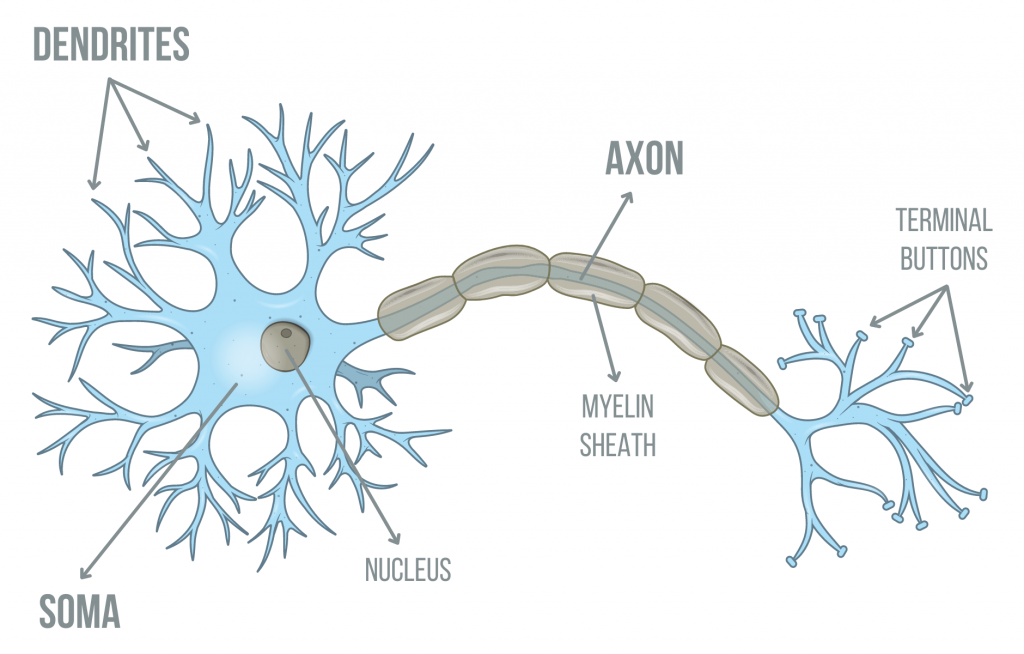
A neuron is a specialized cell designed to transmit electrical and chemical signals. Its primary function is to process and relay information, forming vast, complex networks that enable everything from simple reflexes to abstract reasoning. Despite their diverse forms and functions throughout the brain and body, most neurons share a common structural organization comprising three main parts: the dendrites, the soma (or cell body), and the axon. These three components work in concert to receive, process, and transmit information, embodying a sophisticated communication system that has guided the development of computational intelligence for decades.
The Dendrite: Receiving the Signals
The dendrites are typically tree-like, branching extensions that emanate from the neuron’s cell body. Their appearance, often likened to the branches of a tree, reflects their primary role: to receive incoming signals from other neurons. These signals, in the form of chemical messengers called neurotransmitters, bind to specialized receptors on the dendrite’s surface. A single neuron can possess numerous dendrites, each further branching into a complex arbor, allowing it to receive input from thousands, or even tens of thousands, of other neurons simultaneously.
In the context of Artificial Neural Networks, dendrites find their conceptual parallel in the input connections of an artificial neuron (or node). Each connection carries a signal, often a numerical value, representing data from a previous layer or an initial input feature. The multitude of dendritic branches can be seen as analogous to the multiple weighted inputs that converge on an artificial neuron, where each input has a certain ‘strength’ or ‘weight’ assigned to it, akin to the varying sensitivity of different dendrite receptors or the proximity of a synaptic connection. Understanding how dendrites integrate these diverse inputs is crucial for designing robust input layers and feature extraction mechanisms in AI models.
The Soma (Cell Body): The Processing Hub
The soma, or cell body, is the central part of the neuron. It contains the nucleus, which houses the cell’s genetic material, and other organelles vital for maintaining cellular function. However, beyond its biological maintenance role, the soma is the neuron’s primary integration center. It receives all the electrical signals that have been generated by its dendrites. Here, these numerous incoming signals, which can be excitatory (encouraging the neuron to fire) or inhibitory (discouraging it from firing), are summed up and processed. The soma performs a crucial ‘decision-making’ function: if the cumulative input reaches a certain threshold, the neuron will generate an electrical impulse, known as an action potential.
This integrative function of the soma is directly mirrored by the activation function within an artificial neuron. In an ANN, the weighted sum of all inputs received by a node is computed, much like the soma sums up all dendritic signals. This sum then passes through an activation function (e.g., sigmoid, ReLU, tanh), which decides whether the artificial neuron ‘fires’ or ‘activates’ and what strength its output signal should be. This decision-making process is fundamental to the non-linear computation capabilities of neural networks, allowing them to learn complex patterns and make sophisticated classifications or predictions that linear models cannot achieve. The elegance of the soma’s thresholding mechanism inspired the early ‘perceptrons’ and continues to be a core element in all deep learning architectures.
The Axon: Transmitting the Output
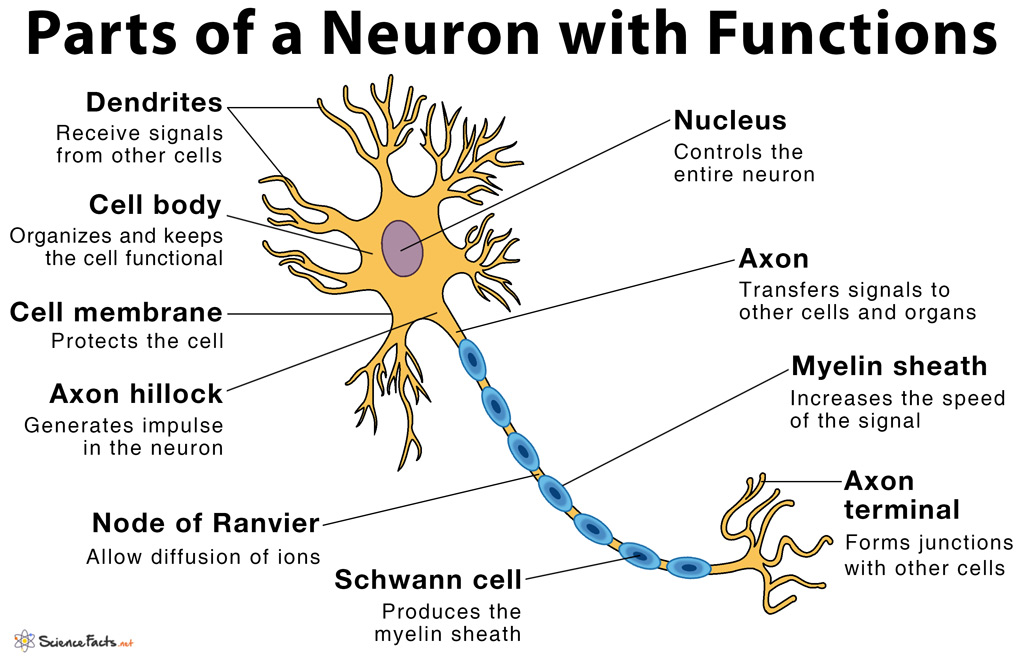
The axon is a long, slender projection that extends from the soma. Its primary role is to transmit the electrical impulse (action potential) generated by the soma to other neurons, muscles, or glands. Axons can vary significantly in length, from fractions of a millimeter to over a meter in some cases, enabling communication across vast distances within the nervous system. Many axons are insulated by a fatty layer called the myelin sheath, which significantly speeds up the transmission of the electrical signal. At its distal end, the axon typically branches into several axon terminals, which form connections with the dendrites or cell bodies of other neurons.
The axon’s function aligns with the output of an artificial neuron. Once an artificial neuron’s activation function determines its output value, this value is then transmitted to other artificial neurons in subsequent layers. The axon terminals, where signals are passed on, are analogous to the weighted connections that extend from one artificial neuron to the inputs of others. In AI, the efficient and accurate propagation of these output signals through the network is critical for the overall performance of the model, directly influencing how well it can learn from data and generalize to new, unseen examples. The concept of signal transmission and its modulation (e.g., by myelin sheath speed) has also influenced thinking about optimizing data flow and processing speeds within complex AI architectures.
The Synapse: Bridging the Information Gap
While not strictly one of the “three parts” of a single neuron, the synapse is an indispensable component of neuronal communication and, by extension, a critical concept for understanding neural networks. A synapse is the specialized junction between the axon terminal of one neuron and the dendrite or soma of another neuron. It is here that information is transferred from one neuron to the next. When an action potential reaches the axon terminal, it triggers the release of neurotransmitters into the synaptic cleft, a tiny gap between the two neurons. These neurotransmitters then bind to receptors on the receiving neuron, thus propagating the signal.
In ANNs, synapses are represented by the weights and biases connecting artificial neurons. The strength of these synaptic connections, or the ‘weight’ assigned to each input, dictates the influence one artificial neuron has on another. The ability of biological synapses to strengthen or weaken over time, a phenomenon known as synaptic plasticity, is the biological basis for learning and memory. This concept is directly translated into the learning algorithms of AI, particularly backpropagation, where the weights (synapses) of the network are iteratively adjusted based on the error in the model’s output. This constant adjustment allows the ANN to ‘learn’ from data, reinforcing useful connections and diminishing less relevant ones, much like the brain forms and refines memories and skills through experience.
From Biology to Silicon: The Rise of Artificial Neural Networks
The structural and functional simplicity yet profound effectiveness of the biological neuron served as the initial inspiration for early computational models. In the 1940s, Warren McCulloch and Walter Pitts developed a simplified mathematical model of a biological neuron, demonstrating how such a unit could perform logical operations. This pioneering work laid the conceptual foundation for Artificial Neural Networks, abstracting the complex biological processes into manageable computational units.
The mapping from biology to AI is elegant in its simplification:
- Dendrites receive inputs from other neurons or external data sources.
- The Soma sums these inputs, applies an activation function, and makes a ‘decision’.
- The Axon transmits the output of this decision to other neurons.
- Synapses represent the trainable weights that modulate the strength of these connections, enabling the network to learn.
While artificial neurons are vastly simpler than their biological counterparts – lacking the biological complexity of ion channels, neurotransmitters, and complex metabolic processes – this abstraction has proven incredibly powerful. It allows for the construction of vast networks of interconnected processing units that, when trained on massive datasets, can identify intricate patterns, make predictions, and even generate creative content.
The Power of Interconnectedness: Mimicking Brain Function
The true power of both biological and artificial neural networks lies not in individual neurons, but in their massive, interconnected nature. Billions of biological neurons form a highly parallel and distributed processing system capable of incredible feats of intelligence. Similarly, ANNs leverage this interconnectedness to process information in parallel, enabling them to tackle complex tasks like image recognition, natural language processing, and predictive analytics with remarkable efficacy. Each layer in a deep neural network learns increasingly abstract representations of the input data, building on the features extracted by previous layers, much like different regions of the brain specialize in processing different types of information.
Deep Learning and Beyond: Evolving Artificial Intelligence
The evolution from simple perceptrons to deep neural networks, characterized by multiple hidden layers, represents a significant leap in AI capabilities. This advancement allowed AI models to learn hierarchical representations of data, mirroring how the human brain processes information from raw sensory input to high-level conceptual understanding. Further innovations, such as convolutional neural networks (CNNs) for image processing, recurrent neural networks (RNNs) for sequential data like language, and more recently, transformer architectures, all draw implicit or explicit inspiration from neuroscience. Concepts like attention mechanisms in transformers, for instance, parallel the brain’s ability to focus on salient information while disregarding distractions, improving the efficiency and accuracy of processing.
The Symbiotic Future: Neuroscience and AI
The relationship between neuroscience and AI is increasingly symbiotic. As AI research advances, particularly with the advent of more sophisticated and interpretable models, it is beginning to offer powerful tools back to neuroscience. AI can help analyze vast amounts of brain imaging data, simulate complex neural activities, and identify subtle patterns in neurological disorders, accelerating our understanding of the brain. Conversely, new discoveries in neuroscience, such as the intricacies of synaptic plasticity, the role of glial cells, or the energy efficiency of biological computation, continue to provide fresh insights and potential blueprints for designing more advanced, energy-efficient, and robust AI architectures. Neuromorphic computing, for example, seeks to build hardware that directly mimics brain structures to achieve greater computational efficiency and closer approximation to biological intelligence.
Conclusion
The biological neuron, with its three fundamental parts – the dendrite for receiving, the soma for processing, and the axon for transmitting – serves as a timeless model of information processing. This elegant design has not only enabled the unparalleled intelligence of biological life but has also provided the foundational inspiration for Artificial Intelligence. From the initial conceptualization of artificial neurons to the advanced architectures of deep learning, the principles of biological communication remain a guiding light. As technology continues to evolve, the intricate dance between understanding the brain and building intelligent machines promises to unlock new frontiers, further blurring the lines between the natural and the artificial and propelling humanity toward an ever-smarter future. The journey to decode the brain’s wisdom continues to be one of the most exciting and fruitful intersections of biology and technology.
aViewFromTheCave is a participant in the Amazon Services LLC Associates Program, an affiliate advertising program designed to provide a means for sites to earn advertising fees by advertising and linking to Amazon.com. Amazon, the Amazon logo, AmazonSupply, and the AmazonSupply logo are trademarks of Amazon.com, Inc. or its affiliates. As an Amazon Associate we earn affiliate commissions from qualifying purchases.