
Cell theory, a foundational pillar of biology, provides a unifying framework for understanding life at its most fundamental level. It’s not a single discovery, but rather a culmination of observations and deductions made by several pioneering scientists over decades. At its core, cell theory elegantly explains what cells are, where they come from, and their indispensable role in all living organisms. While the theory has evolved over time, incorporating new insights from microscopy and molecular biology, its essential tenets remain remarkably consistent. Understanding these core principles is crucial for anyone delving into the life sciences, from aspiring students to seasoned researchers.
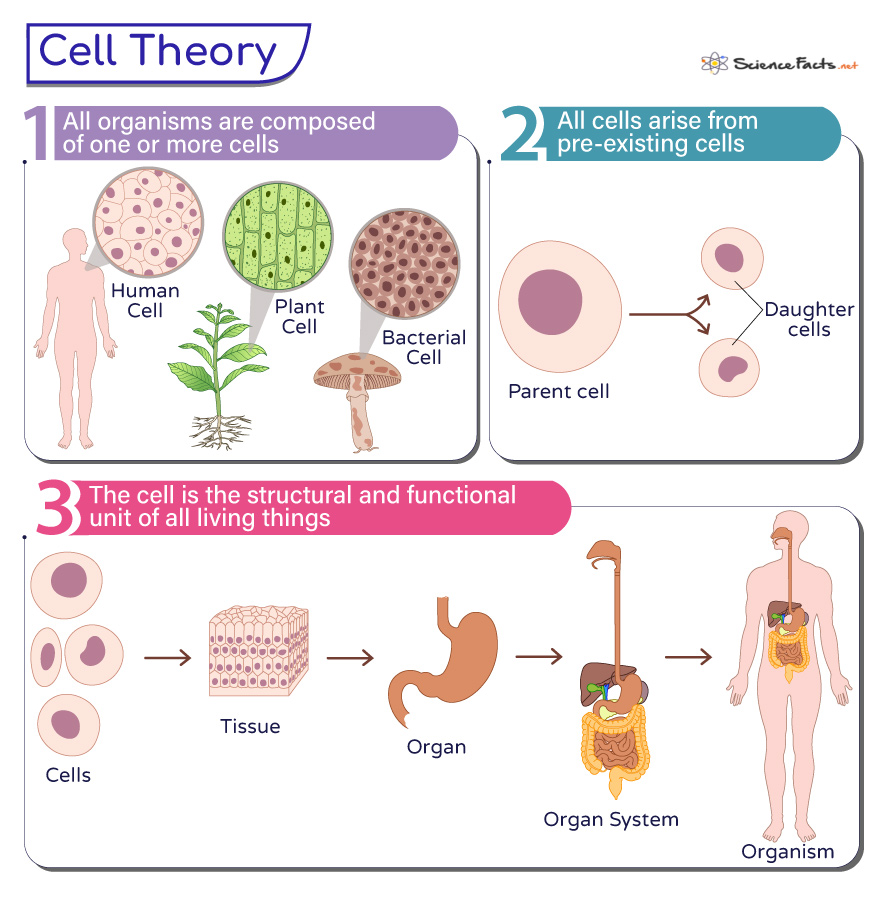
The three main parts of cell theory, often presented as postulates, offer a clear and concise summary of this vital scientific concept. They move from the basic building blocks of life to their origins and their universal presence. Let’s dissect each of these fundamental components to gain a comprehensive appreciation for their significance.
I. The All-Encompassing Presence of Cells: All Living Things Are Composed of Cells
This first tenet of cell theory is perhaps the most intuitive, yet it carries profound implications. It declares that the cell is the fundamental unit of structure and organization in all known living organisms. This means that whether we’re examining a single-celled bacterium, a sprawling redwood tree, or a complex animal like a human, the cell is the irreducible unit that defines and comprises it.
A. The Cell as the Basic Unit of Life
Historically, the understanding that life was built from discrete units took time to solidify. Before the advent of effective microscopes, the notion of microscopic building blocks of life was largely unimaginable. Early microscopists, such as Robert Hooke in the 17th century, observed what he termed “cells” in slices of cork. However, his understanding was limited; he believed these were empty, non-living structures. It wasn’t until the 19th century, with significant advancements in microscope technology and lens grinding, that scientists like Matthias Schleiden and Theodor Schwann began to systematically observe a wide variety of plant and animal tissues.
Schleiden, a botanist, concluded in 1838 that all plants are made of cells. Shortly thereafter, in 1839, zoologist Theodor Schwann extended this observation to animals, stating that all animals are also composed of cells. Their combined work laid the groundwork for this crucial postulate: the cell is the smallest unit that can be called “alive.” This means that any structure or organism considered living must, at some point, exhibit cellular organization. This principle immediately distinguished the living from the non-living, providing a clear biological criterion for life.
B. Diversity and Uniformity in Cellular Structure
While the statement “all living things are composed of cells” emphasizes uniformity, it’s also important to acknowledge the incredible diversity of cells. From the elongated nerve cells in animals to the photosynthetic cells in plants, and the vastly different shapes and sizes of bacteria, there is immense variation in form and function. However, beneath this diversity lies a remarkable underlying unity. All cells, regardless of their specific role or the organism they inhabit, share fundamental characteristics.
These shared features include the presence of a cell membrane that encloses the cell and regulates the passage of substances in and out. Inside the cell membrane, the cytoplasm is the jelly-like substance that fills the cell and houses its internal components. Furthermore, all cells contain genetic material, DNA, which carries the instructions for the cell’s function and reproduction. While the organization of this genetic material differs between simpler prokaryotic cells (like bacteria) and more complex eukaryotic cells (found in plants, animals, fungi, and protists), its presence is universal. This dual aspect of diversity in form and unity in fundamental components makes the cell a truly remarkable and universally applicable biological concept.
C. Implications for Organisms: From Unicellular to Multicellular
The understanding that all living things are composed of cells directly leads to the classification of organisms into two broad categories: unicellular and multicellular. Unicellular organisms, as the name suggests, consist of a single cell that performs all essential life functions – metabolism, reproduction, response to stimuli, and adaptation. Bacteria, archaea, and many protists fall into this category. Their single cell is a self-sufficient entity, a complete life form in itself.
Multicellular organisms, on the other hand, are composed of many cells, often organized into tissues, organs, and organ systems. These cells are specialized for different functions, contributing to the overall survival and reproduction of the organism. For instance, in animals, nerve cells transmit signals, muscle cells enable movement, and blood cells transport oxygen. In plants, specialized cells form roots for absorption, leaves for photosynthesis, and stems for support. The existence of multicellularity is only possible because individual cells can cooperate and communicate, forming a cohesive and functional whole. This principle of cellular composition is the bedrock upon which all biological complexity is built.
II. The Cell as the Unit of Function: All Life Processes Occur Within Cells
The second tenet of cell theory expands upon the first, asserting that all metabolic and life-sustaining activities occur within cells. This means that processes like energy production, synthesis of molecules, waste removal, and growth, which we associate with “life,” are not external phenomena but rather internal cellular events.
A. Metabolism: The Chemical Symphony Within
Metabolism refers to the sum of all chemical reactions that occur within an organism to maintain life. In the context of cell theory, this entire complex web of reactions takes place within the confines of the cell. For example, cellular respiration, the process by which cells convert glucose and oxygen into ATP (adenosine triphosphate), the primary energy currency of the cell, occurs in specific organelles like mitochondria in eukaryotic cells. Photosynthesis, the process by which plants and some other organisms convert light energy into chemical energy, takes place within chloroplasts.
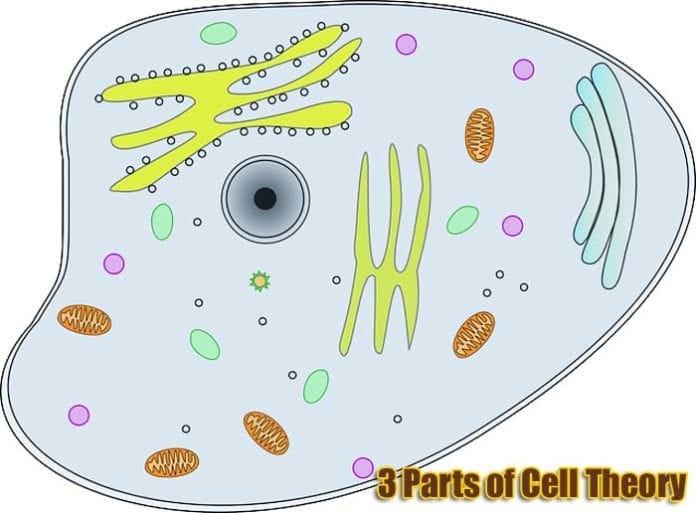
Even simpler processes like the synthesis of proteins, the building blocks of cellular structures and enzymes, are meticulously orchestrated within the cell’s ribosomes, guided by the genetic code from DNA. Waste products generated from these metabolic pathways are also processed and eliminated by the cell. This internalization of life’s essential functions underscores the cell’s role as a self-contained, dynamic entity, capable of sustaining itself and contributing to the life of the organism as a whole.
B. Reproduction and Growth at the Cellular Level
Cell theory also posits that reproduction and growth are fundamentally cellular processes. For unicellular organisms, reproduction typically involves cell division, where one cell divides into two or more daughter cells. This can occur through various mechanisms like binary fission in bacteria. For multicellular organisms, growth involves an increase in the number of cells, also through cell division (mitosis). While specialized germ cells undergo meiosis for sexual reproduction, the fundamental mechanism of increasing cell numbers stems from the inherent reproductive capacity of individual cells.
Furthermore, cellular repair and regeneration also fall under this purview. When cells are damaged, the organism relies on the ability of remaining cells to divide and replace them, or for existing cells to undergo repair processes. This cellular-level activity is crucial for maintaining tissue integrity and organismal health. Thus, the very essence of life’s continuity, from individual organisms to populations, is rooted in the ability of cells to divide, grow, and maintain their functions.
C. The Interdependence of Cellular Functions
Within multicellular organisms, the universality of cellular function takes on a new dimension: interdependence. While each cell is a functional unit, it rarely operates in isolation. Instead, cells within tissues and organs perform specialized roles, and these specialized functions are coordinated to support the entire organism. For instance, muscle cells are specialized for contraction, but they rely on nerve cells to signal them to contract and on circulatory cells to deliver the necessary oxygen and nutrients.
This intricate network of cellular interdependence highlights how the overall life processes of a complex organism are the emergent properties of countless individual cellular activities working in concert. The failure of one type of cell to perform its function can have cascading effects throughout the organism, emphasizing the critical importance of each cell’s contribution to the collective.
III. The Origin of Cells: All New Cells Arise from Pre-existing Cells
The third and final postulate of cell theory, often attributed to Rudolf Virchow in 1855, is perhaps the most revolutionary and definitively refutes earlier ideas about spontaneous generation. It states that all cells arise from pre-existing cells through cell division. This principle is fundamental to our understanding of inheritance, development, and the continuity of life.
A. Rejecting Spontaneous Generation
Before Virchow’s assertion, the prevailing belief for centuries was that living organisms could arise spontaneously from non-living matter. For example, it was thought that maggots spontaneously generated from rotting meat, or that mice could arise from piles of grain and rags. These observations, while seemingly plausible without microscopic investigation, were ultimately disproven through rigorous scientific experimentation.
Pioneering work by scientists like Francesco Redi in the 17th century, who showed that maggots only appeared on meat exposed to flies, and Louis Pasteur in the 19th century, who famously demonstrated that microorganisms in broth would only grow if exposed to air containing microbial spores, systematically dismantled the theory of spontaneous generation. Pasteur’s experiments, in particular, using swan-neck flasks that allowed air in but trapped airborne microorganisms, were crucial in establishing that life, in its microbial form, did not spontaneously arise. Virchow’s postulate cemented this understanding for all life forms, stating that the only way to get a new cell is from another, already existing cell.
B. Cell Division: The Engine of Continuity
Cell division, the process by which a parent cell divides into two or more daughter cells, is the mechanism that underpins this third tenet. As mentioned earlier, this can occur through mitosis for somatic (body) cells or meiosis for germ cells. Mitosis ensures that each daughter cell receives an identical copy of the parent cell’s genetic material, allowing for growth, repair, and asexual reproduction. Meiosis, on the other hand, produces genetically diverse gametes (sperm and egg cells) for sexual reproduction.
The fidelity of cell division is paramount. Errors in this process can lead to significant consequences, including developmental abnormalities or diseases like cancer. Therefore, the intricate regulatory mechanisms that govern cell division highlight its critical role in ensuring the accurate transmission of genetic information from one generation of cells to the next, and consequently, from one generation of organisms to the next.
C. The Concept of Lineage and Inheritance
The postulate that all new cells arise from pre-existing cells establishes a continuous lineage of life stretching back to the very first cells on Earth. Every cell alive today is a descendant of an earlier cell, tracing back through an unbroken chain of divisions. This concept is intrinsically linked to inheritance. The genetic material (DNA) passed from a parent cell to its daughter cells carries the blueprints for the organism’s traits.
This understanding revolutionized biology, providing a mechanistic explanation for heredity. It explained how traits are passed from parents to offspring and how variations arise and are propagated. It laid the foundation for genetics and molecular biology, allowing us to understand the molecular basis of life and the mechanisms by which organisms evolve. In essence, Virchow’s insight provided the crucial missing piece: a mechanism for the origin and continuity of cellular life.
In conclusion, the three main parts of cell theory – that all living things are composed of cells, that all life processes occur within cells, and that all new cells arise from pre-existing cells – form a cohesive and powerful framework for understanding life. These postulates, established through centuries of scientific inquiry, continue to be cornerstones of biological science, guiding research and shaping our comprehension of the living world. They are a testament to the elegance and simplicity of nature’s fundamental building blocks and the enduring principles that govern them.
aViewFromTheCave is a participant in the Amazon Services LLC Associates Program, an affiliate advertising program designed to provide a means for sites to earn advertising fees by advertising and linking to Amazon.com. Amazon, the Amazon logo, AmazonSupply, and the AmazonSupply logo are trademarks of Amazon.com, Inc. or its affiliates. As an Amazon Associate we earn affiliate commissions from qualifying purchases.