
The American financial landscape is anchored by a select group of massive institutions that manage trillions of dollars in assets, facilitate global trade, and provide the essential infrastructure for the domestic economy. Understanding who these giants are—and how they operate—is crucial for anyone navigating personal finance, business investment, or the broader economic environment. These institutions are often categorized by the Federal Reserve and international regulators as “Systemically Important Financial Institutions” (SIFIs), colloquially known as banks that are “too big to fail.”
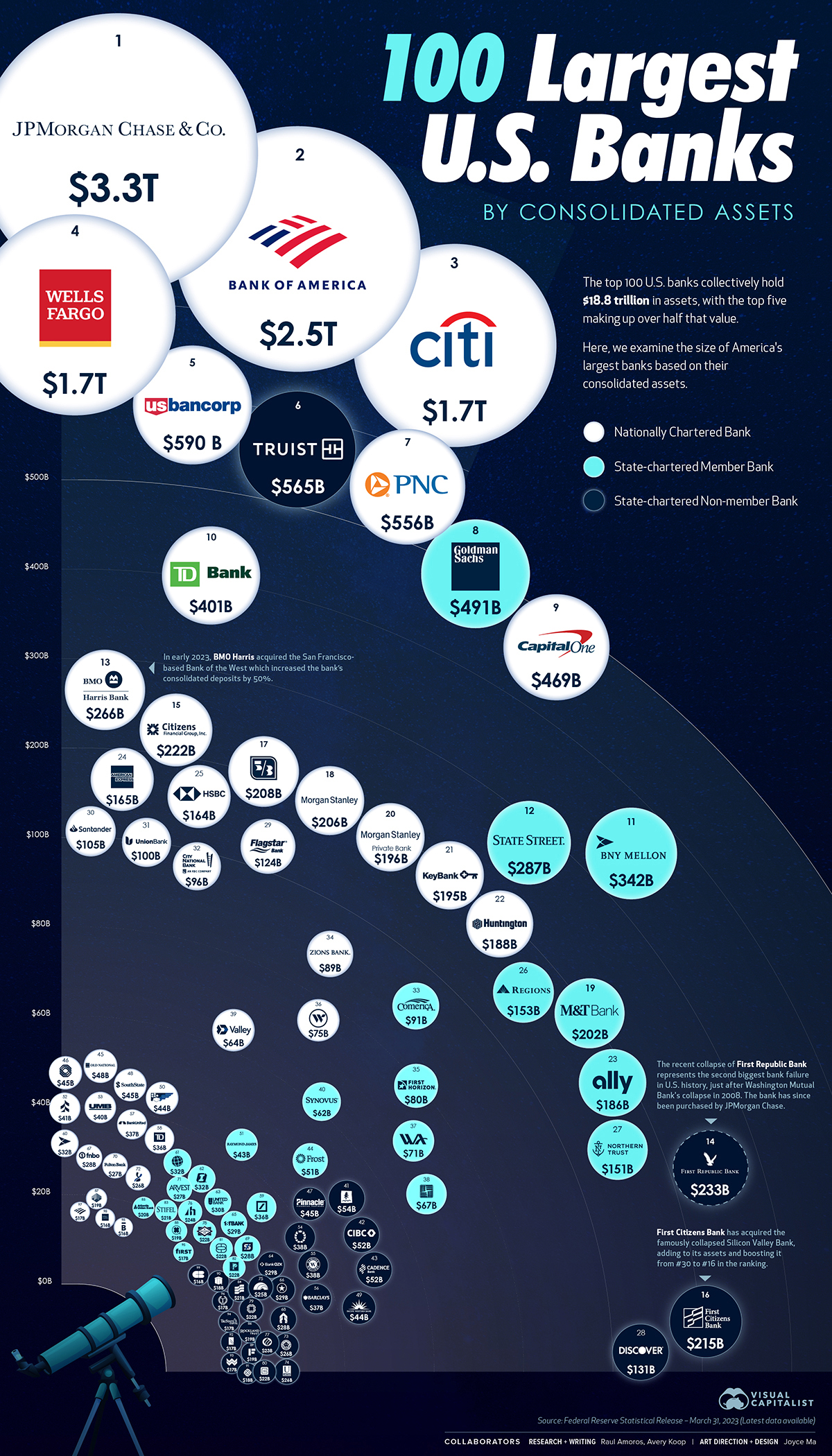
As of the latest reporting cycles, the concentration of wealth within the top tier of American banking is significant. These banks do not merely hold deposits; they act as the primary engines for mortgage lending, corporate credit, investment banking, and the development of fintech solutions. Below, we explore the largest banks in the United States by consolidated assets and analyze their strategic roles in the modern economy.
The “Big Four”: Dominating the American Financial Landscape
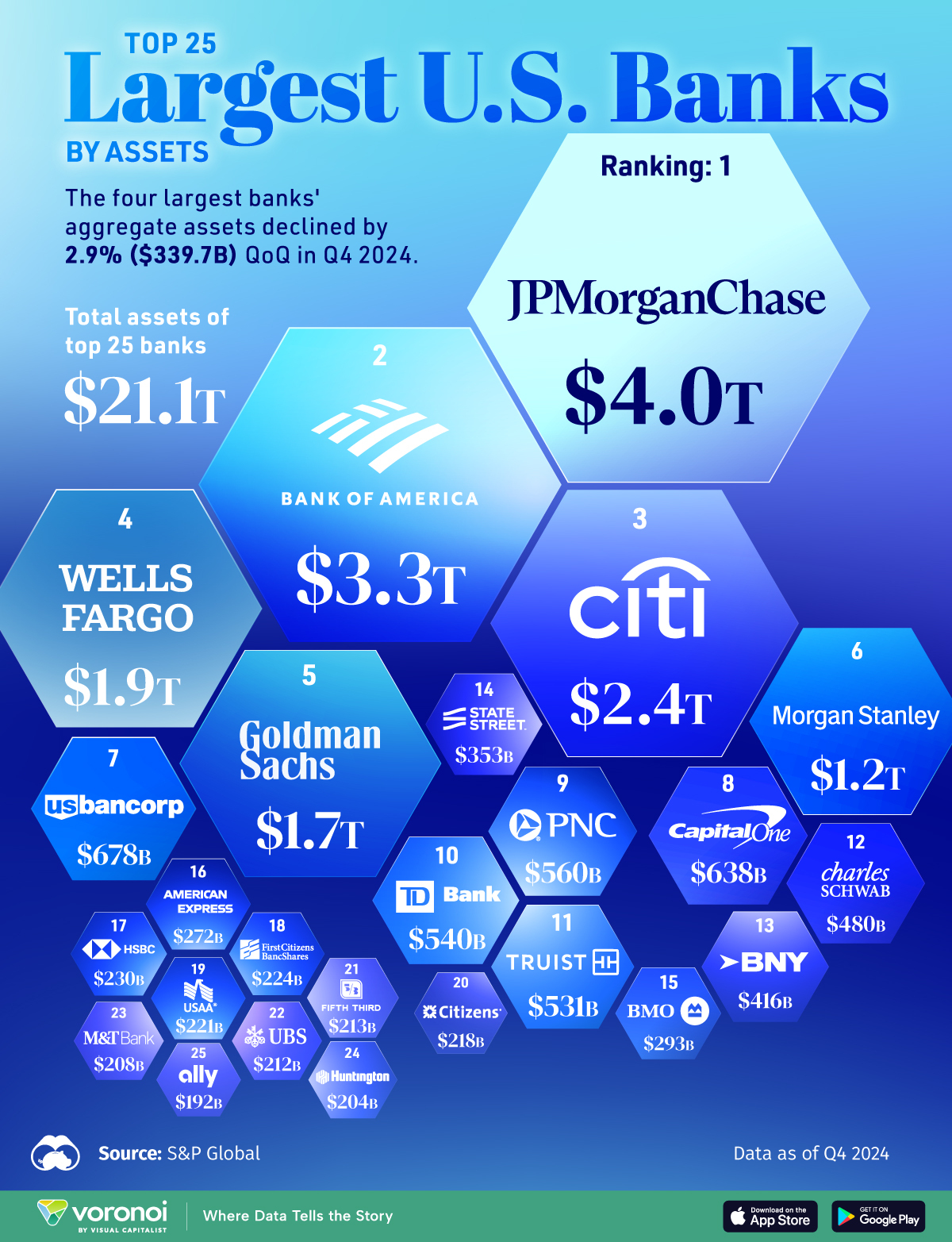
At the pinnacle of the U.S. banking hierarchy sit four institutions that are significantly larger than their nearest competitors. These “Big Four” banks—JPMorgan Chase, Bank of America, Citigroup, and Wells Fargo—possess a combined asset base that exceeds the GDP of many developed nations.
JPMorgan Chase & Co.: The Unrivaled Leader
With consolidated assets hovering around $3.9 trillion, JPMorgan Chase & Co. is the largest bank in the United States and one of the largest in the world. Headquartered in New York City, it is the result of the merger of several historic institutions, most notably the Chase Manhattan Bank and J.P. Morgan & Co.
JPMorgan’s dominance is built on a diversified business model. Through its retail brand, Chase, it operates thousands of branches and serves nearly half of all U.S. households. On the institutional side, its investment bank is a global leader in mergers and acquisitions (M&A) and capital markets. For the individual investor, JPMorgan offers a seamless integration between retail banking and sophisticated investment tools via J.P. Morgan Self-Directed Investing. Its ability to absorb smaller institutions during times of crisis, such as the acquisition of First Republic Bank in 2023, further cements its position as the ultimate pillar of American finance.
Bank of America (BofA): The Consumer Powerhouse
Bank of America, based in Charlotte, North Carolina, holds approximately $3.2 trillion in assets. While it maintains a massive investment banking arm, BofA is perhaps most famous for its vast retail footprint. It has spent the last decade heavily investing in digital transformation, with its “Erica” AI assistant becoming a benchmark for mobile banking technology.
A key strategic advantage for Bank of America is its ownership of Merrill (formerly Merrill Lynch). This allows the bank to offer a tiered ecosystem where a customer’s checking account, mortgage, and retirement portfolio are all linked. This “relationship banking” model incentivizes high-net-worth individuals to keep their assets within the BofA ecosystem through programs like Preferred Rewards, which offer boosted credit card rewards and discounted loan rates based on total balances.
Citigroup Inc.: The Global Connector
Citigroup, with roughly $2.4 trillion in assets, distinguishes itself through its immense international presence. Unlike its peers who focus heavily on the U.S. consumer, Citi operates as a “global bank for global companies.” It facilitates cross-border payments and trade finance in over 160 countries and jurisdictions.
For the domestic consumer, Citigroup is a major player in the credit card market. Through its Citi Retail Services division, it manages private-label credit cards for some of the world’s largest retailers, including Costco and Best Buy. While Citi has recently undergone a strategic “refocusing” to exit several international consumer markets, it remains an indispensable partner for multinational corporations and institutional investors.
Wells Fargo & Co.: The Specialized Lender
Rounding out the Big Four is Wells Fargo, with assets near $1.9 trillion. Historically known as the premier mortgage lender in the United States, Wells Fargo has a deep-rooted presence in communities across the country, particularly in the West and Midwest.
Despite facing significant regulatory scrutiny over the past decade regarding its sales practices, Wells Fargo remains a titan in the commercial banking and mid-market business sectors. Its strategy revolves around “the real economy”—providing the loans and cash management services that small-to-medium enterprises (SMEs) need to operate. As it works through its regulatory asset cap, the bank continues to be a primary choice for consumers seeking traditional retail banking services and home financing.
The Next Tier: Investment Giants and Regional Powerhouses
While the Big Four capture the majority of headlines, the next tier of banks includes institutions that are equally vital but often more specialized in their service offerings.
Goldman Sachs and Morgan Stanley
Goldman Sachs (approx. $1.6 trillion in assets) and Morgan Stanley (approx. $1.2 trillion in assets) are historically known as investment banks rather than retail giants. However, following the 2008 financial crisis, both transitioned into bank holding companies.

In recent years, these firms have moved aggressively into the personal finance space. Goldman Sachs launched Marcus, a digital-only bank offering high-yield savings accounts and personal loans, though it has recently pivoted back toward its core strengths in wealth management and institutional services. Morgan Stanley, meanwhile, solidified its position as a wealth management leader through the acquisitions of E*TRADE and Eaton Vance, moving closer to the consumer by providing high-end brokerage and financial planning services.
U.S. Bancorp and PNC Financial Services
As we move into the $500 billion to $700 billion asset range, we find the “super-regionals.” U.S. Bancorp (the parent of U.S. Bank) and PNC Financial Services have grown through strategic acquisitions to become viable alternatives to the Big Four.
PNC, based in Pittsburgh, expanded its national footprint significantly by acquiring BBVA USA in 2021. These banks are often favored by consumers who want the technological capabilities of a large bank but prefer the perceived “local” feel of a regional institution. They are particularly strong in the Midwest and Mid-Atlantic regions, offering competitive business banking suites that rival the national giants.
Truist and Capital One
Truist Financial was formed by the “merger of equals” between BB&T and SunTrust, creating a powerhouse in the Southeastern United States with over $530 billion in assets. Meanwhile, Capital One (approx. $470 billion in assets) has redefined the banking experience by blending credit card dominance with a unique retail approach, such as its “Capital One Cafés.” Capital One is a leader in using data science and technology to drive lending decisions, making it a favorite for tech-savvy consumers and those looking for high-yield digital products.
How Size Impacts Consumers: Pros and Cons of Banking with Giants
For the individual or business owner, choosing to bank with one of these massive institutions involves a trade-off between scale and personalized service.
The Advantages of Scale
-
Technological Sophistication: The largest banks have multibillion-dollar annual R&D budgets. This results in superior mobile apps, robust digital security features, and integration with third-party financial tools.
-
Global Accessibility: For frequent travelers or international businesses, having a bank with a global ATM network and foreign exchange capabilities is an immense convenience.
-
Product Variety: Large banks are “one-stop shops.” You can manage a checking account, a brokerage account, a mortgage, and a small business loan all under one digital roof.
The Disadvantages of Scale
-
Lower Interest Rates on Savings: Because large banks have an abundance of deposits, they often feel less pressure to offer competitive rates on savings accounts and CDs compared to online-only banks or smaller credit unions.
-
Rigid Lending Criteria: Large institutions rely heavily on automated credit scoring. If your financial situation is complex or “outside the box,” you may find more flexibility at a smaller community bank where a human loan officer has more discretionary power.
-
Customer Service Hurdles: Navigating the bureaucracy of a multi-trillion dollar bank can be frustrating. While digital tools are excellent, getting personalized assistance for a complex problem can sometimes involve long wait times and automated menus.
The Future of Large Banks: Competition and Innovation
The dominance of America’s largest banks is currently being challenged by two fronts: regulatory pressure and the rise of fintech.
Regulators continue to implement stricter capital requirements to ensure these banks can withstand economic downturns. This often limits how much these banks can return to shareholders in the form of dividends or buybacks. Simultaneously, “neobanks” and payment processors like Chime, Revolut, and Block (formerly Square) are peeling away younger consumers by offering fee-free structures and earlier access to paychecks.
To counter this, the largest banks are no longer just financial institutions; they are technology companies with banking licenses. They are integrating AI to detect fraud in real-time, using machine learning to personalize investment advice, and exploring blockchain for faster cross-border settlements. The survival of these giants depends on their ability to remain agile despite their massive size.
Choosing the Right Financial Partner
Identifying the “largest” bank is a matter of looking at the balance sheet, but identifying the “best” bank depends entirely on your financial goals.
If your priority is high-yield interest on your emergency fund, a large national bank may not be your first choice. However, if you are a business owner looking for a revolving line of credit and a sophisticated treasury management platform, the infrastructure provided by a JPMorgan Chase or a Bank of America is virtually unmatched.
As the U.S. economy continues to evolve, the largest banks remain the bedrock of the system. Their health is a proxy for the health of the nation’s finances, and their services remain the primary gateway through which millions of Americans interact with their money every day. Understanding their scale and scope is the first step in making an informed decision about where to place your capital and your trust.
aViewFromTheCave is a participant in the Amazon Services LLC Associates Program, an affiliate advertising program designed to provide a means for sites to earn advertising fees by advertising and linking to Amazon.com. Amazon, the Amazon logo, AmazonSupply, and the AmazonSupply logo are trademarks of Amazon.com, Inc. or its affiliates. As an Amazon Associate we earn affiliate commissions from qualifying purchases.