
For centuries, the gas planets—Jupiter, Saturn, Uranus, and Neptune—were mere points of light in the night sky, shrouded in mystery. However, the advent of the digital age and the exponential growth of aerospace technology have transformed these distant giants into high-definition subjects of scientific inquiry. When we ask “what are the gas planets,” we are no longer just asking about their composition; we are asking about the limits of human engineering, the power of remote sensing technology, and the sophisticated AI algorithms that help us decode the data sent back from the edge of our solar system.
This article explores the gas giants through a technological lens, examining the hardware, software, and digital innovation required to understand these massive celestial bodies.
1. Defining the Giants through Advanced Spectroscopy and Remote Sensing
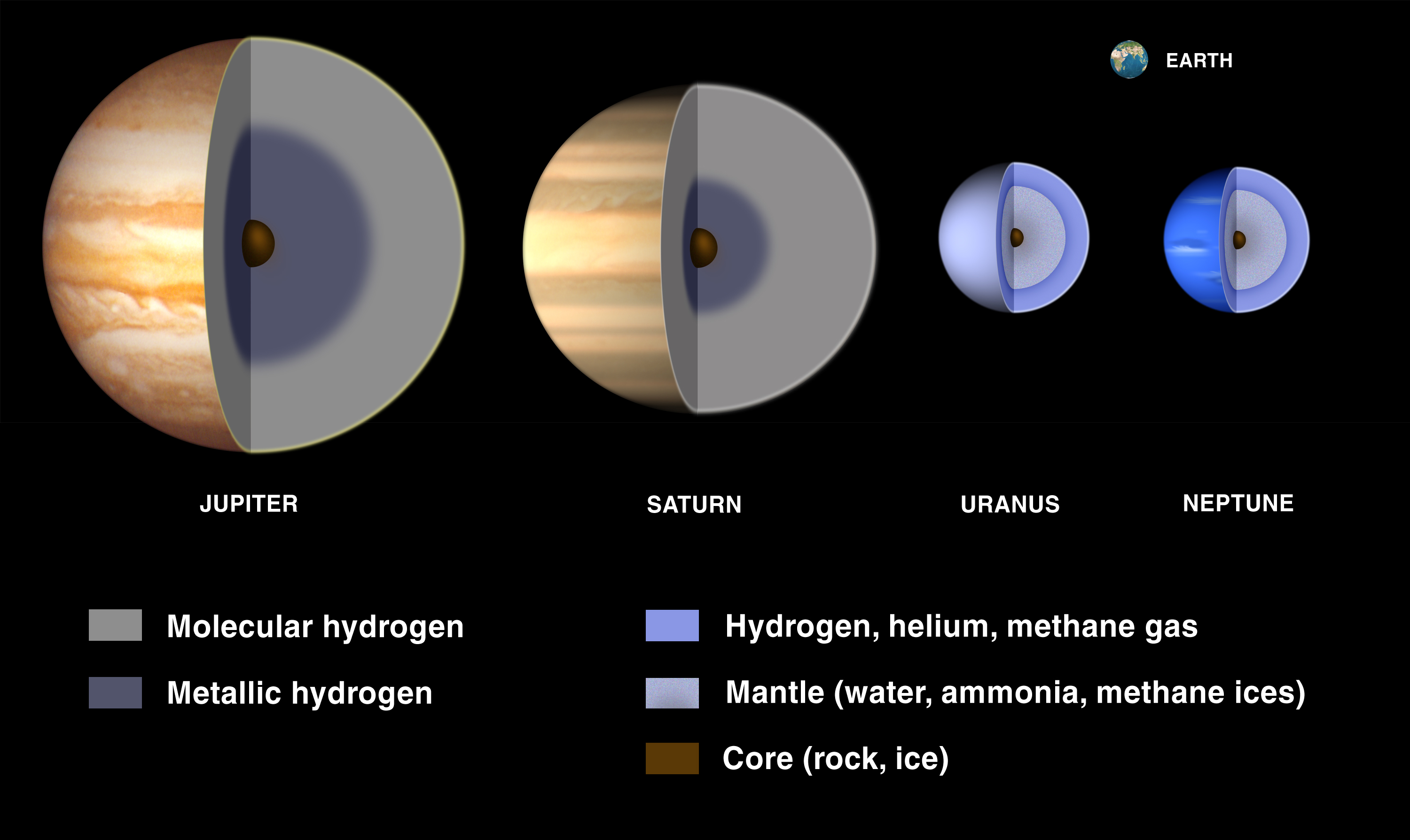
At their core, gas planets are massive spheres composed primarily of hydrogen and helium, lacking a well-defined solid surface. Understanding this composition from billions of miles away requires some of the most advanced optical and chemical analysis technology ever developed.
The Role of Infrared and Ultraviolet Spectroscopy
To determine what these planets are made of, scientists utilize spectroscopy—a technology that analyzes light to identify chemical signatures. Instruments like the Near-Infrared Spectrograph (NIRSpec) on the James Webb Space Telescope (JWST) allow researchers to peer through the thick upper atmospheres of gas giants. By breaking down the light spectrum, tech-driven observatories can identify methane, ammonia, and water ice, providing a chemical “fingerprint” of the planet.
Microwave Radiometry and Internal Structure
Since visible light cannot penetrate the dense clouds of Jupiter or Saturn, engineers developed microwave radiometry. This technology, famously used by the Juno spacecraft, measures electromagnetic waves emanating from deep within the planet. This allows us to “see” hundreds of miles below the cloud tops, revealing how the internal heat engines of these planets drive their massive, perpetual storms.
Gravity Mapping and Computational Modeling
One of the greatest technological feats in planetary science is gravity mapping. By tracking minute shifts in a spacecraft’s radio signal frequency (the Doppler effect), engineers can map the gravitational field of a gas planet. This data is fed into high-performance computing (HPC) clusters on Earth to model the density of the planet’s core, helping us understand if there is a rocky center or a “fuzzy” core of metallic hydrogen.
2. Spacecraft Engineering: The Hardware of Deep Space Exploration
Reaching the gas planets is a monumental task that requires overcoming extreme radiation, freezing temperatures, and vast distances. The technology built into probes like Voyager, Cassini, and the upcoming Europa Clipper represents the pinnacle of modern hardware engineering.
Radiation Hardening and Electronic Resilience
Jupiter, in particular, possesses a magnetic field so powerful it creates a lethal radiation environment. To survive, spacecraft are equipped with “vaults” made of titanium or lead to protect their “brains” (the Command and Data Handling units). Engineers utilize radiation-hardened circuits and redundant systems to ensure that a single high-energy particle doesn’t short-circuit a billion-dollar mission.
Autonomous Navigation and Deep Space Networking
Because radio signals take hours to travel between the gas giants and Earth, these spacecraft cannot be “joysticked” in real-time. They rely on sophisticated autonomous navigation software. These AI-lite systems use star trackers and edge computing to make split-second decisions during flybys or orbital insertions. Furthermore, the Deep Space Network (DSN)—a global array of massive radio antennas—utilizes advanced signal processing to catch the faint whispers of data sent across the vacuum of space.
Powering the Giants: RTGs vs. Advanced Solar Tech
Traditional solar panels are often ineffective in the dim light of the outer solar system. Historically, missions to gas planets have relied on Multi-Mission Radioisotope Thermoelectric Generators (MMRTGs), which convert the heat from decaying plutonium into electricity. However, recent breakthroughs in solar cell efficiency have allowed the Juno mission to use massive, ultra-sensitive solar arrays, pushing the boundaries of what green tech can achieve in deep space.
3. AI and Machine Learning in the Discovery of Gas Giants
While our own solar system has four gas giants, the universe is teeming with thousands more. The technology used to identify “Exoplanetary” gas giants (planets outside our solar system) relies heavily on big data and machine learning.
Algorithm-Driven Transit Photometry
The primary method for finding gas planets elsewhere is the transit method—measuring the slight dimming of a star as a planet passes in front of it. Because the data sets from telescopes like Kepler and TESS are massive, human eyes cannot process them all. Tech companies and space agencies have developed AI algorithms that can sift through millions of light curves to identify the specific signatures of “Hot Jupiters”—gas giants that orbit close to their parent stars.
Predictive Modeling of Atmospheric Dynamics
Once a gas planet is found, AI is used to simulate its atmosphere. By inputting data points like mass, distance from the star, and chemical composition, machine learning models can predict weather patterns, wind speeds, and cloud formations. These simulations are essential for choosing which planets the James Webb Space Telescope should target for deeper atmospheric analysis.
De-noising Deep Space Imagery
Raw data from distant telescopes is often “noisy” due to cosmic interference. Advanced image processing software, utilizing neural networks, is used to “de-noise” these images. This tech-driven enhancement allows us to see the distinct bands of Saturn’s rings or the hexagonal storm on its north pole with a clarity that was once thought impossible.
4. Digital Twins and High-Performance Computing Simulations
In the tech world, a “Digital Twin” is a virtual representation of a physical object used for testing and simulation. Scientists are now creating digital twins of gas planets to understand their complex fluid dynamics.
Simulating Metallic Hydrogen with Quantum Computing
Deep inside Jupiter, the pressure is so intense that hydrogen turns into a liquid metal. This state of matter is nearly impossible to recreate on Earth. However, using quantum chemistry simulations and high-performance computing, researchers can simulate how electrons behave in these extreme environments. This software-based approach is the only way we currently have to “visit” the interior of a gas giant.
Computational Fluid Dynamics (CFD) and Storm Evolution
The Great Red Spot on Jupiter is a storm that has lasted for centuries. To understand why, engineers use Computational Fluid Dynamics—the same software used to design airplane wings and Formula 1 cars. By simulating the gas giant’s atmosphere in a virtual environment, researchers can test theories about heat transfer and planetary rotation, providing insights into the fundamental physics of gas-dominated worlds.
VR and AR in Mission Planning
Before a probe is ever launched, engineers use Virtual Reality (VR) to walk through a digital version of the spacecraft and its projected path through a gas planet’s moon system. This immersive technology allows for better spatial awareness in mission design, ensuring that sensors are pointed in the right direction at the exact microsecond needed to capture data.
The Technological Frontier of the Outer Planets
What are the gas planets? From a technological perspective, they are the ultimate testing grounds for human innovation. They are laboratories that challenge our understanding of materials science, push our software to its limits, and demand the creation of smarter, more autonomous AI.
As we look toward the future, the integration of tech and astronomy will only deepen. We are entering an era of “smart” probes that can adapt their mission parameters on the fly and swarm-based satellite systems that can map an entire gas planet in three dimensions simultaneously. The gas giants may be composed of wind and cloud, but our understanding of them is built on a foundation of silicon, code, and cutting-edge engineering. By continuing to develop these technologies, we do more than just study distant worlds—we advance the very capabilities that define our technological civilization.
aViewFromTheCave is a participant in the Amazon Services LLC Associates Program, an affiliate advertising program designed to provide a means for sites to earn advertising fees by advertising and linking to Amazon.com. Amazon, the Amazon logo, AmazonSupply, and the AmazonSupply logo are trademarks of Amazon.com, Inc. or its affiliates. As an Amazon Associate we earn affiliate commissions from qualifying purchases.