
The humble 5-gallon bucket, a ubiquitous item in garages, construction sites, and even kitchens worldwide, often goes unnoticed despite its crucial role in countless tasks. While its primary function is simple — to hold liquid or solid materials — its precise dimensions are far from arbitrary. These measurements are meticulously engineered, driven by considerations ranging from material science and manufacturing technology to branding, logistics, and even the economics of storage and transport. Understanding the specific dimensions of a standard 5-gallon bucket not only satisfies curiosity but also unlocks insights into the intricate interplay of design, utility, and financial prudence in both industrial and personal contexts.

The Standard Profile: Unpacking the Physical Dimensions
At its core, a 5-gallon bucket is a cylindrical or slightly conical container designed for robust utility. Its dimensions are standardized enough to allow for interchangeability of lids and stacking, yet minor variations exist between manufacturers. This standardization is a testament to years of industrial optimization, ensuring broad compatibility while allowing for subtle competitive differentiation.
Key Measurements: Height, Diameters, and Wall Thickness
When we talk about the dimensions of a 5-gallon bucket, we’re typically referring to its height, its diameter at the top, and its diameter at the base. These measurements are critical for functionality, storage efficiency, and compatibility with accessories like lids and dollies.
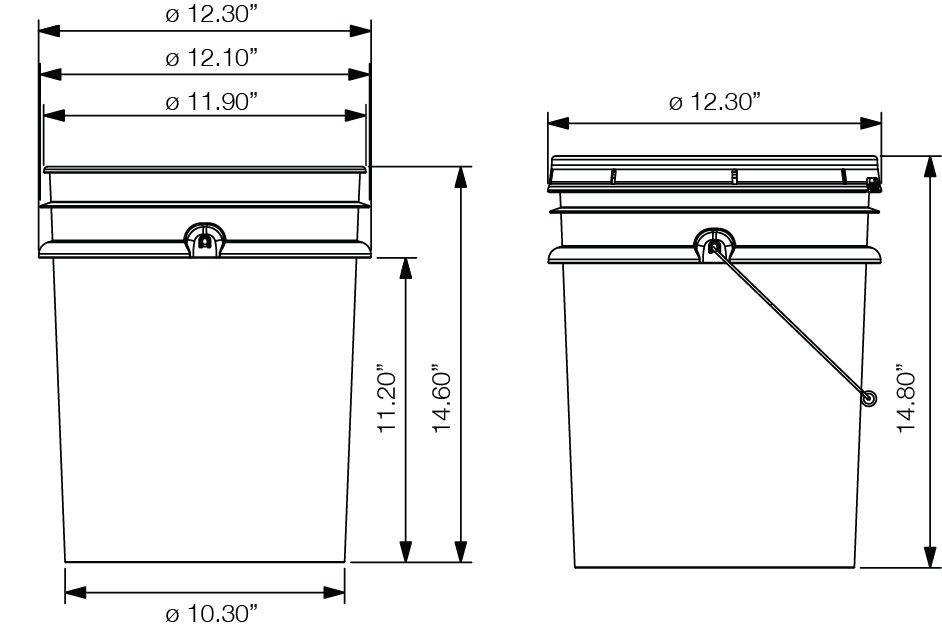
- Height: A standard 5-gallon bucket typically stands between 14.5 and 15 inches (approximately 36.8 to 38.1 cm) tall. This height is a critical factor for ergonomics, allowing most users to lift and carry it comfortably, and for stacking stability. Deviations from this standard can impact how many buckets fit on a pallet or how easily they can be stored under a workbench.
- Top Diameter (Outer Rim): The measurement across the top, including the lip or rim, generally falls between 12 to 12.5 inches (approximately 30.5 to 31.8 cm). This outer diameter is crucial for lid compatibility. Most lids are designed to snap securely onto this specific rim size, creating an airtight or watertight seal.
- Top Diameter (Inner): Just inside the rim, the working diameter of the opening is usually around 11.5 inches (approximately 29.2 cm). This is the effective opening through which contents are poured or accessed, and it influences what tools or materials can fit inside.
- Bottom Diameter (Outer): The base of the bucket is typically narrower than the top, a design feature that facilitates nesting or stacking of empty buckets. This bottom diameter usually measures around 10 to 10.5 inches (approximately 25.4 to 26.7 cm). The conical shape not only saves space during storage and shipping of empty buckets but also makes it easier to separate stacked containers.
- Wall Thickness: While not always explicitly listed, the wall thickness of a 5-gallon bucket is vital for its durability and structural integrity. It can vary from a few millimeters, often 0.070 to 0.090 inches (1.78 to 2.29 mm), depending on the intended use (e.g., food grade buckets might have slightly different specifications than heavy-duty industrial ones). This thickness impacts the bucket’s resistance to crushing, puncturing, and bending, directly correlating with its lifespan and the protection it offers its contents.
Beyond the Basics: Weight, Capacity, and Material Matters
Beyond the core dimensional figures, other characteristics like empty weight, actual liquid capacity, and material composition play significant roles in the bucket’s utility and economic value.
- Empty Weight: An empty 5-gallon bucket typically weighs between 1.5 to 2.5 pounds (approximately 0.68 to 1.13 kg). This weight is influenced by the plastic’s density and the wall thickness. Lighter buckets might be cheaper to produce and ship but could compromise durability, while heavier ones offer greater resilience at a higher cost.
- Nominal vs. Actual Capacity: While referred to as a “5-gallon” bucket, its actual brimful capacity is often slightly more, around 5.2 to 5.5 gallons (19.7 to 20.8 liters). This extra volume provides a necessary buffer, preventing spills when the bucket is filled to what would otherwise be its absolute maximum, especially when transporting liquids. This small but critical overflow capacity is a clever design detail that enhances user experience and reduces waste.
- Material: The vast majority of 5-gallon buckets are made from High-Density Polyethylene (HDPE). HDPE is chosen for its excellent strength-to-density ratio, chemical resistance, flexibility, and durability, especially against impacts and temperature fluctuations. It’s also relatively inexpensive and recyclable, making it an environmentally friendlier choice compared to some other plastics. The specific grade of HDPE can vary, impacting factors like UV resistance, flexibility, and suitability for food contact.
The Intersection of Dimensions and Technology
In an era defined by technological advancement, even something as seemingly simple as a 5-gallon bucket is influenced by cutting-edge innovations. From its design and manufacturing to its role in smart logistics, technology plays a pivotal role in optimizing its dimensions and enhancing its utility.
Precision in Manufacturing: CAD, AI, and Automation
The precise dimensions of a 5-gallon bucket aren’t accidental; they are the result of sophisticated engineering and manufacturing processes.
- CAD (Computer-Aided Design) & 3D Modeling: Before a physical bucket is ever produced, its dimensions are meticulously designed using CAD software like SolidWorks or AutoCAD. Engineers create detailed 3D models, allowing them to simulate wall thickness, material flow during molding, and stress points. This digital prototyping ensures that the bucket meets specific strength requirements, holds the correct volume, and stacks efficiently, all before incurring the cost of physical molds. This technology drastically reduces design cycles and prototyping costs, directly impacting the final product’s efficiency and price.
- AI Tools for Optimization: The application of Artificial Intelligence is starting to find its way even into industrial design. AI algorithms can analyze vast datasets to suggest optimal dimensions, material compositions, and structural designs that minimize material usage while maximizing strength and stackability. For instance, AI could simulate countless variations of bottom diameter taper to find the perfect balance between nesting efficiency and base stability, or optimize the handle design for ergonomic comfort and load-bearing capacity. This translates into more cost-effective production and a superior end-product.
- Automated Manufacturing (Injection Molding): The mass production of HDPE buckets relies heavily on automated injection molding technology. Large industrial machines inject molten plastic into steel molds, creating a bucket in a matter of seconds. Robotics often handle the removal of finished buckets, trimming of flash, and even stacking. This high degree of automation ensures consistent dimensions, high production volumes, and reduced labor costs, making buckets affordable and widely available. Digital sensors and quality control systems monitor every stage, detecting dimensional deviations in real-time to maintain strict specifications.
Smart Storage and Logistics: Leveraging Data for Efficiency
The dimensions of a 5-gallon bucket are not just about the bucket itself but also about how it fits into larger logistical and storage systems, areas increasingly optimized by technology.
- Supply Chain Optimization: For businesses that buy or sell buckets in bulk, or transport goods in buckets, understanding their precise dimensions is critical for supply chain efficiency. Logistics software and data analytics tools use these dimensions to calculate optimal pallet configurations, maximize container loading in trucks and shipping crates, and plan warehouse layouts. This data-driven approach minimizes wasted space, reduces shipping costs, and improves overall logistical flow. Imagine an AI-powered system that determines the ideal packing density for 5,000 buckets, factoring in their conical taper for nesting and their stackability when full – a direct financial saving for any large enterprise.
- IoT for Inventory Management: In a technologically advanced warehouse, buckets filled with products can be tracked using IoT (Internet of Things) sensors. These sensors, combined with warehouse management software, can monitor inventory levels, track movement, and even report on environmental conditions within storage areas. While the bucket itself isn’t “smart,” its standardized dimensions allow it to be easily integrated into automated storage and retrieval systems (AS/RS), where robots rely on precise measurements to pick, place, and move containers, enhancing productivity and reducing human error.
- Digital Measurement Tools: From handheld digital calipers to laser measurement devices, technology provides increasingly accurate and efficient ways to verify bucket dimensions. For quality control in manufacturing or for ensuring compatibility in custom applications, these tools are indispensable, offering precision that traditional tape measures simply cannot match.
Branding and Design: More Than Just a Container
In a competitive market, even a utilitarian product like a 5-gallon bucket becomes a canvas for branding and design. Its dimensions, material quality, and aesthetic features are carefully considered to build corporate identity, influence purchasing decisions, and enhance user experience.
Crafting a Brand Image Through Industrial Design
For manufacturers, the 5-gallon bucket isn’t just a commodity; it’s a product representing their brand’s commitment to quality and utility.
- Material Quality and Durability: A manufacturer’s brand reputation is directly tied to the durability and performance of their buckets. A bucket that cracks easily, leaks, or deforms under stress reflects poorly on the brand. Brands distinguish themselves by using higher-grade HDPE, ensuring consistent wall thickness, and engineering reinforced rims or bases. These subtle yet crucial design choices, often linked to dimensional precision and material specifications, build trust and customer loyalty.
- Ergonomics and User Experience (UX): Good industrial design extends to the user experience. The dimensions of the handle (width, diameter, attachment points), the smoothness of the rim, and the ease with which a lid can be applied and removed all contribute to how a user perceives the product. A well-designed handle, for instance, might incorporate a comfortable grip or be positioned to balance the load effectively. While the core dimensions remain standard, these ergonomic refinements allow brands to differentiate themselves through superior usability, turning a functional item into a preferred choice.
- Color and Customization: Beyond standard white or blue, buckets are often produced in brand-specific colors or feature embossed logos. These visual elements leverage the bucket’s surface dimensions for branding purposes. A particular shade of orange or a distinct company logo molded into the plastic instantly communicates brand identity, turning a simple container into a mobile advertisement.
The Bucket as a Marketing and User Experience Tool
The 5-gallon bucket, by its very nature, often becomes an extension of the product it contains or the service it supports, thereby playing a role in marketing and user engagement.
- Packaging Design: For companies selling products like paint, joint compound, or bulk food items, the 5-gallon bucket is the primary packaging. Its dimensions must not only be practical for storage and transport but also attractive for consumers. Labels, stickers, and printing on the bucket’s surface communicate product information, branding messages, and usage instructions. The overall “look and feel” of the filled bucket contributes to the product’s market appeal.
- Case Studies in Utility: Many brands use 5-gallon buckets in their own operations or recommend them for specific applications. A construction company might standardize on a particular brand of bucket known for its durability, embedding that brand into its corporate identity. Similarly, a gardening supply company might sell branded buckets as part of a kit, leveraging the bucket’s familiar dimensions and utility to enhance their product offering. These subtle integrations build brand association and loyalty.
- Reputation through Reliability: In scenarios where product integrity is paramount—such as storing food, chemicals, or sensitive materials—the reliability of the bucket directly reflects on the brand that produced it and the brand whose contents it holds. A bucket that consistently maintains its dimensions, seals effectively, and withstands its intended environment reinforces a reputation for quality and dependability.
Financial Implications: The Economics of the Humble Bucket
While the dimensions of a 5-gallon bucket might seem like a minor technical detail, they carry significant financial implications for businesses, individuals, and even those engaged in side hustles. From procurement costs to logistical efficiencies and opportunities for income generation, every millimeter and ounce can impact the bottom line.
Cost Efficiency in Procurement and Supply Chain
For businesses that rely on 5-gallon buckets, optimizing their procurement and supply chain based on dimensional understanding can lead to substantial cost savings.
- Material Cost Optimization: Manufacturers constantly balance material cost with product durability. By meticulously optimizing wall thickness and overall dimensions using CAD and AI, they can reduce the amount of HDPE used per bucket without compromising strength. Even a fraction of an ounce saved per bucket, multiplied by millions of units, translates into significant financial savings on raw materials. This cost efficiency can then be passed on to consumers or contribute to a healthier profit margin.
- Shipping and Storage Costs: This is where dimensions truly translate into dollars. The conical shape of empty buckets, allowing them to nest tightly, dramatically reduces the volume required for shipping and storage. If buckets were perfectly cylindrical, a truck could carry only a fraction of what it currently transports, leading to massively inflated shipping costs. For full buckets, precise dimensions allow for optimal pallet loading and warehouse shelving configurations, minimizing wasted space and associated rental or ownership costs. Financial tools used in logistics rely heavily on these exact dimensions to forecast and optimize expenses.
- Bulk Purchasing and Supplier Relationships: Understanding the typical dimensional tolerances and quality standards allows businesses to make informed decisions when bulk purchasing. Negotiating better prices often involves committing to larger orders, and knowing how many units can be cost-effectively stored and transported is crucial for leveraging such deals. Financial analysis tools can model the ROI of buying in larger quantities based on storage capacity and demand forecasts.
Maximizing Value: From Business Operations to Side Hustles
The economic impact of a 5-gallon bucket extends beyond large-scale industry, permeating small businesses, personal finance strategies, and entrepreneurial ventures.
- Business Finance for Users: For small businesses—be it a catering service, a janitorial company, or a craft brewery—the choice of 5-gallon buckets can impact operational costs. Investing in durable, food-grade buckets might have a higher upfront cost but offers better ROI by reducing replacement frequency, preventing product contamination, and ensuring regulatory compliance. The dimensions also dictate compatibility with specialized equipment, like bucket heaters or dispensing taps, impacting workflow efficiency.
- Personal Finance and DIY Savings: In a personal finance context, 5-gallon buckets are champions of DIY savings. Used for gardening, home improvement projects, or emergency preparedness, they offer an inexpensive, reusable solution for storage, transport, and various tasks. Understanding their dimensions helps individuals plan projects, store tools efficiently, or even create simple, cost-effective storage systems in their homes, preventing the need for more expensive, specialized containers.
- Online Income and Side Hustles: The versatility of the 5-gallon bucket makes it an asset for various side hustles and online income streams.
- Gardening/Farming: Buckets are essential for urban farming, composting, or carrying produce to market. Their consistent dimensions allow for easy stacking and transport, whether for selling fresh produce or composting services.
- Brewing/Fermentation: Homebrewers and small-batch fermenters rely on specific bucket dimensions for fermenting vessels. The standardized sizes ensure compatibility with airlocks, spigots, and other brewing accessories sold online.
- Crafts/Etsy Businesses: Entrepreneurs creating and selling large batches of products (e.g., soap, candles, pet treats) might use 5-gallon buckets for storing raw materials or bulk finished goods. Efficient storage of these containers, based on their dimensions, impacts their home-based workshop’s productivity and organization, indirectly affecting their ability to fulfill orders and generate online income.
- Resale and Upcycling: Used buckets, if in good condition, have a resale value in local markets or online, serving as an additional income stream for businesses or individuals. The bucket’s robust design and standardized dimensions make it a desirable item for repurposing.
In conclusion, the dimensions of a 5-gallon bucket are far more than just arbitrary numbers. They are the product of intricate engineering, technological advancements in manufacturing and logistics, strategic branding decisions, and a constant drive for economic efficiency. From the precision of CAD software and AI-driven optimization to the careful consideration of material costs, shipping volumes, and ergonomic design, every aspect of this ubiquitous container is optimized. Whether supporting massive industrial operations, bolstering a brand’s reputation, or enabling a personal DIY project or side hustle, the humble 5-gallon bucket stands as a testament to how fundamental physical dimensions underpin a vast web of technological, financial, and branding considerations in our modern world.
aViewFromTheCave is a participant in the Amazon Services LLC Associates Program, an affiliate advertising program designed to provide a means for sites to earn advertising fees by advertising and linking to Amazon.com. Amazon, the Amazon logo, AmazonSupply, and the AmazonSupply logo are trademarks of Amazon.com, Inc. or its affiliates. As an Amazon Associate we earn affiliate commissions from qualifying purchases.