
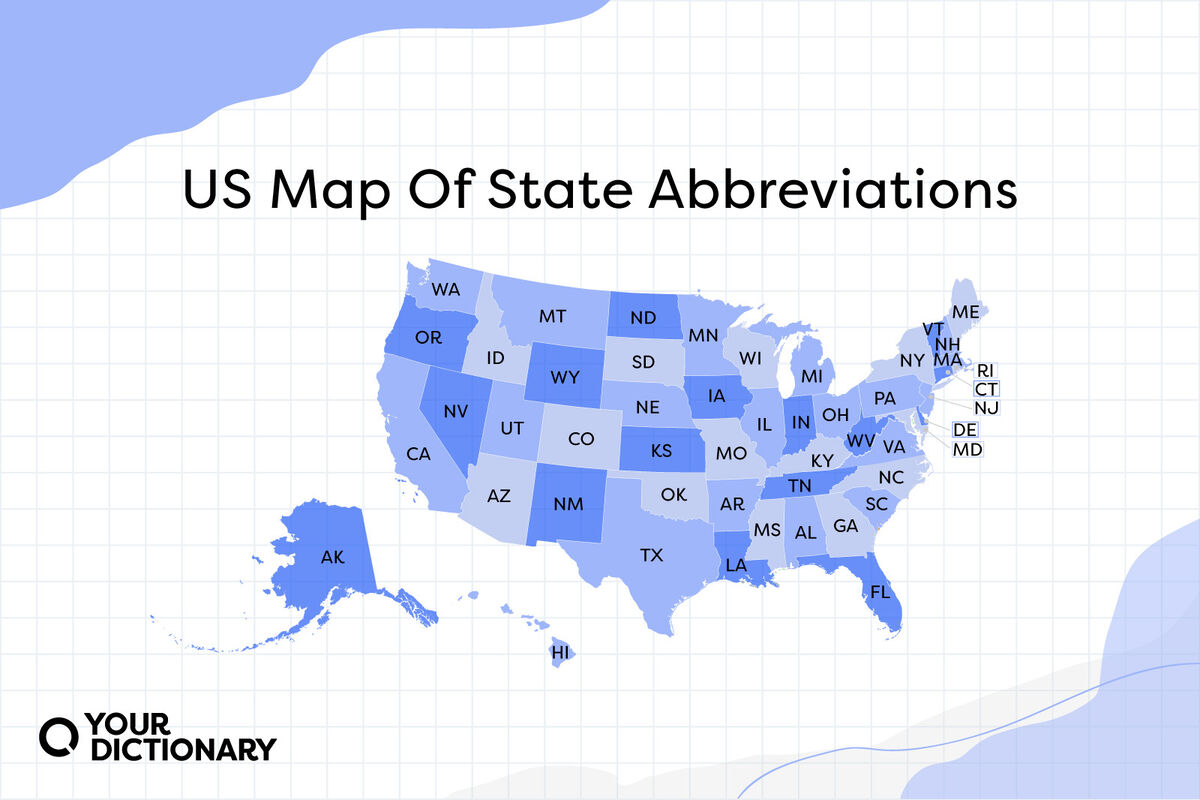
In the digital era, information is the currency of progress. While a casual observer might view the two-letter abbreviations of the United States—such as CA for California or NY for New York—as mere shorthand for postal delivery, these identifiers serve as a critical foundation for global technology infrastructure. From the perspective of software engineering, database management, and artificial intelligence, state abbreviations are not just linguistic shortcuts; they are standardized data points that facilitate seamless interoperability across disparate digital platforms.
Understanding the technical nuances of these abbreviations is essential for developers, data scientists, and IT architects who build the systems that power our modern economy. This article explores how state abbreviations function within the tech ecosystem, the standards that govern them, and their pivotal role in data integrity and automation.

The Architecture of Standardization: Why State Abbreviations Matter in Software Development
Standardization is the bedrock of efficient software development. Without agreed-upon formats, the exchange of information between two different systems would result in catastrophic data silos or constant manual intervention. State abbreviations provide a “Common Language” for software applications.
Data Integrity and Input Validation
In the realm of UI/UX design and front-end development, state abbreviations are vital for maintaining data integrity. When a user fills out a billing address on an e-commerce platform, the “State” field is rarely a free-text box. Instead, developers implement dropdown menus or autocomplete components populated with standardized abbreviations.
This technical choice prevents “dirty data”—the inclusion of typos (e.g., “Clalifornia”), inconsistent formatting (e.g., “Calif.” vs. “CA”), or obsolete terms. By forcing an input that matches a recognized list of abbreviations, developers ensure that the backend database receives a clean, two-character string that is easy to index, search, and validate. This is the first line of defense in maintaining a high-quality data pipeline.
From USPS to ISO: Navigating Different Standards
While most developers default to the United States Postal Service (USPS) abbreviations established in 1963, technology professionals must also be aware of other international standards. The ISO 3166-2:US is a standard published by the International Organization for Standardization that mirrors the USPS codes but places them within a global context.
For developers working on international software, using the ISO standard ensures that U.S. states are handled with the same logic as provinces in Canada or states in Australia. Understanding the overlap between USPS, ANSI (American National Standards Institute), and ISO standards allows software architects to build localized yet globally compatible systems.
Integration and Interoperability: State Abbreviations in API Ecosystems
Modern technology relies on the “API economy,” where different software services talk to one another via Application Programming Interfaces. State abbreviations act as the primary key for geographic data exchange in these integrations.
E-commerce and Geolocation APIs
When a customer clicks “Calculate Shipping” on a website, several APIs spring into action. The website’s server sends the state abbreviation to a tax calculation API (like Avalara or TaxJar) and a shipping carrier API (like FedEx or UPS). These third-party services are programmed to recognize the two-letter code instantly.
If a system sent “Massachusetts” instead of “MA,” and the receiving API only accepted two-character strings, the transaction would fail. In this context, abbreviations are the protocols that enable real-time calculations of sales tax, shipping rates, and delivery estimates. They are the gears that allow e-commerce engines to run with sub-second latency.
Streamlining Global Logistics through Standardized Metadata
In the world of logistics tech (LogTech), state abbreviations are used as metadata in tracking systems. As a package moves from a warehouse in TX to a distribution center in IL, the tracking software logs these transitions using abbreviated codes to minimize the payload size of the data packets being transmitted over cellular or satellite networks.
For Internet of Things (IoT) devices attached to shipping containers, every byte of data transmitted costs energy and money. Using a 2-byte state code instead of a 10-to-15-byte full name represents a significant optimization when multiplied across millions of tracking updates daily.

Database Optimization: Strategies for Handling Geographic Data
At the heart of every enterprise application is a database. How a database stores state information can have long-term implications for performance and scalability.
Normalized vs. Denormalized Geographic Tables
In relational database management systems (RDBMS) like PostgreSQL or MySQL, database administrators often debate between normalization and denormalization. A normalized approach might involve a “States” table where each state has a unique ID, a full name, and an abbreviation. The “Users” table would then simply store a foreign key pointing to the State ID.
However, because the list of U.S. states is static (it rarely changes), many high-performance tech stacks choose to store the two-letter abbreviation directly in the user record. This is a form of intentional denormalization that eliminates the need for a “JOIN” query when retrieving address information, thereby speeding up read operations for high-traffic applications.
Automating State Conversions with Python and SQL
Data scientists often inherit “legacy data” where states are written in various formats. Using technology to clean this data is a common task. Libraries in Python, such as us or pycountry, allow developers to programmatically map full names to abbreviations.
A typical data cleaning script might look like this:
- Load a CSV with a “Location” column.
- Use a fuzzy matching algorithm to identify the state.
- Replace the string with the standardized two-letter abbreviation.
- Export the cleaned data for machine learning training.
This automation is only possible because of the existence of a definitive, standardized list of abbreviations that serves as the “source of truth.”
The Future of Geographic Identifiers: AI, Machine Learning, and NLP
As we move deeper into the age of Artificial Intelligence, the way machines interpret geographic identifiers is evolving. State abbreviations are playing a new role in how Natural Language Processing (NLP) models understand regional context.
Solving the Ambiguity of Non-Standard Abbreviations in NLP
Large Language Models (LLMs) like GPT-4 or Claude are trained on massive datasets where state names and abbreviations appear in countless contexts. However, abbreviations can sometimes be ambiguous. For instance, “AL” could refer to Alabama or it could be a common name.
Modern AI engineering involves “named entity recognition” (NER) to distinguish between these cases. By training models on the specific patterns of address blocks, AI can accurately extract state abbreviations from unstructured text—such as emails or PDF invoices—and convert them into structured data for business intelligence tools. This bridges the gap between human-readable text and machine-readable data.
Predictive Analytics and Regional Data Modeling
In the field of predictive analytics, state abbreviations serve as categorical variables in machine learning models. If a tech company wants to predict the churn rate of its users based on geography, the state abbreviation becomes a feature in the model.
Standardized abbreviations allow models to group data efficiently. An algorithm can quickly aggregate millions of rows of data tagged with “FL” to identify trends in the Florida market without the computational overhead of processing long-form strings. As edge computing and real-time analytics become more prevalent, the efficiency of these two-letter codes remains a vital asset for data-driven decision-making.
Conclusion
The two-letter abbreviations of the United States are far more than a convenience for the postal service. In the landscape of modern technology, they are a fundamental component of the digital infrastructure. They enable precise data validation, facilitate seamless API communication, optimize database performance, and empower the next generation of artificial intelligence.
For the technologist, the state abbreviation is a symbol of the power of standardization. By adhering to these simple, two-character codes, we build systems that are more resilient, more efficient, and more interconnected. As technology continues to evolve, our reliance on these standardized geographic identifiers will only grow, proving that sometimes the smallest pieces of data are the ones that hold the entire system together.
aViewFromTheCave is a participant in the Amazon Services LLC Associates Program, an affiliate advertising program designed to provide a means for sites to earn advertising fees by advertising and linking to Amazon.com. Amazon, the Amazon logo, AmazonSupply, and the AmazonSupply logo are trademarks of Amazon.com, Inc. or its affiliates. As an Amazon Associate we earn affiliate commissions from qualifying purchases.