
The Dow Jones Industrial Average (DJIA), often simply referred to as “the Dow,” stands as one of the oldest, most frequently cited, and enduring stock market indices in the world. For over a century, it has served as a widely watched barometer of the U.S. stock market and, by extension, the health of the American economy. While its methodology and representation have evolved significantly since its inception, the curiosity surrounding “the 30 Dow Jones stocks” remains as potent as ever. These aren’t just any companies; they represent a select group of America’s largest, most influential, and historically significant corporations, whose performance is believed to offer a snapshot of the broader market sentiment.
Understanding what makes up the Dow, how these companies are chosen, and why their performance matters is crucial for anyone navigating the financial landscape, from seasoned investors to curious observers. This article will delve into the essence of the Dow 30, explore its significance, list its current constituents, and discuss how investors can engage with this iconic index.
Understanding the Dow Jones Industrial Average (DJIA)
To appreciate the Dow 30, it’s essential to first grasp the index itself – its origins, purpose, and the unique way it is constructed. Far from a mere average of 30 stock prices, the DJIA is a carefully curated and maintained indicator with a storied history.
A Brief History and Purpose
The Dow Jones Industrial Average was created by Charles Dow, editor of The Wall Street Journal and co-founder of Dow Jones & Company, and his business associate Edward Jones. It first appeared on May 26, 1896, originally comprising 12 industrial stocks. Dow’s vision was to create a simple, intuitive measure to track the performance of the leading industrial companies in the burgeoning American economy. His hope was that this average would serve as a useful tool for understanding the prevailing market trend.
Over time, as the U.S. economy diversified beyond heavy industry, the index adapted. While it retains “Industrial” in its name, the companies it includes today span a wide array of sectors, reflecting a much broader economic landscape. Its primary purpose remains unchanged: to provide a quick, accessible indicator of the overall direction of the stock market and investor sentiment. Unlike market-capitalization-weighted indices like the S&P 500, the Dow is a price-weighted index. This means stocks with higher per-share prices have a greater influence on the index’s value than those with lower prices, regardless of their total market capitalization. To maintain continuity when component companies change or split their stocks, a “Dow divisor” is used to ensure the average remains comparable over time.
Beyond Just an Average
While widely quoted, the Dow Jones Industrial Average is not without its critics. Its primary criticisms often revolve around its limited number of components and its price-weighted methodology. Thirty companies, however large and influential, represent only a tiny fraction of the thousands of publicly traded companies in the U.S. stock market. Therefore, it is often argued that the Dow may not be truly representative of the entire market’s breadth and depth. Furthermore, the price-weighted nature can lead to situations where a high-priced stock with a relatively small market cap can have a disproportionately large impact on the index compared to a lower-priced, but much larger, company.
Despite these critiques, the Dow’s enduring popularity and media presence are undeniable. Its simplicity and historical lineage give it a certain gravitas, making it a powerful psychological benchmark for many investors and the general public. News reports frequently lead with the Dow’s daily performance, shaping immediate perceptions of economic health. It acts as a familiar touchstone, a bellwether that, while imperfect, continues to capture public imagination and guide initial market interpretations.
The Significance of the Dow 30
Inclusion in the Dow 30 is more than just a listing; it confers a significant degree of prestige and recognition upon a company. These are not merely large corporations; they are often seen as titans of industry, innovators, and pillars of the American economy.
A Bellwether for the Economy
For many decades, the Dow has been observed as a primary bellwether for the U.S. economy. When the Dow rises, it often signals investor confidence, robust corporate earnings, and a generally healthy economic outlook. Conversely, a significant drop can indicate economic headwinds, market uncertainty, or a potential recession. Because its components are leaders in their respective fields, their collective performance is often viewed as a proxy for the broader economic environment.
Economists, financial analysts, and policymakers closely monitor the Dow’s movements for clues about consumer spending, industrial production, and corporate profitability. While its direct correlation to every facet of the economy can be debated, its influence on investor sentiment is profound. A rising Dow can encourage investment and spending, while a falling Dow can foster caution and belt-tightening.
Blue-Chip Companies
The companies that comprise the Dow 30 are almost universally classified as “blue-chip” stocks. This term refers to financially sound, well-established companies with long track records of stable earnings, reliable dividends, and often, significant market share in their industries. They are typically leaders in their sectors, known for their strong brand recognition, vast operational scale, and resilience through various economic cycles.
Inclusion in the Dow is a testament to a company’s sustained success, managerial prowess, and importance to the national economy. These companies are generally less volatile than smaller, growth-oriented stocks and often attract investors seeking stability and long-term value. Their blue-chip status contributes to the Dow’s reputation as an index of quality and reliability, albeit one that moves with the tides of market sentiment.
Who Are the Current 30 Dow Jones Stocks?
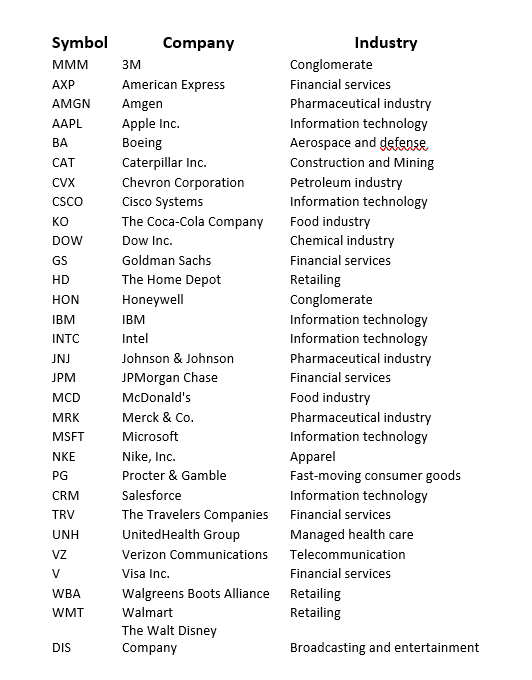
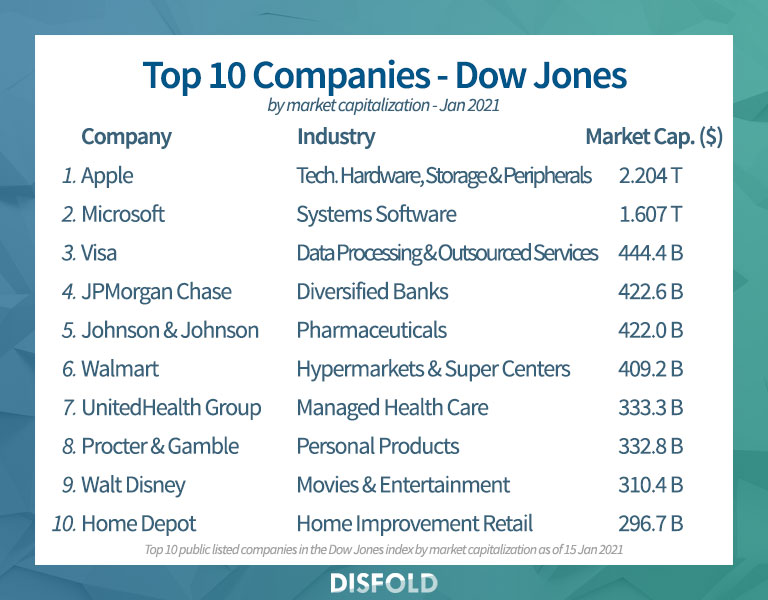
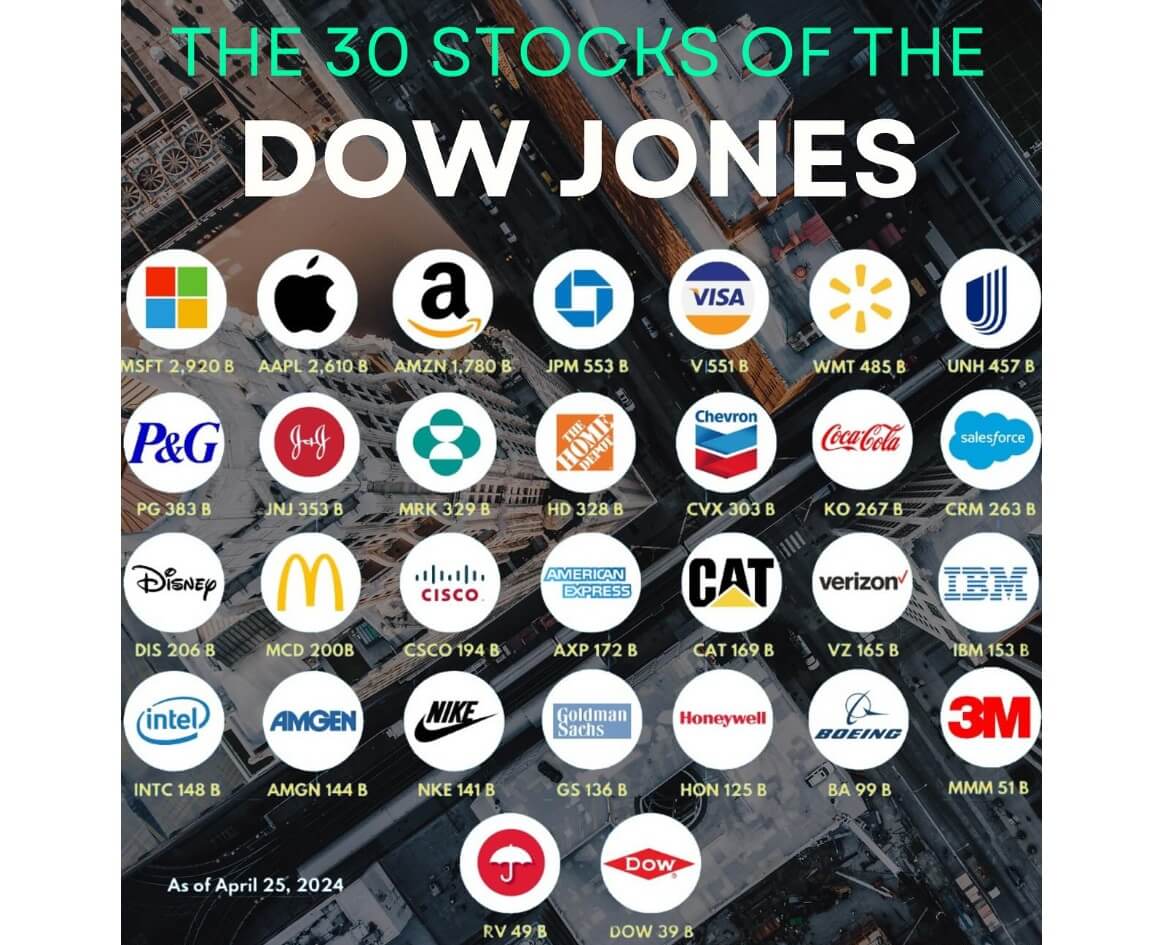
The composition of the Dow 30 is not static; it evolves to reflect changes in the U.S. economy and the broader market landscape. Companies are added and removed periodically to ensure the index remains relevant and representative of leading industries. As of early 2024 (with Amazon.com Inc. being the most recent addition, effective February 26, 2024, replacing Walgreens Boots Alliance Inc.), the 30 Dow Jones stocks represent a diverse cross-section of American enterprise.
The Diverse Landscape of American Industry
Here is the current list of the 30 companies included in the Dow Jones Industrial Average, along with a brief description of their primary industry:
- 3M Co. (MMM): Diversified industrial manufacturing (adhesives, abrasives, laminates, passive fire protection, electronic materials, medical products).
- Amazon.com Inc. (AMZN): Consumer Discretionary (e-commerce, cloud computing via AWS, digital streaming, artificial intelligence).
- American Express Co. (AXP): Financials (credit card services, travel-related services).
- Amgen Inc. (AMGN): Healthcare (biotechnology, pharmaceuticals).
- Apple Inc. (AAPL): Technology (consumer electronics, software, online services).
- Boeing Co. (BA): Industrials (aerospace and defense manufacturing).
- Caterpillar Inc. (CAT): Industrials (construction and mining equipment, diesel and natural gas engines).
- Chevron Corp. (CVX): Energy (oil, gas, and geothermal energy operations).
- Cisco Systems Inc. (CSCO): Technology (networking hardware, software, telecommunications equipment).
- Coca-Cola Co. (KO): Consumer Staples (beverages).
- Walt Disney Co. (DIS): Communication Services (entertainment, media networks, theme parks, streaming services).
- Dow Inc. (DOW): Materials (chemicals, plastics, agricultural products).
- Goldman Sachs Group Inc. (GS): Financials (investment banking, securities, investment management).
- Home Depot Inc. (HD): Consumer Discretionary (home improvement retail).
- Honeywell International Inc. (HON): Industrials (aerospace systems, building technologies, performance materials).
- IBM Corp. (IBM): Technology (information technology services, consulting, software, hardware).
- Intel Corp. (INTC): Technology (semiconductors, computing platforms).
- Johnson & Johnson (JNJ): Healthcare (pharmaceuticals, medical devices, consumer health products).
- JPMorgan Chase & Co. (JPM): Financials (banking, financial services).
- McDonald’s Corp. (MCD): Consumer Discretionary (fast food restaurants).
- Merck & Co. Inc. (MRK): Healthcare (pharmaceuticals).
- Microsoft Corp. (MSFT): Technology (software, cloud computing, consumer electronics).
- Nike Inc. (NKE): Consumer Discretionary (athletic footwear, apparel, equipment).
- Procter & Gamble Co. (PG): Consumer Staples (consumer goods: cleaning, beauty, health care).
- Salesforce Inc. (CRM): Technology (cloud-based software, customer relationship management).
- Travelers Companies Inc. (TRV): Financials (insurance).
- UnitedHealth Group Inc. (UNH): Healthcare (managed healthcare, health insurance).
- Verizon Communications Inc. (VZ): Communication Services (telecommunications, wireless services).
- Walmart Inc. (WMT): Consumer Staples (retail).
This list showcases the Dow’s evolution from purely industrial roots to a composite of technology giants, financial powerhouses, healthcare innovators, and leading consumer brands.
How the Dow 30 Are Selected and Maintained
Unlike many other indices that rely on strict quantitative rules (like market capitalization for the S&P 500), the selection process for the Dow 30 is more qualitative and committee-driven. This unique approach ensures the index remains relevant to the broader economic narrative.
The Selection Criteria
The selection of companies for the Dow is not based on a formula but is rather the decision of a committee at S&P Dow Jones Indices. The primary goal is to maintain an adequate representation of the broader U.S. stock market and economy. While no rigid rules apply, several factors are generally considered:
- Reputation and Sustained Growth: Companies must have an excellent reputation, demonstrate sustained growth, and be of interest to a large number of investors.
- Broad Market Representation: The committee aims for a diverse mix of industries to reflect significant sectors of the economy.
- Major U.S. Corporation: Components are typically large, well-established U.S. companies listed on either the New York Stock Exchange (NYSE) or Nasdaq.
- Financial Health: While not explicitly a rule, financial stability and a proven track record are implicit requirements for inclusion in such a prestigious index.
The absence of a strict formula allows the committee flexibility to adapt to changing economic landscapes, ensuring the index evolves with the times rather than being bound by outdated metrics.
Index Rebalancing and Changes
Changes to the Dow’s components are relatively infrequent, typically occurring only when a company’s core business significantly changes, if it undergoes a major merger or acquisition, or if the committee determines a change is necessary to better reflect the current economic environment. When a company is added or removed, it often generates significant media attention due to the prestige associated with Dow inclusion or exclusion.
When a change occurs, the “Dow divisor” is adjusted to ensure the continuity of the index. This mathematical adjustment prevents the index’s value from being artificially inflated or deflated by the change in components or by stock splits and dividend payouts. This meticulous maintenance ensures that day-to-day fluctuations accurately reflect the aggregate price movements of the constituent stocks, rather than administrative adjustments.
Investing in the Dow Jones Industrial Average
For investors interested in gaining exposure to these prominent American companies, there are several avenues available, ranging from direct stock ownership to diversified fund investments.
Direct Stock Ownership vs. Index Funds
One approach is to directly purchase shares in some or all of the 30 Dow components. This offers investors the potential for higher returns if individual stock picks perform exceptionally well, but it also carries higher risk and requires significant research and active management. Building a portfolio of all 30 stocks can be costly and challenging to manage effectively.
A more common and often recommended strategy for gaining exposure to the Dow is through exchange-traded funds (ETFs) or mutual funds that track the index. The most well-known Dow-tracking ETF is the SPDR Dow Jones Industrial Average ETF Trust (DIA), often referred to as “Diamonds.” These funds hold shares of all 30 companies in proportions designed to mirror the Dow’s performance. Investing in such funds offers several advantages:
- Diversification: Instant exposure to 30 large-cap U.S. companies, reducing the risk associated with individual stock fluctuations.
- Lower Fees: ETFs typically have lower expense ratios compared to actively managed mutual funds.
- Liquidity: ETFs can be bought and sold throughout the trading day, similar to individual stocks.
- Passive Management: Eliminates the need for individual stock research and decision-making.
Considerations for Investors
While the Dow 30 represents a collection of robust companies, it’s crucial for investors to understand its role within a broader investment strategy. As noted, the Dow is a price-weighted index with a relatively small number of components, meaning it might not offer the most comprehensive representation of the entire U.S. stock market compared to broader indices like the S&P 500 or the Russell 3000.
For most investors, the Dow 30 can be a valuable component of a well-diversified portfolio, particularly for those seeking exposure to blue-chip, established companies. However, it should ideally be considered alongside other investments that offer broader market exposure, international diversification, and different asset classes to achieve a truly robust and resilient portfolio. Focusing on a long-term perspective and understanding the inherent limitations and unique characteristics of the Dow Jones Industrial Average will enable investors to utilize this iconic index effectively in their financial planning.
aViewFromTheCave is a participant in the Amazon Services LLC Associates Program, an affiliate advertising program designed to provide a means for sites to earn advertising fees by advertising and linking to Amazon.com. Amazon, the Amazon logo, AmazonSupply, and the AmazonSupply logo are trademarks of Amazon.com, Inc. or its affiliates. As an Amazon Associate we earn affiliate commissions from qualifying purchases.