
When designing custom cabinetry or selecting hardware for a kitchen remodel, the terminology surrounding hinge mechanics can often feel overwhelming. Among the various types of hardware available, the overlay hinge stands out as the industry standard for modern, clean-lined cabinetry. Understanding these components is essential for both aesthetic design and functional performance. Whether you are a professional interior designer or a homeowner embarking on a DIY renovation, knowing the nuances of overlay hinges is the first step toward achieving a seamless, professional finish.
Understanding the Basics of Overlay Hinges
An overlay hinge is a specific type of cabinet hinge designed to allow a door to mount onto the face of the cabinet box, covering a portion of the cabinet frame. Unlike “inset” hinges, which allow the door to sit flush inside the frame, overlay hinges enable the door to sit on top of the cabinet box. This configuration is widely used in frameless (European-style) cabinetry, though it is increasingly common in face-frame applications as well.

How Overlay Works
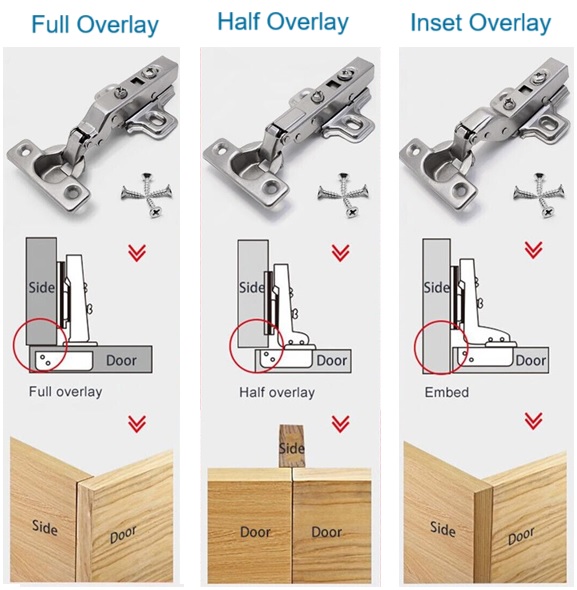
The term “overlay” refers to the amount of the cabinet edge that the door covers when closed. If you have a full overlay door, the door sits over the entire cabinet frame, leaving only a minimal reveal (the gap between the door and the cabinet edge) visible. This creates a sleek, contemporary look where the hardware is hidden, and the focus remains on the door panels and the overall cabinetry design.
Why They Are Essential for Design
Overlay hinges are the backbone of the “Euro-style” aesthetic. By allowing the door to cover the majority of the cabinet box, they minimize the visible gaps and frame material, creating a uniform, expansive appearance. This design choice is particularly effective in small kitchens, where clean lines can make a space feel larger and more organized.
Identifying Your Overlay Type: Full vs. Partial
Not all overlay hinges provide the same level of coverage. To select the correct hardware for your project, you must first distinguish between full and partial overlay configurations. Miscalculating these measurements is the most common cause of installation errors, leading to doors that do not close properly or clash with adjacent cabinetry.
Full Overlay Hinges
Full overlay hinges are designed for cabinetry where the door covers almost the entire face frame or cabinet edge. When you look at a wall of cabinets featuring full overlay doors, you see primarily the door faces, with very little of the cabinet box showing. This creates a minimalist aesthetic that is highly sought after in luxury kitchen design and high-end modern furniture.
Partial (Half) Overlay Hinges
Partial overlay hinges—sometimes referred to as half-overlay or twin-overlay—are used when two cabinet doors are mounted to a single center stile or cabinet partition. In this scenario, each door covers only half of the partition thickness. If you were to use a full overlay hinge here, the doors would collide with one another. Partial overlay hinges provide the necessary clearance to ensure that both doors can open and close independently without interference.
Inset vs. Overlay
It is helpful to contrast the overlay hinge with the inset hinge. Inset doors are recessed into the frame so that the door face is flush with the cabinet box. While inset cabinetry offers a classic, traditional aesthetic, it requires high-precision craftsmanship because any slight gap between the door and the frame is immediately visible. Overlay hinges, by contrast, are far more forgiving regarding installation tolerances, making them the preferred choice for both modular factory-made cabinets and custom-built projects.
Mechanical Components and Adjustability
One of the primary benefits of modern overlay hinges is their adjustability. Unlike old-fashioned butt hinges, which required shimming and complex manual adjustments to align, most contemporary overlay hinges are “concealed” or “European” hinges that feature built-in adjustment screws.
The Three-Axis Adjustment System
A high-quality concealed overlay hinge allows for adjustments across three axes, which is crucial for achieving that “perfect” factory-set gap between cabinet doors.
- Lateral (Side-to-Side) Adjustment: This screw moves the door left or right, allowing you to close the gap between two doors or align a door perfectly with the edge of the cabinet box.
- Depth Adjustment: This allows you to move the door closer to or further away from the cabinet box. This is essential for ensuring that the door face sits flush with the adjacent doors or the cabinet frame.
- Vertical (Up-and-Down) Adjustment: By loosening the mounting screws on the cabinet plate, you can slide the entire hinge up or down to ensure the doors are perfectly leveled, preventing the “crooked door” look that plagues poorly installed cabinetry.
Soft-Close Integration
Modern overlay hinges frequently incorporate soft-close dampening technology. A small hydraulic piston is integrated into the hinge arm, which catches the door as it nears the closed position and pulls it shut silently. This feature not only prevents the loud slamming of cabinet doors but also protects the longevity of the cabinet box by reducing the impact force during closure. For busy households, this has become a non-negotiable standard in contemporary kitchen design.
Installation and Compatibility Considerations
Installing overlay hinges requires precision, but the process is straightforward if you understand the underlying mechanics of the hinge and the cabinet construction. Before purchasing hardware, there are several variables that must be accounted for to ensure the door operates smoothly.
Calculating the Boring Pattern
Concealed overlay hinges require a circular hole (cup) to be bored into the back of the cabinet door. Most standard hinges use a 35mm bore diameter. The distance from the edge of the door to the edge of this cup is referred to as the “bore distance” or “edge distance.” It is vital to use the manufacturer’s specific template for this measurement, as the bore distance directly dictates how much of the door will “overlay” the frame. If the bore is too close to the edge, the door may hit the frame upon closing; if it is too far, you may end up with an unsightly gap.
Considering Hinge Degrees and Clearance
Different overlay hinges offer different opening angles. While a standard hinge might open to 110 degrees, some specialized hinges allow for 170-degree openings. The higher the opening angle, the easier it is to access the contents of the cabinet—a crucial factor if your cabinets have pull-out drawers or sliding trays.
Furthermore, you must consider “zero protrusion” hinges. These are specialized overlay hinges that allow the door to swing entirely out of the way, preventing the door edge from protruding into the cabinet opening. This is essential when you have interior roll-out shelves that need to clear the width of the cabinet door to be fully extended.
Material Compatibility
Overlay hinges are generally designed for wood or wood-composite doors. However, if you are working with glass doors or aluminum-framed glass panels, you will need to source specific overlay hinges equipped with adapter plates. Using a standard wood hinge on a glass door is impossible without the proper mounting hardware, and attempting to modify a hinge to fit a non-standard material will almost certainly result in the failure of the hinge arm over time.
Selecting the Right Hardware for Your Project
Choosing the correct overlay hinge is not merely a matter of buying the cheapest option at the hardware store; it is an investment in the long-term functionality of your cabinetry.
Assessing Load Capacity
Consider the weight and size of your cabinet doors. Large pantry doors or oversized wardrobe doors require heavy-duty overlay hinges with reinforced arms. Installing a standard-duty hinge on a heavy, oversized door will lead to sagging, misalignment, and potential failure of the door hinges over time. Always check the manufacturer’s weight rating for the hinge to ensure it matches the size and material of your cabinetry.

Aesthetic Finishes
While the majority of an overlay hinge is hidden inside the cabinet, the base plate and the hinge arm are visible when the door is opened. Most hinges come in a standard zinc or nickel-plated finish. However, for high-end projects, you can opt for matte black, antique brass, or stainless steel finishes to match the overall interior aesthetic of your kitchen or bathroom. This level of attention to detail distinguishes custom work from mass-produced solutions.
By mastering the selection, adjustment, and installation of overlay hinges, you ensure that your cabinetry remains both beautiful and highly functional for years to come. Whether you are aiming for a minimalist, full-overlay look or require the precision of a partial-overlay application, the right hinge is the unsung hero that brings the design together.
aViewFromTheCave is a participant in the Amazon Services LLC Associates Program, an affiliate advertising program designed to provide a means for sites to earn advertising fees by advertising and linking to Amazon.com. Amazon, the Amazon logo, AmazonSupply, and the AmazonSupply logo are trademarks of Amazon.com, Inc. or its affiliates. As an Amazon Associate we earn affiliate commissions from qualifying purchases.