
Mirrors, those ubiquitous objects that adorn our homes, cars, and even our smartphones, are far more than just passive surfaces. They are sophisticated pieces of technology, the result of centuries of scientific inquiry and manufacturing innovation. Understanding what mirrors are made of reveals a fascinating interplay of chemistry, physics, and advanced material science. While the common perception of a mirror is a simple pane of glass with a silvery backing, the reality is a multi-layered composite designed to achieve optimal reflectivity, durability, and functionality. This exploration will delve into the core components and manufacturing processes that bring mirrors to life, focusing on the technological advancements that have shaped their evolution.
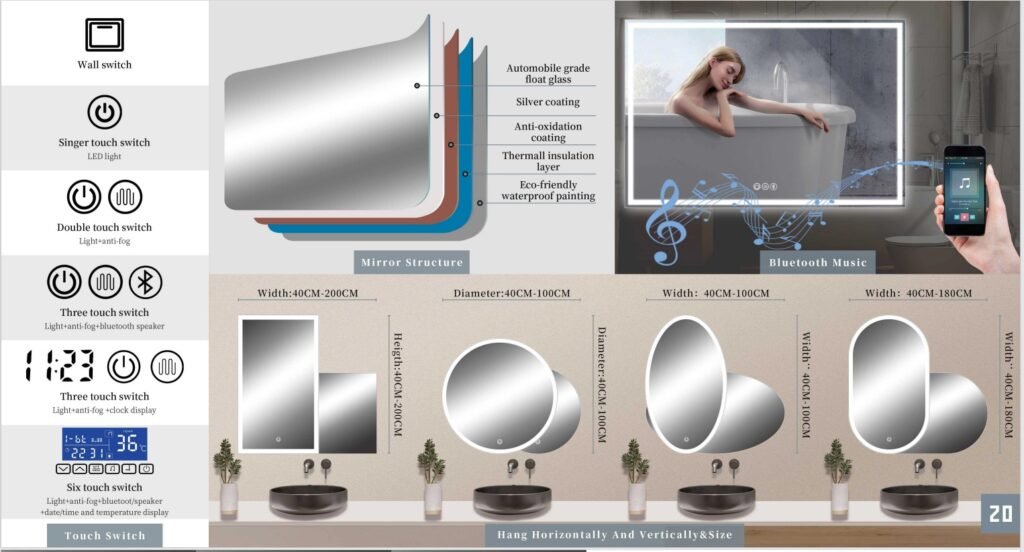
The Foundation: Glass and its Crucial Role
The starting point for virtually every modern mirror is glass. However, not just any glass will suffice. The specific type and quality of glass used are paramount to the mirror’s performance.
The Necessity of Float Glass
The vast majority of mirrors today utilize float glass. Developed by Sir Alastair Pilkington in the late 1950s, the float process revolutionized glass manufacturing. In this method, molten glass is poured onto a bed of molten tin. Because glass is less dense than tin and immiscible with it, the molten glass spreads out evenly, forming a perfectly flat and uniform surface. This process eliminates the need for grinding and polishing, which were previously labor-intensive and expensive steps required to achieve a smooth finish.
The benefits of float glass for mirror production are manifold:
- Uniformity and Flatness: The inherent flatness of float glass is critical for accurate reflection. Any distortion or waviness in the glass substrate would translate into warped images, rendering the mirror functionally impaired.
- Surface Quality: The float process produces a smooth, pristine surface, ideal for subsequent coating processes. A rough or contaminated surface would lead to inconsistent adhesion of the reflective layer and compromised reflectivity.
- Scalability and Cost-Effectiveness: The float process allows for continuous, high-volume production, making float glass a readily available and cost-effective material, which is essential for mass-produced mirrors.
Specialized Glass Types
While standard float glass is the norm, certain applications demand specialized types of glass. For instance, in high-precision optical instruments, such as telescopes and lasers, ultra-low expansion (ULE) glass or fused silica might be used. These materials exhibit exceptional thermal stability, meaning they do not expand or contract significantly with changes in temperature. This precision is crucial for maintaining the optical integrity of sensitive equipment. Similarly, toughened glass, also known as tempered glass, is often used for safety mirrors in public spaces or in automotive applications. This glass undergoes a heat treatment process that dramatically increases its strength and causes it to shatter into small, blunt pieces when broken, rather than sharp shards.
The Reflective Core: Metals and Their Magical Properties
The defining characteristic of a mirror is its ability to reflect light. This is achieved through a thin, highly reflective metallic layer deposited onto the glass substrate. The choice of metal is critical, influencing the mirror’s reflectivity, durability, and cost.
The Dominance of Silver
For decades, silver has been the metal of choice for high-quality mirrors. Its exceptional reflectivity across a broad spectrum of visible light, coupled with its relatively ease of deposition, makes it an ideal candidate. The process of silvering involves a chemical reaction, typically the Tollens’ reagent reaction, where silver ions in solution are reduced to metallic silver, which then deposits as a thin, uniform film on the glass surface.
The advantages of silver for mirrors include:
- Superior Reflectivity: Silver reflects approximately 95% of visible light, a higher percentage than most other common metals. This results in bright, clear, and true-to-life reflections.
- Broad Spectral Response: Silver’s high reflectivity extends across the visible spectrum, ensuring that colors are reproduced accurately.
- Ease of Deposition: Chemical deposition methods for silver are well-established and can be performed at relatively low temperatures, compatible with the glass substrate.
However, silver has a significant drawback: its susceptibility to corrosion. Silver tarnishes when exposed to sulfur compounds in the air, forming a dark layer that diminishes reflectivity. This necessitates protective layers to ensure longevity.
The Rise of Aluminum
In many consumer applications and in situations where cost is a primary consideration, aluminum has become a popular alternative to silver. Aluminum is significantly cheaper than silver and is also highly reflective, though generally not to the same degree as silver. The deposition of aluminum is typically achieved through vacuum metallization, where aluminum is evaporated in a vacuum chamber and then condenses onto the glass surface.
Key characteristics of aluminum in mirrors:
- Cost-Effectiveness: Aluminum is a more economical choice, making mirrors more affordable for widespread use.
- Good Reflectivity: While slightly lower than silver (around 90-92% for visible light), aluminum still provides excellent reflectivity for most everyday applications.
- Durability: Aluminum forms a protective oxide layer on its surface, which offers some resistance to corrosion. However, it can still be susceptible to scratching and etching.
- UV Reflectivity: Aluminum also reflects ultraviolet (UV) light very effectively, making it suitable for specialized applications where UV reflection is desired.
Other Reflective Materials and Emerging Technologies
While silver and aluminum dominate the market, other metals and advanced materials are used in specialized mirror applications:
- Gold: Gold’s exceptional resistance to corrosion and its high reflectivity in the infrared spectrum make it ideal for scientific instruments, such as telescopes designed to observe infrared radiation. However, gold is significantly more expensive than silver or aluminum.
- Chromium: Chromium is often used in decorative mirrors due to its bright, polished finish. It offers good reflectivity but is not typically used for applications requiring the highest fidelity reflection.
- Dielectric Mirrors: In advanced optical systems, particularly in lasers and interferometry, dielectric mirrors are employed. These mirrors are not made of metal at all but consist of multiple alternating thin layers of dielectric materials with different refractive indices. By carefully controlling the thickness and number of these layers, scientists can achieve extremely high reflectivity over specific wavelengths with virtually no absorption. These mirrors are crucial for high-power laser systems where metallic mirrors would absorb too much energy.

The Protective Mantle: Safeguarding the Reflective Layer
The thin metallic layer of a mirror, especially silver, is inherently fragile and vulnerable to environmental damage. To ensure the mirror’s longevity and maintain its reflective properties, a series of protective coatings are applied. This multi-layer system is as crucial to the mirror’s function as the reflective layer itself.
The Role of Copper Backing
Following the deposition of the reflective metal, a layer of copper is often applied over it. This copper layer serves a dual purpose:
- Corrosion Prevention: Copper acts as a barrier, preventing external corrosive agents from reaching the underlying silver. Silver is particularly reactive with sulfur compounds, and copper provides a crucial shield against such reactions.
- Adhesion Promotion: The copper layer can also improve the adhesion of the subsequent protective paint layers, ensuring a robust and integrated structure.
The Essential Paint Layers
The final stage in the manufacturing of a standard mirror involves applying several layers of protective paint. These paints are not for aesthetics but are a critical technological component of the mirror.
- Primer Layer: The first paint layer, often a primer, adheres to the copper backing and provides a stable base for subsequent layers.
- Main Protective Paint: This layer, typically a durable epoxy or polyurethane-based paint, forms the bulk of the protective coating. It shields the copper and reflective metal from physical damage, moisture, and chemical attack. Modern paints are formulated to be resistant to abrasion, chemicals, and weathering.
- Finishing Layer: In some cases, a final, thinner layer of paint might be applied for added protection or to achieve a specific visual finish, especially for decorative mirrors.
The development of specialized paints with enhanced durability, chemical resistance, and adhesion properties has been a significant technological advancement in mirror manufacturing, extending their lifespan and applicability in diverse environments.
Beyond the Ordinary: Specialized Mirror Technologies
The fundamental construction of glass, metal, and protective coatings forms the basis for most mirrors. However, innovation continues to push the boundaries, leading to specialized mirrors designed for unique technological applications.
Front-Surface Mirrors
In conventional mirrors, light passes through the glass, reflects off the metallic backing, and then passes back through the glass to the observer. This means the light interacts twice with the glass surface, leading to minor light loss and ghosting due to reflections from the front surface of the glass. For high-precision optical applications, such as in telescopes, microscopes, and scientific instruments, front-surface mirrors are employed.
In a front-surface mirror, the reflective metallic layer is deposited on the front surface of the glass substrate, meaning it is exposed directly to the environment. This eliminates the double passage of light through the glass, resulting in:
- Increased Reflectivity: Less light is lost, leading to brighter and sharper images.
- Reduced Ghosting: The unwanted reflections from the front surface of the glass are eliminated, improving image clarity.
- Color Accuracy: Light doesn’t pass through the glass, so any inherent color of the glass itself does not affect the reflected image.
However, the exposed reflective layer is extremely fragile and requires careful handling and, in some cases, transparent protective coatings to prevent damage.
Two-Way Mirrors (One-Way Mirrors)
A common misconception surrounds two-way mirrors, often seen in surveillance or interrogation rooms. These are not truly one-way mirrors but rather semi-transparent mirrors. They are constructed by applying an extremely thin layer of highly reflective material, typically aluminum, to a piece of glass. This layer is so thin that a small percentage of light can pass through it.
The “one-way” effect is achieved through lighting and observation conditions:
- Illumination: The side intended for observation is kept brightly lit.
- Darkness: The side intended for surveillance is kept significantly darker.
When light hits the mirror from the brighter side, most of it is reflected back, creating the appearance of a normal mirror for observers on that side. However, the small amount of light that passes through is insufficient to illuminate the dark side, allowing observers on the dark side to see through to the brighter side. The technology lies in precisely controlling the thickness of the reflective coating to achieve the desired balance between reflection and transmission.

Heated and Coated Mirrors
Modern automotive mirrors often incorporate heating elements to defrost or defog the surface, ensuring visibility in adverse weather conditions. These mirrors have thin, conductive coatings or embedded wires that generate heat when an electric current is passed through them. Furthermore, specialized coatings can be applied to enhance performance, such as anti-glare coatings that reduce headlight glare from trailing vehicles or even integrated digital displays that appear only when activated.
In conclusion, the seemingly simple mirror is a testament to human ingenuity and technological advancement. From the precise flatness of float glass to the reflective prowess of silver and aluminum, and the protective resilience of advanced coatings, each component plays a vital role. The evolution of mirror technology continues, driven by the demand for enhanced performance, durability, and novel functionalities, ensuring that these reflective surfaces will continue to be integral to our lives and technological progress.
aViewFromTheCave is a participant in the Amazon Services LLC Associates Program, an affiliate advertising program designed to provide a means for sites to earn advertising fees by advertising and linking to Amazon.com. Amazon, the Amazon logo, AmazonSupply, and the AmazonSupply logo are trademarks of Amazon.com, Inc. or its affiliates. As an Amazon Associate we earn affiliate commissions from qualifying purchases.