
In the ever-evolving landscape of academic and professional writing, the ability to capture an audience’s attention from the very first sentence is not merely a stylistic flourish; it’s a strategic imperative. A compelling hook acts as the gateway to your essay, signaling the quality and engagement that lies within. It’s the initial handshake, the first impression, and in many cases, the deciding factor in whether your reader will invest their time and mental energy into your ideas. Without a strong opening, even the most profound arguments can languish, unseen and unappreciated. This article delves into the art and science of crafting effective hooks, exploring various techniques and providing actionable insights to elevate your writing from the outset.

The Indispensable Role of a Hook in Modern Communication
The modern information ecosystem is characterized by an overwhelming deluge of content. From social media feeds to professional reports, readers are constantly bombarded with stimuli, and their attention spans are notoriously brief. In such an environment, the hook isn’t just a nice-to-have; it’s a necessity for survival. It’s the initial filter that helps your reader decide if your content is worth their limited cognitive resources. Beyond simply grabbing attention, a good hook serves several crucial functions that directly impact the reception and effectiveness of your entire piece.
Establishing Immediate Relevance and Intrigue
A well-crafted hook immediately signals to the reader why they should care about your topic. It taps into their existing knowledge, curiosity, or concerns, making the subject matter feel personal and relevant. This could involve posing a thought-provoking question, presenting a surprising statistic, or weaving a brief, engaging anecdote. The goal is to create an immediate emotional or intellectual connection, fostering a desire to learn more. When a reader feels that the topic directly relates to their interests or challenges, they are far more likely to remain engaged throughout the essay.
Setting the Tone and Anticipating the Essay’s Direction
The opening lines of your essay also play a vital role in establishing its overall tone and hinting at the journey the reader is about to embark upon. Are you aiming for a serious and analytical approach, a persuasive and passionate argument, or a narrative-driven exploration? The hook can subtly (or overtly) communicate this intention. For instance, a startling statistic might suggest a data-driven analysis, while a vivid description could foreshadow a more literary or experiential approach. This foresight helps manage reader expectations and prepares them for the style and substance of your content.
Demonstrating Writing Prowess and Credibility
A strong hook is often an indicator of strong writing throughout the essay. It demonstrates a writer’s command of language, their ability to think critically, and their commitment to engaging their audience. This initial display of skill can build immediate credibility in the reader’s mind. When you open with confidence and clarity, you suggest that the rest of your essay will be equally well-structured and insightful. Conversely, a weak or cliché opening can undermine the reader’s faith in your ability to deliver a valuable piece of writing.
Proven Hook Techniques for Captivating Audiences
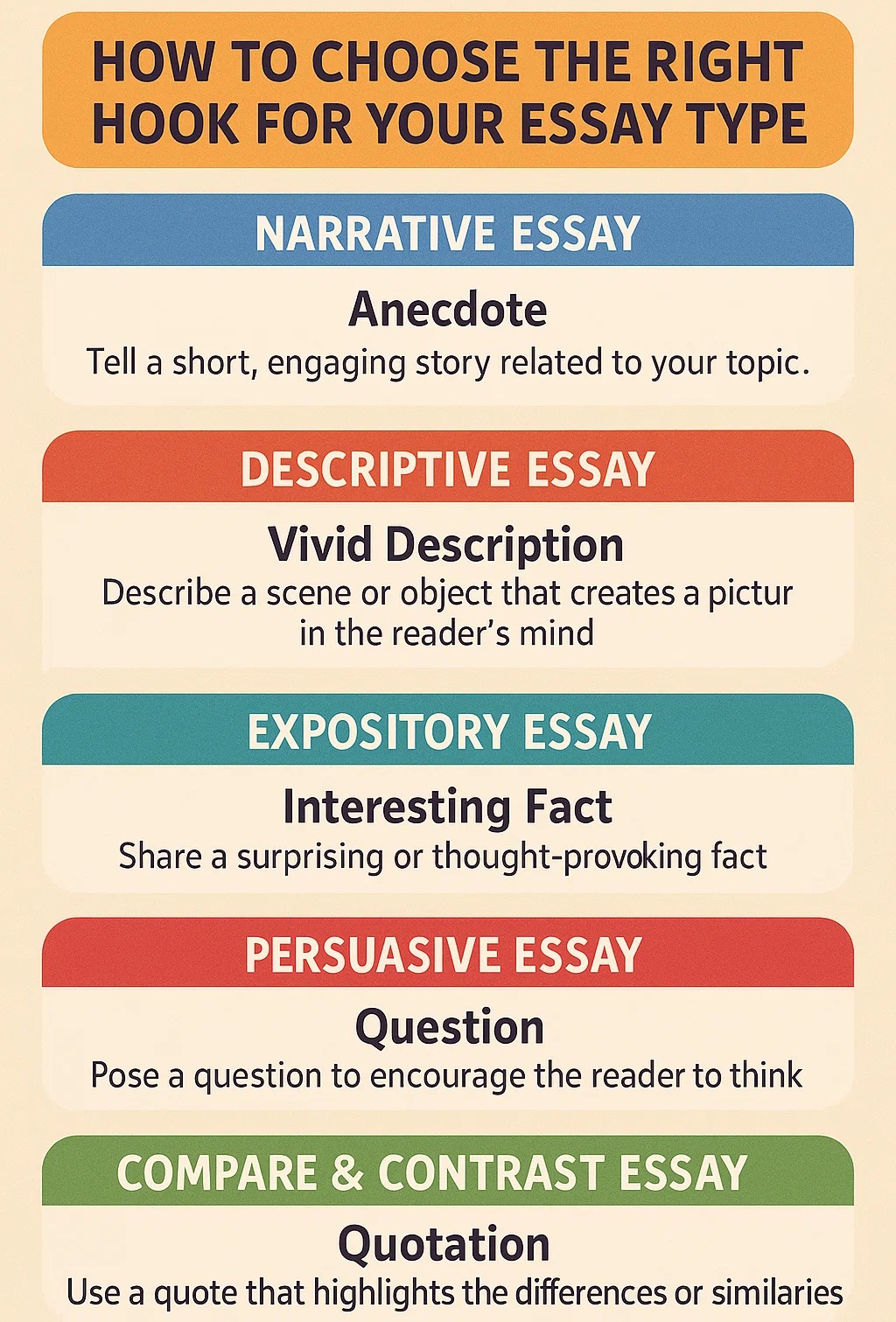
The effectiveness of a hook lies in its ability to break through the noise and resonate with the reader. While the specific application will vary depending on the essay’s subject matter and intended audience, several tried-and-true techniques consistently yield strong results. Experimenting with these diverse approaches can help you discover the most impactful way to begin your writing.
The Power of the Question
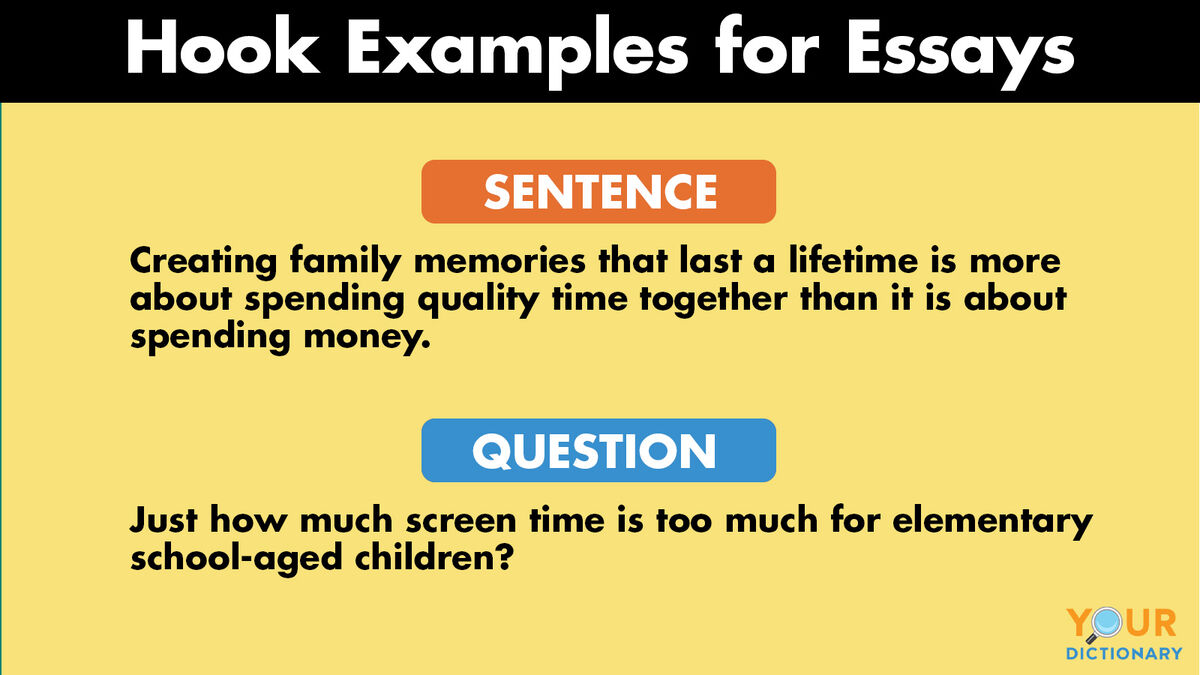
Posing a well-chosen question is a classic and highly effective hook. It directly engages the reader’s mind, prompting them to consider the subject matter and seek an answer. Rhetorical questions can be particularly potent, forcing the reader to contemplate a concept or problem that your essay will then explore. For example, “What if the very technologies designed to connect us are inadvertently pushing us further apart?” This type of question immediately sparks curiosity and establishes the essay’s central inquiry. To maximize the impact of a question hook, ensure it is:
- Relevant: Directly tied to the core theme of your essay.
- Provocative: Encourages deeper thought rather than a simple yes/no answer.
- Specific: Avoids being too broad or vague, which can lead to reader confusion.
The Startling Statistic or Fact
Numbers can be incredibly persuasive, and a surprising statistic or little-known fact can immediately capture attention by presenting something the reader likely didn’t know. This technique is especially effective when dealing with topics that benefit from empirical evidence or highlighting the scale of a phenomenon. For instance, “Globally, over 90% of internet users are exposed to malware through a website each month.” This statement is arresting because it presents a significant and potentially alarming piece of information that compels the reader to understand the implications. When using statistics, remember to:
- Source your data: Ensure accuracy and credibility by citing reputable sources, even if only implicitly in the introduction.
- Contextualize: Briefly explain what the statistic means or why it is significant to your argument.
- Surprise: Choose statistics that are not commonly known or expected.
The Vivid Anecdote or Story
Human beings are hardwired for stories. A brief, compelling anecdote or a captivating narrative can draw readers in by creating an emotional connection and illustrating a point in a relatable way. This technique is particularly effective for essays that explore personal experiences, social issues, or complex human behaviors. For example, “Sarah logged onto her social media, expecting to connect with old friends, only to find her personal photos had been used to create a fake dating profile.” This opening immediately immerses the reader in a scenario, sparking empathy and curiosity about the outcome. When employing an anecdote:
- Keep it concise: The anecdote should be brief and to the point, serving as a springboard for your argument.
- Make it relevant: Ensure the story directly illustrates the central theme or problem your essay will address.
- Focus on impact: Choose details that are vivid and emotionally resonant.
The Bold Statement or Declaration
A strong, declarative statement can assert your position or introduce a key concept with confidence, immediately establishing your authority and the essay’s central premise. This can be particularly effective when you have a unique or counterintuitive perspective to offer. For instance, “The pursuit of constant connectivity has paradoxically led to unprecedented levels of social isolation.” This type of hook is direct, assertive, and immediately frames the reader’s understanding of the essay’s trajectory. When making a bold statement:
- Be confident: The statement should be delivered with conviction.
- Be clear: Avoid ambiguity; your reader should understand your assertion immediately.
- Be prepared to defend it: The rest of your essay must rigorously support this initial declaration.
The Expert Quote
Leveraging the words of a recognized authority can lend immediate weight and credibility to your essay. A well-chosen quote can encapsulate a complex idea, highlight a significant trend, or provide a provocative starting point for your discussion. For example, “As renowned cybersecurity expert Bruce Schneier stated, ‘Security is not a product, but a process.'” This quote not only introduces a key concept but also imbues the essay with the authority of its source. When using a quote:
- Select wisely: Choose quotes that are impactful, relevant, and not overused.
- Attribute clearly: Always provide the name and, if possible, the credentials of the speaker.
- Explain its relevance: Briefly connect the quote to your essay’s topic and argument.
Crafting Hooks for Different Essay Contexts
The effectiveness of a hook is intrinsically linked to the specific context of the essay, including its intended audience, purpose, and subject matter. While the fundamental principles of engagement remain constant, the most appropriate hook technique will vary significantly. Understanding these nuances allows for a more strategic and impactful opening.
Academic Essays: Establishing Authority and Intellectual Rigor
In academic settings, hooks often need to demonstrate intellectual curiosity and an understanding of the existing discourse. They should signal that the essay will offer a thoughtful contribution to a scholarly conversation. While creativity is encouraged, it must be balanced with a clear indication of the essay’s academic focus.
- H3: The Provocative Claim in Academia: Similar to a bold statement, an academic hook might present a provocative claim that challenges conventional wisdom. For example, in an essay on AI ethics, one might start with: “The ethical quandaries surrounding artificial intelligence are not solely about preventing malevolent machines, but about redefining human agency in an increasingly automated world.” This immediately signals a nuanced and critical approach.
- H3: The Historical or Definitional Hook: For essays delving into historical analysis or defining key concepts, a hook that establishes historical context or provides a precise definition can be highly effective. For instance, “The advent of the internet, once hailed as a democratizing force, has inadvertently become a breeding ground for sophisticated forms of digital manipulation.” This sets the stage by framing the historical development and its contemporary implications.
- H3: The Interdisciplinary Connection: In interdisciplinary essays, a hook that draws a surprising connection between two seemingly unrelated fields can pique reader interest. For example, “Just as the principles of natural selection govern biological evolution, the dynamics of online information dissemination are creating a unique digital ecosystem with its own set of survival pressures.”
Professional and Business Essays: Demonstrating Insight and Problem-Solving
In professional and business contexts, hooks are often designed to immediately convey value, address pressing issues, and demonstrate a capacity for insight and problem-solving. The audience is typically looking for actionable information, strategic perspectives, or solutions to challenges.
- H3: The Urgent Problem/Opportunity: Highlighting a pressing problem or a significant opportunity that the essay will address is a powerful way to engage a business audience. For example, “In an era where customer data is the new currency, organizations that fail to implement robust data privacy protocols face not only regulatory penalties but also irreparable reputational damage.” This immediately signals the essay’s relevance to contemporary business concerns.
- H3: The Future-Oriented Projection: For essays focused on innovation, strategy, or market trends, a forward-looking hook can capture attention by hinting at future developments. “The rise of quantum computing, once relegated to the realm of science fiction, is poised to fundamentally disrupt existing cybersecurity paradigms within the next decade.” This prompts the reader to consider the implications of emerging technologies.
- H3: The Client-Centric Scenario: For essays directly relevant to specific industries or client needs, a hook that presents a relatable client scenario can immediately resonate. “Imagine a small e-commerce business struggling to differentiate itself in a crowded online marketplace, its marketing efforts yielding diminishing returns.” This sets up a problem that the subsequent discussion will aim to solve.
Personal and Reflective Essays: Evoking Emotion and Shared Experience
Essays that are personal or reflective in nature often benefit from hooks that tap into universal human emotions, experiences, or curiosities. The goal is to create an immediate sense of connection and empathy with the reader, inviting them into the writer’s world.
- H3: The Universal Emotion: Starting with a statement or question that evokes a common human emotion can be highly effective. “The quiet hum of a refrigerator late at night can sometimes amplify the loudest doubts we carry.” This taps into a shared experience of introspection and vulnerability.
- H3: The Intriguing Observation: A unique or insightful observation about everyday life can draw readers in by offering a fresh perspective. “We spend so much of our lives curating our digital selves, yet the most profound moments often occur when our filters are off.” This invites reflection on the nature of authenticity.
- H3: The Sensory Detail: For essays aiming for a vivid and immersive experience, starting with a strong sensory detail can transport the reader. “The scent of rain on hot pavement, a smell that always transports me back to childhood summers and the unsettling feeling of impending change.” This uses sensory imagery to evoke a mood and hint at deeper themes.
Refining and Testing Your Hooks for Maximum Impact
Crafting a hook is an iterative process, and what might seem perfect on the first draft could be improved with careful refinement and testing. The goal is to ensure your opening is not only attention-grabbing but also genuinely sets the stage for the valuable content that follows.
The Importance of Brevity and Clarity
Regardless of the technique employed, a hook should always be concise and easy to understand. Long, convoluted sentences or overly abstract ideas at the outset can deter readers. Aim for impact through precision, not verbosity. A hook should be a sprinter, not a marathon runner; it needs to make its mark quickly and powerfully.
Eliminating Clichés and Overused Phrases
The landscape of writing is littered with tired clichés that have lost their ability to surprise or engage. Phrases like “In today’s fast-paced world…” or “It is a well-known fact that…” can immediately signal a lack of originality. Actively identify and eliminate these worn-out expressions to ensure your hook feels fresh and authentic.
The Power of Reading Aloud and Seeking Feedback
One of the most effective ways to assess the strength of your hook is to read it aloud. Does it flow naturally? Does it sound engaging? Does it create the intended impact? Furthermore, seeking feedback from peers, mentors, or writing groups can provide invaluable insights. A fresh pair of eyes can often identify weaknesses or suggest improvements that you might have overlooked. Ask your readers: “Does this opening make you want to read more? What impression does it give you of the essay’s topic?”
Iterative Development: Don’t Be Afraid to Revise
The process of writing is rarely linear. If your initial hook isn’t working, or if your essay’s direction shifts during the writing process, don’t hesitate to revisit and revise your opening. Sometimes, a better hook can emerge only after you have a clearer understanding of the entire essay’s content and argument. Think of your hook not as a rigid starting point, but as a dynamic element that can evolve to best serve your final piece.
In conclusion, the hook is far more than a mere introductory sentence; it’s a strategic tool that shapes the reader’s entire experience. By understanding the fundamental role of a hook, mastering various effective techniques, tailoring them to specific essay contexts, and committing to rigorous refinement, you can transform your introductions from mundane formalities into powerful invitations that draw your readers in and keep them engaged from the very first word to the last.
aViewFromTheCave is a participant in the Amazon Services LLC Associates Program, an affiliate advertising program designed to provide a means for sites to earn advertising fees by advertising and linking to Amazon.com. Amazon, the Amazon logo, AmazonSupply, and the AmazonSupply logo are trademarks of Amazon.com, Inc. or its affiliates. As an Amazon Associate we earn affiliate commissions from qualifying purchases.