
Navigating the financial landscape of modern adulthood often feels like a balancing act between career aspirations and family responsibilities. For millions of working professionals, the cost of providing care for children or aging parents is one of the most significant line items in their annual budget. Understanding “dependent care expenses” is not merely an academic exercise in tax terminology; it is a critical component of personal finance that can save a household thousands of dollars each year.
At its core, dependent care expenses refer to the costs incurred to ensure the well-being of a qualifying individual while the primary caregivers are at work or actively looking for employment. These expenses are recognized by the Internal Revenue Service (IRS) and various financial institutions as necessary outlays that justify specific tax breaks and savings vehicles. By mastering the nuances of these expenses, you can effectively lower your taxable income and better manage your family’s financial future.
Defining Dependent Care Expenses and Eligibility
The first step in managing these costs is identifying what qualifies as a dependent care expense. The IRS maintains strict guidelines to ensure that these benefits are used as intended: to support the workforce by providing safe environments for their dependents.
Who Qualifies as a Dependent?
To claim dependent care expenses, the person receiving care must be a “qualifying person.” This typically includes a child under the age of 13 whom you can claim as a dependent. However, the definition extends further. It also encompasses a spouse or a legal dependent (such as an elderly parent or a disabled adult child) who is physically or mentally incapable of self-care and lives with you for more than half the year. The financial distinction here is vital: for children, the age limit is a hard cutoff, whereas for adults, the focus is on their inability to care for themselves.
Which Expenses Are Considered “Work-Related”?
The primary litmus test for a dependent care expense is its “work-related” status. The expense must be necessary for you (and your spouse, if filing jointly) to work or look for work. If one parent stays at home and does not earn income or seek it, the costs associated with daycare are generally not considered eligible for tax benefits. This requirement ensures that the financial relief is directed toward those contributing to the economy.
Age Limits and Special Circumstances
While the age limit for children is 13, there are exceptions for dependents with disabilities. If a child has a physical or mental impairment that prevents them from caring for themselves, the age limit is waived. Furthermore, in cases of divorced or separated parents, usually only the custodial parent—the one with whom the child lives for the greater part of the year—can claim these expenses, regardless of who claims the child as a tax dependent.
Maximizing the Child and Dependent Care Tax Credit (CDCTC)
One of the most powerful financial tools available to families is the Child and Dependent Care Tax Credit (CDCTC). Unlike a deduction, which reduces the amount of income you are taxed on, a credit is a dollar-for-dollar reduction of your actual tax bill.
How the Credit Works
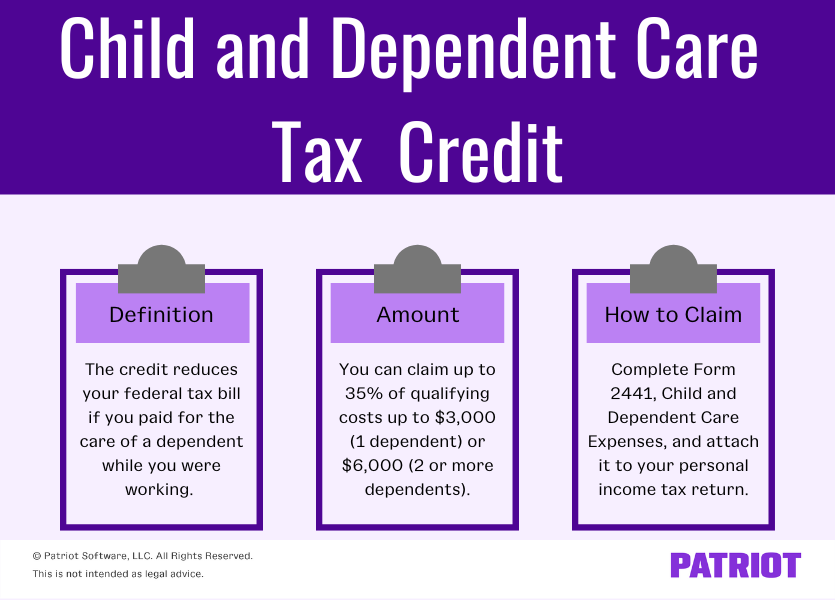
To claim the CDCTC, you must complete Form 2441 when filing your federal income tax return. The credit is calculated based on a percentage of the work-related expenses you paid to a care provider. You must provide the name, address, and Taxpayer Identification Number (usually a Social Security Number or an Employer Identification Number) of the care provider. This transparency is a safeguard to ensure that the “money” remains within a traceable, legal financial framework.
Percentage of Expenses Covered
The amount of the credit depends on your Adjusted Gross Income (AGI). Typically, the credit ranges from 20% to 35% of your eligible expenses. There is a cap on the total amount of expenses you can use to calculate the credit—usually $3,000 for one qualifying person or $6,000 for two or more. For example, if you have two children in daycare and spend $15,000 annually, you can only apply the credit percentage to the first $6,000. For a middle-income family at a 20% credit rate, this results in a $1,200 direct reduction in taxes.
Necessary Documentation and IRS Requirements
Financial discipline is required to successfully claim this credit. You must keep meticulous records, including receipts, cancelled checks, and invoices. If you pay an individual to provide care in your home (like a nanny), you may also be subject to “nanny tax” requirements, involving Social Security and Medicare taxes. Understanding these secondary financial obligations is crucial to avoid penalties that could negate the benefits of the tax credit.
Leveraging Dependent Care Flexible Spending Accounts (FSAs)

Beyond tax credits, many employers offer a Dependent Care Flexible Spending Account (FSA). This is a “pre-tax” financial tool that allows you to set aside a portion of your salary before taxes are taken out to pay for eligible care expenses.
FSA vs. Tax Credit: Which is Better?
For many high-earning individuals, a Dependent Care FSA offers greater financial benefits than the CDCTC. Because the money is diverted from your paycheck before federal, state, and payroll taxes are applied, it effectively lowers your taxable income. For someone in a high tax bracket, the savings could exceed 30% or 40% of the contributed amount. However, you cannot “double-dip.” Any dollar spent using FSA funds cannot be used to calculate the Child and Dependent Care Tax Credit.
Contribution Limits and “Use It or Lose It” Rules
The IRS sets an annual limit on FSA contributions, commonly $5,000 for married couples filing jointly. A critical aspect of the FSA is the “use it or lose it” rule. If you contribute $5,000 but only spend $4,500 on care, the remaining $500 may be forfeited to the employer, depending on your plan’s specific grace period or carryover provisions. This requires precise financial forecasting at the start of each benefit year.
Employer-Provided Benefits and Payroll Deductions
The beauty of the FSA lies in its automation. Once you determine your contribution during open enrollment, the funds are deducted systematically. This “set it and forget it” approach to personal finance ensures that the money for care is always available, reducing the monthly stress of managing liquid cash for daycare or elder care invoices.
Eligible vs. Ineligible Expenses: Navigating the Fine Print
To optimize your financial strategy, you must distinguish between what the IRS views as “care” and what it views as “personal enrichment” or “education.”
Common Qualifying Costs
Standard qualifying expenses include nursery school, preschool, after-school programs, and licensed daycare centers. Even summer day camps qualify, provided the primary purpose is to ensure the child’s protection and well-being while the parents work. In-home care, such as a housekeeper or nanny who also spends a portion of their time caring for a dependent, can also qualify, though the portion of their salary attributed to care must be reasonably calculated.
What Doesn’t Count
A common financial pitfall is assuming all child-related costs are deductible. Tutoring, private school tuition (for kindergarten and above), and overnight camps do not qualify as dependent care expenses. Similarly, the costs of transporting a dependent to a care facility are generally not eligible unless provided by the care provider as part of the total fee. Understanding these boundaries prevents costly errors during tax audits.
Caring for Adult Dependents and Spouses
The “Money” aspect of dependent care is increasingly shifting toward elder care. As the population ages, more professionals are paying for adult day centers or in-home aides for their parents. These costs are eligible if the parent meets the IRS dependency tests. This provides a vital financial cushion for the “sandwich generation”—those who are simultaneously funding their children’s upbringing and their parents’ senior years.
Strategic Financial Planning for Caregiving Costs
Managing dependent care expenses is not just about filling out tax forms; it is about long-term wealth management and cash flow optimization.
Budgeting for the Rising Cost of Care
With the cost of childcare often rivaling mortgage payments in many metropolitan areas, proactive budgeting is essential. Families should treat dependent care as a fixed expense and investigate local subsidies or sliding-scale programs that may be available based on income levels. Integrating these costs into a comprehensive five-year financial plan allows for better preparation for when children eventually age out of the system.
Coordinating Benefits for Maximum Savings
Strategic taxpayers often use a combination of an FSA and the tax credit. If you have two children and spend $10,000 on care, you could use $5,000 from your FSA. Since the CDCTC limit for two children is $6,000, you may still be able to apply the tax credit to the remaining $1,000 of expenses that weren’t covered by the pre-tax FSA funds. This “stacking” strategy requires careful calculation but maximizes every available dollar.

The Role of Professional Financial Advice
Given the complexity of tax laws and the varying rules regarding FSAs, consulting with a financial advisor or a tax professional is often a wise investment. They can help model different scenarios to determine whether the FSA or the Tax Credit provides a higher net return based on your specific income bracket and state tax laws. In the realm of personal finance, being informed is the most effective way to protect your assets and provide for your family’s needs.
By understanding what dependent care expenses are and how to leverage the financial tools associated with them, you transform a significant cost into a manageable, strategically handled component of your financial life. Whether through tax credits or pre-tax accounts, the goal remains the same: ensuring your loved ones are cared for without compromising your financial stability.
aViewFromTheCave is a participant in the Amazon Services LLC Associates Program, an affiliate advertising program designed to provide a means for sites to earn advertising fees by advertising and linking to Amazon.com. Amazon, the Amazon logo, AmazonSupply, and the AmazonSupply logo are trademarks of Amazon.com, Inc. or its affiliates. As an Amazon Associate we earn affiliate commissions from qualifying purchases.