
The intricate dance of life, from the smallest bacterium to the most complex mammal, is orchestrated by a remarkable molecule known as deoxyribonucleic acid, or DNA. At the heart of DNA’s ability to store and transmit genetic information lies a fundamental principle: complementary base pairing. This elegant mechanism, a cornerstone of molecular biology and a driving force behind countless technological innovations, dictates how DNA strands are replicated, transcribed, and ultimately translated into the building blocks of life. Understanding complementary base pairs isn’t just an academic pursuit; it’s essential for comprehending the very foundations of fields like genetic engineering, diagnostics, and advanced bioinformatics, all of which are rapidly transforming our world.

The Building Blocks of Genetic Information: Nucleotides and Bases
Before delving into the concept of complementarity, it’s crucial to understand the fundamental units that comprise DNA: nucleotides. Each nucleotide is composed of three components: a phosphate group, a deoxyribose sugar, and a nitrogenous base. It is the nitrogenous base that holds the key to the genetic code and the principle of complementary pairing.
The Four Nitrogenous Bases
DNA utilizes four distinct nitrogenous bases, each with a unique chemical structure and a specific role in forming the genetic alphabet. These bases are:
- Adenine (A): A purine base, characterized by its double-ring structure. Adenine is relatively large and chemically reactive.
- Guanine (G): Another purine base, also with a double-ring structure. Guanine is structurally similar to adenine but possesses a slightly different arrangement of atoms, leading to distinct chemical interactions.
- Cytosine (C): A pyrimidine base, distinguished by its single-ring structure. Cytosine is smaller and less complex than the purines.
- Thymine (T): Another pyrimidine base, with a single-ring structure. Thymine is chemically similar to cytosine, differing primarily in a single methyl group.
These four bases are the letters with which the genetic instruction manual of every living organism is written. The sequence of these bases along a DNA strand determines the inherited traits and functions of an organism.
The DNA Double Helix: A Structural Marvel
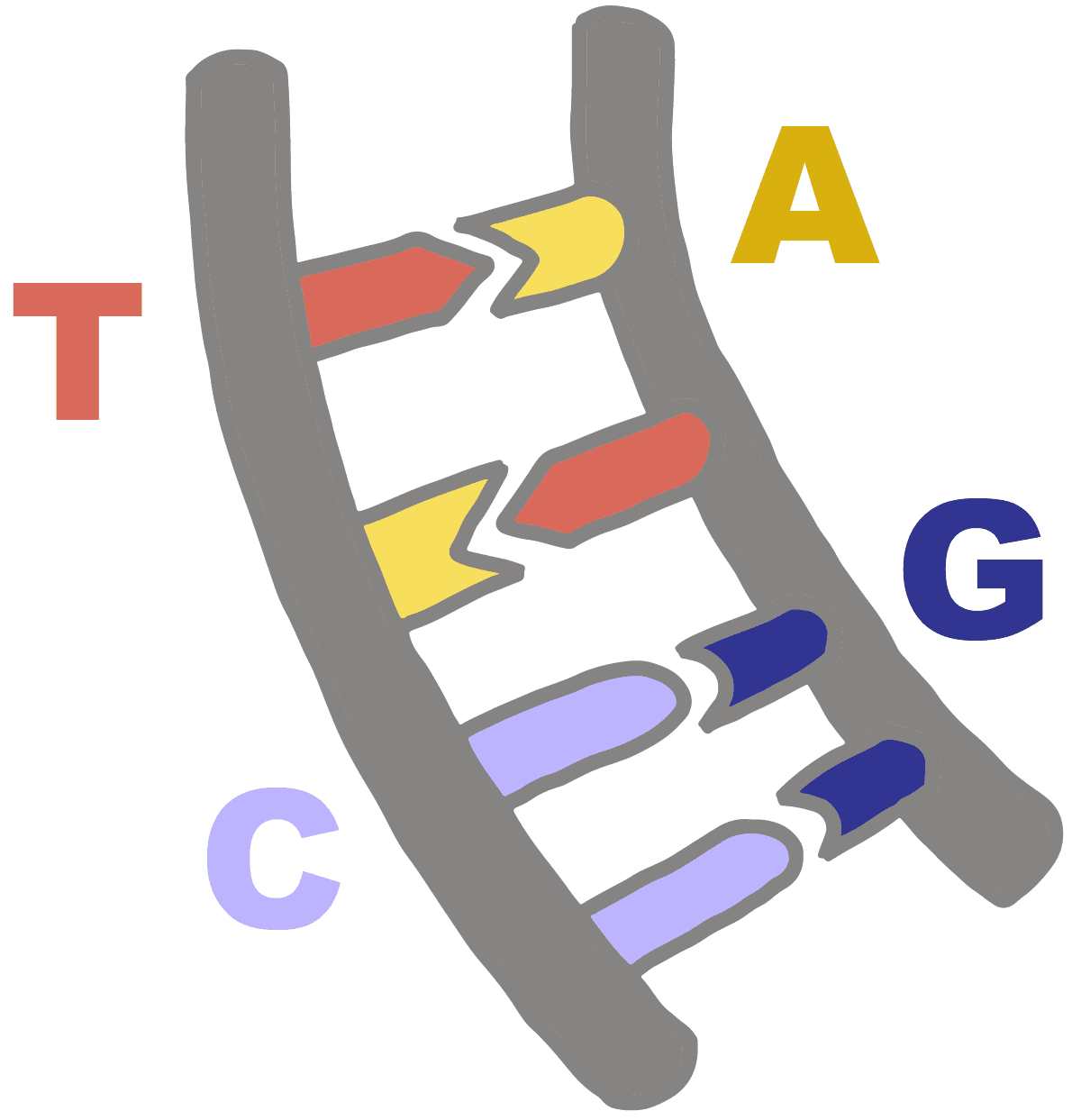
DNA typically exists as a double helix, a structure famously elucidated by James Watson and Francis Crick. This iconic shape resembles a twisted ladder, where the “sides” of the ladder are formed by alternating sugar and phosphate groups, and the “rungs” are formed by pairs of nitrogenous bases. However, it’s not any two bases that can form a rung. The specific way these bases interact is dictated by the principle of complementary base pairing, ensuring the stability and accuracy of the DNA molecule.
The Rules of Engagement: Hydrogen Bonds and Specific Pairing
Complementary base pairing is governed by a precise set of rules that dictate which bases can bind to each other and how they do so. This specificity is crucial for maintaining the integrity of the genetic code during replication and transcription.
The Purine-Pyrimidine Rule
The fundamental rule of complementary base pairing is that a purine base always pairs with a pyrimidine base. This “purine-pyrimidine rule” ensures that the width of the DNA double helix remains constant. If two purines were to pair, the structure would be too wide, and if two pyrimidines paired, it would be too narrow. The consistent width is vital for the stable coiling of the DNA molecule.
Adenine-Thymine (A-T) Pairing
Adenine (A) specifically pairs with Thymine (T). This pairing is facilitated by two hydrogen bonds that form between specific atoms on each base. These hydrogen bonds are relatively weak individually but, when present in the millions that form a DNA molecule, they provide significant stability to the double helix. The A-T pairing is a hallmark of DNA.
Guanine-Cytosine (G-C) Pairing
Guanine (G) specifically pairs with Cytosine (C). This pairing is facilitated by three hydrogen bonds, which are stronger than the two hydrogen bonds found in A-T pairs. Consequently, G-C rich regions of DNA are generally more stable and require higher temperatures to separate compared to A-T rich regions. This difference in bond strength has important implications in various molecular biology techniques.
The Significance of Complementarity
The strict adherence to these pairing rules—A always with T, and G always with C—is what makes the two strands of a DNA molecule complementary. This means that if you know the sequence of bases on one strand, you can perfectly predict the sequence of bases on the opposite strand. For example, if one strand reads 5′-ATGC-3′, its complementary strand will read 3′-TACG-5′. This inherent complementarity is the foundation for DNA’s ability to be accurately copied.
Complementarity in Action: DNA Replication and Transcription
The principle of complementary base pairing is not merely a structural curiosity; it is the engine that drives the fundamental processes of DNA replication and RNA transcription, processes essential for cell division, growth, and the expression of genetic information.
DNA Replication: Copying the Blueprint
DNA replication is the process by which a cell makes an identical copy of its DNA before cell division. This process relies entirely on complementary base pairing to ensure that the daughter cells receive a complete and accurate set of genetic instructions.
- Unwinding the Helix: The DNA double helix first unwinds, with specialized enzymes breaking the hydrogen bonds between the base pairs, separating the two parental strands.
- Template Strands: Each of the now-separated parental strands acts as a template for the synthesis of a new complementary strand.
- Base Pairing and Polymerization: Free nucleotides in the cell nucleus are brought in and pair with their complementary bases on the template strands (A with T, and G with C). DNA polymerase, a crucial enzyme, then catalyzes the formation of phosphodiester bonds between these incoming nucleotides, building the new complementary strand.
- Two Identical Molecules: The result is two identical DNA double helices, each consisting of one original parental strand and one newly synthesized complementary strand. This “semiconservative” replication ensures faithful transmission of genetic information from one generation of cells to the next.
Transcription: From DNA to RNA
Transcription is the process by which the genetic information encoded in a DNA sequence is copied into a messenger RNA (mRNA) molecule. This is the first step in gene expression, where the instructions for building proteins are relayed from the DNA in the nucleus to the ribosomes in the cytoplasm. Again, complementary base pairing is central to this process, with a slight modification.
- Template Strand: Similar to replication, one strand of the DNA serves as a template.
- RNA Nucleotide Pairing: RNA nucleotides are brought in to pair with the DNA template strand. The base pairing rules are largely the same, with A pairing with U (Uracil) in RNA, and G pairing with C. Crucially, thymine (T) in DNA pairs with adenine (A) in RNA, while adenine (A) in DNA pairs with uracil (U) in RNA. Guanine (G) still pairs with cytosine (C), and cytosine (C) still pairs with guanine (G).
- RNA Synthesis: RNA polymerase, the enzyme responsible for transcription, links these RNA nucleotides together to form an mRNA strand.
- Ribonucleic Acid (RNA): The resulting mRNA molecule is a single-stranded nucleic acid that carries the genetic code for protein synthesis. It then travels to the ribosome, where it will be translated into a protein.
Technological Applications Fueled by Complementarity
The fundamental principle of complementary base pairing is not just a biological curiosity; it is the bedrock upon which numerous transformative technologies are built. From diagnostics that detect diseases to tools that edit genomes, our ability to harness and manipulate DNA is directly dependent on understanding and exploiting the predictable nature of these base pairings.
Genetic Sequencing and Diagnostics
The ability to read the genetic code, or sequence DNA, is a cornerstone of modern biotechnology. Techniques like Sanger sequencing and next-generation sequencing (NGS) rely heavily on complementary base pairing.
- Primers: In PCR (Polymerase Chain Reaction), short synthetic DNA sequences called primers are designed to bind to specific regions of a DNA template. These primers are complementary to the DNA sequence flanking the region of interest. By annealing (binding) to these complementary sequences, they provide a starting point for DNA polymerase to synthesize new DNA, amplifying the target sequence.
- Hybridization: Many diagnostic tests, such as those for infectious diseases or genetic predispositions, utilize the principle of hybridization. Labeled DNA or RNA probes, which are short, single-stranded sequences, are designed to be complementary to specific target sequences within a patient’s sample. When the sample contains the target sequence, the probe will bind to it through complementary base pairing, allowing for detection and diagnosis.
Gene Editing Technologies
Revolutionary gene editing technologies, most notably CRISPR-Cas9, leverage complementary base pairing in sophisticated ways.
- Guide RNA (gRNA): In the CRISPR system, a crucial component is the guide RNA (gRNA). This molecule contains a sequence that is complementary to the target DNA sequence that needs to be edited. This complementarity allows the gRNA to direct the Cas9 enzyme to the precise location within the genome.
- Targeting and Cleavage: Once the gRNA binds to its complementary DNA sequence, the Cas9 enzyme is activated to make a precise cut in the DNA double helix. This cut can then be repaired by the cell’s natural repair mechanisms, or researchers can introduce specific DNA sequences to be inserted at the cleavage site. The accuracy of this entire process hinges on the precise complementary binding of the gRNA to the target DNA.

Bioinformatics and Data Analysis
The vast amounts of genomic data generated by sequencing technologies require sophisticated computational tools for analysis. Bioinformatics, the interdisciplinary field that develops and applies computational approaches to biological data, heavily relies on the predictable nature of complementary base pairing.
- Sequence Alignment: Algorithms used to align DNA sequences, identify similarities and differences between them, and infer evolutionary relationships are built upon the foundation of base-pairing rules. Researchers can compare a newly sequenced genome to known reference genomes, and the alignment process implicitly understands the complementary nature of the strands to identify homologous regions.
- Database Searching: When searching large genetic databases for specific genes or sequences, the search algorithms often account for both the forward and reverse complementary strands to ensure comprehensive results.
In conclusion, complementary base pairing is far more than just a biological phenomenon. It is a fundamental principle that underpins the very mechanisms of life and serves as a powerful tool in the hands of scientists and engineers. As our understanding of DNA and its intricacies continues to grow, the applications of complementary base pairing in technology, medicine, and beyond will undoubtedly expand, promising further breakthroughs in our quest to understand and improve the living world.
aViewFromTheCave is a participant in the Amazon Services LLC Associates Program, an affiliate advertising program designed to provide a means for sites to earn advertising fees by advertising and linking to Amazon.com. Amazon, the Amazon logo, AmazonSupply, and the AmazonSupply logo are trademarks of Amazon.com, Inc. or its affiliates. As an Amazon Associate we earn affiliate commissions from qualifying purchases.