
The Anti-lock Braking System, universally recognized by its acronym ABS, stands as one of the most significant safety advancements in the history of automotive engineering. While modern drivers often take for granted the ability to stomp on the brake pedal during an emergency without losing steering control, this functionality is the result of sophisticated electronic sensors, hydraulic valves, and high-speed computing. Understanding how ABS works, why it was developed, and how it fundamentally changed vehicle safety requires a deep dive into the intersection of mechanical engineering and digital control systems.
The Evolution of Braking Technology
Before the widespread implementation of ABS, emergency braking was a skill that had to be mastered by drivers, often through trial and error. When a driver applied maximum pressure to the brakes in a traditional system, the wheels would frequently lock up. When a wheel stops rotating while the vehicle is still in motion, it loses its grip on the road surface, leading to a skid.
The Physics of Friction
To understand why ABS is necessary, one must understand the difference between static and kinetic friction. Static friction—where the tire is gripping the road surface—provides significantly more stopping power and, crucially, allows for directional control. When a wheel locks and slides, the tire enters a state of kinetic friction, which is not only less effective at slowing the car down but renders the steering wheel useless. Because a sliding tire cannot change the direction of travel, a driver who locks their brakes in an emergency loses the ability to steer around an obstacle, effectively turning their vehicle into an uncontrollable projectile.
Early Implementations and Mechanical Roots
The concept of anti-lock braking dates back to the early 20th century, initially developed for aircraft to prevent wheel lock during landing on slippery runways. The first mechanical systems were cumbersome and inconsistent. It wasn’t until the late 1970s and 1980s, with the advent of reliable microprocessors and high-speed solenoid valves, that ABS became viable for passenger automobiles. What began as a luxury feature on high-end German sedans has since become a standard mandate for nearly every passenger vehicle sold globally.
The Digital Anatomy of ABS
At its core, an Anti-lock Braking System is a closed-loop control system. It does not simply “brake” for the driver; it monitors the state of the vehicle at millisecond intervals and adjusts brake pressure to optimize the interaction between the tire and the road.
Core Components
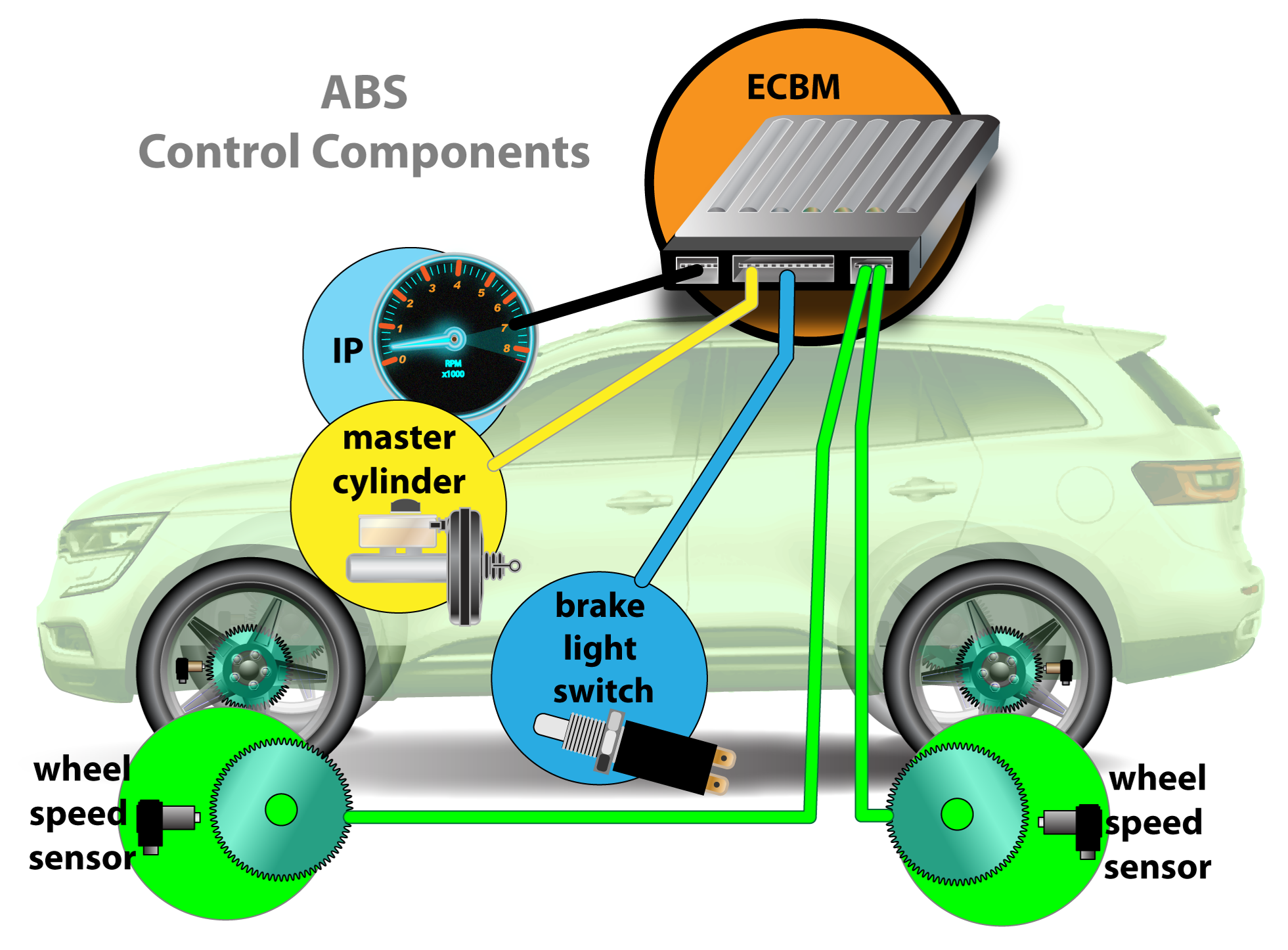
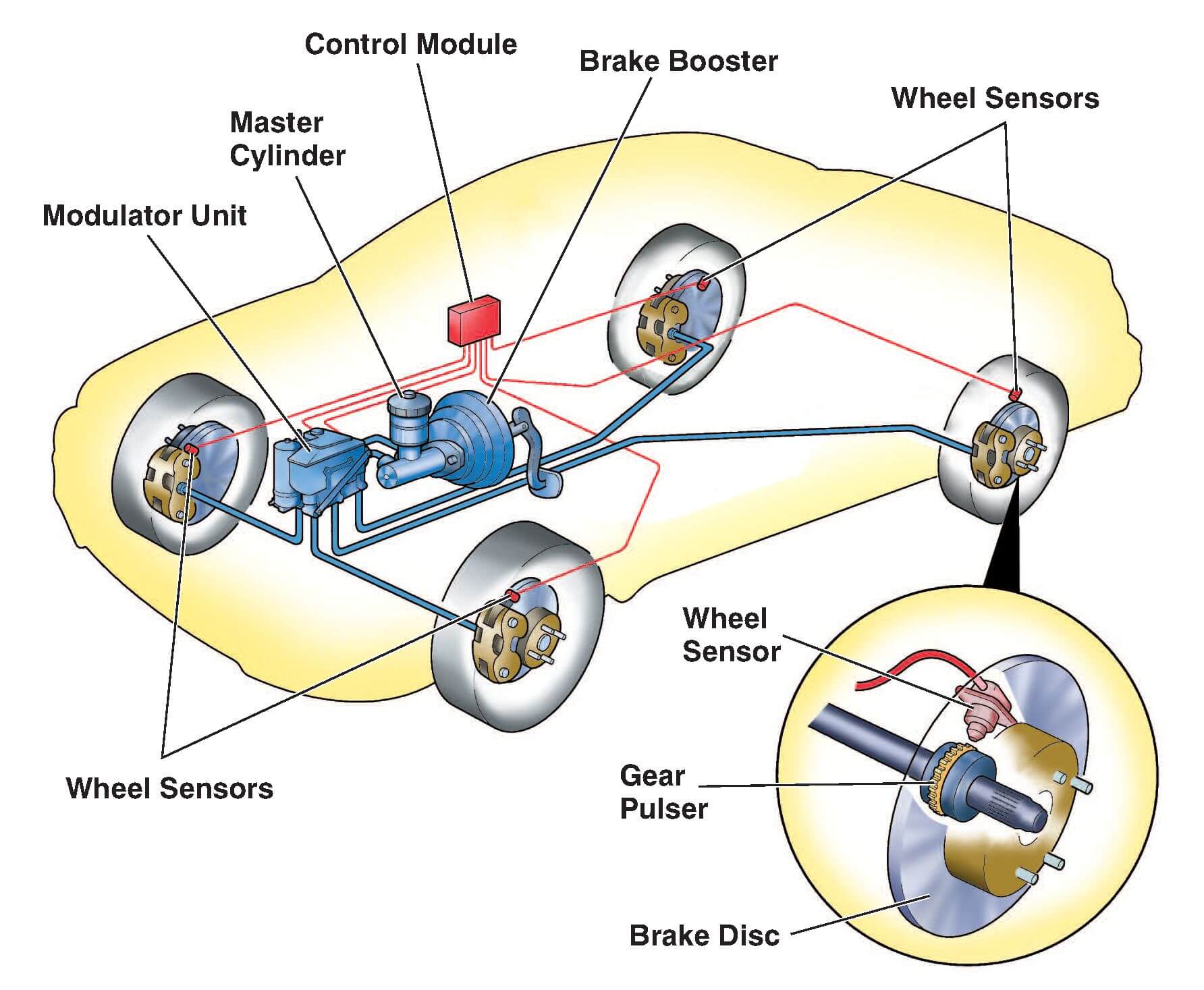
A typical ABS architecture consists of four primary components working in seamless integration:
- Wheel Speed Sensors: Located at each wheel, these sensors constantly track how fast the wheel is spinning. They generate an electrical signal that is sent to the central control unit.
- Electronic Control Unit (ECU): This is the “brain” of the system. The ECU receives the data from the speed sensors and monitors for signs of impending wheel lock. If it detects a wheel decelerating at a rate that suggests it is about to stop rotating while the vehicle is still moving, it triggers the ABS response.
- Hydraulic Pump and Valve Unit: This unit is situated in the brake line. When the ECU detects a potential lock-up, it sends a signal to these valves to rapidly reduce and then re-apply hydraulic pressure to the specific brake caliper.
The Modulation Process
The magic of ABS lies in its speed. A human driver, even an experienced one, cannot manually pump the brakes more than a few times per second. An ABS unit, however, can modulate brake pressure up to 15 times per second. This rapid cycling prevents the wheel from ever reaching a full lock. By keeping the wheel right on the edge of skidding—where grip is maximized—the system ensures the vehicle comes to a halt in the shortest distance possible while maintaining the driver’s ability to steer around hazards.
Driving Dynamics and Driver Experience
The implementation of ABS significantly shifted the burden of emergency maneuvers from the driver’s physical skill to the vehicle’s automated intelligence. This shift has altered how drivers should react in crisis situations.
The “Stomp and Steer” Philosophy
In a vehicle without ABS, defensive driving courses traditionally taught drivers to “pump the brakes” to avoid skidding. With ABS, this advice is obsolete. If a driver pumps the brakes in an ABS-equipped vehicle, they inadvertently disrupt the system’s ability to perform its rapid calculations, potentially increasing the stopping distance.
Modern training emphasizes a “stomp and steer” technique: in an emergency, the driver should press the brake pedal down as hard as possible and maintain that pressure. The system will handle the modulation. During this process, the driver will likely feel a rhythmic vibration or hear a mechanical grinding noise. This is normal; it is simply the sound and feel of the hydraulic valves and the pump rapidly cycling to prevent the tires from skidding.
Limitations of ABS
While ABS is a triumph of safety technology, it is not a magic solution to every road condition. Its efficacy depends heavily on the state of the vehicle’s tires. Because ABS works by maximizing the grip between the tire and the road, worn-out or improper tires will significantly diminish the system’s performance.
Furthermore, on certain surfaces, ABS can actually increase stopping distances. On loose surfaces like deep snow or gravel, a locked wheel can act like a plow, digging into the soft material to build up a “wedge” that helps slow the car. Because ABS prevents the wheel from locking, it essentially “floats” over the top of the loose surface, which can lead to longer stopping distances. Engineers are aware of this, and modern ABS software often includes specialized algorithms for different road surfaces, but drivers should remain cognizant that no electronic system can override the laws of physics.
The Future of Braking Integration
ABS serves as the foundational architecture for nearly all modern electronic vehicle stability systems. It is no longer an isolated safety feature; it is a critical node in an integrated network of vehicle controls.
Integration with Stability Control (ESC)
Electronic Stability Control (ESC) builds directly upon the sensors and hydraulic actuators used by ABS. While ABS prevents wheels from locking during braking, ESC uses the same technology to prevent the vehicle from skidding or losing traction during cornering or acceleration. By individually applying the brakes to specific wheels, the system can correct oversteer or understeer, keeping the vehicle on the driver’s intended path. Without the precise, high-speed pressure modulation developed for ABS, the complex stability systems of today’s modern vehicles would not exist.

Autonomous Systems and Connectivity
As the automotive industry pivots toward autonomous driving, the role of ABS continues to evolve. In a self-driving car, the “driver” is a suite of AI algorithms. The ability of the car to interpret its environment—knowing exactly how much braking force to apply without compromising control—is reliant on the data fidelity provided by the ABS sensors. As we move into an era of connected vehicles, the data harvested by these sensors may eventually be used to map road conditions in real-time, warning trailing vehicles about slippery patches or road hazards before they reach them.
In conclusion, the anti-lock braking system is a cornerstone of automotive safety that demonstrates how technological innovation can compensate for human limitations. By transforming the blunt mechanical act of stopping a car into a sophisticated, calculated digital process, ABS has saved countless lives. It remains a testament to the power of integrating high-speed computing with mechanical systems, proving that the safest way to travel is to ensure the vehicle remains, at all times, under the complete control of the driver—even when the driver is no longer the one pulling the levers.
aViewFromTheCave is a participant in the Amazon Services LLC Associates Program, an affiliate advertising program designed to provide a means for sites to earn advertising fees by advertising and linking to Amazon.com. Amazon, the Amazon logo, AmazonSupply, and the AmazonSupply logo are trademarks of Amazon.com, Inc. or its affiliates. As an Amazon Associate we earn affiliate commissions from qualifying purchases.