
In an increasingly digitized world, the foundational principles of geometry remain as critical as ever, underpinning everything from the sleek curves of a product design to the complex algorithms that power artificial intelligence. Among these fundamental concepts, the angle bisector stands out—a seemingly simple geometric construction that plays a pivotal role in computational geometry, digital design, robotics, and beyond. Far from being a mere academic exercise, understanding angle bisectors is key to mastering precision, symmetry, and efficient problem-solving in numerous technological domains.
This article delves into the essence of angle bisectors, exploring their definition, properties, and, most importantly, their indispensable applications in the tech landscape. We will uncover how this ancient mathematical idea fuels modern innovations, enabling engineers, designers, and developers to craft more accurate, functional, and aesthetically pleasing digital experiences.
The Geometric Foundation: Understanding the Basics of Angle Bisection
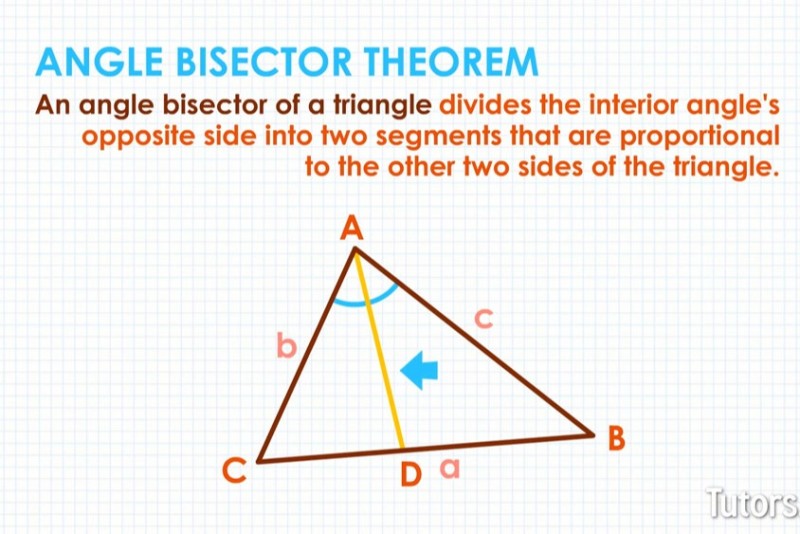
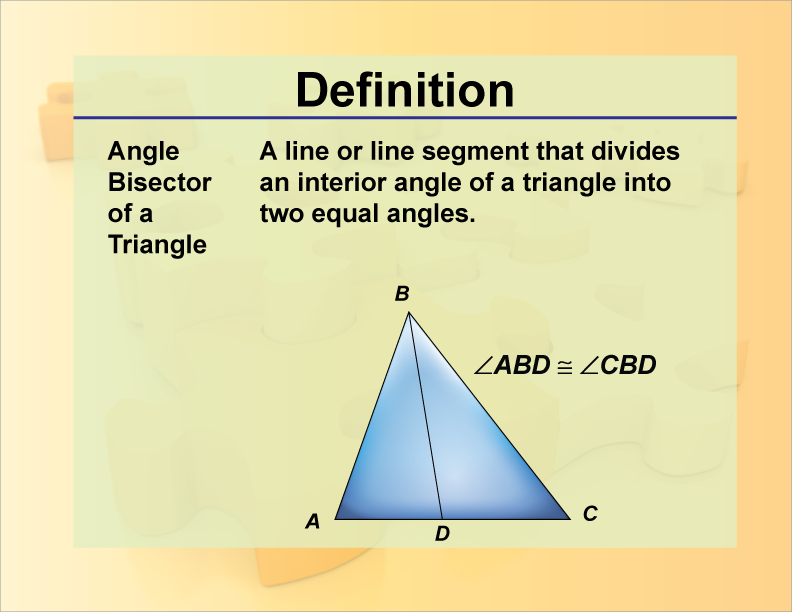
At its core, an angle bisector is a line, ray, or segment that divides an angle into two equal angles. This simple act of division carries profound implications for symmetry, measurement, and spatial relationships, making it a cornerstone of both theoretical and applied geometry. Before we plunge into its tech applications, a brief review of its fundamental definition and properties is essential.
Defining an Angle and its Components
An angle is formed by two rays (sides) sharing a common endpoint (vertex). Angles are typically measured in degrees or radians. The concept of an angle bisector arises from the need to precisely divide this angular space. Imagine a corner in a room, a junction in a circuit board, or the articulation point of a robotic arm; each involves angles that often require precise bisection for optimal performance or design.
The Equal Distance Principle: A Key Property
One of the most crucial properties of an angle bisector is that any point on the bisector is equidistant from the two sides of the angle. This “equal distance principle” is not just an elegant mathematical fact; it’s a powerful tool for construction and analysis. For instance, if you’re designing a pathway or placing a sensor, knowing that a point lies on the angle bisector guarantees it is optimally centered relative to the two intersecting boundaries, a principle frequently leveraged in automated path planning and sensor array optimization in robotics.
Construction Methods: From Compass to Code
Traditionally, angle bisectors are constructed using a compass and straightedge. This manual method involves drawing arcs and connecting points to accurately divide an angle. While valuable for conceptual understanding, the digital realm offers far more efficient and precise methods. In software, angle bisectors are calculated using vector mathematics and trigonometric functions. Given two vectors representing the sides of an angle emanating from a common origin, the bisector can be found by normalizing the vectors, adding them, and then normalizing the resultant vector. This computational approach allows for instantaneous and error-free bisection, crucial for real-time applications.
Angle Bisectors in Software and Digital Design
The digital world thrives on precision. From crafting intricate 3D models to ensuring seamless user interfaces, accuracy in geometry is paramount. Angle bisectors provide a powerful tool for achieving this precision in various software and digital design contexts.
CAD, CAM, and 3D Modeling Applications
Computer-Aided Design (CAD) and Computer-Aided Manufacturing (CAM) software are perhaps the most direct beneficiaries of geometric principles like angle bisection. In CAD, angle bisectors are implicitly or explicitly used for:
- Filleting and Chamfering: Creating smooth transitions (fillets) or angled cuts (chamfers) at corners often involves calculating bisectors to ensure consistent radii or angles.
- Tool Path Generation: In CAM, when a cutting tool needs to navigate an internal corner, the tool path often follows a line parallel to the angle bisector to ensure an even cut without gouging.
- Symmetry and Alignment: Designers use bisectors to ensure perfect symmetry in parts and assemblies, crucial for functionality and aesthetics in mechanical design, architecture, and product development. For instance, when designing a complex joint, the axis of rotation might be derived from an angle bisector to ensure balanced stress distribution.
Computer Graphics and Game Development
The realism and interactivity of modern computer graphics, from video games to virtual reality environments, heavily rely on sophisticated geometric calculations. Angle bisectors play a subtle yet significant role:
- Lighting and Shading: In advanced rendering techniques, especially those involving physically based rendering (PBR), the calculation of light reflection and refraction can involve angles of incidence and reflection, where bisectors might implicitly guide vector calculations for realistic surface interactions.
- Collision Detection and Physics Engines: While complex, many collision detection algorithms simplify objects into basic geometric primitives. Determining the direction of a bounce or deflection, especially off angled surfaces, often uses principles related to angle bisectors to calculate the reflection vector correctly.
- Pathfinding and AI Navigation: For characters or autonomous agents navigating complex environments, calculating optimal paths around obstacles or through corridors can involve bisecting angles at junctions to find a central, clear route.
UI/UX Design and Layout Algorithms
Even in the seemingly abstract world of User Interface (UI) and User Experience (UX) design, geometric principles provide structure. Angle bisectors can influence:
- Responsive Layouts: Algorithms that automatically adjust UI elements for different screen sizes might use angle bisection principles to distribute space evenly around angled elements or maintain visual balance.
- Iconography and Logo Design: Designers often employ geometric grids and guidelines to ensure visual harmony and precision in logos and icons. Angle bisectors help create perfectly balanced curves and sharp corners, contributing to a professional and polished appearance.
- Interactive Elements: When designing interactive elements that involve gestures or directional input (e.g., a pie menu), the division of the interaction space into equal angular segments inherently relies on the concept of angle bisection to ensure consistent targeting zones.
Algorithmic Implementations and Computational Geometry
The true power of angle bisectors in technology lies in their algorithmic representation. Modern software libraries and computational geometry engines abstract these concepts into functions and methods that developers can utilize without needing to perform manual geometric proofs.
Mathematical Libraries and APIs
Programming languages like Python (with libraries like NumPy or SciPy), C++ (with various geometry libraries), and JavaScript (for web-based graphics) offer robust mathematical functions that can compute angle bisectors. These often involve:
- Vector Operations: Representing the sides of an angle as vectors, then using vector addition and normalization to find the bisector vector. This is computationally efficient and forms the backbone of many 2D and 3D geometry calculations.
- Trigonometric Functions: While less common for direct bisector calculation, trigonometric functions can be used to determine the angle itself, which can then be halved to find the bisector’s orientation.
- Geometric Primitives: Many game engines and CAD software provide built-in functions for common geometric operations, including finding the bisector of two lines or planes, simplifying development and ensuring accuracy.
Robotics and Path Planning
Robotics is a field where precise spatial understanding is paramount. Angle bisectors find applications in:
- Navigation and Obstacle Avoidance: When a robot encounters an acute corner or a narrow passage, calculating the angle bisector can help determine the safest or most efficient path to follow, maintaining maximal distance from both walls.
- Robot Arm Kinematics: The movement and articulation of multi-joint robot arms involve complex angular calculations. While inverse kinematics is more dominant, understanding the bisector of an angle formed by two arm segments can assist in designing movements that avoid self-collision or reach targets efficiently.
- Autonomous Driving: Similar to general robotics, self-driving cars utilize geometric calculations to navigate intersections, maintain lane centering, and predict the paths of other vehicles, often implicitly using bisector-like logic for optimal trajectory planning.
Data Visualization and Machine Learning
While perhaps less direct, the principles related to angle bisectors can emerge in advanced data processing:
- Clustering Algorithms: Some spatial clustering techniques might implicitly use concepts of “centrality” or “equal distance” from boundaries, akin to the angle bisector’s property, to define cluster centroids or decision boundaries.
- Geometric Deep Learning: In nascent fields like geometric deep learning, neural networks are trained on geometric data (e.g., point clouds, meshes). Understanding and manipulating fundamental geometric primitives, including how to divide angles, can be crucial for interpreting and generating complex 3D structures.
- Voronoi Diagrams: These diagrams, widely used in computational geometry for partitioning space based on proximity to a set of points, are constructed using perpendicular bisectors. While not angle bisectors, the underlying principle of “equal distance” from boundaries is shared, demonstrating the broader applicability of bisection in spatial data analysis.
Practical Tools and Modern Applications
The accessibility of geometric concepts in technology has been revolutionized by user-friendly tools and innovative platforms that leverage these principles, often without the user even realizing the underlying math.
Educational Software and Interactive Learning Platforms
For students and professionals alike, understanding complex geometric concepts is made easier with interactive software. Platforms for geometry education, like GeoGebra or specific CAD training modules, allow users to dynamically draw and manipulate angle bisectors, instantly visualizing their properties and applications. This hands-on digital experience significantly enhances comprehension, demonstrating the “why” behind the math.
Emerging Technologies: AR/VR and Real-time Geometry
Augmented Reality (AR) and Virtual Reality (VR) thrive on real-time spatial awareness and interaction. In these environments, geometric calculations, including those involving angle bisectors, are performed continuously:
- Object Placement and Alignment: When placing virtual objects in an AR scene, ensuring they align correctly with real-world surfaces or intersect at precise angles often involves implicit bisection calculations.
- User Interaction in VR: Navigating virtual spaces, aiming projectiles, or interacting with UI elements in VR can use angle bisectors to define interaction zones or guide dynamic projections.
- Environmental Meshing: AR/VR systems constantly scan and mesh the real environment. The processing of these meshes, identifying corners and edges, can involve geometric operations that leverage bisector properties for accurate representation.
The Future of Precision: How AI Leverages Geometric Primitives
As AI continues to evolve, its ability to understand, generate, and manipulate geometric data becomes increasingly sophisticated. Angle bisectors, as fundamental geometric primitives, play a foundational role:
- Generative Design: AI-powered generative design tools can create multiple design iterations based on specified constraints. These tools implicitly use geometric rules, including bisection, to produce optimized structures, components, or architectural layouts.
- Computer Vision and Scene Understanding: AI models in computer vision interpret geometric features from images and videos. Recognizing corners, determining spatial relationships, and reconstructing 3D scenes often involve detecting and processing angles, where bisector-like principles can guide feature extraction.
- Robotic Manipulation: As robots become more adept at complex tasks, they rely on AI to plan precise movements. Understanding how to orient a gripper relative to an object, or how to navigate a tool around an obstacle, involves sophisticated geometric reasoning that traces back to fundamental concepts like angle bisection for accuracy and efficiency.

Conclusion: The Enduring Relevance of Angle Bisectors in Tech
From the ancient Greeks’ compass-and-straightedge constructions to the cutting-edge algorithms of today’s AI and virtual reality systems, angle bisectors have remained a surprisingly potent and enduring geometric concept. While often hidden beneath layers of complex software and user-friendly interfaces, their fundamental property of dividing angles precisely into two equal parts is indispensable.
In the tech world, angle bisectors are not just abstract mathematical curiosities; they are practical tools that enable engineers to design with precision, developers to create robust algorithms, and designers to craft visually harmonious experiences. As technology continues its rapid advancement, pushing the boundaries of what’s possible in digital design, robotics, and artificial intelligence, the elegant simplicity and profound utility of angle bisectors will undoubtedly continue to form a critical, albeit often unseen, backbone of innovation. Understanding them is not just about comprehending geometry; it’s about appreciating a core ingredient in the recipe for technological excellence.
aViewFromTheCave is a participant in the Amazon Services LLC Associates Program, an affiliate advertising program designed to provide a means for sites to earn advertising fees by advertising and linking to Amazon.com. Amazon, the Amazon logo, AmazonSupply, and the AmazonSupply logo are trademarks of Amazon.com, Inc. or its affiliates. As an Amazon Associate we earn affiliate commissions from qualifying purchases.