
In the rapidly evolving digital ecosystem, the concept of “space” has shifted from physical storefronts to complex web architectures and mobile applications. As our lives migrate online, the legal frameworks governing civil rights have had to adapt. Central to this evolution is the Americans with Disabilities Act (ADA). While originally signed into law in 1990 to address physical barriers, the ADA’s mandate now extends deeply into the world of technology. For tech leaders, developers, and software engineers, understanding ADA requirements is no longer a niche specialty—it is a fundamental pillar of modern digital product development.
Understanding the Digital Evolution of ADA Requirements
The Americans with Disabilities Act was designed to ensure that individuals with disabilities have the same rights and opportunities as everyone else. Under Title III of the ADA, businesses that are considered “public accommodations” are prohibited from discriminating on the basis of disability. In the context of the 21st century, the Department of Justice (DOJ) and various federal courts have increasingly interpreted “public accommodations” to include websites, mobile apps, and digital platforms.
From Brick-and-Mortar to Browser
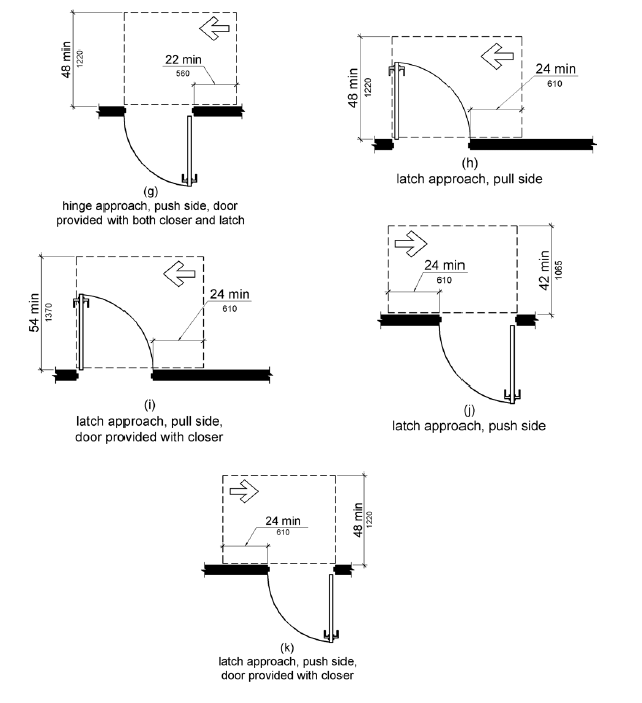
Initially, ADA compliance focused on ramps, wide doorways, and Braille signage. However, as the internet became the primary medium for commerce, education, and communication, the definition of a “place of public accommodation” expanded. Today, a website that is inaccessible to a user with a visual or hearing impairment is legally viewed similarly to a physical store that lacks a wheelchair ramp. This shift means that digital architects must treat accessibility as a core functional requirement rather than an aesthetic afterthought.
The Role of the DOJ and Legal Precedents
While the original text of the ADA does not explicitly mention “source code” or “HTML,” the Department of Justice has consistently maintained that the ADA applies to all goods, services, and privileges offered by public accommodations, including those offered online. Landmark legal cases have solidified this stance, pushing tech companies to adopt rigorous standards. The lack of a specific “digital” statute in the original law has led the industry to look toward global technical standards as the de facto blueprint for compliance.
The Technical Framework: WCAG 2.1 and Beyond
When tech professionals ask “what are ADA requirements,” they are usually looking for a technical benchmark. Because the ADA itself does not provide a list of technical code requirements, the industry relies on the Web Content Accessibility Guidelines (WCAG) developed by the World Wide Web Consortium (W3C). These guidelines are the gold standard for digital accessibility and are frequently cited by courts as the measure of whether a site is “ADA compliant.”
The Four Pillars of Accessibility (POUR)
To meet ADA requirements in a tech context, a platform must adhere to the four functional principles known as POUR:
- Perceivable: Information and user interface components must be presentable to users in ways they can perceive. This means providing text alternatives for non-text content, such as images and video.
- Operable: User interface components and navigation must be operable. A user must be able to navigate the site using various inputs, most notably a keyboard, without requiring a mouse.
- Understandable: Information and the operation of the user interface must be understandable. This includes making text readable and ensuring that web pages appear and operate in predictable ways.
- Robust: Content must be robust enough that it can be interpreted reliably by a wide variety of user agents, including assistive technologies like screen readers.
Navigating Compliance Levels: A, AA, and AAA
WCAG is organized into three levels of conformance. For most tech companies and commercial entities, Level AA is the targeted standard for ADA compliance.
- Level A: The most basic web accessibility features. Failing to meet this level makes the site nearly impossible for people with disabilities to use.
- Level AA: This level addresses the most common barriers for disabled users. It is the standard typically required by legal settlements and international regulations.
- Level AAA: The highest and most complex level of web accessibility, often reserved for specialized platforms or government sites where maximum inclusivity is the primary mission.
Essential Technical Implementation Strategies
Achieving ADA compliance requires more than just a plugin or a “widget.” It requires a deep dive into the codebase and a commitment to inclusive design patterns. Modern tech stacks offer various tools to facilitate this, but the responsibility remains with the engineering team.
Semantic HTML and ARIA Labels
The foundation of a compliant website is semantic HTML. Using tags like <header>, <nav>, <main>, and <footer> correctly allows assistive technologies to understand the structure of a page. When standard HTML falls short—such as in complex JavaScript-heavy web apps—developers must use WAI-ARIA (Web Accessibility Initiative – Accessible Rich Internet Applications). ARIA labels provide additional context to screen readers, explaining the purpose of dynamic elements like modal windows, dropdown menus, and progress bars.
Keyboard Navigation and Focus Management
A significant portion of ADA requirements centers on “operability.” Many users with motor impairments rely on keyboards or switch devices rather than a mouse. Tech teams must ensure that every interactive element on a page (links, buttons, form fields) can be reached using the “Tab” key. Furthermore, there must be a visible “focus indicator”—usually a highlight or border—that shows the user which element they are currently interacting with. Managing “focus traps” is also critical; for example, when a modal opens, the keyboard focus must shift into the modal and stay there until it is closed.
Color Contrast and Visual Flexibility
For users with visual impairments or color blindness, information cannot be conveyed through color alone. ADA requirements specify a minimum contrast ratio for text and interactive elements (usually 4.5:1 for standard text). From a tech perspective, this involves using CSS to ensure that backgrounds and foregrounds remain distinct. Additionally, layouts must be responsive; a compliant site should allow users to zoom in up to 200% without the text overlapping or the functionality breaking.
Assistive Technologies and the User Experience
To truly understand ADA requirements, tech developers must understand how users interact with their products through assistive technology (AT). Designing for accessibility is essentially designing for a different set of “user agents.”
Screen Readers and Voice Recognition
Screen readers, such as JAWS, NVDA, or VoiceOver, translate on-screen text and metadata into speech or Braille. Meeting ADA requirements means ensuring that your software’s DOM (Document Object Model) is ordered logically so that a screen reader reads the content in the intended sequence. Similarly, voice recognition software allows users to navigate via verbal commands. This requires that every clickable element has an accessible name that matches its visual label.
The Role of AI in Accessibility Auditing
The tech industry is increasingly turning to Artificial Intelligence to bridge the accessibility gap. AI-driven tools can now automatically generate “alt-text” for images by analyzing their content, or identify missing ARIA labels in massive codebases. However, while AI can assist in compliance, it is not a “silver bullet.” ADA requirements are based on the human experience, meaning that manual testing by users with disabilities remains the gold standard for ensuring a platform is truly accessible.
The Security and DevOps Implications of Compliance
In modern software development, ADA compliance should not be treated as a final “check-off” before launch. Instead, it should be integrated into the Continuous Integration/Continuous Deployment (CI/CD) pipeline.
Integrating Accessibility into the DevOps Lifecycle
By shifting accessibility “to the left”—meaning earlier in the development process—tech teams can catch issues when they are cheaper and easier to fix. Automated accessibility testing tools (like Axe-core or Lighthouse) can be integrated into the build process, failing a build if a developer introduces a major accessibility regression. This ensures that compliance is maintained even as the product evolves.
Data Security and Privacy for Disabled Users
There is also a subtle intersection between ADA requirements and digital security. Many users with disabilities use third-party browser extensions or specialized hardware to browse the web. A site’s security headers or “Content Security Policies” (CSP) must be configured carefully so they do not inadvertently block these essential assistive tools. Ensuring that your site is secure while remaining open to AT is a delicate balance that requires sophisticated technical oversight.
Avoiding the Legal Risks of Non-Compliance
From a business-tech perspective, failing to meet ADA requirements is a significant liability. The number of digital accessibility lawsuits has skyrocketed over the last five years. These legal challenges often result in expensive settlements and court-ordered remediation timelines that can derail a company’s product roadmap. By adhering to WCAG 2.1 AA standards, tech companies protect themselves from litigation while simultaneously expanding their market reach to the millions of users globally who live with a disability.
In conclusion, ADA requirements in the tech sector are synonymous with universal design. By prioritizing perceivability, operability, and robustness, developers do more than just avoid legal pitfalls; they create more resilient, user-friendly, and high-quality software for everyone. As technology continues to permeate every facet of human existence, the commitment to an accessible web is not just a legal obligation—it is a hallmark of technical excellence.
aViewFromTheCave is a participant in the Amazon Services LLC Associates Program, an affiliate advertising program designed to provide a means for sites to earn advertising fees by advertising and linking to Amazon.com. Amazon, the Amazon logo, AmazonSupply, and the AmazonSupply logo are trademarks of Amazon.com, Inc. or its affiliates. As an Amazon Associate we earn affiliate commissions from qualifying purchases.