
Thirty-year interest rates are a critical benchmark, frequently cited in financial news and personal finance discussions, primarily because they profoundly influence the housing market and long-term borrowing costs. For millions, the 30-year fixed-rate mortgage is the bedrock of homeownership, offering stability and predictability over decades. However, their significance extends far beyond real estate, impacting everything from government borrowing to corporate finance and investment strategies. Understanding what these rates are today, what drives them, and their broader implications is essential for anyone navigating the complexities of personal finance and investing.
In an ever-evolving economic landscape, marked by inflation concerns, central bank policies, and global geopolitical shifts, 30-year interest rates rarely remain static. They are a dynamic reflection of market expectations, economic health, and the perceived risk of future inflation. For prospective homebuyers, a shift of even a quarter or half-percentage point can translate into thousands of dollars over the life of a loan, significantly altering affordability. For investors, these rates offer insights into the expected returns on long-term bonds and can influence capital allocation decisions across different asset classes. This article will delve into the current state of 30-year rates, explore the forces that shape them, and provide actionable insights for consumers and investors alike.
Understanding 30-Year Interest Rates: A Cornerstone of Financial Planning
At its core, a 30-year interest rate represents the cost of borrowing money for a three-decade period. While this term can apply to various financial instruments, its most common and impactful manifestation for the average person is the 30-year fixed-rate mortgage. This type of loan is a cornerstone of American homeownership, allowing borrowers to secure a consistent monthly payment for an extended duration, providing unparalleled stability against market fluctuations.
Defining the 30-Year Fixed-Rate Mortgage
The 30-year fixed-rate mortgage is a loan where the interest rate remains constant for the entire 30-year term. This means your principal and interest payment will never change, regardless of how market interest rates fluctuate. This predictability is its primary appeal, allowing homeowners to budget with confidence. Lenders offer these rates based on a complex interplay of factors, including their own cost of funds, credit risk assessment of the borrower, and the prevailing market conditions for long-term debt. When someone asks “what are 30-year interest rates today,” they are almost invariably referring to the average rate offered on this popular mortgage product.
The Broader Context: Beyond Mortgages
While mortgages dominate the conversation, 30-year interest rates also apply to other long-term financial instruments. For instance, the yield on a 30-year U.S. Treasury bond is a critical economic indicator. These bonds are considered among the safest investments globally, and their yields serve as a baseline for other long-term debt. When these yields rise, it often signals an expectation of higher future inflation or robust economic growth, which can, in turn, push up mortgage rates and other long-term borrowing costs. Similarly, some corporate bonds and municipal bonds may have 30-year maturities, with their interest rates being influenced by, and influencing, the broader long-term debt market. Understanding this broader context reveals how deeply interconnected different parts of the financial system are, all moving in response to long-term interest rate signals.
Why 30 Years? The Appeal of Long-Term Stability
The 30-year term’s popularity stems from its unique balance of affordability and stability. Spreading payments over such a long period results in lower monthly installments compared to shorter-term loans (like a 15-year mortgage), making homeownership more accessible to a wider range of buyers. For many, this lower monthly burden is crucial for managing household budgets and achieving other financial goals. The “fixed” aspect provides psychological comfort and financial certainty, insulating borrowers from the volatility of adjustable-rate mortgages (ARMs) that reset periodically. This long-term stability is particularly attractive during periods of economic uncertainty, as it locks in a known cost for a significant portion of a household’s largest asset.
The Economic Drivers Behind 30-Year Rates
Thirty-year interest rates are not determined in a vacuum; they are a sensitive barometer of the broader economic climate. Numerous complex factors interact to push these rates up or down, making their trajectory a subject of constant analysis for economists, policymakers, and financial markets alike. Understanding these drivers is key to anticipating future movements and making informed financial decisions.
Federal Reserve Policy and the Federal Funds Rate
While the Federal Reserve directly controls the federal funds rate (the overnight lending rate between banks), this short-term rate has a profound, albeit indirect, influence on long-term rates like the 30-year mortgage. When the Fed raises the federal funds rate, it generally signals a tightening of monetary policy, aiming to cool inflation or slow down an overheating economy. This tightening increases the cost of borrowing for banks, which then passes those higher costs on to consumers in the form of higher interest rates for various loans, including long-term mortgages. Conversely, when the Fed cuts rates, it generally aims to stimulate economic activity, which can lead to lower borrowing costs across the board. The market anticipates these moves, often pricing them into long-term rates even before the Fed makes an official announcement.
Inflation Expectations and Their Role
Perhaps one of the most critical drivers of long-term interest rates is inflation expectations. Lenders demand a return that compensates them not only for the use of their money but also for the erosion of its purchasing power over time due to inflation. If lenders expect high inflation in the future, they will demand higher interest rates on long-term loans to ensure their real return remains positive. This is why periods of high or rising inflation often coincide with higher 30-year mortgage rates. Conversely, low inflation expectations tend to keep long-term rates subdued. Economic data, such as the Consumer Price Index (CPI) and Producer Price Index (PPI), along with various surveys of inflation expectations, are closely watched for clues about this vital factor.
Economic Growth and Market Sentiment
A robust economy typically brings with it increased demand for credit from businesses and consumers, which can push interest rates higher. Strong economic growth also often correlates with higher inflation expectations, further contributing to rising rates. Conversely, during periods of economic slowdown or recession, demand for credit weakens, and inflation concerns might subside, leading to lower long-term rates. Market sentiment, influenced by news headlines, corporate earnings, and consumer confidence, also plays a significant role. If investors are optimistic about the future, they might be willing to take on more risk, potentially moving money out of safe-haven bonds and into equities, which can cause bond yields (and thus long-term rates) to rise. Conversely, fear or uncertainty can drive investors towards the safety of bonds, pushing yields down.
Global Events and Geopolitical Factors
In today’s interconnected world, global events and geopolitical developments can have a swift and dramatic impact on domestic interest rates. International conflicts, major trade disputes, shifts in commodity prices (like oil), or economic instability in major global economies can trigger a “flight to safety,” where investors pull money out of riskier assets and pour it into safe-haven assets like U.S. Treasury bonds. This increased demand for U.S. bonds can push their prices up and their yields (interest rates) down. Conversely, global economic booms or significant international spending can increase global demand for capital, potentially exerting upward pressure on rates. These external factors add another layer of complexity to the already intricate dance of domestic economic indicators.
Current Snapshot: Where Do 30-Year Rates Stand?
Pinpointing the exact “current” 30-year interest rate is akin to hitting a moving target, as rates fluctuate daily, sometimes even hourly, based on market activity and breaking news. However, we can establish a general understanding of where rates stand today, how to interpret the figures, and compare them to historical patterns to gain perspective.
Real-Time Rate Data: Where to Look and What to Expect

Today’s 30-year fixed-rate mortgage rates typically hover within a certain range, which can be found on various financial news websites, mortgage lender platforms, and dedicated rate-tracking services. Websites like Mortgage News Daily, Bankrate, Zillow, or directly from major lenders like Chase, Wells Fargo, and Rocket Mortgage, provide daily updates on average rates. It’s crucial to understand that these published rates are often national averages for borrowers with excellent credit (e.g., FICO scores of 740 or higher) and a significant down payment. Your personal rate will depend on numerous factors specific to your financial profile, including your credit score, debt-to-income ratio, loan-to-value ratio, property type, and even the specific lender you choose. Therefore, treat published averages as a general guide rather than a guaranteed offer.
Understanding APR vs. Interest Rate
When comparing mortgage offers, it’s vital to differentiate between the nominal interest rate and the Annual Percentage Rate (APR). The interest rate is the percentage of the principal that lenders charge for the loan. The APR, on the other hand, is a broader measure of the total cost of the loan, encompassing the interest rate plus other fees and charges, such as origination fees, discount points, and some closing costs. For example, a loan might have an interest rate of 6.5%, but an APR of 6.75% due to additional fees. The APR provides a more comprehensive picture of the true cost of borrowing and is often a better tool for comparing different loan offers, as it allows for an “apples-to-apples” comparison that includes all associated costs.
Comparing Today’s Rates to Historical Trends
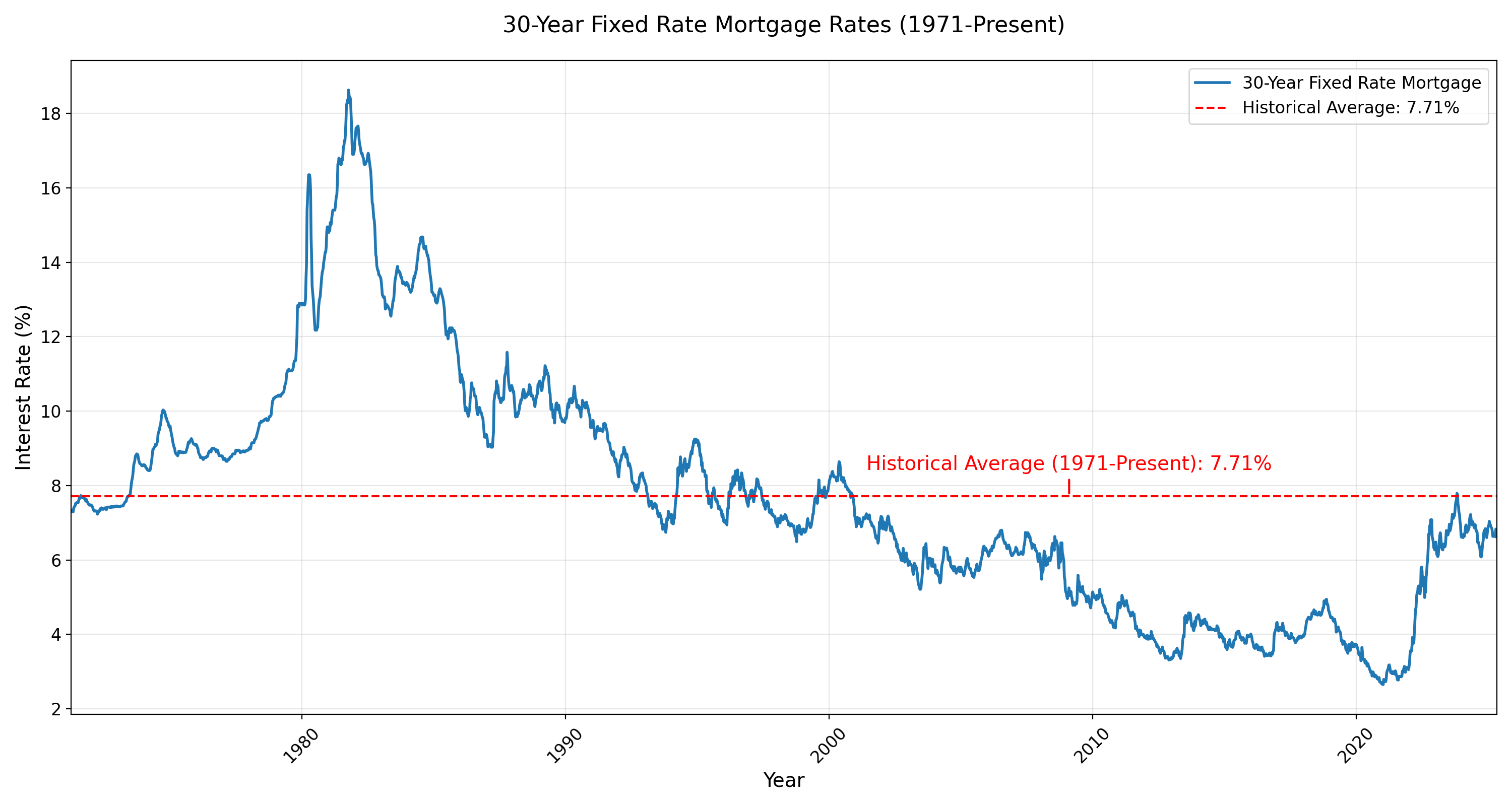
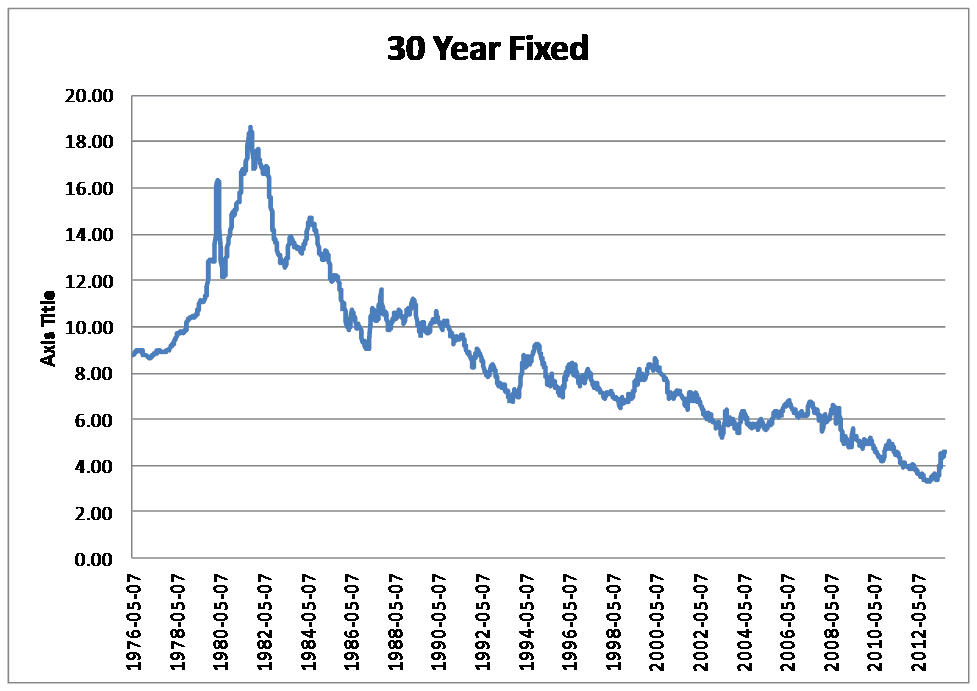
Current 30-year mortgage rates, while variable, are often viewed through the lens of historical context. For much of the 2010s, rates were at historically low levels, frequently dipping below 4% and even into the 2-3% range during the COVID-19 pandemic. This period created unprecedented affordability for many homebuyers and a boom in refinancing activity. In contrast, the 1980s saw rates climb to double-digits, peaking at over 18% in 1981. Today’s rates, which have seen a significant increase from their pandemic lows, are often closer to the long-term historical average, somewhere in the 6-8% range, although this can still feel high to those accustomed to the ultra-low rates of the recent past. Understanding this historical context helps temper expectations and provides perspective on what constitutes a “good” rate in different economic environments.
Impact and Implications: Who Benefits, Who Pays?
Changes in 30-year interest rates reverberate throughout the economy, creating winners and losers, opportunities and challenges for various stakeholders. From individual households planning their next big purchase to large corporations strategizing their investments, the prevailing long-term rate environment dictates much of the financial calculus.
For Homebuyers and Homeowners: Mortgage Decisions
For prospective homebuyers, 30-year rates are arguably the most significant determinant of affordability. Higher rates mean higher monthly mortgage payments for the same loan amount, reducing purchasing power and potentially pricing some buyers out of the market. Conversely, lower rates enhance affordability, making homeownership accessible to more people. For existing homeowners, rate changes dictate the viability of refinancing. If current rates are significantly lower than their existing mortgage rate, refinancing can lead to substantial savings on monthly payments or a reduced loan term. However, when rates are high, refinancing becomes less appealing unless the homeowner is looking to tap into equity or consolidate debt for other strategic reasons, despite a potentially higher rate. The choice between a fixed-rate mortgage and an adjustable-rate mortgage (ARM) also becomes more acute: in a high-rate environment, ARMs might offer lower initial payments but carry the risk of future rate increases, making the predictability of a fixed rate often more attractive.
For Savers and Investors: Opportunity Costs and Returns
While high interest rates are generally a burden for borrowers, they can be a boon for savers and certain types of investors. Higher 30-year Treasury bond yields, for instance, mean that investors can earn a better risk-free return on their long-term savings. This can translate to more attractive rates on certificates of deposit (CDs) and other fixed-income instruments, providing a safer haven for capital compared to volatile equity markets. However, higher long-term rates can also pose challenges for equity investors. When bond yields rise, they become more competitive with stock dividends and earnings, potentially drawing investment away from stocks. This can lead to downward pressure on stock valuations, particularly for growth companies whose future earnings are discounted more heavily in a higher interest rate environment. Investors must carefully rebalance their portfolios to account for these shifts, evaluating the opportunity cost of various asset classes.
For Businesses: Cost of Capital and Expansion Plans
Businesses, particularly those planning long-term investments in new equipment, facilities, or research and development, are highly sensitive to 30-year interest rates. These rates directly influence their cost of capital for financing such projects. When rates are high, the cost of borrowing increases, making it more expensive to fund expansion or invest in new ventures. This can lead companies to delay or scale back their growth plans, potentially slowing economic development. Conversely, lower long-term rates reduce financing costs, encouraging businesses to borrow and invest, thereby stimulating job creation and economic output. The ability to secure stable, long-term financing at a reasonable rate is crucial for strategic planning and competitiveness, especially for capital-intensive industries.
Navigating the Current Rate Environment: Strategic Financial Moves
Given the dynamic nature of 30-year interest rates, adopting a strategic approach to your financial decisions is paramount. Whether you’re considering a home purchase, refinancing an existing loan, or managing your investments, understanding how to respond to the current rate environment can lead to significant financial advantages.
For Prospective Homebuyers: Locking in Rates and Shopping Around
If you’re in the market to buy a home, the current 30-year interest rates will largely dictate your monthly payment and overall affordability. It’s crucial to get pre-approved for a mortgage early in the process, as this provides a clear picture of what you can afford and often allows you to secure a rate lock. A rate lock guarantees your interest rate for a specific period (e.g., 30, 45, or 60 days) while you finalize your home purchase. This protects you from potential rate increases before closing. Additionally, don’t settle for the first offer. Shop around and compare offers from multiple lenders, including traditional banks, credit unions, and online mortgage brokers. Even a slight difference in the interest rate or APR can save you tens of thousands of dollars over 30 years. Leverage online comparison tools and be prepared to negotiate, as lenders often have some flexibility.
For Existing Homeowners: Refinancing Considerations
For those who already own a home, evaluating your current mortgage against today’s 30-year rates is an ongoing exercise. If rates have fallen significantly since you originated your loan, refinancing could be a smart move to lower your monthly payments, reduce the total interest paid over the life of the loan, or even shorten your loan term (e.g., from 30 to 15 years) if you can afford higher monthly payments. However, refinancing comes with closing costs, so you must calculate the break-even point – how long it will take for your savings to offset these costs. If you plan to stay in your home beyond that break-even point, refinancing is generally worthwhile. Conversely, if current rates are higher than your existing rate, refinancing might only make sense if you’re looking to tap into your home equity (a “cash-out” refinance) for specific purposes like home improvements or debt consolidation, provided you fully understand the implications of extending your loan term or increasing your principal.
For Investors: Diversification and Long-Term Planning
In a fluctuating interest rate environment, investors need to reassess their portfolios. Higher long-term rates can make fixed-income investments more attractive, but also increase the risk for existing bonds (as their value falls when new bonds offer higher yields). Diversification across different asset classes – stocks, bonds, real estate, and alternatives – becomes even more critical to mitigate risk. Consider strategies like bond ladders, where you invest in bonds with staggered maturity dates to continuously reinvest at prevailing rates. For equity investors, focus on companies with strong fundamentals, healthy balance sheets, and consistent cash flows, as they tend to weather higher interest rate environments better than highly leveraged growth companies. The overarching principle remains long-term planning: avoid making hasty decisions based on short-term rate movements and instead align your investment strategy with your financial goals and risk tolerance.
General Financial Prudence: Debt Management and Emergency Funds
Regardless of the interest rate climate, fundamental financial prudence remains essential. Prioritizing debt management, especially high-interest consumer debt like credit cards, is always a wise strategy. A robust emergency fund (typically 3-6 months of living expenses) provides a crucial buffer against unexpected financial shocks, reducing the need to take on high-cost debt during periods of economic uncertainty. Regularly reviewing your budget, cutting unnecessary expenses, and seeking opportunities to increase your income can bolster your financial resilience. By building a strong financial foundation, you position yourself to better absorb the impacts of changing interest rates and capitalize on opportunities as they arise.
In conclusion, 30-year interest rates are a potent force shaping the financial landscape. Their current levels and future trajectory depend on a complex interplay of economic indicators, central bank policy, and global events. By staying informed and adopting a strategic, proactive approach, individuals and businesses can navigate this environment effectively, making sound decisions that support their long-term financial health and goals.
aViewFromTheCave is a participant in the Amazon Services LLC Associates Program, an affiliate advertising program designed to provide a means for sites to earn advertising fees by advertising and linking to Amazon.com. Amazon, the Amazon logo, AmazonSupply, and the AmazonSupply logo are trademarks of Amazon.com, Inc. or its affiliates. As an Amazon Associate we earn affiliate commissions from qualifying purchases.