
For over seven decades, the United States Air Force Air Demonstration Squadron, better known as the Thunderbirds, has served as a global ambassador for American airpower. While their maneuvers appear like a choreographed ballet in the clouds, the backbone of their performance is one of the most sophisticated pieces of aerospace technology ever conceived: the Lockheed Martin F-16 Fighting Falcon.
Currently flying the F-16C and F-16D (Block 52) variants, the Thunderbirds utilize a platform that redefined modern fighter design. To understand what the Thunderbirds fly is to understand a shift in aviation technology—moving from heavy, stable interceptors to lightweight, agile, and “aerodynamically unstable” digital machines. This article explores the technological intricacies, engineering marvels, and specific modifications that allow the F-16 to perform at the edge of physical possibility.
The F-16 Fighting Falcon: A Masterpiece of Aerodynamic Engineering
The F-16, often affectionately called the “Viper” by its pilots, was born out of the Lightweight Fighter (LWF) program in the 1970s. Unlike its predecessors, which relied on sheer engine power and large wing surfaces to overcome drag, the F-16 was designed with a focus on agility and high-G maneuvers.
The Stability Paradigm: Relaxed Static Stability
One of the most significant technological leaps in the F-16’s design is “Relaxed Static Stability” (RSS). In traditional aircraft, the center of gravity is located forward of the center of lift, making the plane naturally stable—if a pilot lets go of the stick, the plane wants to level out. However, stability is the enemy of maneuverability.
The F-16 was the first production aircraft designed to be inherently unstable. Its center of gravity is closer to its center of lift, meaning the aircraft constantly wants to pitch up or down. While this makes the plane impossible for a human to fly manually, it allows for near-instantaneous pitch changes. This instability is managed by a sophisticated flight control computer that makes thousands of tiny adjustments per second, providing the Thunderbirds with the “snappy” response times required for their signature tight formations.
High-G Capability and Pilot Ergonomics
Thunderbird pilots frequently pull up to 9Gs—nine times the force of gravity. To facilitate this, the F-16 features a revolutionary cockpit design. The seat is reclined at a 30-degree angle, rather than the standard 13 degrees. This technological choice helps the pilot’s cardiovascular system handle high-G loads by shortening the vertical distance between the heart and the brain, reducing the risk of G-induced Loss of Consciousness (G-LOC).
Furthermore, the F-16 utilizes a side-stick controller rather than a center-mounted joystick. This pressure-sensitive stick is fixed (or has very minimal travel), allowing the pilot to send inputs to the flight computer simply by applying pressure. This design provides superior control during high-stress maneuvers where moving a large stick would be physically difficult due to G-forces.
Avionics and Fly-By-Wire: The Digital Heart of the Thunderbird
The Thunderbirds fly the Block 52 variant, which represents a significant technological upgrade in terms of computing power and signal processing. While the F-16 looks like a mechanical beast, it is fundamentally a flying computer.
Revolutionizing Flight with Quadruplex Fly-By-Wire Systems
The F-16 was the first aircraft to implement a total Fly-By-Wire (FBW) system. There are no mechanical cables or hydraulic linkages connecting the pilot’s stick to the flight control surfaces. Instead, the pilot’s inputs are converted into electronic signals.
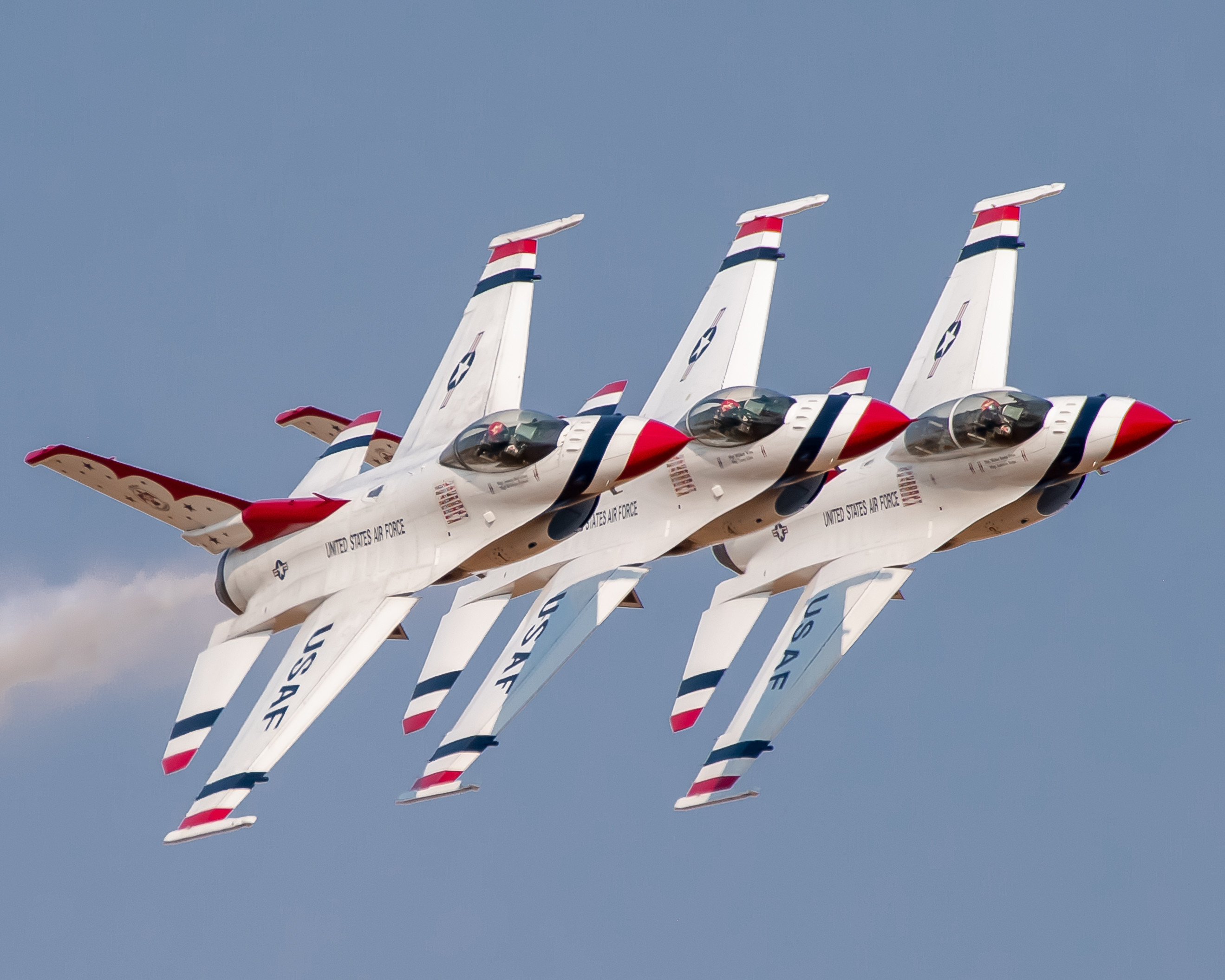
The “Quadruplex” nature of this system refers to its four-channel redundancy. The aircraft’s computers compare signals from four different sensors; if one sensor provides a reading that disagrees with the others, the system ignores the outlier. This digital architecture is what allows the Thunderbirds to fly just 18 inches apart at speeds exceeding 400 miles per hour. The FBW system filters out turbulence and pilot “noise,” ensuring that the aircraft’s movements are as smooth as possible.
The Evolution of Radar and Heads-Up Displays (HUD)
Though the Thunderbirds do not carry active missiles during shows, their aircraft are fully combat-capable. The Block 52 variant is equipped with the APG-68(V)9 radar, which provides high-resolution synthetic aperture radar (SAR) mapping.
For the demonstration pilots, the most critical tech interface is the Heads-Up Display (HUD). The HUD projects vital flight data—airspeed, altitude, climb rate, and G-load—directly onto a glass pane in the pilot’s line of sight. This allows the pilot to maintain “eyes out” of the cockpit at all times, a necessity when flying in a “diamond” formation where the margin for error is measured in centimeters.
Propulsion and Performance: The F110-GE-129 Engine
At the heart of the Thunderbirds’ F-16 is the General Electric F110-GE-129 Increased Performance Engine (IPE). This powerhouse is responsible for the incredible vertical climbs and high-speed passes that define an air show.
Thrust-to-Weight Ratio and Vertical Performance
The F110 engine produces approximately 29,000 pounds of thrust in afterburner. Given that an F-16 in demonstration configuration is relatively light, the aircraft achieves a thrust-to-weight ratio of greater than 1:1.
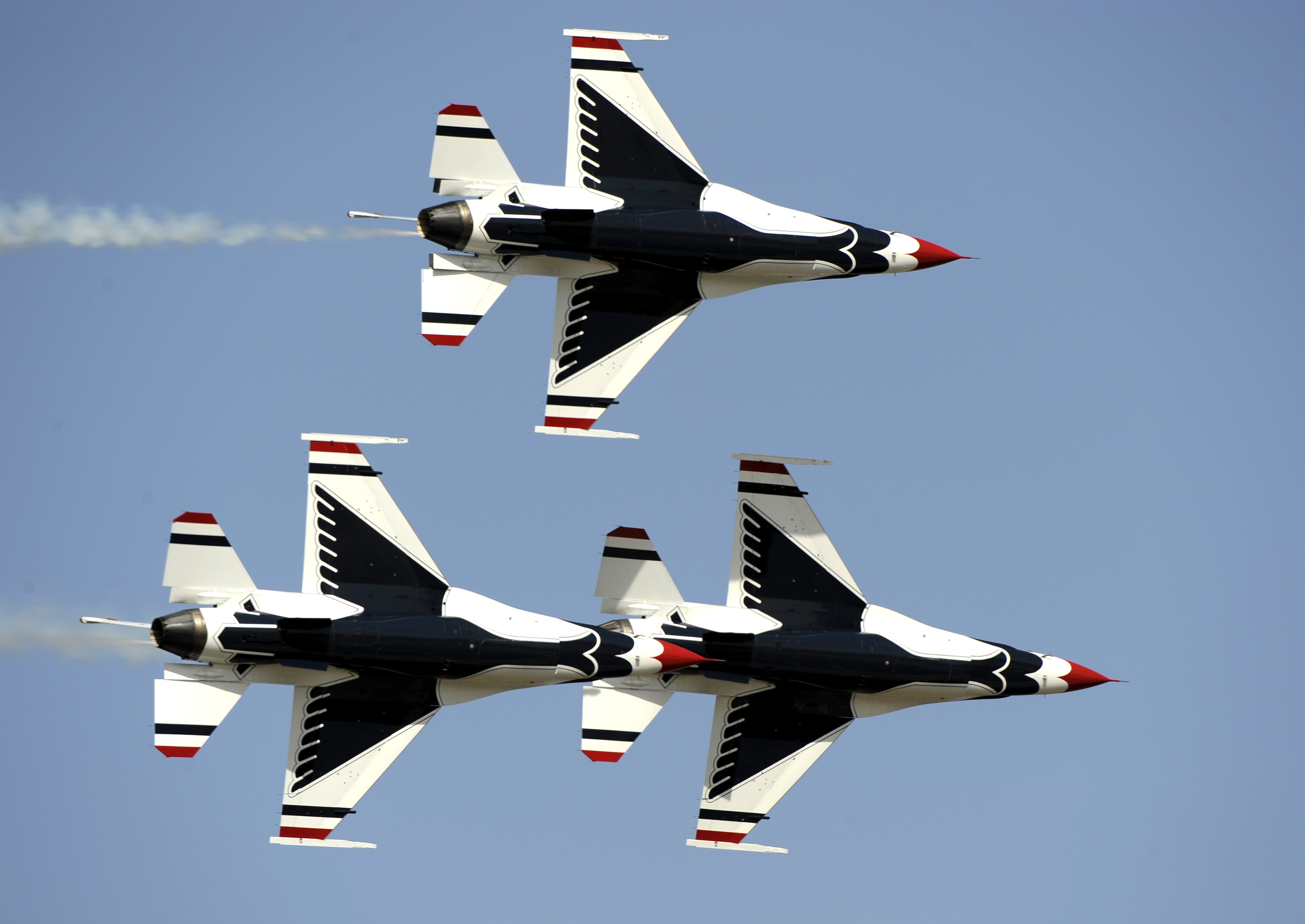
Technologically, this means the F-16 can accelerate while climbing vertically. This “overpowered” nature is what allows the Thunderbirds to perform the “Vertical Bomb Burst,” where four aircraft pull up into a vertical climb and break in different directions, maintaining enough kinetic energy to perform subsequent maneuvers without needing to dive to regain speed.
Fuel Management Systems for Extended Demonstrations
Operating a high-performance jet at full afterburner consumes fuel at an astronomical rate. The F-16’s digital fuel management system is a marvel of efficiency, balancing the weight distribution of the aircraft as fuel is consumed from different internal tanks. Maintaining a specific center of gravity is vital for the flight control computer to maintain the “relaxed stability” profile. The system ensures that the aircraft’s handling characteristics remain consistent from the beginning of the 30-minute show to the end, regardless of fuel weight.
Modifications for the Mission: Converting Combat Jets to Demonstration Platforms
While the Thunderbirds fly the same basic airframe used by frontline combat wings, their F-16s undergo several specific technological modifications to transition from a “Fighting Falcon” to a “Thunderbird.”
Removing the Vulcan Cannon: The Smoke Generation System
The most visible modification is the removal of the internal M61A1 20mm Vulcan cannon. In its place, engineers install a smoke-generation system. This system consists of a tank filled with paraffin-based oil and a series of pumps and injectors located in the engine nozzle.
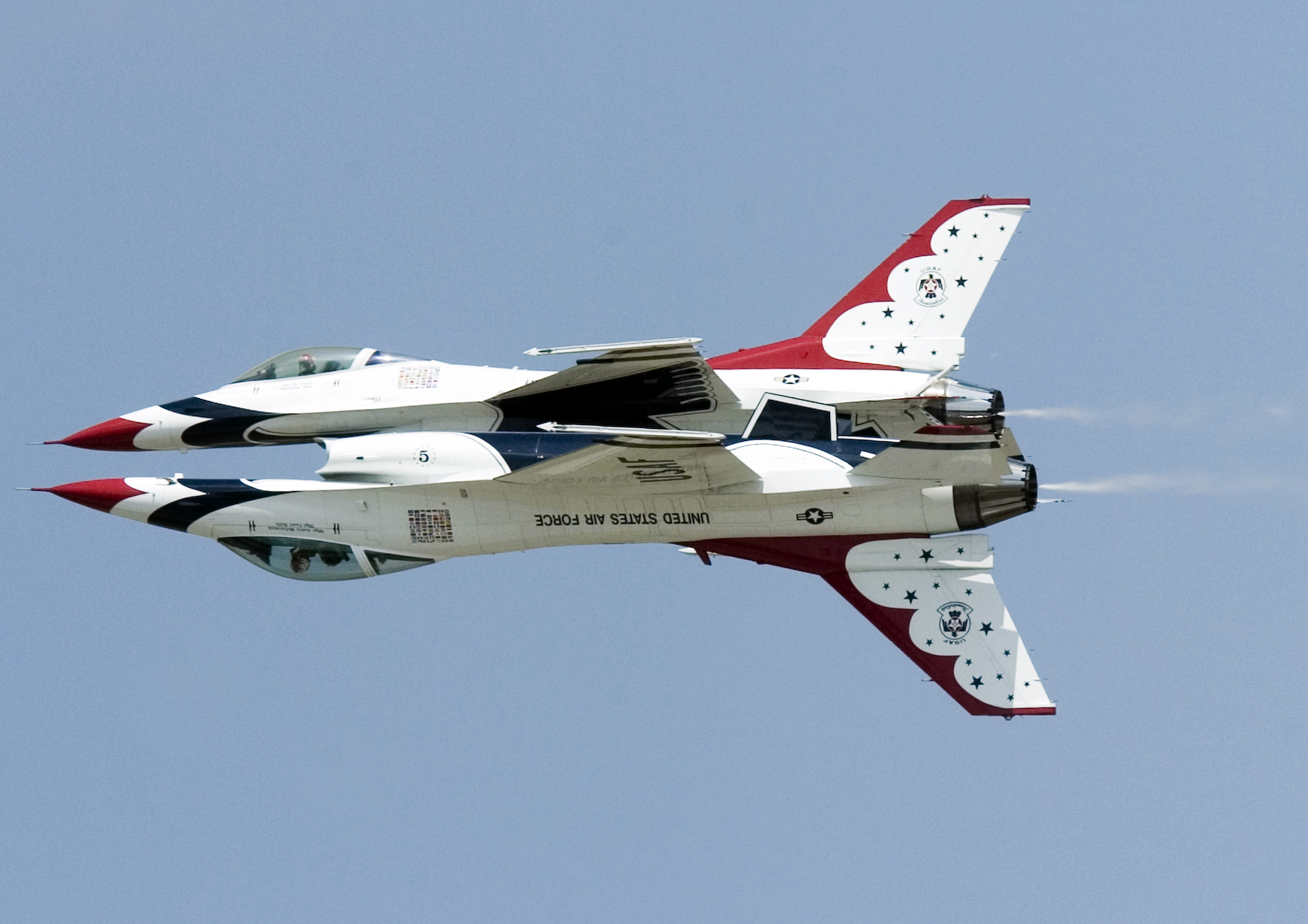
When the pilot toggles a switch on the throttle, the oil is injected into the hot exhaust gases. The oil vaporizes instantly, creating the thick white trails that allow the audience to track the aircraft’s path. From a tech standpoint, this requires precise timing and flow control to ensure the smoke is consistent and does not interfere with engine performance or thermal signatures.
Instrument Precision and Navigation Upgrades
Thunderbird aircraft feature specialized instrumentation. Because they fly in such close proximity, their altimeters and pitot-static systems (which measure airspeed) must be calibrated to a higher degree of precision than standard fleet aircraft. Even a slight lag in instrument reporting could lead to a formation error.
Additionally, the livery itself is a feat of material science. The red, white, and blue “Thunderbird” paint is not just for show; it is a high-gloss, low-drag polyurethane coating. While combat jets use matte “Have Glass” radar-absorbent paint, the Thunderbirds use a slicker finish that is easier to clean and provides a slight reduction in parasitic drag, emphasizing the aircraft’s sleek lines.
The Future of Aerial Performance: Next-Generation Integration
As the Air Force moves toward the F-35 Lightning II and advanced unmanned platforms, the technology used by the Thunderbirds continues to evolve. While the F-16 remains the primary platform, the integration of new training and maintenance tech ensures these aging airframes stay “flight-ready” at an elite level.
Simulation and Virtual Training Environments
Before a pilot ever takes a Block 52 F-16 into a tight formation, they spend hundreds of hours in high-fidelity simulators. These simulators use the same flight control software found in the actual aircraft. The technology has advanced to include VR (Virtual Reality) and AR (Augmented Reality), allowing pilots to practice “visual cues” for formation flying without the risk or cost of burning jet fuel. This digital twin technology is essential for maintaining the safety record of a team that operates at the very limits of human and mechanical endurance.
Materials Science and Longevity
The F-16 was originally designed for an 8,000-hour service life. However, through the Service Life Extension Program (SLEP), many of the Thunderbirds’ aircraft are being reinforced with advanced composite materials and new structural components. This allows the team to continue flying a 40-year-old design that remains, thanks to its digital architecture and aerodynamic profile, one of the most capable and agile aircraft in the sky today.
In conclusion, the aircraft the Thunderbirds fly is far more than a stunt plane. The F-16 Fighting Falcon is a pinnacle of late-20th-century technology that has successfully transitioned into the 21st century. Through its Fly-By-Wire systems, relaxed static stability, and high-performance turbofan engines, it remains the perfect technological partner for the world’s premier aerial demonstration team. When you watch the Thunderbirds, you aren’t just seeing pilot skill—you are seeing the harmonious integration of human intuition and cutting-edge aerospace engineering.
aViewFromTheCave is a participant in the Amazon Services LLC Associates Program, an affiliate advertising program designed to provide a means for sites to earn advertising fees by advertising and linking to Amazon.com. Amazon, the Amazon logo, AmazonSupply, and the AmazonSupply logo are trademarks of Amazon.com, Inc. or its affiliates. As an Amazon Associate we earn affiliate commissions from qualifying purchases.