
In the intricate world of personal finance, business operations, and investment strategies, percentages are not just mathematical concepts; they are the bedrock upon which sound financial decisions are built. From understanding the discount on a new purchase to calculating interest on a loan, assessing investment returns, or even determining your tax burden, the ability to accurately work out percentages of money is an indispensable skill. It empowers individuals and businesses to make informed choices, optimize spending, and plan for a secure financial future.
Many people approach percentages with a sense of trepidation, viewing them as complex or intimidating. However, with a clear understanding of the underlying principles and a few practical methods, anyone can master this essential financial tool. This comprehensive guide will demystify percentages, providing you with the knowledge and confidence to apply them across various monetary scenarios, transforming a seemingly daunting task into an accessible and powerful financial habit.

Understanding the Basics: What Are Percentages and Why Do They Matter for Your Money?
Before diving into calculations, it’s crucial to grasp what a percentage truly represents and why its comprehension is paramount in financial literacy. A solid foundation here will make subsequent calculations intuitive and meaningful.
The Concept of “Per Cent”
The word “percent” originates from the Latin phrase “per centum,” meaning “by the hundred.” Essentially, a percentage is a way of expressing a number or a ratio as a fraction of 100. It’s a standardized way to compare parts of a whole, regardless of the size of the whole itself. For example, 50% means 50 out of every 100. In monetary terms, if you have 50% of a $100 bill, you have $50. If you have 50% of a $1,000,000 fortune, you have $500,000. The ratio remains constant. The percentage sign (%) is the universal symbol used to denote this proportion.
Why Financial Literacy Requires Percentage Prowess
Percentages provide a common language for financial comparison. Imagine trying to compare the performance of two different investments: one that gained $200 on an initial $1,000 investment and another that gained $2,000 on an initial $50,000 investment. Without percentages, it’s harder to see which performed “better” proportionally. The first gained 20% ($200/$1000 * 100), while the second gained 4% ($2,000/$50,000 * 100). Clearly, the first investment had a higher percentage return.
This comparative power extends to every corner of finance:
- Budgeting: What percentage of your income goes towards housing, food, or entertainment?
- Saving: What percentage of your paycheck should you save?
- Investing: What is the annual percentage return (APR) on your investments?
- Debt: What is the interest rate (APR) on your credit card or loan?
- Discounts: How much money are you saving on a 25% off sale?
Common Scenarios Where Percentages Reign Supreme
From everyday transactions to long-term financial planning, percentages are constantly at play:
- Sales and Discounts: “Up to 50% off!”
- Taxes: Sales tax, income tax, property tax rates.
- Tips: Standard tipping percentages in service industries.
- Interest Rates: Credit cards, mortgages, savings accounts, loans.
- Commissions: Sales commissions for agents.
- Inflation: The percentage increase in prices over time.
- Stock Market: Percentage gains or losses for stocks and funds.
- Budgeting: Allocating percentages of income to different spending categories.
Mastering percentage calculations unlocks a deeper understanding and control over these financial elements, turning passive observation into active management.
The Fundamental Formulas: Calculating Simple Percentages of an Amount
At its core, calculating a percentage of money involves a straightforward mathematical operation. There are a couple of primary methods, both yielding the same correct result. Understanding these will equip you for all subsequent, more complex calculations.
Method 1: Convert Percentage to Decimal
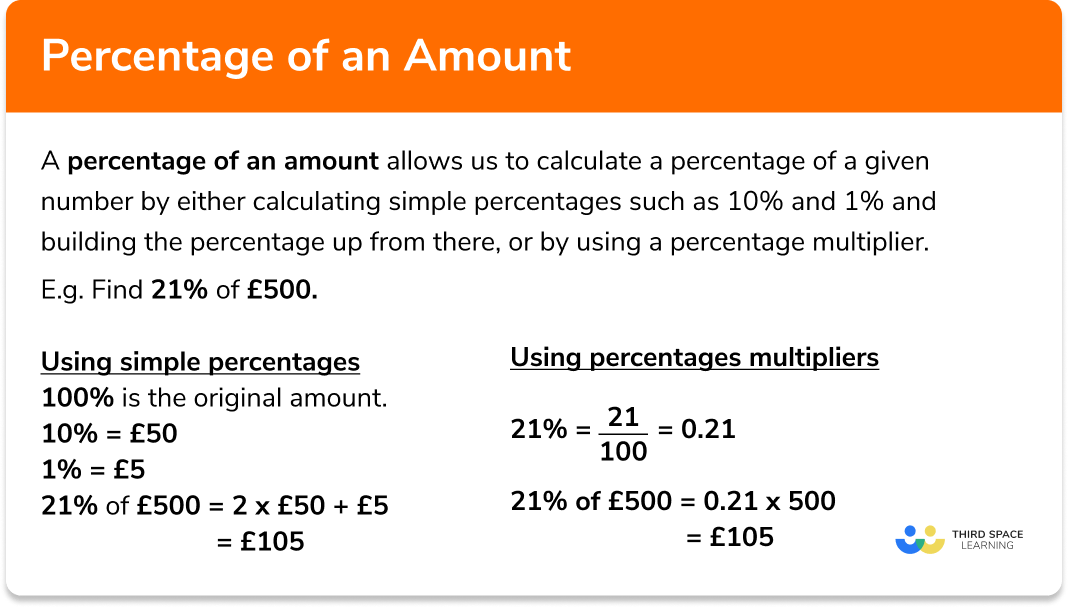
This is often the most intuitive and widely used method, especially with calculators. To convert a percentage to a decimal, simply divide the percentage by 100. Then, multiply this decimal by the total amount.
Formula: Percentage as Decimal × Total Amount = Part Amount
Example: What is 15% of $200?
- Convert percentage to decimal: 15% ÷ 100 = 0.15
- Multiply by total amount: 0.15 × $200 = $30
So, 15% of $200 is $30.
Method 2: Use Fractions
This method involves expressing the percentage as a fraction with a denominator of 100 and then multiplying it by the total amount.
Formula: (Percentage / 100) × Total Amount = Part Amount
Example: What is 15% of $200?
- Express as a fraction: 15/100
- Multiply by total amount: (15/100) × $200
- Calculate: (15 × $200) / 100 = $3000 / 100 = $30
This method yields the same result and is particularly useful for mental math with simpler percentages (e.g., 25% is 1/4, 50% is 1/2).
Practical Example: Finding a Discount Amount
Imagine you want to buy a jacket that originally costs $150, and it’s on sale for 20% off. How much money do you save?
- Identify the percentage: 20%
- Identify the total amount: $150
- Apply Method 1 (Decimal): 0.20 × $150 = $30
You save $30. To find the final price, you would subtract the discount from the original price: $150 – $30 = $120.
Beyond the Basics: Percentage Increase and Decrease
Financial situations often involve changes over time – a salary raise, an investment growing, or an item depreciating in value. Understanding how to calculate percentage increases and decreases, and the overall percentage change, is crucial for tracking financial progress and making projections.
Calculating a Percentage Increase (e.g., Salary Raises, Investment Growth)
To calculate a percentage increase, you first find the amount of the increase, then divide it by the original amount, and finally multiply by 100 to express it as a percentage.
Formula: [(New Amount - Original Amount) / Original Amount] × 100 = Percentage Increase

Example: Your salary increased from $50,000 to $55,000. What is the percentage increase?
- Find the increase amount: $55,000 – $50,000 = $5,000
- Divide by original amount: $5,000 / $50,000 = 0.10
- Multiply by 100: 0.10 × 100 = 10%
Your salary increased by 10%.
Calculating a Percentage Decrease (e.g., Sales, Depreciation)
Similar to an increase, for a decrease, you find the amount of the decrease, divide it by the original amount, and multiply by 100.
Formula: [(Original Amount - New Amount) / Original Amount] × 100 = Percentage Decrease
Example: A car purchased for $30,000 is now valued at $24,000. What is the percentage decrease in value?
- Find the decrease amount: $30,000 – $24,000 = $6,000
- Divide by original amount: $6,000 / $30,000 = 0.20
- Multiply by 100: 0.20 × 100 = 20%
The car’s value decreased by 20%.
Finding the Percentage Change Between Two Values
Sometimes you just need to know the magnitude of change, whether it’s an increase or a decrease. The same core formula for percentage change applies, where a positive result indicates an increase and a negative result (if you express the change as (New-Original)) indicates a decrease.
General Formula for Percentage Change: [(New Value - Original Value) / Original Value] × 100
This formula serves as a versatile tool for analyzing fluctuations in various financial metrics, from quarterly earnings to market share or personal expenses.
Real-World Financial Applications of Percentages
The ability to calculate percentages becomes truly powerful when applied to practical financial scenarios. Here, we explore some of the most common applications you’ll encounter in your daily financial life.
Discounts, Sales Tax, and Tips
- Discounts: As seen earlier, a 25% discount on a $80 item saves you 0.25 * $80 = $20. The final price is $80 – $20 = $60.
- Sales Tax: If you buy an item for $50 and the sales tax is 8%, the tax amount is 0.08 * $50 = $4. Your total cost is $50 + $4 = $54.
- Tips: A common practice in service industries. For a $75 restaurant bill with a desired 18% tip, the tip amount is 0.18 * $75 = $13.50. The total payment would be $75 + $13.50 = $88.50.
Interest Rates: Simple vs. Compound
Interest is the cost of borrowing money or the return on lending/saving money, almost always expressed as a percentage.
-
Simple Interest: Calculated only on the principal amount.
Formula:Principal × Rate × Time
Example: You deposit $1,000 in a savings account with a 2% simple annual interest rate for 3 years.
Interest = $1,000 × 0.02 × 3 = $60.
Total after 3 years = $1,000 + $60 = $1,060. -
Compound Interest: Interest calculated on the initial principal and also on the accumulated interest from previous periods. This is a much more common and powerful concept, especially for investments and loans.
While the full compound interest formula is more complex (P(1 + r/n)^(nt)), understanding the concept of interest earning interest is key. For example, if you earn 5% compound interest annually on $1,000:
Year 1: $1,000 + (0.05 * $1,000) = $1,050
Year 2: $1,050 + (0.05 * $1,050) = $1,102.50
Notice the interest earned in Year 2 is higher because it’s calculated on the new, larger principal.
Investment Returns and Portfolio Performance
Investors constantly monitor percentage returns to gauge the success of their portfolios.
- Return on Investment (ROI):
[(Current Value - Initial Investment) / Initial Investment] × 100
Example: You invested $5,000 in a stock that is now worth $6,500.
ROI = [($6,500 – $5,000) / $5,000] × 100 = ($1,500 / $5,000) × 100 = 0.30 × 100 = 30%.
This 30% tells you the proportional gain, allowing you to compare it to other investment opportunities.
Budgeting and Financial Planning
Percentages are invaluable for creating and sticking to a budget. Many financial experts recommend allocating specific percentages of your after-tax income to various categories.
- The 50/30/20 Rule: A popular budgeting guideline suggesting 50% of your income for needs (housing, utilities, groceries), 30% for wants (entertainment, dining out), and 20% for savings and debt repayment.
By calculating these percentages for your actual income and expenses, you gain clear insights into your spending habits and areas for adjustment to meet financial goals.
Tools and Tips for Mastering Money Percentages
While the core concepts are straightforward, applying them effectively requires practice and the right tools.
Leveraging Calculators and Spreadsheets
- Basic Calculator: For simple percentage calculations, any basic calculator (physical or on your phone) will suffice. Remember the decimal conversion method: multiply the total amount by the percentage as a decimal.
- Financial Calculators: Many online financial calculators are specifically designed for tasks like calculating compound interest, loan payments, or investment growth, often incorporating percentage calculations seamlessly.
- Spreadsheets (e.g., Excel, Google Sheets): For more complex or repetitive calculations, spreadsheets are incredibly powerful. You can set up formulas that automatically calculate percentages for entire columns of data.
- To find 15% of a number in cell A1:
=A1*0.15or=A1*15% - To calculate percentage change between A1 (original) and B1 (new):
=((B1-A1)/A1)*100
- To find 15% of a number in cell A1:
Mental Math Shortcuts
For quick estimations or simple percentages, mental math can be very useful:
- 10% Rule: To find 10% of a number, simply move the decimal point one place to the left. (e.g., 10% of $250 is $25.0).
- Building Blocks: Use 10% to find other percentages.
- 20% is 10% multiplied by 2.
- 5% is 10% divided by 2.
- 15% is 10% plus 5%.
- 1% is 10% divided by 10.
- Fractions: Knowing common percentage-fraction equivalents can speed things up.
- 25% = 1/4
- 50% = 1/2
- 75% = 3/4
- 33.33% ≈ 1/3
Avoiding Common Percentage Pitfalls
- “Of” means Multiply: Remember that “percentage OF something” always implies multiplication.
- Base Value is Crucial: When calculating percentage change, always divide by the original or starting amount. Using the wrong base will lead to incorrect results.
- Don’t Add Percentages Blindly: A 10% increase followed by a 10% decrease does not result in the original amount. (e.g., $100 + 10% = $110. $110 – 10% = $99, not $100). Each percentage is applied to the current amount.
- Confusing Percentage Points vs. Percentage Change: If an interest rate goes from 5% to 7%, that’s a 2 percentage point increase, but a 40% percentage change (2/5 * 100). Be clear about which you are referring to.
Mastering percentages of money is more than just an academic exercise; it’s a fundamental life skill that empowers you to navigate the complexities of personal and business finance with clarity and confidence. By understanding the core concepts, applying the right formulas, and leveraging available tools, you can transform daunting financial calculations into actionable insights, paving the way for smarter decisions and a more robust financial future.
aViewFromTheCave is a participant in the Amazon Services LLC Associates Program, an affiliate advertising program designed to provide a means for sites to earn advertising fees by advertising and linking to Amazon.com. Amazon, the Amazon logo, AmazonSupply, and the AmazonSupply logo are trademarks of Amazon.com, Inc. or its affiliates. As an Amazon Associate we earn affiliate commissions from qualifying purchases.