
American Express Membership Rewards (MR) points are widely considered the gold standard of flexible credit card currency. Unlike “fixed” rewards programs tied to a single airline or hotel chain, Amex points offer a versatile financial toolset that can be leveraged for everything from high-end international travel to everyday retail purchases. However, the sheer breadth of the program often leads to “analysis paralysis” for many cardholders. To truly master the art of personal finance via credit card rewards, one must understand that not all redemptions are created equal. This guide explores the strategic avenues for utilizing Amex points to ensure you derive the maximum possible value from every point earned.
1. The Strategic Hierarchy of Amex Point Valuations
Before diving into specific redemption methods, it is essential to understand the financial logic behind point valuation. In the world of personal finance, Membership Rewards points are a variable asset. Their value is not fixed at a standard rate; rather, it fluctuates based on how they are “spent.”
The Concept of Cent-Per-Point (CPP)
To determine if a redemption is a “good deal,” savvy investors in the rewards space use the Cent-Per-Point (CPP) calculation. This is calculated by taking the cash price of the item or service, subtracting any taxes or fees, and dividing it by the number of points required. Generally, a value of 1.0 cent per point is the baseline. Anything below 0.8 cents is considered poor value, while strategic travel transfers can often yield between 2.0 and 5.0 cents per point, effectively quintupling the value of your rewards.
Why Flexibility Matters in Personal Finance
Amex points are “transferable currencies.” This means they act as a hedge against the devaluation of any single airline or hotel program. If a specific airline increases the price of its award tickets, you have the financial mobility to move your points to a different partner. This flexibility is the primary reason why financial experts recommend earning transferable points like Amex MR over brand-specific miles.
2. High-Value Travel Redemptions: Leveraging Transfer Partners
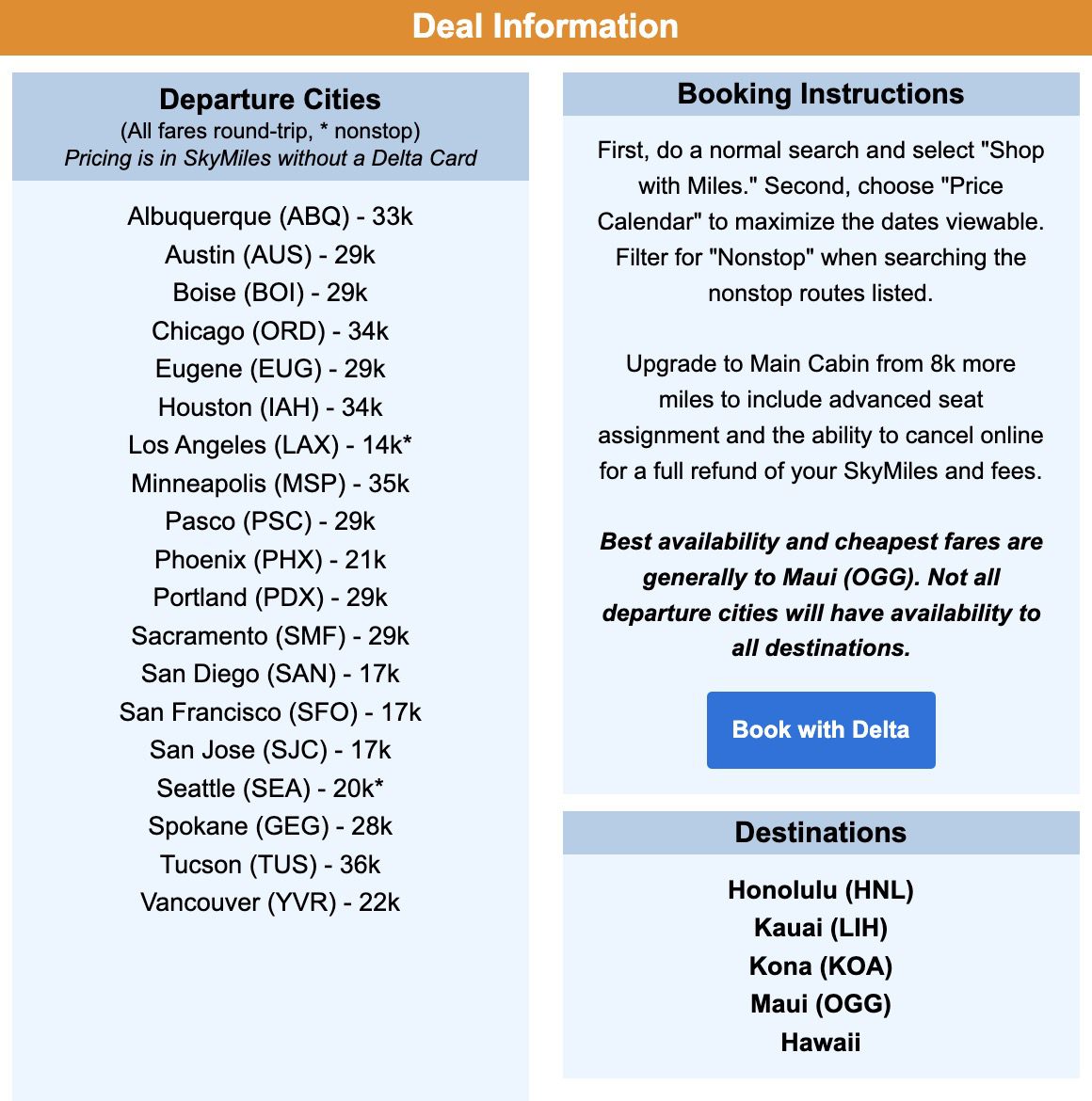
The most lucrative way to use Amex points—and the method that offers the highest return on investment—is transferring points to airline and hotel partners. American Express maintains one of the largest networks of partners in the industry, allowing for global coverage across all major airline alliances (Star Alliance, Oneworld, and SkyTeam).
Mastering Airline Transfers
When you transfer Amex points to an airline partner, such as Delta, British Airways, or ANA, you are essentially converting your points into that airline’s specific currency. This is particularly powerful when booking international business or first-class cabins. For example, a round-trip business class ticket to Europe might cost $5,000 in cash but only 100,000 points. In this scenario, your points are worth 5 cents each—a massive leap over the standard 1-cent valuation.
Strategic Hotel Transfers
While airline transfers usually offer the best value, hotel transfers can be beneficial in specific circumstances. Amex partners with Marriott Bonvoy, Hilton Honors, and Choice Privileges. While the transfer ratios vary, utilizing these points for high-end resorts or during peak holiday seasons can save thousands of dollars in out-of-pocket costs. However, users should exercise caution, as hotel points are generally worth less than airline miles on a per-unit basis.
The Amex Travel Portal vs. Direct Transfers
For those who prefer simplicity, the Amex Travel portal allows you to book flights, hotels, and cruises directly with points at a fixed rate (usually 1 cent per point). For holders of The Business Platinum Card®, there is a unique benefit: a 35% points back bonus on select flights booked through the portal. This effectively raises the value to 1.54 cents per point, providing a guaranteed, high-value floor for your redemptions without needing to hunt for award seat availability.
3. Everyday Utility: Shopping and Statement Credits
While travel offers the highest potential value, American Express provides several “liquid” options for those looking to offset their monthly expenses or reduce their debt load. These methods are convenient but generally offer a lower financial return.
Using Points at Checkout (Amazon and Retailers)
Amex has integrated its rewards program with major retailers like Amazon, Best Buy, and Walmart. At the checkout screen, you can opt to pay with points. While seamless, this typically values points at approximately 0.7 cents per point. From a financial optimization perspective, this is often discouraged. You are better off paying with the credit card to earn more points on the purchase and then using your points for a higher-value redemption later.
Statement Credits and “Cover Your Charges”
Perhaps the most straightforward use of points is applying them directly to your billing statement. This effectively turns your points into cash to pay off previous purchases. This method offers a fixed value of 0.6 cents per point. While this provides immediate relief for personal cash flow, it represents the lowest possible value in the Amex ecosystem. Financial planners usually suggest saving points for travel unless you are facing a financial emergency where the immediate liquidity of a statement credit outweighs the long-term value loss.
Gift Cards and The Amex Mall
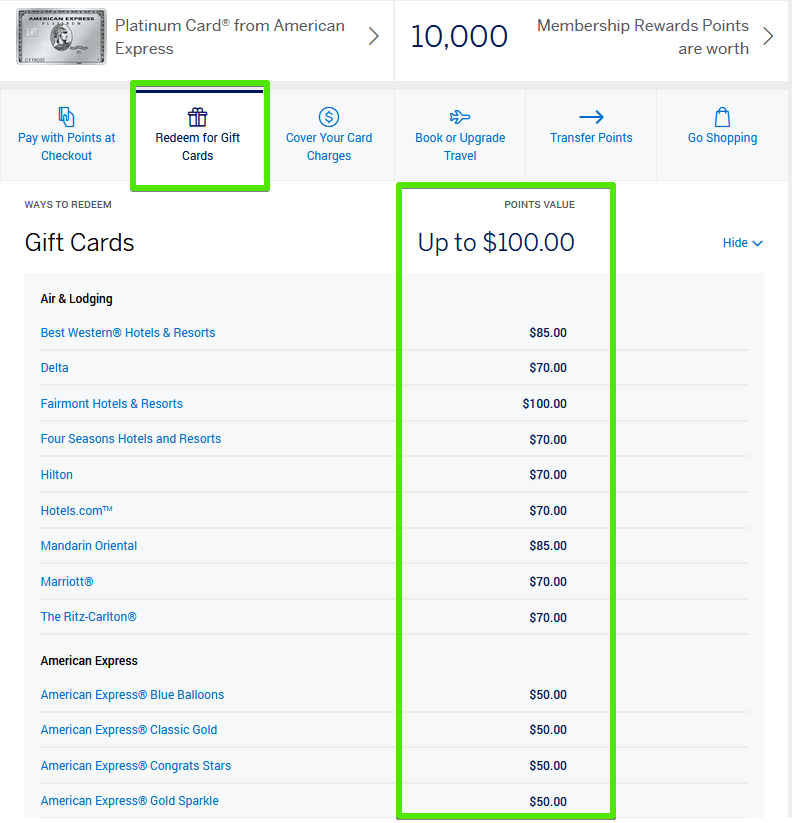
Users can also redeem points for gift cards from hundreds of brands, ranging from dining to luxury retail. The value here is typically 1 cent per point for brands like Home Depot or Applebee’s, but it can drop lower for others. If you plan on making a purchase at a specific retailer anyway, this can be a decent way to utilize points without the complexity of travel transfers.
4. Advanced Strategies for Optimization and Timing
To truly excel at managing your Amex “portfolio,” you must look beyond simple redemptions and focus on timing and advanced tools.
Exploiting Transfer Bonuses
Periodically, American Express offers “Transfer Bonuses.” For a limited time, you might get 30% more miles when transferring to Virgin Atlantic or 20% more when transferring to Marriott. By waiting for these windows, you can significantly stretch the “purchasing power” of your points. A savvy user keeps a “points reservoir” and only transfers when a bonus aligns with their upcoming travel needs.
Leveraging the International Airline Program (IAP)
For Platinum Card® members, the International Airline Program offers discounted fares on premium cabins with over 20 world-class airlines. When you combine these discounts with the ability to pay with points, you can secure luxury travel for a fraction of the standard points price. Furthermore, when you book through IAP with points, you often still earn airline miles on the flight, a “double-dip” strategy that is a favorite among financial enthusiasts.
Point Pooling and Household Management
Unlike some other programs, Amex does not allow you to “pool” points into a single account with friends. However, you can transfer your points into the frequent flyer accounts of your Authorized Users. This is a critical feature for families trying to consolidate points for a large group trip. By adding a spouse or child as an authorized user, you can effectively direct your points into their loyalty accounts to facilitate group bookings.
5. Protecting Your Assets: Expiration and Security
In the realm of personal finance, your points are an asset, and like any asset, they require protection and management.
No Expiration Policy
One of the greatest advantages of the American Express Membership Rewards program is that points do not expire as long as you have at least one active card that earns MR points. This allows for long-term “hoarding” of points for a major life event, such as a honeymoon or a milestone anniversary trip. However, be wary of “point inflation”—airlines frequently change their pricing, so while points don’t expire, their value may decrease over time if left unused for a decade.
Security and Fraud Prevention
Because Amex points have a high cash-equivalent value, they are often targets for digital theft. It is vital to use two-factor authentication (2FA) on your American Express account and to monitor your points balance as closely as you do your bank account. If your account is compromised, the “liquidity” of points makes them difficult to recover once they have been transferred out to an external airline partner.
Conclusion: Crafting Your Personal Points Strategy
Using Amex points effectively is a balance between lifestyle needs and financial optimization. While the highest “ROI” is found in international premium cabin travel via transfer partners, the “best” use of points is ultimately the one that provides you with the most utility. Whether that is a $5,000 flight for “free” or simply erasing a $500 charge on your statement during a tight month, understanding the math behind your choices is the key to financial empowerment. By following the hierarchy of value—prioritizing transfers and bonuses while being cautious with retail redemptions—you can transform your everyday spending into a powerful engine for wealth and luxury.
aViewFromTheCave is a participant in the Amazon Services LLC Associates Program, an affiliate advertising program designed to provide a means for sites to earn advertising fees by advertising and linking to Amazon.com. Amazon, the Amazon logo, AmazonSupply, and the AmazonSupply logo are trademarks of Amazon.com, Inc. or its affiliates. As an Amazon Associate we earn affiliate commissions from qualifying purchases.