
In an increasingly data-driven world, the ability to effortlessly navigate different numerical representations is a cornerstone of precision and efficiency. Whether you’re an engineer designing critical components, a student tackling complex equations, or simply someone trying to follow a recipe, the need to convert decimals into fractions arises frequently. While manual conversion can be a tedious and error-prone process, the advent of digital “decimals into fractions calculators” has revolutionized this task, transforming it from a mathematical chore into an instantaneous, accurate operation.
These specialized tools are more than just simple converters; they are sophisticated pieces of software that embody the seamless integration of computational power with fundamental mathematical principles. This article delves into the technological underpinnings, diverse applications, and profound impact of these calculators, highlighting their indispensable role in modern problem-solving and education within the broader tech landscape. We’ll explore how these digital utilities empower users across various disciplines to achieve clarity and precision, bridging the gap between seemingly disparate numerical systems with unparalleled ease.
The Core Functionality: Demystifying Decimal to Fraction Conversion
At its heart, a decimal to fraction calculator performs a seemingly straightforward conversion, yet the underlying mathematics and computational logic are what make these tools so powerful and essential. Understanding this core functionality is key to appreciating their value in various tech-driven applications.
Understanding the Underlying Math
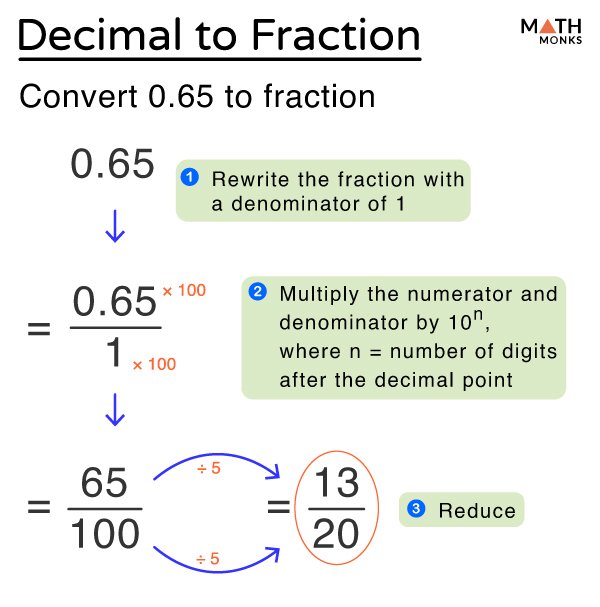
Decimals and fractions are simply different ways of representing parts of a whole. Decimals use a base-10 system, where each digit after the decimal point represents a power of ten (e.g., 0.5 is 5/10, 0.25 is 25/100). Fractions, on the other hand, represent a ratio of two integers (numerator over denominator, e.g., 1/2, 1/4). For simple terminating decimals, manual conversion is relatively straightforward: identify the place value of the last digit and express the decimal as a fraction over that power of ten, then simplify (e.g., 0.75 = 75/100, which simplifies to 3/4).
However, this process quickly becomes cumbersome for longer decimals, and especially challenging for recurring or repeating decimals (e.g., 0.333… or 0.142857142857…). Manually converting these requires algebraic manipulation that can be complex and time-consuming. This is where digital calculators truly shine, abstracting away the mathematical complexity for the user.
How Digital Calculators Automate the Process
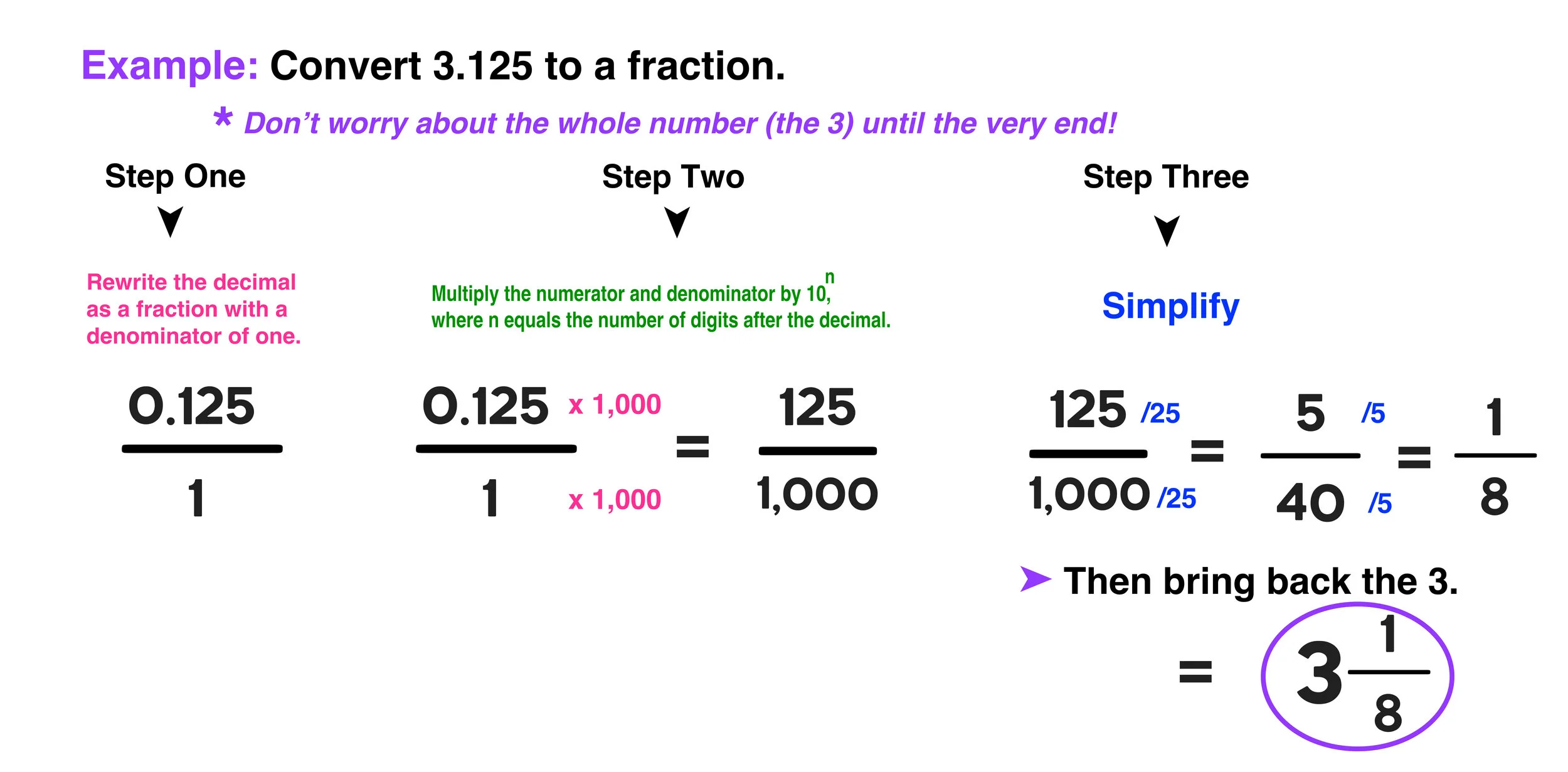
Digital decimals to fractions calculators employ sophisticated algorithms to perform these conversions instantaneously. For terminating decimals, the process typically involves:
-
Counting Decimal Places: Determine the number of digits after the decimal point.
-
Forming an Initial Fraction: Create a fraction where the numerator is the decimal part (without the decimal point) and the denominator is 10 raised to the power of the number of decimal places (e.g., for 0.125, numerator is 125, denominator is 10^3 = 1000, so 125/1000).
-
Simplification: The calculator then finds the Greatest Common Divisor (GCD) of the numerator and denominator and divides both by it to produce the simplest form of the fraction (e.g., 125/1000 simplifies to 1/8).
For recurring decimals, the algorithms are more complex, often involving algebraic techniques to represent the repeating pattern as a fraction. Some advanced calculators might use methods based on continued fractions to find the best rational approximation for any given decimal input, even non-terminating, non-repeating ones, up to a certain precision. The user simply inputs the decimal, and the calculator provides the output in various formats: a simplified proper fraction, an improper fraction, or a mixed number, offering flexibility based on the user’s need. Precision is a critical factor, with higher-end tools supporting a greater number of decimal places to ensure accuracy.
The Tech Landscape of Conversion Tools
The “decimals into fractions calculator” isn’t a monolithic entity but rather a feature integrated across a diverse range of technological platforms. From web-based utilities to dedicated mobile apps and powerful software libraries, the accessibility and implementation of this functionality vary widely, catering to different user needs and technical proficiencies.
Online Web-Based Calculators
The most common and accessible form of these tools are online web-based calculators. Websites like Calculator.net, Symbolab, Wolfram Alpha, and countless educational portals offer free, instant conversion services.
-
Accessibility: They require no software installation, making them universally accessible from any device with an internet connection and a web browser.
-
Integration: Many are integrated into broader mathematical toolkits, offering graphing, equation solving, and unit conversion alongside decimal-to-fraction functionality.
-
Advantages: They are quick, convenient, often ad-supported (making them free), and regularly updated. Their user interfaces are typically intuitive, requiring minimal technical expertise.
-
Disadvantages: Reliance on an internet connection is a drawback, and some sites may be cluttered with advertisements, potentially distracting the user.
Dedicated Mobile Applications
For users on the go, mobile applications provide a powerful and portable solution. Math apps available on iOS and Android platforms often include a decimal-to-fraction converter as a core feature or part of a comprehensive calculator suite.
-
Portability & Offline Access: Mobile apps offer the convenience of instant calculations anytime, anywhere, with many providing offline functionality.
-
User Experience: They are designed with touch interfaces in mind, often featuring larger buttons and clear displays. Some advanced apps even integrate optical character recognition (OCR), allowing users to snap a photo of a math problem and have the numbers automatically processed.
-
Examples: Apps like Photomath, Microsoft Math Solver, and various scientific calculator emulators incorporate this feature.
-
Advantages: High convenience, often ad-free with premium versions, and integrated with the device’s ecosystem.
-
Disadvantages: Requires app installation, consumes device storage, and some advanced features might be behind a paywall.
Integrated Software Suites and Programming Libraries

Beyond casual use, the decimal-to-fraction conversion capability is deeply embedded within more robust software environments and programming tools, crucial for professionals and developers.
-
Scientific and Graphing Calculators: Both physical and virtual scientific calculators (e.g., those found in operating systems or specialized software) offer robust decimal-to-fraction conversion as part of their extensive mathematical functions.
-
Spreadsheet Software: Programs like Microsoft Excel or Google Sheets, while not having a direct “decimal to fraction” button, can achieve this through custom formulas or formatting options, allowing users to handle large datasets.
-
Programming Languages: For developers and data scientists, programming languages like Python (with its
fractionsmodule), JavaScript, R, or MATLAB provide libraries and functions to work with rational numbers, enabling precise decimal-to-fraction conversion within scripts and applications. This is invaluable for tasks requiring high numerical accuracy in scientific computing, financial modeling, or data analysis. -
Advantages: Unparalleled power, customization, and scalability for complex projects, batch processing, and integration into larger systems.
-
Disadvantages: Requires technical proficiency in programming or specialized software, making it less accessible for the average user.
Beyond Simple Conversion: Advanced Features and Use Cases
While the core task is straightforward, modern decimal to fraction calculators offer advanced features and find applications across a surprisingly broad spectrum of fields, underscoring their versatility within the tech ecosystem.
Handling Recurring Decimals
One of the most significant challenges in manual decimal-to-fraction conversion is dealing with recurring (or repeating) decimals, such as 0.333… or 0.142857142857…. Digital calculators excel here. They employ algorithms that can detect repeating patterns, even subtle ones over several digits, and accurately convert them into their precise fractional equivalent (e.g., 0.333… becomes 1/3, and 0.142857… becomes 1/7).
For non-terminating, non-repeating decimals (irrational numbers like Pi or the square root of 2), these calculators provide the “best fit” fractional approximation within a specified level of precision. This feature is particularly valuable in fields requiring exact values, preventing rounding errors that can accumulate in complex calculations.
Contextual Applications in STEM and Beyond
The utility of these calculators extends far beyond the classroom:
-
Engineering and Architecture: Precision is paramount. Engineers need to convert decimal measurements to fractional specifications for manufacturing, design, and construction, where fractions might be more practical for certain materials or standard parts.
-
Science and Research: In experimental sciences, data often comes in decimal form, but comparing or combining measurements might be clearer or more accurate when expressed as fractions, especially in theoretical contexts.
-
Finance and Economics: While often dealing with decimals for currency, specific financial models, ratios, or historical data analysis might benefit from fractional representation for exactness or to understand proportional relationships more intuitively.
-
Education: These calculators serve as invaluable learning aids, helping students understand the relationship between decimals and fractions, verify their manual calculations, and build confidence in mathematical problem-solving.
-
DIY and Trades: From carpentry to cooking, fractions are often the preferred unit of measurement. A calculator that quickly converts 0.875 inches to 7/8 inches or 0.66 cups to 2/3 cups simplifies practical tasks and reduces errors.
Customization and User Experience
Modern calculators, especially apps and sophisticated online tools, don’t just provide an answer; they enhance the user experience. Features include:
-
Output Formatting: Users can often choose between improper fractions (e.g., 5/2), mixed numbers (e.g., 2 1/2), or simplified proper fractions, catering to specific display or calculation needs.
-
History & Memory: Many tools log past calculations, allowing users to revisit previous conversions without re-entering data.
-
Theming and Accessibility: Customizable interfaces, dark modes, and accessibility features (like larger fonts or voice input) improve usability for a wider audience.
-
Integration with Other Tools: Seamless transitions between decimal-to-fraction conversion and other mathematical functions (like graphing or equation solving) create a comprehensive utility.
Choosing the Right Decimal to Fraction Calculator
With a multitude of options available, selecting the appropriate decimal to fraction calculator depends on individual needs, technical context, and specific requirements.
Factors to Consider
-
Accuracy and Precision: For critical applications, ensure the calculator supports a sufficient number of decimal places to maintain high precision. Some basic tools might round too aggressively.
-
Ease of Use (UI/UX): A clean, intuitive interface is crucial for efficiency. Is it easy to input numbers, understand the output, and navigate any additional features?
-
Availability and Platform: Do you need an online tool for quick access, a mobile app for portability, or a desktop software solution for integrated work?
-
Cost: While many excellent free options exist, paid apps or premium software suites often offer enhanced features, no ads, or advanced support.
-
Additional Features: Consider if you need other mathematical functions (e.g., fraction to decimal, scientific calculations, graphing) integrated into the same tool.
-
Step-by-Step Solutions: For educational purposes, some calculators provide a breakdown of the conversion process, which can be invaluable for learning.
Security and Privacy (for online tools/apps)
When using online calculators or mobile apps, particularly those that might request permissions or log usage, it’s prudent to consider security and privacy. Opt for reputable websites and apps from trusted developers. Be mindful of the data you input, especially if it’s sensitive, though mathematical conversions typically pose minimal risk. Always ensure your internet connection is secure if using web-based tools for critical work.
Conclusion
The “how to turn decimals into fractions calculator” epitomizes the practical power of technology in simplifying fundamental mathematical tasks. These digital tools have transitioned from niche utilities to indispensable components of our computational landscape, empowering individuals across various fields to navigate numerical complexities with unprecedented ease and accuracy. From streamlining everyday calculations for students and hobbyists to providing critical precision for engineers and scientists, these calculators enhance efficiency, minimize errors, and foster a deeper understanding of mathematical relationships.
Their evolution across web platforms, mobile applications, and integrated software suites demonstrates a commitment to accessibility and innovation, ensuring that anyone, regardless of their technical background, can leverage sophisticated algorithms to bridge the gap between decimals and fractions. In a world increasingly reliant on data integrity and precise measurements, the decimal to fraction calculator stands as a testament to how technology continues to empower us, turning challenging conversions into effortless operations and solidifying its role as an essential digital utility.
aViewFromTheCave is a participant in the Amazon Services LLC Associates Program, an affiliate advertising program designed to provide a means for sites to earn advertising fees by advertising and linking to Amazon.com. Amazon, the Amazon logo, AmazonSupply, and the AmazonSupply logo are trademarks of Amazon.com, Inc. or its affiliates. As an Amazon Associate we earn affiliate commissions from qualifying purchases.