
In the intricate world of finance, numbers are the language, and percentages are its most eloquent dialect. From personal budgeting to global investment strategies, understanding how to calculate and interpret percentages is not just a useful skill—it’s an absolute necessity. Whether you’re trying to figure out a sales discount, calculate interest on a loan, understand your investment returns, or analyze business profits, percentages provide a standardized, universally understood way to express proportions and changes.
This guide aims to demystify the art of taking a percentage of a number, transforming what might seem like a daunting mathematical task into an accessible and empowering financial tool. We’ll delve into the fundamental concepts, explore various calculation methods, and illustrate their practical applications across personal finance, business, and investing. By the end, you’ll not only know how to take a percentage of a number but also appreciate why it’s a cornerstone of sound financial literacy.

Understanding the Fundamentals of Percentages
Before we dive into the “how-to,” it’s crucial to establish a clear understanding of what a percentage truly represents. This foundational knowledge will make all subsequent calculations intuitive and meaningful.
What Exactly Is a Percentage?
At its core, a percentage is a way of expressing a number as a fraction of 100. The word “percent” literally means “per one hundred” or “out of one hundred.” When you see “25%”, it means 25 out of 100, or 25/100. This makes percentages incredibly useful for comparisons, as they normalize different quantities to a common base.
Every percentage can be easily converted into a decimal or a fraction, which are often more practical for actual calculations.
- Percentage to Decimal: Divide the percentage by 100. For example, 25% = 25 / 100 = 0.25.
- Percentage to Fraction: Place the percentage over 100 and simplify. For example, 25% = 25/100 = 1/4.
This interchangeability is key to mastering percentage calculations, as different scenarios might favor one format over another.
Why Percentages Matter in Finance
Percentages are the bedrock of countless financial concepts and calculations. Their ability to express proportional relationships and rates of change makes them indispensable for both individuals and businesses.
Consider these common financial scenarios where percentages are paramount:
- Interest Rates: Whether it’s the interest you earn on savings or pay on a loan (mortgage, credit card, personal loan), these are almost always expressed as annual percentage rates (APRs).
- Discounts and Sales: Every time you see a “20% off” sign, you’re looking at a percentage-based reduction in price. Understanding how to calculate these helps you determine the final cost and actual savings.
- Taxes: Sales tax, income tax, property tax—these are typically calculated as a percentage of a base amount.
- Investment Returns: The performance of stocks, bonds, or mutual funds is commonly reported as a percentage gain or loss over a period.
- Profit Margins: Businesses use percentages to express their profitability, such as gross profit margin or net profit margin.
- Financial Growth/Decline: Economic indicators, inflation rates, and even personal budget allocations are often discussed in terms of percentage change.
Without a firm grasp of percentages, making informed financial decisions, comparing options, or even just understanding your bank statement becomes significantly more challenging.
The Core Methods for Calculating a Percentage of a Number
Now that we appreciate the importance of percentages, let’s explore the practical methods for calculating a percentage of a given number. While the underlying principle remains the same, different approaches can be more efficient depending on the context.
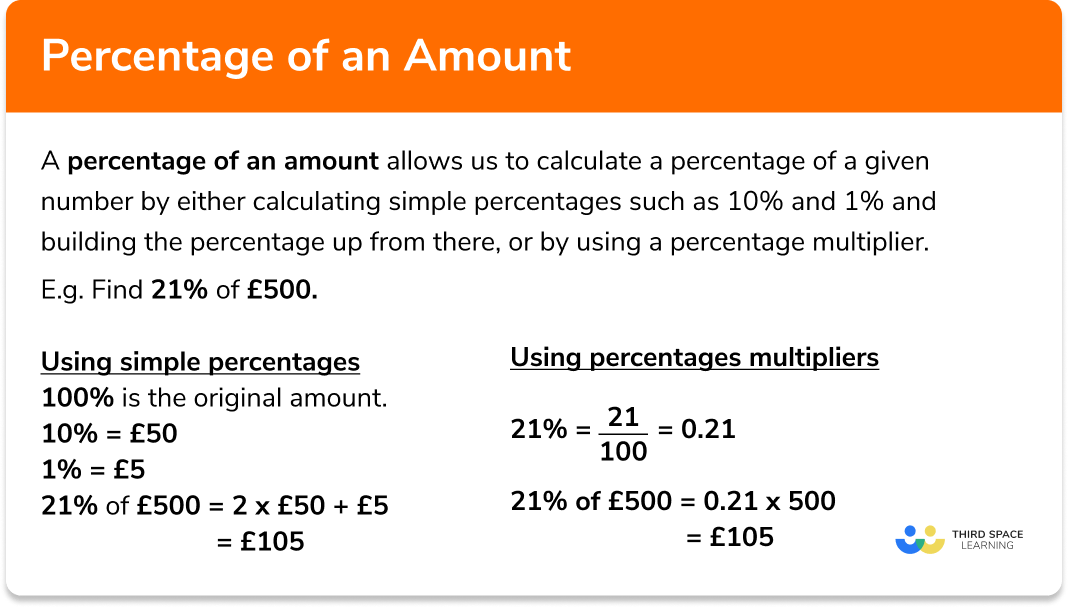
The Decimal Method
This is arguably the most straightforward and widely used method, especially when using calculators or spreadsheets.
Steps:
- Convert the percentage to a decimal: Divide the percentage by 100 (or simply move the decimal point two places to the left).
- Multiply the decimal by the number: The result is the percentage of that number.
Example: What is 15% of $200?
- Convert 15% to a decimal: 15 / 100 = 0.15
- Multiply: 0.15 * $200 = $30
So, 15% of $200 is $30.
The Fraction Method
While less common for complex percentages, the fraction method can be very intuitive, especially for common percentages like 25%, 50%, or 75%.
Steps:
- Convert the percentage to a fraction: Place the percentage over 100 and simplify the fraction to its lowest terms.
- Multiply the fraction by the number: Multiply the number by the numerator of the fraction and divide by the denominator.
Example: What is 25% of $80?
- Convert 25% to a fraction: 25/100 = 1/4
- Multiply: (1/4) * $80 = $80 / 4 = $20
So, 25% of $80 is $20.
Using a Calculator or Spreadsheet
For larger numbers or more complex percentages, a calculator or spreadsheet becomes an invaluable tool.
- Basic Calculator: Most scientific or financial calculators have a “%” button. To find 15% of $200, you might type “200 * 15 % =”. However, be aware that the exact keystrokes can vary by calculator model. A more universal approach is the decimal method: “200 * 0.15 =”.
- Online Tools: Numerous websites offer percentage calculators. Simply input the numbers, and they’ll provide the result.
- Spreadsheet Software (Excel, Google Sheets): Spreadsheets are incredibly powerful for percentage calculations, especially when dealing with lists of numbers.
- To find a percentage of a number: If your number is in cell A1 and your percentage (as a decimal) is in cell B1, you would use the formula
=A1*B1. - If your percentage is expressed as “15%” in cell B1, you can still use
=A1*B1, as spreadsheets often recognize percentages and convert them to decimals internally for calculations. - To calculate a 15% discount on a price in A1:
=A1*(1-0.15)or=A1*0.85.
- To find a percentage of a number: If your number is in cell A1 and your percentage (as a decimal) is in cell B1, you would use the formula
Mastering these methods ensures you can confidently tackle any percentage calculation thrown your way, regardless of the tools at your disposal.
Practical Applications in Personal Finance
The ability to take a percentage of a number directly translates into real-world financial empowerment. Here’s how it impacts your daily personal finance decisions.
Budgeting and Savings
Percentages are critical for effective budgeting and achieving savings goals.
- Budget Allocation: Many financial advisors recommend allocating specific percentages of your income to different categories (e.g., 50% needs, 30% wants, 20% savings). If your monthly take-home pay is $4,000, you can quickly calculate that $800 should go towards savings (20% of $4,000 = $4,000 * 0.20 = $800).
- Tracking Spending: You can analyze what percentage of your income you spend on groceries, entertainment, or housing to identify areas for adjustment and improvement.

Discounts and Sales
Shopping wisely often involves calculating discounts.
- Single Discount: If an item costs $75 and is 30% off, you calculate the discount amount first: $75 * 0.30 = $22.50. Then subtract it from the original price: $75 – $22.50 = $52.50. Alternatively, you can calculate the remaining percentage: $75 * (1 – 0.30) = $75 * 0.70 = $52.50.
- Stacking Discounts: Be careful with successive discounts (e.g., “20% off, then an extra 10% off”). These are usually applied sequentially, not added together. For a $100 item: 20% off means $100 * 0.80 = $80. Then, an extra 10% off that new price means $80 * 0.90 = $72. This is different from a straight 30% off ($70).
Interest Rates
Understanding interest is vital for managing debt and growing wealth.
- Loan Interest: If you take out a $10,000 loan with a 5% annual interest rate, you’ll pay $500 in interest for that year (assuming simple interest): $10,000 * 0.05 = $500. Compound interest, which involves calculating interest on the principal and accumulated interest, requires more complex calculations but still builds upon the fundamental percentage operation.
- Savings Account Growth: If you have $1,000 in a savings account earning 0.5% interest annually, you’ll earn $5 in interest in a year: $1,000 * 0.005 = $5.
Tips and Gratuities
Tipping for services is a common practice in many places.
- To calculate a 18% tip on a $60 bill: $60 * 0.18 = $10.80. This skill ensures fair compensation for service providers and helps you manage your total spending.
Percentages in Business and Investing
Beyond personal finance, percentages are the backbone of commercial operations and investment analysis, offering insights into profitability, risk, and growth.
Profit Margins and Markups
Businesses rely on percentages to price products and assess financial health.
- Markup: If a product costs a business $50 to produce, and they want a 40% markup, they calculate the markup amount: $50 * 0.40 = $20. The selling price would be $50 + $20 = $70.
- Profit Margin: If an item sells for $100 and costs $60 to produce, the gross profit is $40. The gross profit margin is $40 / $100 = 0.40, or 40%. This tells the business how much profit they make for every dollar of revenue.
Sales Tax and VAT
Understanding how to calculate sales tax (or Value Added Tax) is essential for both consumers and businesses.
- If an item costs $25 and the sales tax rate is 8%, the tax amount is $25 * 0.08 = $2. The total cost is $25 + $2 = $27. Businesses need to collect and remit these taxes accurately.
Investment Returns and Portfolio Allocation
In the world of investing, percentages are ubiquitous for evaluating performance and managing risk.
- Return on Investment (ROI): If you invest $5,000 and it grows to $5,750, your profit is $750. Your percentage return is ($750 / $5,000) * 100% = 15%. This metric allows you to compare the performance of different investments.
- Portfolio Allocation: Investors often diversify their portfolios by allocating percentages to different asset classes (e.g., 60% stocks, 30% bonds, 10% cash). If your total portfolio is $100,000, you’d allocate $60,000 to stocks, $30,000 to bonds, and $10,000 to cash.
Commission Structures
Many sales roles and some financial services operate on a commission basis.
- If a salesperson earns a 7% commission on sales, and they make $10,000 in sales, their commission is $10,000 * 0.07 = $700.
These examples underscore how crucial percentage calculations are for navigating the financial landscape, whether you’re managing personal wealth or running a multi-million-dollar enterprise.
Common Pitfalls and Advanced Considerations
While the basic calculation of percentages is straightforward, certain nuances and more complex scenarios require careful attention to avoid common mistakes.
Percentage Increase vs. Percentage Decrease
It’s vital to distinguish between increasing a number by a percentage and decreasing it by a percentage.
- Increase: To increase a number by X%, you multiply the number by (1 + X/100).
- Example: Increase $100 by 10%. $100 * (1 + 0.10) = $100 * 1.10 = $110.
- Decrease: To decrease a number by X%, you multiply the number by (1 – X/100).
- Example: Decrease $100 by 10%. $100 * (1 – 0.10) = $100 * 0.90 = $90.
A common mistake is to think that a 10% increase followed by a 10% decrease will bring you back to the original number. This is incorrect because the base number changes.
- $100 increased by 10% is $110.
- $110 decreased by 10% is $110 * 0.90 = $99.
You end up with $99, not $100.
Successive Percentages
As seen with discounts, applying multiple percentages sequentially requires careful step-by-step calculation. This is particularly relevant in financial modeling for compound growth or depreciation.
- If an investment grows by 5% in year 1 and then by 8% in year 2, you apply the percentages to the new base amount each time.
- Initial investment: $1,000
- After year 1: $1,000 * 1.05 = $1,050
- After year 2: $1,050 * 1.08 = $1,134
This concept is fundamental to understanding compound interest, which is the engine of long-term wealth creation.
The “Of What?” Principle
Always be clear about the base number to which the percentage is being applied. Misidentifying the “whole” can lead to significant errors.
- For example, if a store says sales were “up 15% this quarter,” it means 15% of the previous quarter’s sales, not 15% of some arbitrary total.
- In calculating profit margin, it’s typically “profit as a percentage of revenue,” not as a percentage of cost.
Paying attention to these details can prevent costly financial miscalculations and ensure you’re interpreting financial data accurately.
Conclusion
The ability to take a percentage of a number is more than just a mathematical trick; it’s a fundamental pillar of financial literacy. From navigating everyday purchases and managing personal budgets to making shrewd investment decisions and analyzing business performance, percentages provide the crucial framework for understanding proportions, changes, and comparative values.
By mastering the core methods—decimal, fraction, and calculator-based—and by understanding their practical applications across personal finance, business, and investing, you equip yourself with an invaluable skill. Furthermore, being aware of common pitfalls like successive percentages and the importance of the base number will sharpen your financial acumen, enabling you to make more informed, confident, and ultimately, more successful financial choices. Practice these calculations regularly, and you’ll soon find that percentages become an intuitive and empowering part of your financial toolkit.
aViewFromTheCave is a participant in the Amazon Services LLC Associates Program, an affiliate advertising program designed to provide a means for sites to earn advertising fees by advertising and linking to Amazon.com. Amazon, the Amazon logo, AmazonSupply, and the AmazonSupply logo are trademarks of Amazon.com, Inc. or its affiliates. As an Amazon Associate we earn affiliate commissions from qualifying purchases.