
In the intricate world of numerical operations, subtracting fractions often presents a unique challenge, not just for students learning fundamental arithmetic but also for the technological systems designed to process and present these values. While the manual process involves finding common denominators and straightforward subtraction, the digital realm grapples with representation, precision, and efficiency. This article delves into the technological landscape surrounding fraction subtraction, exploring how software, AI tools, and digital security protocols facilitate these operations, ensuring accuracy and accessibility in an increasingly data-driven environment.
The Digital Backbone of Fractional Operations: Understanding the Basics in Software
The seemingly simple act of subtracting one fraction from another becomes a complex dance of algorithms and data structures when translated into the digital domain. For technology to accurately perform this operation, it must first correctly interpret, store, and manipulate fractional values, often facing challenges that go beyond mere arithmetic.
Representing Fractions in Digital Systems: Challenges and Standards
Before any subtraction can occur, a fraction must be represented in a way that computers can understand and process. Unlike integers, which have direct binary representations, fractions (or rational numbers) introduce complexities. A common approach is to store the numerator and denominator as separate integer values (e.g., Fraction(numerator, denominator) objects in programming languages). However, this can lead to issues with simplification (e.g., 1/2 versus 2/4) and potential overflow if denominators become excessively large during intermediate calculations.
Floating-point numbers (like float or double types in programming) are another way to represent fractions, but they are inherently approximations. For instance, 1/3 cannot be represented perfectly in binary floating-point, leading to 0.333333... with a finite precision. While suitable for many scientific and engineering calculations where a degree of error is acceptable, this approximation becomes problematic when exact fractional arithmetic is required, such as in financial systems or certain cryptographic algorithms.
To maintain precision, specialized libraries and data types have emerged. Python’s fractions module, Java’s BigDecimal, or custom fraction classes in C++ aim to handle rational numbers exactly. These systems typically store fractions in their lowest terms (e.g., 2/4 is internally stored as 1/2) to prevent unnecessary complexity and maintain canonical representation. This initial digital representation is the critical first step in ensuring that subsequent subtraction operations yield accurate results. The choice of representation directly impacts the integrity and reliability of all fractional computations performed by software.
The Fundamental Algorithm: Common Denominators and Digital Precision
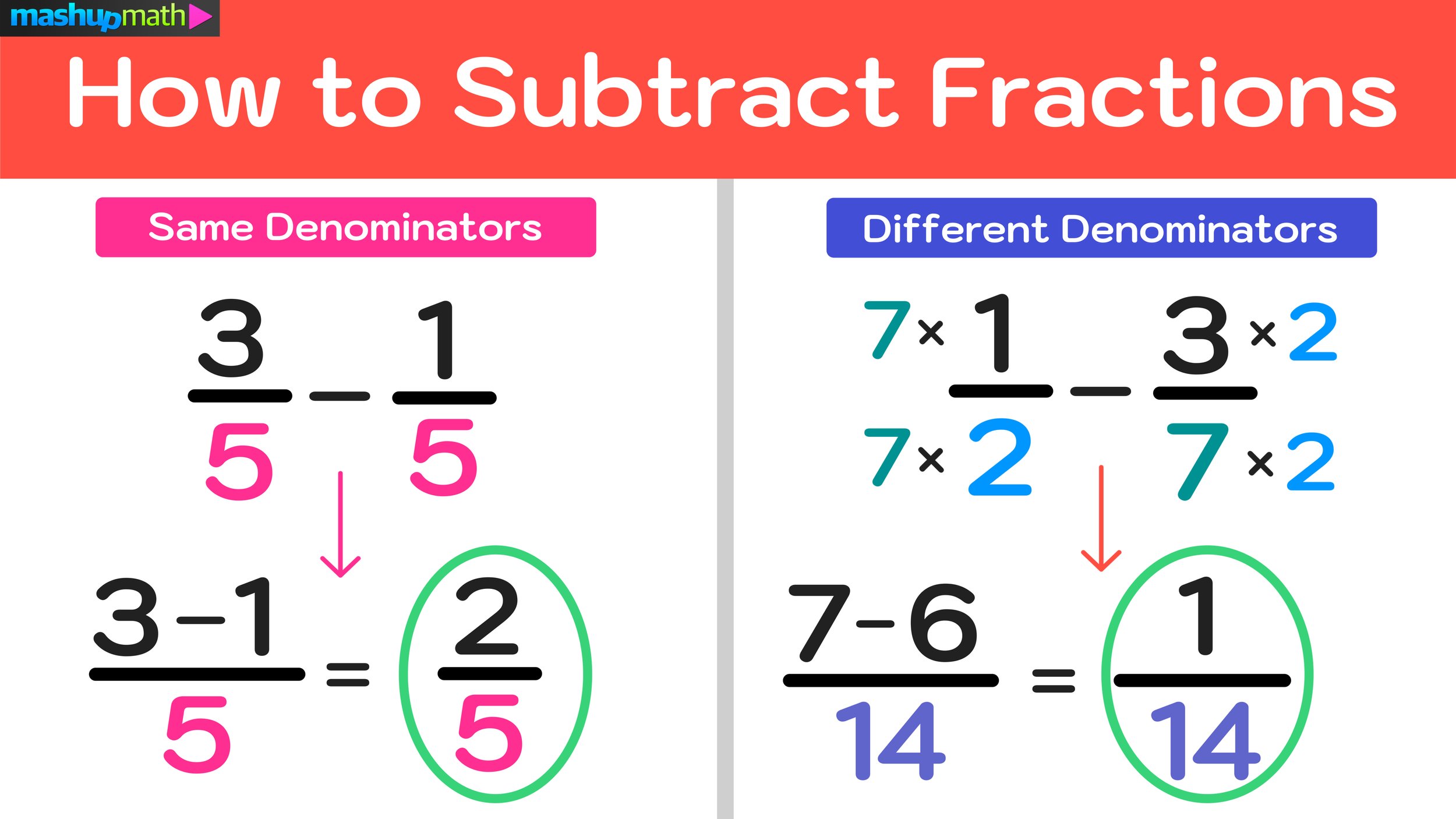
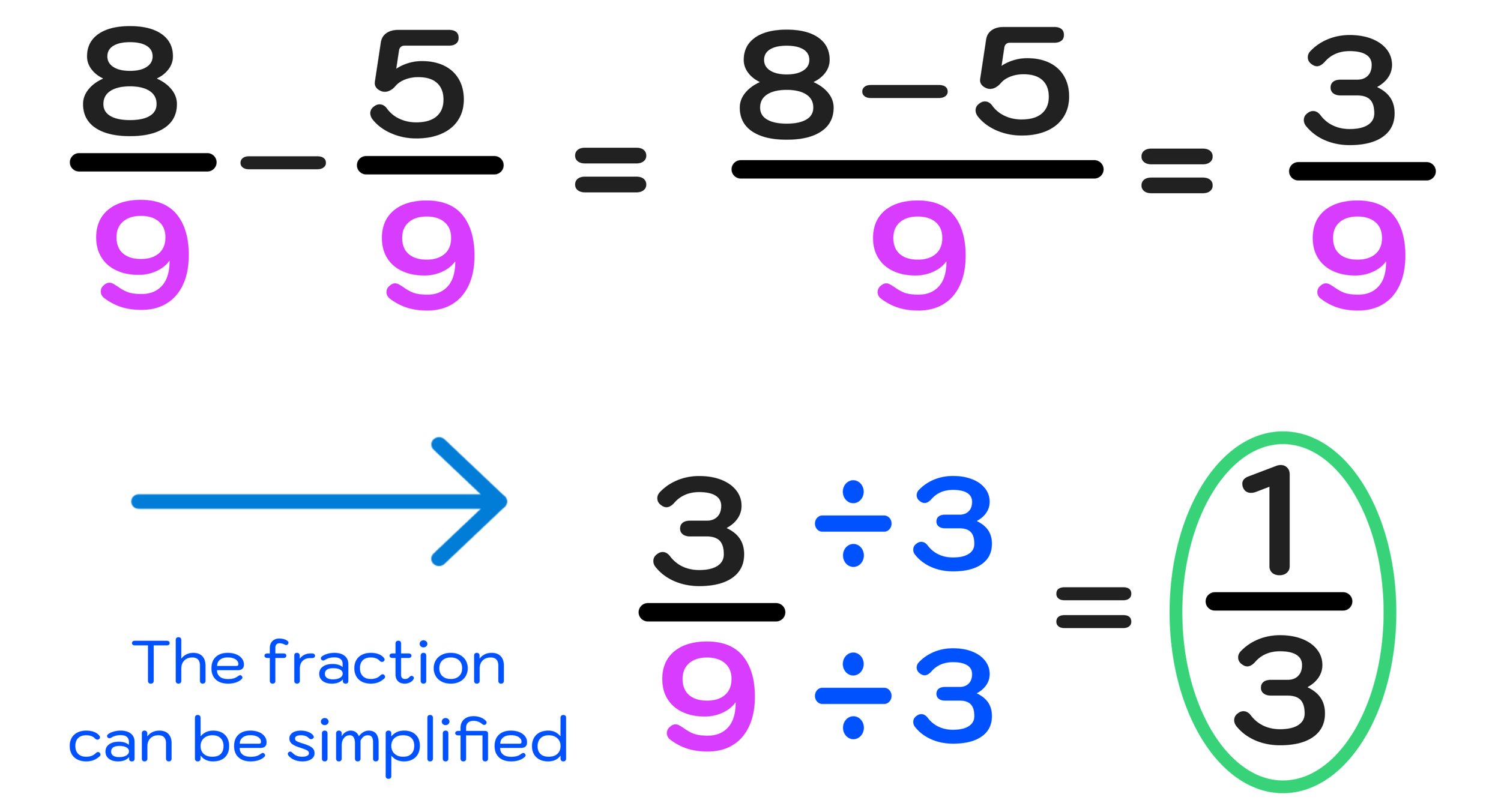
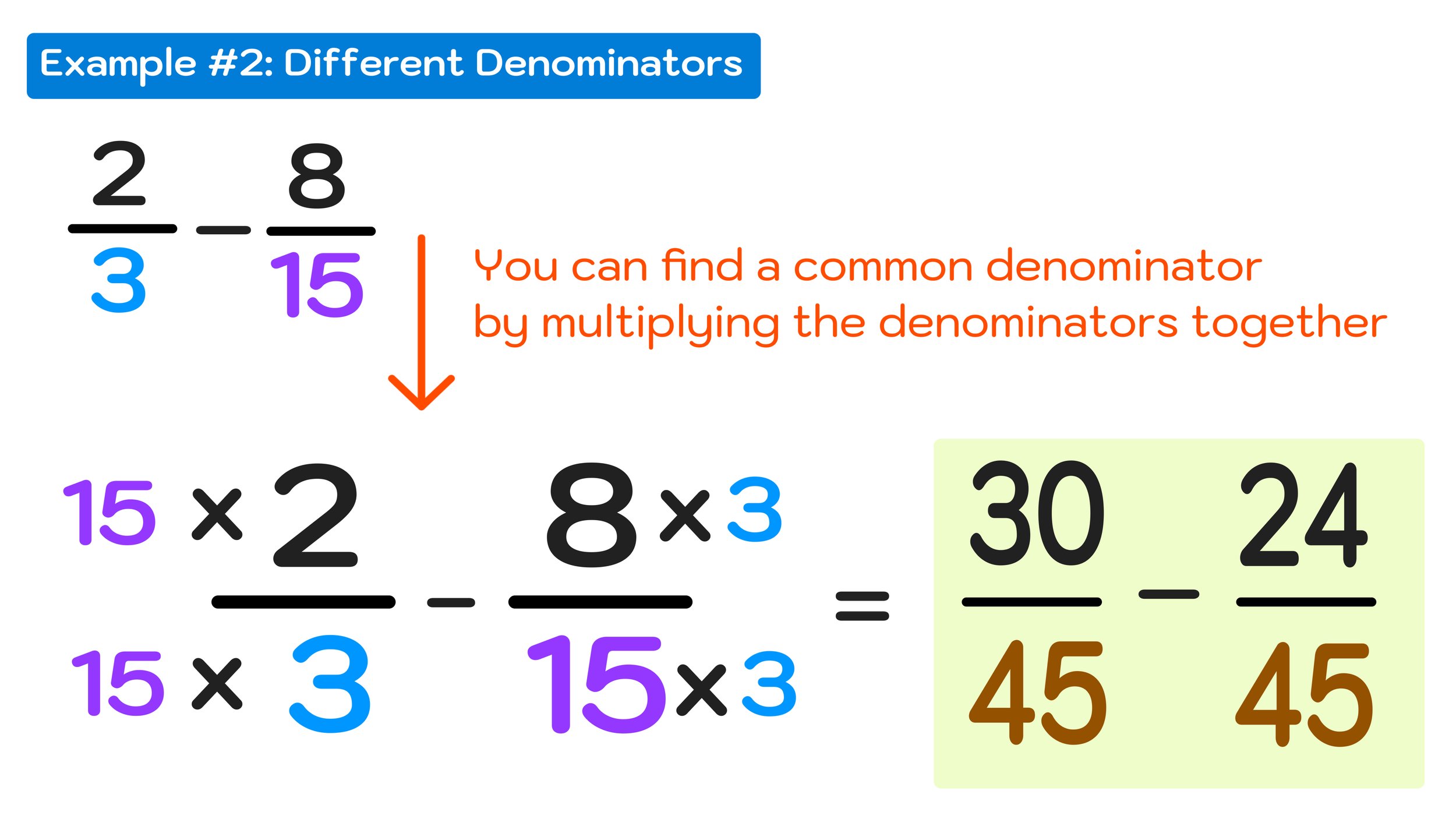
The core mathematical principle for subtracting fractions—finding a common denominator—is directly mirrored in the algorithms employed by digital systems. When presented with two fractions, say a/b - c/d, a computer program must:
- Find a Common Denominator: The least common multiple (LCM) of
banddis typically used. For example, if subtracting1/3from1/2, the LCM of2and3is6. - Adjust Numerators: Both fractions are then converted to equivalent fractions with the common denominator. So,
1/2becomes3/6and1/3becomes2/6. This step involves multiplication, which can lead to larger numbers, testing the limits of integer types if not handled carefully. - Subtract Numerators: The numerators are subtracted (
3 - 2 = 1), while the common denominator remains (6). The result is1/6. - Simplify the Result: The resulting fraction (
1/6) is then reduced to its lowest terms by dividing both the numerator and denominator by their greatest common divisor (GCD). In this case, the GCD of1and6is1, so1/6remains1/6.
This sequence of operations, while conceptually simple, requires robust algorithms to handle various edge cases:
- Zero Denominators: Systems must prevent division by zero, flagging errors if a denominator is zero.
- Negative Numbers: Handling negative numerators or denominators correctly to ensure the sign of the result is accurate.
- Large Numbers: Employing arbitrary-precision arithmetic libraries (like
BigIntegerin Java or Python’s native integer handling) is crucial when numerators or denominators grow extremely large during intermediate steps, especially when calculating LCMs or multiplying terms, preventing overflow errors that could corrupt results.
Digital precision extends beyond merely avoiding overflow. It encompasses the correct implementation of GCD and LCM algorithms (e.g., Euclidean algorithm for GCD) to ensure efficiency and correctness. Every step must be meticulously coded to prevent subtle errors that could propagate through complex calculations, highlighting the precision engineering required in even fundamental arithmetic operations within software.
Software Tools and AI for Seamless Fraction Subtraction
The inherent complexities of fractional arithmetic, both conceptually and computationally, have spurred the development of various technological solutions. From dedicated calculators to sophisticated AI-powered learning platforms, technology plays a pivotal role in simplifying, teaching, and performing fraction subtraction.
Specialized Calculators and Math Software: Beyond the Manual
For decades, digital calculators have been indispensable tools for arithmetic. Modern scientific and graphing calculators often include dedicated fraction modes, allowing users to input fractions directly (e.g., using a a b/c button) and perform operations like subtraction. These calculators are programmed with the algorithms discussed above, handling common denominators, numerator subtraction, and simplification automatically. They abstract away the manual steps, providing instant, accurate results.
Beyond handheld devices, comprehensive math software suites like Wolfram Alpha, MATLAB, Mathematica, and open-source alternatives like GNU Octave or SymPy (a Python library) offer far more robust capabilities. These platforms can perform symbolic fraction subtraction, meaning they can handle variables within fractions (e.g., (x/2) - (y/3)) and simplify the resulting algebraic expression. They are equipped with advanced numerical engines that manage precision, handle complex fractions, and often visualize the steps involved, making them invaluable for educators, students, and professionals alike. The utility of such software lies in its ability to not only compute answers but also to provide insights into the process, acting as a digital tutor or a powerful analytical tool.
AI-Powered Learning Platforms: Making Fraction Subtraction Intuitive
The educational sector has seen a transformative shift with the integration of AI, particularly in making challenging topics like fraction subtraction more accessible and engaging. AI-powered learning platforms and intelligent tutoring systems leverage machine learning algorithms to:
- Personalize Learning Paths: By analyzing a student’s performance, these platforms can identify specific areas of weakness in fraction subtraction (e.g., difficulty finding the LCM, errors in simplifying) and provide targeted exercises and explanations.
- Adaptive Feedback: Unlike static textbooks, AI tutors can offer real-time, context-aware feedback, guiding students through each step of the subtraction process, similar to a human tutor. If a student makes an error in finding a common denominator, the AI can immediately intervene with hints or relevant instructional content.
- Gamification and Engagement: Many platforms incorporate gamified elements, turning fraction practice into interactive challenges, thereby increasing student motivation and engagement.
- Step-by-Step Explanations: Advanced AI models can break down the fraction subtraction process into granular steps, explaining why each step is taken, not just what the correct answer is. This fosters deeper understanding rather than rote memorization.
Tools like Khan Academy, Prodigy, and specialized math apps are continuously evolving with AI integration, transforming how students learn and master fractional operations. They move beyond simple calculation to cultivate conceptual understanding, preparing users for more complex mathematical challenges.
Programming Fractional Logic: From Scripting to Libraries
For developers, the ability to program fractional arithmetic is fundamental in applications ranging from financial modeling to scientific simulations. Programming languages often provide native support or robust libraries to handle fractions precisely.
- Native Data Types and Libraries: Languages like Python offer a built-in
fractionsmodule, enabling developers to createFractionobjects and perform arithmetic operations directly, ensuring exact results without floating-point approximations. Other languages might require external libraries (e.g.,BigRationallibraries in Java or C#). - Custom Implementations: For specific needs, developers might implement their own fraction classes, which involve defining constructors, arithmetic operators (addition, subtraction, multiplication, division), and simplification logic (using GCD). This offers fine-grained control but requires careful attention to detail to avoid bugs.
- Symbolic Math Libraries: For advanced scenarios involving algebraic fractions, libraries like SymPy (Python) or the Symbolic Math Toolbox (MATLAB) allow programmers to manipulate expressions containing fractions symbolically, preserving accuracy and enabling complex algebraic simplifications.
These programming capabilities are crucial for applications where precision is paramount. For instance, in blockchain technologies, where every transaction must be perfectly reconciled, or in computational geometry, where exact coordinates are vital, the underlying fractional arithmetic must be flawless. Developers choose their tools and methods based on the required level of precision, performance, and ease of implementation for their specific use cases.
Digital Security and Accuracy in Numerical Computations
The accuracy of numerical computations, especially fractional ones, is not merely a matter of convenience; it is a critical component of digital security and system reliability. Errors in fraction subtraction, whether due to computational limitations or malicious intent, can have profound consequences, particularly in sensitive domains.
Mitigating Rounding Errors: Ensuring Data Integrity
As previously noted, floating-point numbers inherently carry the risk of rounding errors. While seemingly small, these errors can accumulate over numerous calculations, leading to significant discrepancies. In systems where exact fractional values are expected, such as financial ledger reconciliation, scientific data analysis, or engineering designs, relying solely on floating-point arithmetic for fraction subtraction can compromise data integrity.
Strategies to mitigate these risks include:
- Exact Rational Arithmetic: Employing libraries or custom implementations that store and operate on fractions as separate numerator and denominator integers (e.g., Python’s
fractionsmodule,BigDecimalin Java). This ensures that calculations are performed precisely, avoiding any rounding. - Precision Control: When floating-point numbers are unavoidable (e.g., for very large or very small numbers, or performance reasons), careful management of precision settings is crucial. This involves defining the number of decimal places to retain and understanding how rounding modes (e.g., round half up, round half even) affect the final result.
- Error Analysis: For complex systems, formal error analysis can be employed to quantify the maximum potential error accumulation. This helps in understanding the reliability of computations and designing systems that can tolerate or correct for these errors.
Ensuring data integrity in fractional subtraction is paramount. A single miscalculated fraction in a financial transaction could lead to discrepancies across accounts, while an error in scientific simulation could invalidate research findings. Robust design and rigorous testing are essential to prevent these issues.
Validating Inputs and Outputs: Robustness in Fractional Operations
Beyond the internal calculation, the security and reliability of fractional operations heavily depend on robust input validation and output verification. Malicious actors or unintentional user errors can introduce invalid fractional inputs that could lead to crashes, incorrect calculations, or even security vulnerabilities.
Input Validation:
- Denominator Checks: Ensuring denominators are non-zero is fundamental. Division by zero can crash programs or lead to undefined behavior.
- Type and Format Validation: Verifying that inputs are indeed numbers or valid fractional strings. For instance, preventing text or malformed strings from being interpreted as fractions.
- Range Checks: Depending on the application, specific ranges for numerators and denominators might be required. For example, a system might only accept positive fractions.
Output Verification:
- Consistency Checks: Cross-referencing results with alternative calculation methods or known valid ranges can help detect errors.
- Simplification Validation: Ensuring that resulting fractions are always simplified to their lowest terms.
- Logging and Auditing: Maintaining logs of fractional computations, especially in critical systems, allows for auditing and debugging if discrepancies arise. This is particularly important in regulated industries where financial transactions or scientific results must be traceable and verifiable.
By implementing strict input validation and thorough output verification, software systems can enhance their robustness against both accidental errors and deliberate attacks, ensuring that fractional subtraction operations consistently produce accurate and reliable results.
The Future of Fractional Math: AI, Quantum Computing, and Beyond
As technology continues to advance, the landscape of numerical computation, including fractional arithmetic, is poised for further evolution. Emerging technologies like advanced AI and quantum computing promise to redefine how we approach and execute fractional operations, opening new possibilities for precision, speed, and complexity.
Predictive Analytics and Fractions: Complex Financial Models
In the realm of predictive analytics, particularly in finance, fractional values are ubiquitous. Stock prices are often quoted with fractional components, interest rates are essentially fractions of principal amounts, and derivatives contracts frequently involve complex fractional calculations. As AI models become more sophisticated in forecasting market trends, assessing risk, and optimizing portfolios, their ability to handle precise fractional arithmetic efficiently will be crucial.
- Fractional Differencing in Time Series: Advanced time-series analysis techniques sometimes involve “fractional differencing” to capture long-range dependencies in data, an area where precise fractional calculations are indispensable for accurate model calibration.
- Micro-transactions and Cryptocurrencies: The rise of micro-transactions and cryptocurrencies necessitates extremely precise handling of fractional amounts, often beyond the typical two decimal places of traditional currency. AI systems processing these transactions must maintain absolute fractional accuracy to prevent discrepancies.
- Optimizing Resource Allocation: AI algorithms used in logistics, manufacturing, and supply chain management often deal with fractional resource allocation (e.g., parts of a raw material, fractions of staff hours). The ability to subtract and manipulate these fractions precisely helps in optimizing efficiency and minimizing waste.
The future of predictive analytics will increasingly rely on AI’s capacity for exact fractional arithmetic to build more robust, accurate, and trustworthy models, moving beyond approximations to deliver verifiable precision.
Quantum Computing’s Potential: Revolutionizing Numerical Processing
Quantum computing, still in its nascent stages, holds the promise of revolutionizing numerical processing, including how fractions are handled. While classical computers rely on binary bits (0s and 1s), quantum computers use qubits, which can exist in a superposition of states (both 0 and 1 simultaneously) and leverage quantum phenomena like entanglement.
- Exponential Speedup for Certain Algorithms: For specific computational problems, quantum algorithms (like Shor’s algorithm for factorization or Grover’s algorithm for search) offer exponential speedups over classical algorithms. While not directly about fraction subtraction, these capabilities could indirectly impact the underlying components, such as finding the greatest common divisor (GCD) or least common multiple (LCM) for extremely large numbers, which are critical steps in fractional arithmetic.
- Handling Large Numbers: The ability of quantum computers to process massive datasets and perform complex calculations could benefit fractional arithmetic involving numbers currently too large for efficient classical processing, or where the accumulation of rounding errors becomes intractable.
- New Paradigms for Precision: Quantum algorithms could potentially introduce entirely new paradigms for maintaining precision in numerical computations, possibly offering exact representations for a wider range of numbers or enabling faster error correction in complex calculations.
While practical quantum computers are still some time away from widespread use, their potential to fundamentally alter numerical processing, including how we subtract fractions, is a fascinating prospect. It could usher in an era where precision is not a trade-off for performance but an intrinsic quality of computation, reshaping our understanding and application of fundamental mathematical operations in the digital age.
In conclusion, “how to subtract a fraction” is far more than a basic math problem in the technological landscape. It is a foundational challenge that drives innovation in software design, algorithmic development, AI-driven education, and digital security. As our digital world becomes increasingly complex and reliant on precise calculations, the technological advancements in handling fractional operations will continue to be a critical pillar, underpinning everything from personal finance applications to advanced scientific research and the emerging frontiers of quantum computing.
aViewFromTheCave is a participant in the Amazon Services LLC Associates Program, an affiliate advertising program designed to provide a means for sites to earn advertising fees by advertising and linking to Amazon.com. Amazon, the Amazon logo, AmazonSupply, and the AmazonSupply logo are trademarks of Amazon.com, Inc. or its affiliates. As an Amazon Associate we earn affiliate commissions from qualifying purchases.