
In the vast and ever-evolving landscape of technology, the ability to understand, manipulate, and ultimately “solve for a variable” is not merely a mathematical exercise—it’s a foundational skill that underpins everything from coding and data analysis to understanding complex algorithms and building sophisticated systems. While often associated with algebra textbooks, the concept of a variable and the process of determining its value are critical for anyone looking to truly master technological concepts or excel in a tech-driven career.
This article delves into the principles of solving for a variable, framing it not just as a math problem, but as a crucial analytical capability. We will explore its relevance across various tech domains, provide practical strategies, and highlight how modern tools and programming languages empower us to tackle increasingly complex equations. Whether you’re a budding developer, a data enthusiast, or simply aiming to sharpen your analytical edge, grasping how to solve for a variable is a fundamental step towards enhanced tech literacy.
Understanding the Fundamentals: What is a Variable?
Before we can solve for something, we must first understand what that “something” is. In its simplest form, a variable is a placeholder for an unknown value or a quantity that can change. Its ubiquitous nature spans both abstract mathematical concepts and tangible computing applications, making it a cornerstone of logical thought and system design.
Variables in Mathematics: The Abstract Unknown
Historically, variables (often represented by letters like x, y, z, or a, b, c) emerged as powerful tools in mathematics, particularly in algebra. They allow us to express relationships, formulate problems, and generalize patterns without knowing the specific numerical values involved. For instance, in the equation 2x + 5 = 15, ‘x’ is the variable—an unknown number whose value we aim to discover. The act of “solving for x” means finding the unique number that makes the equation true. This abstract representation is crucial because it enables us to model real-world scenarios, from calculating trajectories to predicting financial outcomes, before plugging in concrete data. The rules of algebra provide a systematic framework for isolating and determining the value of these mathematical unknowns.
Variables in Computing: Memory, Data, and Dynamic State
While sharing the same fundamental idea of a placeholder, variables in computing take on a more concrete role. In programming languages like Python, JavaScript, or C++, a variable is a named storage location in memory that holds a value. This value can be a number, a string of text, a true/false (boolean) statement, or even a more complex data structure. For example, userName = "Alice" assigns the string “Alice” to the variable userName.
The key difference from mathematical variables is their dynamic nature. Computer variables can be reassigned (their value can change) throughout a program’s execution. This dynamic capability is what allows programs to interact with users, process data, and adapt to different conditions. Solving for a variable in a computational context might involve debugging a program to see what value a variable holds at a certain point, or writing an algorithm that iteratively updates a variable until a condition is met. Understanding data types, scope, and mutability are all crucial aspects of working with variables in a programming environment. They represent the living, breathing data that drives all software.
Why They Matter in Tech: The Building Blocks of Logic
The concept of a variable is fundamental to virtually every aspect of technology. In software development, variables store user input, intermediate calculations, and program state. Without them, programs would be static and unable to process or respond to changing conditions. In data science and analytics, variables represent features in datasets, parameters in statistical models, and metrics that are analyzed to extract insights. Understanding how to isolate and manipulate these variables is key to everything from A/B testing to machine learning model tuning. Even in hardware design, variables can represent signal strengths, component values, or environmental conditions that a system needs to monitor and respond to. Ultimately, variables are the universal language for expressing relationships, defining states, and building logical flows in all technological systems.
Core Principles for Isolating the Variable
The process of solving for a variable, particularly in equations, relies on a set of fundamental algebraic principles. These principles ensure that whatever operations we perform to isolate our unknown, the equality of the equation remains intact. Mastering these concepts is essential for accurate problem-solving, whether done manually or when designing algorithms.
The Golden Rule of Algebra: Maintaining Balance
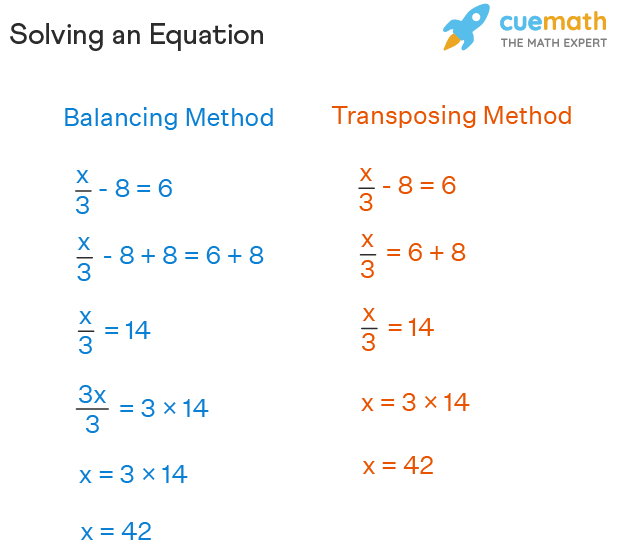
The most critical principle in solving for a variable is the idea of balance. An equation is like a balanced scale: whatever you do to one side, you must do to the other side to keep it balanced. If you add 5 to the left side, you must add 5 to the right side. If you divide the left side by 2, you must divide the right side by 2. This “golden rule” ensures that while the equation might look different after each step, the underlying relationship between the two sides remains true, and the value of the variable you’re solving for does not change. This principle is not just for simple equations; it applies equally to complex algebraic manipulations, ensuring that each transformation is mathematically valid.
Inverse Operations: Undoing the Math
To isolate a variable, we need to “undo” the operations being performed on it. This is where inverse operations come into play. Every basic arithmetic operation has an inverse that cancels it out:
- Addition and Subtraction: If a number is added to the variable, subtract that number from both sides. If a number is subtracted, add it to both sides. (e.g.,
x + 7 = 10becomesx = 10 - 7) - Multiplication and Division: If the variable is multiplied by a number, divide both sides by that number. If it’s divided by a number, multiply both sides by that number. (e.g.,
3x = 12becomesx = 12 / 3) - Exponents and Roots: If the variable is raised to a power, take the corresponding root of both sides. If it’s under a root, raise both sides to that power. (e.g.,
x² = 25becomesx = √25)
Understanding and correctly applying inverse operations is the core mechanical skill needed to systematically dismantle an equation and reveal the variable’s value.
Order of Operations (PEMDAS/BODMAS) in Reverse
When evaluating an expression, we follow the order of operations: Parentheses/Brackets, Exponents/Orders, Multiplication and Division (from left to right), and Addition and Subtraction (from left to right) – often remembered by mnemonics like PEMDAS or BODMAS. However, when solving for a variable, we often work backward through this order to undo the operations.
For example, in 2x + 5 = 15:
- Undo Addition/Subtraction first: The
+5is the last operation done to2x. So, subtract 5 from both sides:2x = 10. - Undo Multiplication/Division next: The
2is multiplied byx. So, divide both sides by 2:x = 5.
This reverse application of the order of operations helps systematically peel back the layers of an equation to isolate the variable, making the process logical and manageable even for multi-step problems.
Practical Strategies for Isolating the Variable
With the foundational principles in place, we can now explore practical strategies for applying them to solve a variety of equations, from simple linear ones to those that appear more complex.
Step-by-Step Approach: Deconstructing the Equation
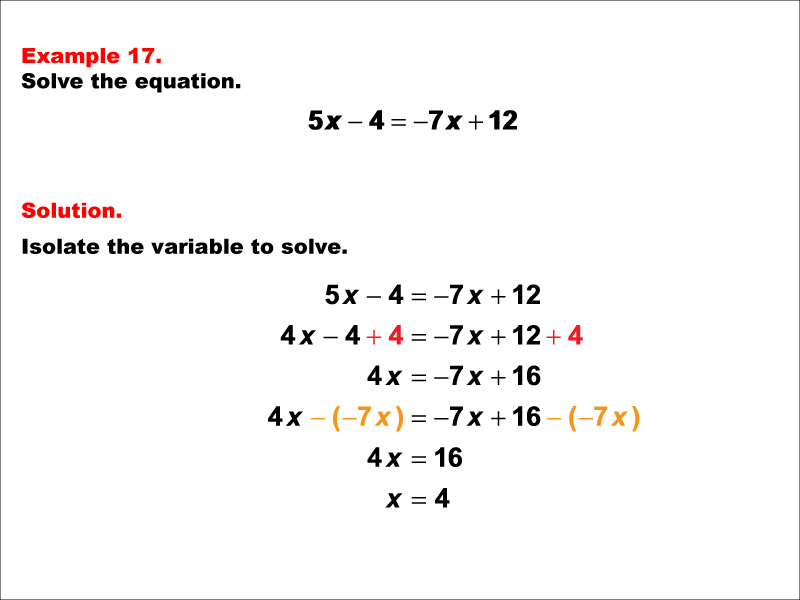
The most effective strategy is a methodical, step-by-step approach. Regardless of the equation’s complexity, breaking it down into smaller, manageable tasks is key:
- Simplify Each Side: If possible, combine like terms (e.g.,
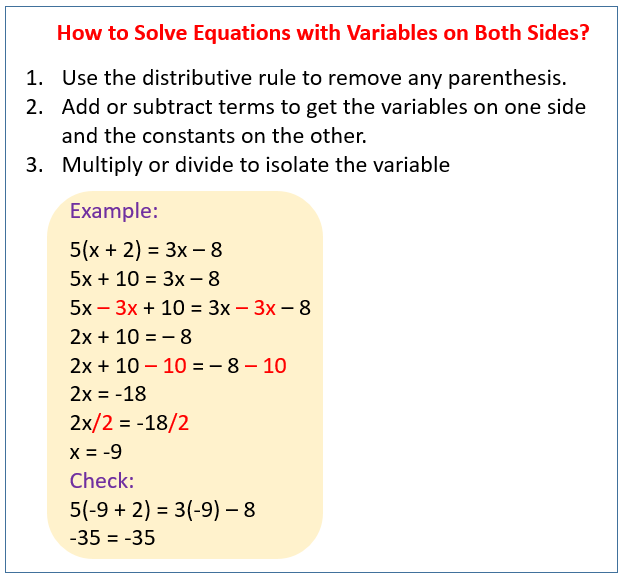
3x + 2xbecomes5x) and distribute any multiplication over parentheses on each side of the equation before attempting to move terms across the equality sign. - Move Variable Terms to One Side: If the variable appears on both sides of the equation (e.g.,
5x + 3 = 2x + 12), use addition or subtraction to move all variable terms to one side (e.g., subtract2xfrom both sides). - Move Constant Terms to the Other Side: Use addition or subtraction to move all constant terms (numbers without variables) to the opposite side of the equation from where your variables now reside.
- Isolate the Variable: Finally, use multiplication or division (or roots/exponents) to get the variable by itself. This usually involves dividing by the coefficient (the number multiplied by the variable).
This structured approach minimizes errors and helps maintain clarity throughout the solution process.
Handling Complex Equations: Fractions, Parentheses, and Multiple Variables
Complex equations can often seem daunting, but the same fundamental principles apply:
- Parentheses: Always start by distributing multiplication over terms inside parentheses (e.g.,
3(x + 2)becomes3x + 6). - Fractions: To eliminate fractions, multiply every term on both sides of the equation by the least common multiple (LCM) of all the denominators. This converts the equation into one without fractions, which is usually easier to solve. For example, if you have
x/2 + 1/3 = 5/6, multiply everything by 6. - Variables on Both Sides: As mentioned, use inverse operations to gather all variable terms on one side and all constant terms on the other.
- Multiple Variables (Solving for one): If an equation has multiple variables (e.g.,
A = P(1 + rt)), you might be asked to solve for a specific one (e.g., solve fort). Treat the other variables as if they were known constants and apply the same inverse operations to isolate the target variable.
Real-World Tech Examples: Pseudocode and Spreadsheets
While these concepts are algebraic, their application in tech is direct.
-
Pseudocode Example: Imagine an algorithm that calculates a future value:
BEGIN SET principal = 1000 SET rate = 0.05 SET time = ? SET futureValue = 1215.51// Solve for time: futureValue = principal * (1 + rate)^time // This would involve logarithms, but computationally, you might iterate or use a financial function.END
Here,
timeis a variable we might need to solve for, given the others. -
Spreadsheet Formulas: In Excel or Google Sheets, you might have
Cost = Quantity * Price. If you know theCostandQuantity, you can solve forPriceby entering=Cost/Quantityinto a cell. Advanced features like “Goal Seek” in Excel allow you to specify a target value for a formula and have Excel adjust an input variable to reach that target, essentially solving an equation iteratively.
Leveraging Technology to Solve for Variables
While understanding the manual process is crucial for developing logical reasoning, technology provides powerful tools to solve for variables efficiently and accurately, especially for complex or iterative problems.
Scientific Calculators and Online Solvers: Quick Solutions
For straightforward algebraic equations, a scientific calculator can often solve for a variable directly or simplify expressions. Many modern calculators have “solver” functions where you can input an equation and let the calculator determine the unknown. Online equation solvers (like Wolfram Alpha or Symbolab) are even more powerful, providing step-by-step solutions for a wide range of mathematical problems, including those with multiple variables or requiring advanced calculus. These tools are excellent for checking your work, understanding solution steps, or quickly solving problems where the process isn’t the primary learning objective.
Spreadsheet Software (Excel, Google Sheets): Data-Driven Problem Solving
Spreadsheet applications are incredibly versatile for solving variable-related problems, especially when dealing with data or financial models.
- Formulas: You can directly implement equations. If
Total_Sales = Units_Sold * Price_Per_Unit, and you want to findUnits_Sold, you can use the formula=Total_Sales / Price_Per_Unitin a cell, referencing other cells as variables. - Goal Seek/Solver Add-ins: As mentioned earlier, “Goal Seek” (Excel) or similar features allow you to define a target outcome for a formula and specify which input variable to change to achieve that target. This is effectively solving for a single variable in a given equation by iteration, which is invaluable for financial planning, engineering design, or optimization problems. Solver add-ins extend this capability to handle systems of equations and inequalities, allowing for optimization under constraints.
Programming Languages (Python, JavaScript): Algorithmic Solutions
Programming languages offer the ultimate flexibility for solving variable-related problems, from simple calculations to complex numerical simulations.
- Direct Calculation: For simple equations, you can implement the inverse operations directly:
python

# Example: Solving 2x + 5 = 15

# Known: y = 2x + 5, where y = 15

y = 15

constant = 5

coefficient = 2

x = (y - constant) / coefficient

print(f"The value of x is: {x}") # Output: The value of x is: 5.0
- Symbolic Libraries: Libraries like SymPy in Python allow you to perform symbolic mathematics, meaning you can manipulate equations with variables just as you would on paper, rather than just plugging in numbers. SymPy can algebraically solve equations, simplify expressions, and perform calculus operations.
- Numerical Methods: For equations that cannot be solved algebraically (e.g., transcendental equations), programming languages are essential for implementing numerical methods (like Newton-Raphson, bisection method, etc.) to find approximate solutions for variables. These methods are crucial in scientific computing, engineering, and machine learning.
AI and Symbolic Solvers: Advanced Capabilities
The advent of AI has further revolutionized variable solving. AI-powered tools and specialized symbolic AI systems can understand natural language problem descriptions, interpret complex mathematical expressions, and often provide not just solutions but also explanations of the steps involved. Machine learning models themselves rely heavily on optimizing parameters (variables) through iterative solving processes. These advanced tools promise to make complex problem-solving more accessible and efficient, offloading the tedious manual steps and allowing users to focus on the higher-level implications of their solutions.
The Broader Impact: Problem-Solving in the Digital Age
The ability to solve for a variable extends far beyond specific mathematical problems; it cultivates a mode of thinking that is indispensable in the digital age. It’s about more than just finding ‘x’; it’s about understanding relationships, identifying unknowns, and systematically working towards a resolution.
Beyond Math: Logical Thinking and Debugging
The process of solving for a variable inherently trains logical thinking. You learn to break down problems, identify dependencies, and apply a sequence of logical operations. This analytical rigor directly translates to skills like debugging in programming. When a piece of code isn’t working as expected, a developer effectively “solves for a variable” – trying to pinpoint which variable holds an unexpected value or which logical step is incorrect, leading to the erroneous output. It’s about tracking cause and effect within a system, a skill honed by algebraic problem-solving. It builds the patience and persistence required to untangle complex issues in any tech domain.
Data Analysis and Modeling: Understanding System Dynamics
In data science, variables are at the heart of everything. Each column in a dataset is a variable, each parameter in a machine learning model is a variable, and each outcome we wish to predict is often a variable. The act of “solving for a variable” in this context can mean:
- Predicting a target variable: Using known input variables to estimate an unknown outcome (e.g., predicting house prices based on size, location, and number of bedrooms).
- Inferring relationships: Understanding how changes in one variable impact another (e.g., how advertising spend affects sales).
- Optimizing parameters: Adjusting variables in a model to achieve the best performance (e.g., tuning the learning rate in a neural network).
The analytical mindset fostered by solving for variables is crucial for building robust models, interpreting results, and making data-driven decisions.
Future-Proofing Your Skills: The Enduring Relevance
As technology continues its rapid advancement, the specific tools and languages we use may change, but the underlying principles of logic, problem-solving, and understanding relationships between quantities will remain constant. The ability to abstract a problem, represent it with variables, and systematically solve for an unknown is a future-proof skill. It empowers individuals to adapt to new technologies, understand how complex systems function, and contribute meaningfully to innovation. It’s not just about passing a math test; it’s about building the cognitive framework necessary to navigate and shape the technological world of tomorrow.
In conclusion, solving for a variable is far more than an academic exercise. It is a fundamental literacy requirement for anyone engaging with technology at a meaningful level. By understanding what variables are, adhering to core algebraic principles, and leveraging powerful technological tools, individuals can unlock deeper insights, build more effective solutions, and cultivate a robust problem-solving mindset crucial for success in the digital age. This skill is a gateway to truly understanding the logic that powers our modern world.
aViewFromTheCave is a participant in the Amazon Services LLC Associates Program, an affiliate advertising program designed to provide a means for sites to earn advertising fees by advertising and linking to Amazon.com. Amazon, the Amazon logo, AmazonSupply, and the AmazonSupply logo are trademarks of Amazon.com, Inc. or its affiliates. As an Amazon Associate we earn affiliate commissions from qualifying purchases.