
In the dynamic world of entrepreneurship, a business plan isn’t merely a formality; it’s the financial compass that guides your venture from conception to sustained profitability. Far beyond a simple checklist, a well-crafted business plan serves as your strategic roadmap, articulating your financial goals, outlining the resources required, and detailing how you intend to generate and manage revenue. For any aspiring or existing business owner, understanding the intricacies of financial planning, investment attraction, and sustainable growth mechanisms inherent in a business plan is paramount. This document, primarily viewed through the lens of sound financial stewardship, is the bedrock upon which successful enterprises are built. It translates vision into concrete, measurable financial objectives, enabling stakeholders, from founders to potential investors, to assess viability, risk, and return on investment.

The Indispensable Blueprint for Financial Success
At its core, a business plan is a comprehensive document that meticulously details an organization’s objectives and how it plans to achieve them. From a financial perspective, it is the ultimate tool for forecasting, budgeting, and securing the capital necessary for operations and expansion. Without a robust business plan, even the most innovative ideas risk faltering due to a lack of financial foresight and strategic direction. It forces entrepreneurs to confront the economic realities of their venture, providing a structured framework for making informed financial decisions.
Why a Business Plan is More Than Just a Document
A business plan transcends being a mere paper exercise; it’s a living financial instrument crucial for attracting funding, guiding operational spending, and achieving fiscal targets. For startups, it’s the persuasive argument presented to angel investors, venture capitalists, and traditional lenders, demonstrating a clear path to profitability and return on investment. It quantifies market opportunity, projects sales, estimates costs, and outlines the funding required, along with a strategy for its repayment or equity distribution. For established businesses, it’s a tool for strategic repositioning, identifying new revenue streams, optimizing cost structures, and planning for expansion or diversification. It provides a benchmark against which actual financial performance can be measured, allowing for timely adjustments and course corrections. It’s an ongoing commitment to financial discipline and strategic evaluation.
Setting the Foundation for Fiscal Responsibility
Developing a business plan instills a critical sense of fiscal responsibility from the outset. It compels entrepreneurs to thoroughly research their market, understand their competitive landscape, and meticulously project their financial performance. This rigorous process helps in identifying potential financial pitfalls, calculating startup costs accurately, and forecasting cash flow with greater precision. By documenting every aspect of the business from a financial standpoint—from projected income and expenses to asset acquisition and liability management—the plan acts as a foundational agreement between the entrepreneur and their financial future. It dictates how resources will be allocated, how revenue will be generated, and how profitability will be sustained, establishing a framework for sound financial governance.
Core Components of a Financially Sound Business Plan
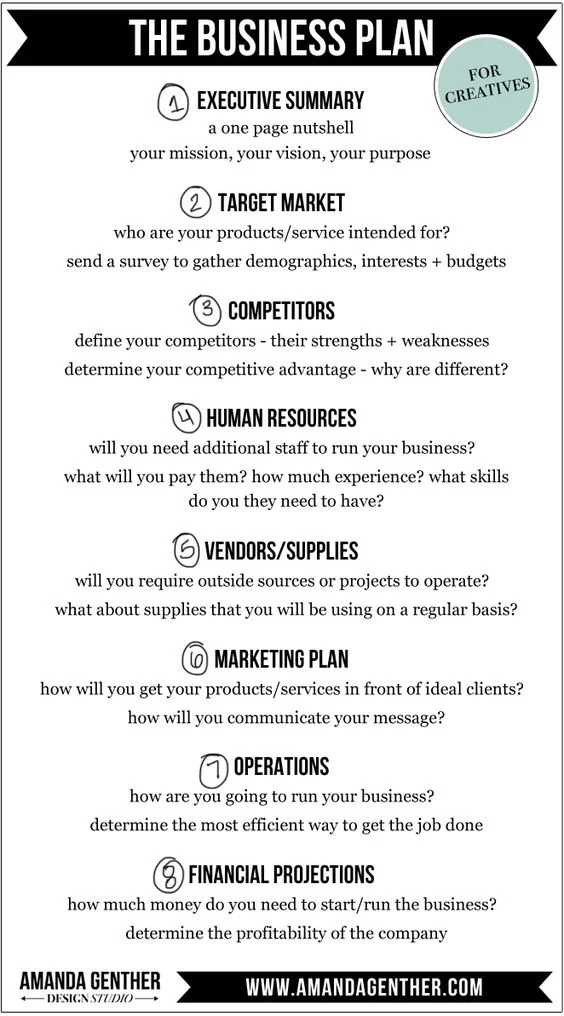
While every business plan is unique, certain sections are universal and particularly critical from a financial perspective. These components collectively paint a comprehensive picture of the business’s financial viability and strategic direction.
Executive Summary: Your Financial Snapshot
The executive summary is arguably the most crucial section, especially when seeking funding. It’s a concise, compelling overview of the entire business plan, emphasizing key financial highlights, market opportunity, proposed solution, management team, and, most importantly, the financial projections and funding request. For investors, this section is their first, and often only, impression of your financial acumen and the venture’s potential ROI. It must clearly articulate the problem your business solves, its unique value proposition, the size of the market opportunity (quantified in monetary terms), and a summary of your financial projections, including expected revenue, profit margins, and break-even point. A strong executive summary leaves no doubt about the business’s financial attractiveness and potential.
Company Description: Understanding Your Economic Model
This section details the nature of your business, its mission, vision, and legal structure. From a financial standpoint, it establishes the economic model of your operation. Are you a service-based company with low overhead but high labor costs? A product-based business with significant inventory and manufacturing expenses? This description should also touch upon your competitive advantages that contribute to your economic durability, such as proprietary technology leading to cost efficiencies or a unique distribution model that lowers customer acquisition costs. Understanding the fundamental economic characteristics here sets the stage for accurate financial forecasting later on.
Market Analysis: Sizing Up Your Revenue Potential
A thorough market analysis is critical for validating revenue projections. This section delves into the target market’s size, demographics, purchasing power, and unmet needs, all quantified in monetary terms. It assesses market trends, growth potential, and competitive intensity. Financial analysis within this section includes market sizing (total addressable market, serviceable available market), pricing strategies in relation to competitors, potential market share, and anticipated revenue streams. It answers the crucial question: Is there a large enough and willing market to support the projected sales and profitability? Demonstrating a deep understanding of market dynamics and how your business will capture a profitable segment is essential for financial credibility.
Organization & Management: The Engine of Financial Execution
This section introduces the organizational structure and the management team, highlighting their relevant experience and expertise. From a financial viewpoint, it’s about showcasing the team’s ability to execute the business plan and manage financial resources effectively. Investors back strong teams as much as strong ideas. Details here include key personnel, their roles, salaries, and any equity distribution, which directly impacts the company’s financial health and capital structure. An experienced team with a proven track record in financial management, sales, or operations instills confidence in the business’s capacity to achieve its financial objectives.
Product/Service Line: What You’re Selling for Profit
Here, you describe your products or services in detail, focusing on their features, benefits, and lifecycle. Financially, this section addresses cost of goods sold (COGS), pricing strategy, profit margins, and potential for scaling. It should outline how your pricing model is competitive yet profitable, considering production costs, marketing expenses, and perceived value. For physical products, inventory management and supply chain costs are critical. For services, labor costs and utilization rates are paramount. Clearly articulating your revenue streams and how your offerings generate value, and therefore income, is essential.
The Critical Financial Projections Section
This is the nerve center of your business plan, providing a quantitative forecast of your company’s future financial performance. It’s where all the assumptions and strategies from previous sections converge into hard numbers, directly impacting investment decisions.
Startup Costs & Funding Request: Securing Capital
This subsection precisely details the initial capital required to launch and operate the business until it reaches self-sufficiency or profitability. It includes itemized lists of expenses such as equipment, inventory, rent, legal fees, marketing, and initial salaries. Following this, the funding request outlines how much capital you are seeking, how it will be utilized (e.g., working capital, capital expenditure), and what percentage of equity or debt you are offering in return. A clear, well-justified funding request is crucial for convincing investors or lenders of your financial prudence and the specific allocation of their funds.
Income Statements: Projecting Profitability
Also known as profit and loss (P&L) statements, these project your revenues, costs of goods sold, operating expenses, and net income over a specified period (typically 3-5 years, monthly for the first year, then quarterly). They illustrate your projected ability to generate profit from your operations. Key elements include sales revenue, gross profit, operating expenses (salaries, rent, utilities, marketing), depreciation, interest expense, and taxes. A robust income statement shows a clear path to profitability and sustainable growth.
Cash Flow Projections: Managing Liquidity
Cash flow statements are perhaps the most critical financial projection, as they detail the actual inflow and outflow of cash over time. A business can be profitable on paper but still fail due to a lack of liquidity (insufficient cash to meet obligations). This section projects cash from operations, investing activities (e.g., purchasing assets), and financing activities (e.g., debt or equity injections). Positive cash flow is essential for day-to-day operations, demonstrating the ability to pay suppliers, employees, and debt obligations. It’s a realistic view of how your business manages its working capital.
Balance Sheets: Assessing Financial Health
Projected balance sheets provide a snapshot of your company’s financial position at specific points in time, showcasing your assets, liabilities, and owner’s equity. Assets include cash, accounts receivable, inventory, and equipment. Liabilities encompass accounts payable, loans, and deferred revenue. Owner’s equity represents the residual value belonging to the owners. This statement confirms the accounting equation (Assets = Liabilities + Equity) and offers insights into the company’s financial structure, leverage, and overall solvency. It assures investors of the business’s long-term financial stability.
Break-Even Analysis: Understanding Your Viability Point
This critical analysis determines the sales volume (in units or revenue) required to cover all fixed and variable costs, meaning the point at which your business starts to make a profit. It’s a fundamental indicator of financial risk and operational efficiency. A clear break-even point helps assess the feasibility of your pricing and cost structure and provides a crucial target for early-stage operations. It illustrates the minimum performance necessary for financial survival.
Key Financial Ratios: Measuring Performance
Including key financial ratios (e.g., gross profit margin, net profit margin, return on investment, debt-to-equity ratio, current ratio) provides a concise way to analyze and communicate the business’s financial performance and health. These ratios offer comparative insights, allowing investors to benchmark your projections against industry standards or competitors. They are powerful indicators of profitability, liquidity, solvency, and efficiency, providing a quick, data-driven assessment of your financial projections.
Implementing and Adapting Your Financial Roadmap
A business plan isn’t a static document; it’s a dynamic financial roadmap that requires continuous monitoring and adaptation. Its true value lies in its application and evolution alongside your business.
Beyond the Initial Plan: Monitoring and Review
Once developed, the business plan serves as a living document to track actual financial performance against projections. Regular reviews, perhaps quarterly or annually, allow you to identify variances, understand their causes, and adjust strategies accordingly. This continuous financial monitoring helps in identifying new opportunities for cost reduction, revenue enhancement, and optimizing capital allocation. It ensures that the business remains on its financial trajectory, adapting to market changes and internal operational shifts. This iterative process of planning, executing, monitoring, and adjusting is fundamental to long-term financial health and sustainability.

Attracting Investors and Lenders: The Financial Pitch
The business plan is your primary tool for securing external financing. When pitching to investors or lenders, your financial projections, cash flow statements, and funding request will be under intense scrutiny. Be prepared to articulate your assumptions, defend your numbers, and clearly demonstrate a viable path to profitability and return for investors. Highlight your team’s financial acumen and ability to manage resources. A well-prepared financial pitch, backed by a robust business plan, significantly increases your chances of attracting the necessary capital to fuel your business growth.
In conclusion, preparing a comprehensive business plan is an exercise in meticulous financial forecasting and strategic planning. It compels entrepreneurs to understand the economic underpinnings of their venture, project their financial future, and lay a solid foundation for sustainable growth. By prioritizing the financial aspects of each section, from market analysis to detailed projections, you create a powerful document that not only guides your own decisions but also persuades investors and lenders of your business’s immense financial potential. It’s the ultimate tool for navigating the complexities of the business world, ensuring your enterprise is not just envisioned, but financially viable and prosperous.
aViewFromTheCave is a participant in the Amazon Services LLC Associates Program, an affiliate advertising program designed to provide a means for sites to earn advertising fees by advertising and linking to Amazon.com. Amazon, the Amazon logo, AmazonSupply, and the AmazonSupply logo are trademarks of Amazon.com, Inc. or its affiliates. As an Amazon Associate we earn affiliate commissions from qualifying purchases.