
The burden of student debt is a defining financial challenge for millions of graduates worldwide. While a degree is often the most significant investment one can make in their earning potential, the subsequent debt can feel like a psychological and financial anchor. Learning how to pay student loans effectively is not merely about making monthly transfers from a bank account; it is about architectural financial planning. By understanding the mechanics of interest, the nuances of federal versus private options, and the tactical deployment of repayment strategies, borrowers can transform a decades-long obligation into a manageable, and ultimately conquered, milestone.

This guide provides a comprehensive framework for personal finance management focused specifically on student debt, offering a roadmap to accelerate your payoff and optimize your financial health.
1. Auditing Your Debt: The Foundation of Repayment
Before implementing a high-velocity repayment strategy, you must conduct a thorough audit of your current financial position. Student loans are rarely monolithic; they are typically a collection of individual disbursements with varying interest rates, terms, and lender protections.
Identifying Loan Types: Federal vs. Private
The first step in any financial plan is categorization. Federal loans are funded by the government and come with unique protections, such as income-driven repayment (IDR) plans, deferment, forbearance, and forgiveness programs. Private loans, issued by banks, credit unions, or online lenders, lack these safety nets but may offer lower interest rates for borrowers with high credit scores.
Understanding this distinction is critical because the strategy for a federal loan (where you might aim for forgiveness) is diametrically opposed to the strategy for a private loan (where you usually aim for the lowest possible interest rate through refinancing).
Analyzing Interest Rates and Capitalization
The “cost” of your debt is determined by the interest rate. However, many borrowers overlook interest capitalization—the process where unpaid interest is added to the principal balance, causing the loan to grow exponentially. This often occurs after periods of deferment or during certain repayment transitions. By identifying which loans have the highest interest rates and which are unsubsidized (accruing interest while you are in school), you can prioritize your payments to minimize the total cost of the loan over time.
2. Navigating Federal Repayment Ecosystems
For those with federal debt, the Department of Education offers a suite of repayment plans designed to provide flexibility. Choosing the right one is a matter of balancing your current cash flow requirements against your long-term wealth-building goals.
Income-Driven Repayment (IDR) Plans
IDR plans, such as the SAVE (Saving on a Valuable Education) plan, are powerful financial tools. They cap your monthly payment at a percentage of your discretionary income. For many, this can reduce the monthly burden significantly, sometimes even resulting in a $0 payment while still counting toward eventual forgiveness. From a personal finance perspective, IDR plans are excellent for maintaining liquidity during the early stages of a career, though it is important to monitor how much interest is accruing if your payment doesn’t cover the monthly interest charge.
Public Service Loan Forgiveness (PSLF) and Niche Programs
If you work in a non-profit, government, or public service role, the PSLF program is perhaps the most potent financial strategy available. After 120 qualifying monthly payments under an IDR plan, the remaining balance is forgiven tax-free. Other programs, such as Teacher Loan Forgiveness or NHSC for healthcare professionals, offer similar incentives. Utilizing these programs requires meticulous record-keeping and annual employment certification, but the “return on investment” is unmatched by any other repayment method.
Standard and Extended Repayment
The Standard Repayment Plan is the default 10-year path. While it results in higher monthly payments than IDR plans, it ensures the loan is paid off quickly and minimizes interest. Extended or Graduated plans can stretch the timeline to 25 years, lowering the monthly requirement but significantly increasing the total interest paid. These should generally be avoided unless you are in a temporary financial crunch.
3. Advanced Payoff Tactics: Snowball vs. Avalanche
Once you have established a baseline repayment plan, the next step is optimization. If you have extra capital—whether from a side hustle, a bonus, or disciplined budgeting—where should it go? In the world of personal finance, two primary philosophies dominate: the Debt Snowball and the Debt Avalanche.
The Debt Avalanche: The Mathematical Superiority
The Debt Avalanche method focuses on efficiency. You make minimum payments on all loans and direct every extra dollar toward the loan with the highest interest rate. Once that is eliminated, you move to the next highest. Mathematically, this is the fastest way to pay off debt and results in the least amount of interest paid. For the analytical borrower, this is the gold standard of repayment.
The Debt Snowball: The Psychological Catalyst
The Debt Snowball method prioritizes behavior over math. You pay off the smallest balance first, regardless of the interest rate. The “win” of seeing a loan disappear entirely provides a dopamine hit and psychological momentum. For many, the sense of progress is more important than saving a few hundred dollars in interest, as it prevents burnout and keeps the borrower committed to the long-term goal.
Lump Sum Payments and Principal Reduction
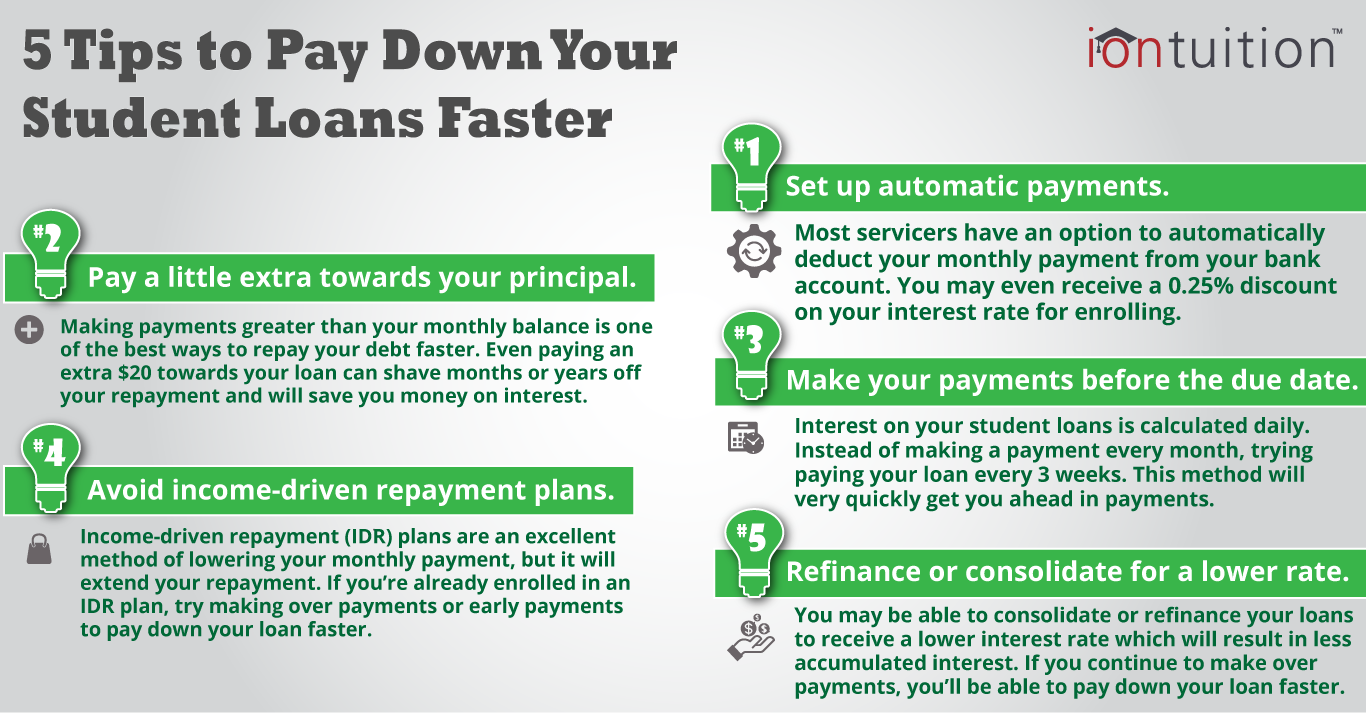
When making extra payments, it is vital to ensure the lender applies the funds to the principal rather than simply “advancing the due date.” By reducing the principal, you lower the base upon which interest is calculated, creating a compounding effect in your favor. Contact your loan servicer to confirm that overpayments are being applied correctly to the highest-interest loan’s principal balance.
4. Refinancing and Consolidation: Structural Optimization
For many borrowers, the original terms of their loans are no longer competitive. As your credit score improves and your income increases, you may have the opportunity to restructure your debt to your advantage.
Private Loan Refinancing
Refinancing involves taking out a new loan with a private lender to pay off your existing student loans. The goal is to secure a lower interest rate. If you have high-interest private loans, refinancing is almost always a smart move if you can lower your rate by 1% or more. However, a word of caution for federal borrowers: refinancing federal loans into private ones means permanently losing access to federal protections, IDR plans, and forgiveness programs. Only refinance federal loans if you have a stable high income, a robust emergency fund, and no intention of seeking public service forgiveness.
Federal Loan Consolidation
Federal Consolidation is different from refinancing. It combines multiple federal loans into one Direct Consolidation Loan. While this doesn’t usually lower your interest rate (it uses a weighted average rounded up to the nearest 1/8th of a percent), it can simplify billing and make certain older loans eligible for PSLF or IDR plans. This is a structural move to gain access to better repayment features rather than a direct cost-saving move.
5. Integrating Student Loans into a Holistic Financial Strategy
Paying off student loans should not happen in a vacuum. It must be balanced against other financial priorities, such as retirement savings, emergency funds, and homeownership.
The Opportunity Cost of Aggressive Repayment
If your student loan interest rate is low (e.g., 3-4%) and the stock market historically returns 7-10%, it may be more financially sound to make the minimum loan payments and invest your extra cash in a tax-advantaged retirement account like a 401(k) or IRA. This is the “opportunity cost” of debt repayment. However, if your interest rates are high (6% or more), the “guaranteed return” of paying down that debt often outweighs the speculative returns of the market.
Employer-Assisted Repayment and Tax Benefits
Modern corporate benefits often include student loan assistance. Under the SECURE Act 2.0, some employers can even match your student loan payments with contributions to your 401(k) retirement account. This allows you to tackle debt without sacrificing your retirement future. Additionally, don’t forget the Student Loan Interest Deduction, which allows you to deduct up to $2,500 of interest paid on your taxes, effectively lowering your taxable income.
Automating for Success
The simplest way to stay on track is automation. Most loan servicers offer a 0.25% interest rate reduction if you sign up for auto-pay. Beyond the minor savings, automation removes the “decision fatigue” associated with debt repayment. By treating your loan payment as a non-negotiable fixed expense, you ensure consistent progress toward your goal.
Conclusion: The Path to Debt Freedom
Mastering your student loans is a marathon of discipline and strategy. By auditing your debt, choosing the correct repayment plan, and employing tactics like the Debt Avalanche or strategic refinancing, you can significantly shorten your timeline to freedom. Remember that personal finance is personal; the “best” strategy is the one that you can stick to until the balance hits zero. With a clear plan and a professional approach to your finances, student debt becomes a temporary hurdle rather than a permanent barrier to your life goals.
aViewFromTheCave is a participant in the Amazon Services LLC Associates Program, an affiliate advertising program designed to provide a means for sites to earn advertising fees by advertising and linking to Amazon.com. Amazon, the Amazon logo, AmazonSupply, and the AmazonSupply logo are trademarks of Amazon.com, Inc. or its affiliates. As an Amazon Associate we earn affiliate commissions from qualifying purchases.