
Navigating the complexities of the tax system can be a daunting task for many, particularly those with income not subject to traditional employer withholding. For self-employed individuals, freelancers, small business owners, and those with significant investment income, quarterly estimated tax payments are not just a suggestion but a critical obligation. Historically, this involved mailing checks and paper forms, a process prone to delays and errors. Today, however, the digital age has revolutionized how we interact with tax authorities, making it easier and more efficient than ever to fulfill these financial responsibilities. Paying quarterly taxes online offers unparalleled convenience, speed, and security, transforming a once cumbersome chore into a streamlined process integral to sound financial management.

This comprehensive guide delves into the necessity of quarterly tax payments, outlines the various online avenues available, and provides a step-by-step approach to ensure your payments are made accurately and on time. By embracing the digital tools at our disposal, you can demystify estimated taxes and maintain robust financial health for yourself or your business.
Understanding Your Quarterly Tax Obligations
Before diving into how to pay, it’s crucial to grasp why and when these payments are necessary. Quarterly taxes are essentially a “pay-as-you-go” system for income that doesn’t have taxes withheld by an employer. This ensures that taxpayers are meeting their tax liability throughout the year, preventing a massive tax bill – and potential penalties – at year-end.
Who Needs to Pay Estimated Taxes?
The requirement to pay estimated taxes applies to individuals and businesses who expect to owe at least $1,000 in tax for the year (or $500 for corporations) and do not have sufficient taxes withheld through other means. This typically includes:
- Self-employed individuals: Freelancers, independent contractors, gig workers, and sole proprietors whose income is not subject to employer withholding.
- Small business owners: Partnerships, S-corporations, and LLCs whose owners draw income directly from the business.
- Individuals with significant investment income: Dividends, interest, capital gains, and rental income.
- Individuals with other non-wage income: Alimony, pension, or annuity income, where withholding might not cover the full tax liability.
It’s important to remember that even if you have a traditional job, you might still need to pay estimated taxes if you have a substantial amount of other income that isn’t being withheld. Failure to pay enough tax throughout the year through withholding and/or estimated payments can result in an underpayment penalty.
What Are the Payment Deadlines?
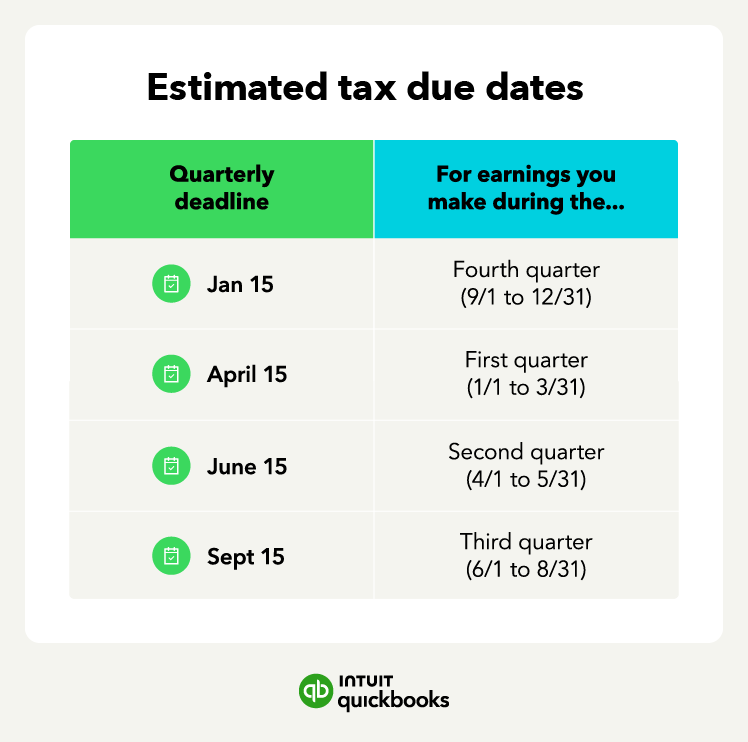
The “quarterly” nature of these payments can be a bit misleading, as the periods don’t perfectly align with calendar quarters. The IRS sets specific due dates for each payment period. While these dates can sometimes shift if they fall on a weekend or holiday, the standard schedule is as follows:
- Payment Period 1 (January 1 to March 31): Due April 15
- Payment Period 2 (April 1 to May 31): Due June 15
- Payment Period 3 (June 1 to August 31): Due September 15
- Payment Period 4 (September 1 to December 31): Due January 15 of the following year
It’s imperative to mark these dates on your calendar and set reminders. Missing a deadline can trigger penalties, even if you eventually pay the full amount. State estimated tax deadlines often mirror federal ones but can vary, so always check your specific state’s tax authority website.
Calculating Your Estimated Tax
Accurately calculating your estimated tax is the cornerstone of effective quarterly tax management. The IRS provides Form 1040-ES, Estimated Tax for Individuals, which includes a worksheet to help you figure out your projected adjusted gross income, deductions, credits, and ultimately, your estimated tax liability for the year. This calculation should account for all sources of income (both taxable and non-taxable), as well as any credits or deductions you anticipate taking.
Key considerations for calculation include:
- Prior Year’s Tax: A common “safe harbor” rule allows you to avoid penalties if you pay at least 90% of your current year’s tax liability, or 100% of your prior year’s tax liability (110% if your Adjusted Gross Income was over $150,000 in the prior year), whichever is smaller.
- Income Fluctuations: If your income varies significantly throughout the year, you might need to adjust your estimated payments. For instance, if you expect a large bonus or a significant increase in freelance work later in the year, you may need to increase subsequent payments.
- Deductions and Credits: Factor in any anticipated business deductions, retirement contributions, or tax credits that could reduce your overall tax burden.
While the 1040-ES worksheet is a valuable tool, many taxpayers find it beneficial to use tax software or consult with a qualified tax professional to ensure accuracy, especially if their financial situation is complex.
Navigating the Online Payment Landscape
The internet offers a variety of secure and convenient options for paying your federal and state estimated taxes. Understanding these different platforms is key to choosing the method that best suits your preferences and needs.
Official IRS Payment Options
For federal estimated tax payments, the IRS offers several direct online channels:
- IRS Direct Pay: This free service allows you to make payments directly from your checking or savings account. It’s simple to use, doesn’t require registration, and provides instant confirmation. You can schedule payments up to 365 days in advance, making it ideal for planning out all four quarterly payments at once.
- Electronic Federal Tax Payment System (EFTPS): EFTPS is another free service offered by the U.S. Department of the Treasury. It requires enrollment, which can take several business days to complete as a confirmation PIN is mailed to you. Once enrolled, EFTPS offers robust features, including the ability to review your payment history, cancel or change pending payments, and make payments for various tax types. It’s often preferred by businesses and individuals who make frequent tax payments.
- Credit/Debit Card Processors: The IRS works with several third-party payment processors that allow you to pay your taxes using a credit card, debit card, or digital wallet (like PayPal). While convenient, these services typically charge a processing fee, which can range from 1.87% to 2.25% for credit cards, and a flat fee for debit cards. This option can be useful for those who want to earn credit card rewards or need to defer payment, but the fees should be weighed against the benefits.
State Tax Agency Portals
Just as with federal taxes, most states have their own online portals for estimated tax payments. It is critical not to assume that paying your federal taxes covers your state obligations. Each state’s tax agency website will typically have a dedicated section for making estimated payments. These often mirror the federal options, allowing for direct bank transfers or credit/debit card payments. You’ll usually need your state tax identification number or Social Security number, along with other personal identifiers. Always search for your state’s official Department of Revenue or Franchise Tax Board to ensure you’re using a legitimate and secure platform.
Third-Party Tax Software Integration
Many popular tax preparation software solutions, such as TurboTax, H&R Block, and TaxAct, offer integrated features for paying estimated taxes. When you use these programs to calculate your annual tax liability, they can often automatically generate your estimated payment vouchers and, in some cases, even facilitate the direct online payment for both federal and state taxes. This can be a significant time-saver, as the software already has your financial information and can pre-fill many of the necessary fields. These services often link directly to IRS Direct Pay or state portals, or use their own secure payment gateways. It’s an efficient option, especially if you already rely on tax software for your annual filing.

A Step-by-Step Guide to Online Payment
Once you’ve calculated your estimated tax and chosen your preferred online method, the actual payment process is straightforward. Here’s a general step-by-step guide to ensure a smooth transaction.
Choosing Your Payment Method
As discussed, your primary choices are IRS Direct Pay, EFTPS, or a third-party credit/debit card processor for federal taxes, and similar options for state taxes.
- IRS Direct Pay is excellent for one-off or occasional payments due to its simplicity and no-registration requirement.
- EFTPS is better for regular business payments or if you prefer a system with detailed payment history and greater control over scheduled payments (but remember the enrollment time).
- Credit/Debit card processors are for those valuing convenience over cost, or seeking rewards.
Consider which method aligns with your current needs and future tax strategy.
Setting Up Your Account (If Required)
- IRS Direct Pay: No account setup needed. Just select “Make a Payment,” choose “Estimated Tax,” and follow the prompts.
- EFTPS: This is the only method that requires prior enrollment. Visit EFTPS.gov, click “Enroll,” and follow the instructions to register as an individual or business. Be patient, as receiving your PIN via postal mail can take 5-7 business days. Once received, you can activate your account online.
- State Portals: Many state portals might require you to set up an account with a user ID and password, similar to EFTPS, especially if you’re a business or plan to make recurring payments.
Entering Your Payment Details
Once logged in or on the Direct Pay interface, you will typically need to provide:
- Tax Type: Select “Estimated Tax” or “Form 1040-ES.”
- Tax Year: Specify the tax year for which you are making the estimated payment (e.g., 2024).
- Payment Amount: Enter the exact amount you wish to pay for the current quarter.
- Identifying Information: Your Social Security Number (SSN) or Employer Identification Number (EIN).
- Bank Account Information (for Direct Pay/EFTPS/ACH): Your bank routing number and checking or savings account number. Double-check these carefully to avoid errors.
- Credit/Debit Card Information (for processors): Card number, expiration date, CVV, and billing address.
For state payments, the process will be very similar, asking for your state ID (if applicable) and ensuring the correct tax type is selected.
Verifying and Confirming Your Payment
This is perhaps the most critical step. Before submitting, meticulously review all the information you’ve entered: the amount, the tax year, your personal identifiers, and your bank/card details. A small error can lead to a misapplied payment or a failed transaction.
After submission, you will receive a confirmation number. Save this confirmation number immediately. Print it, take a screenshot, or email it to yourself. This number is your proof of payment and is invaluable if there are any discrepancies or issues later. For EFTPS, you can often view your payment history directly within your account. For credit card payments, you’ll also receive an email confirmation from the processor.
Best Practices for Seamless Quarterly Tax Payments
Effective management of your estimated taxes extends beyond simply knowing how to make an online payment. It involves proactive planning and diligent record-keeping.
Stay Organized and Plan Ahead
- Budgeting: Incorporate estimated tax payments into your regular financial budget. Treat them as a fixed expense, setting aside funds from each paycheck or invoice received.
- Income Tracking: Maintain meticulous records of your income and deductible expenses throughout the year. This makes accurate tax estimation much easier. Consider using accounting software or a simple spreadsheet.
- Annual Review: At the beginning of each year, estimate your total income and deductions for the upcoming year to project your tax liability. Revisit this estimate periodically, especially if your income changes significantly.
Automate Your Payments (Where Possible)
Utilize the scheduling features available through IRS Direct Pay and EFTPS. You can set up all four quarterly payments at the beginning of the year, essentially automating the process. This greatly reduces the risk of missing deadlines and frees up mental energy. If using tax software, explore if it offers features to push payments directly to the IRS or state.
Keep Thorough Records
Beyond just saving confirmation numbers, maintain a dedicated digital or physical folder for all your estimated tax payment records. This should include:
- Copies of your Form 1040-ES worksheet or tax software calculations.
- Confirmation emails and pages from online payment systems.
- Bank statements showing the debited payments.
- Any correspondence from the IRS or state tax authorities regarding estimated taxes.
These records are vital for tax reconciliation at year-end and for defending against any potential IRS inquiries.
Understanding Penalties for Underpayment
The IRS imposes penalties for underpayment of estimated tax if you don’t pay enough tax throughout the year, either through withholding or estimated payments, or if you don’t pay it on time. The penalty is typically a percentage of the underpaid amount for each day the tax remains unpaid. While there are some exceptions (e.g., if you had a casualty, disaster, or unusual circumstances), generally, avoiding penalties requires meeting the 90% current year or 100%/110% prior year safe harbor rules. Being proactive with your estimated payments online is the best defense against these avoidable financial setbacks.
Paying quarterly taxes online is not just a modern convenience; it’s an essential financial discipline for many taxpayers. By understanding your obligations, leveraging official online portals, and adopting best practices for organization and automation, you can ensure timely and accurate payments. This proactive approach not only keeps you compliant with tax law but also contributes to your overall financial peace of mind, allowing you to focus on your income-generating activities without the looming stress of a year-end tax surprise. If your financial situation is particularly complex, or you’re unsure about your estimated tax calculations, always consider consulting with a qualified tax professional to ensure you’re meeting your obligations optimally.
aViewFromTheCave is a participant in the Amazon Services LLC Associates Program, an affiliate advertising program designed to provide a means for sites to earn advertising fees by advertising and linking to Amazon.com. Amazon, the Amazon logo, AmazonSupply, and the AmazonSupply logo are trademarks of Amazon.com, Inc. or its affiliates. As an Amazon Associate we earn affiliate commissions from qualifying purchases.