
For many, a car is a necessity, a tool for commuting, errands, and family adventures. However, it often comes with a significant financial commitment: a car loan. While the monthly payments might seem manageable, the cumulative interest paid over the life of the loan can be substantial, tying up your cash flow and delaying other financial goals. The desire to shed this debt sooner is a common one, driven by the lure of financial freedom and the opportunity to save hundreds, if not thousands, in interest.
This article delves into the strategies and the indispensable tool – the car loan faster payoff calculator – that empowers individuals to accelerate their debt repayment journey. We’ll explore why paying off your car loan quickly is a smart financial move, outline actionable tactics, and demonstrate how a calculator can be your most valuable ally in visualizing and executing your plan. Taking control of your car loan isn’t just about speed; it’s about gaining clarity, building momentum, and ultimately, freeing up your finances for a brighter future.

Understanding Your Car Loan: The Foundation of Faster Payoff
Before you can effectively strategize to pay off your car loan faster, it’s crucial to understand the fundamental mechanics of how it works. This knowledge provides the bedrock for making informed decisions and appreciating the impact of accelerated payments.
Key Loan Terms: Principal, Interest Rate, Term
Every car loan is built upon a few core components:
- Principal: This is the original amount of money you borrowed to purchase the car. As you make payments, a portion goes towards reducing this principal balance. The goal of early payoff is to reduce this faster.
- Interest Rate (APR): Expressed as a percentage, the interest rate is the cost of borrowing money. A higher interest rate means you pay more for the privilege of using the lender’s money. Paying off your loan faster minimizes the total interest accrued over the life of the loan.
- Loan Term: This is the duration, typically in months (e.g., 36, 48, 60, 72 months), over which you’ve agreed to repay the loan. A longer term generally means lower monthly payments but results in paying significantly more interest overall. Conversely, a shorter term has higher monthly payments but less total interest.
Understanding these elements is the first step towards manipulating them to your advantage. Your interest rate dictates how much of each payment goes towards interest versus principal, especially in the early stages of the loan.
How Amortization Works
Car loans are typically amortized loans. This means that over the loan’s term, your fixed monthly payment is split between paying down the principal and covering the interest. A critical aspect of amortization, particularly for consumers, is that during the initial phase of the loan, a larger portion of your monthly payment goes towards interest, and a smaller portion goes towards the principal. As time progresses and your principal balance decreases, this ratio gradually shifts, with more of your payment attacking the principal.
This front-loading of interest means that making extra payments early in your loan term has a disproportionately powerful effect. Any additional money you pay beyond your scheduled minimum, designated specifically for principal reduction, directly reduces the amount on which future interest is calculated. This creates a compounding effect, saving you more interest and shortening your loan term significantly. Grasping this concept is vital for anyone aiming to pay off their car loan faster.
Strategies to Accelerate Your Car Loan Payoff
Once you understand the mechanics of your loan, you can employ several proven strategies to reduce your debt faster. Each method, or a combination thereof, can significantly cut down on the total interest paid and shorten your repayment period.
Making Extra Principal Payments
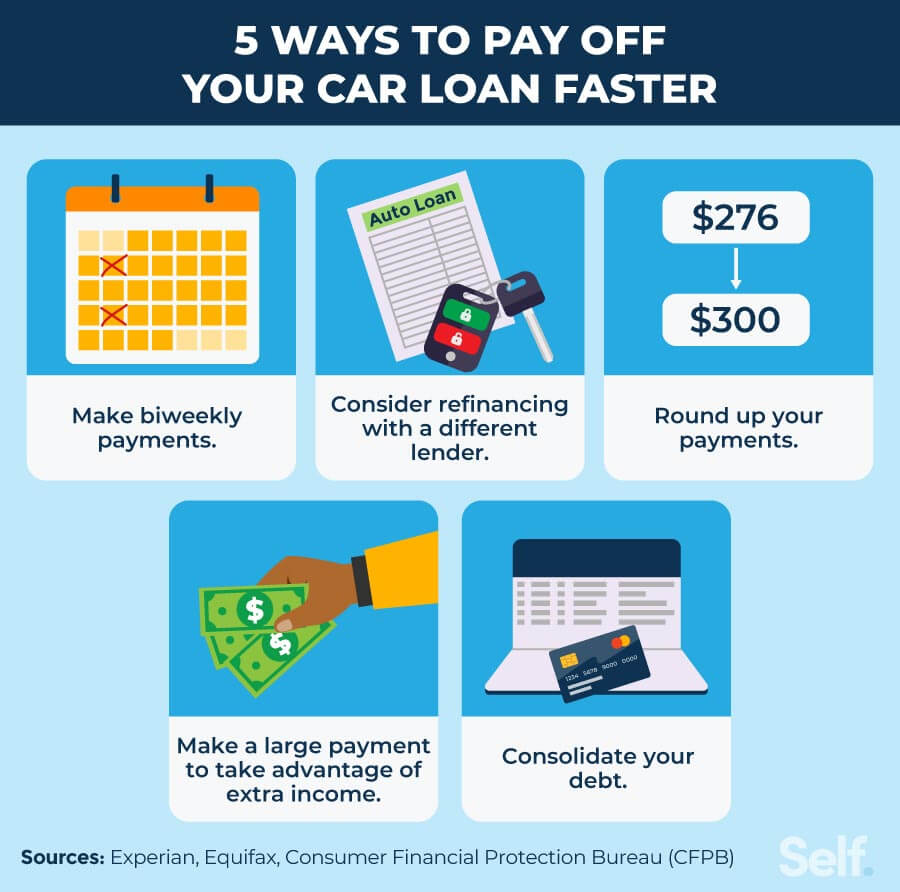
This is arguably the most straightforward and effective strategy. Any amount you pay over your minimum monthly payment, when specifically directed to reduce the principal balance, directly attacks the core of your debt. Even small, consistent extra payments can yield substantial savings. For instance, if your payment is $300, adding an extra $50 each month can shave months off your loan and save you hundreds in interest. Ensure your lender applies these extra funds directly to the principal, not just prepaying interest or future payments.
Bi-Weekly Payments
Instead of making one full payment per month, you can opt to make half of your monthly payment every two weeks. Since there are 52 weeks in a year, this results in 26 half-payments, which equates to 13 full monthly payments annually instead of 12. This extra “payment” each year is directly applied to the principal, effectively shaving off a significant portion of your loan term and reducing total interest. It’s a subtle change in payment frequency that can have a profound impact without feeling like a major strain on your budget.
Refinancing for a Better Rate
If your credit score has improved since you first took out your car loan, or if interest rates have dropped, refinancing could be a powerful strategy. By securing a new loan with a lower interest rate, more of your monthly payment will go towards the principal, accelerating your payoff. When refinancing, always aim to keep your loan term the same or, ideally, shorten it. Extending the term, even with a lower rate, might lead to paying more interest overall in the long run. Use a calculator to compare your current loan with potential refinancing offers.
Rounding Up Payments or Applying Windfalls
Another simple tactic is to round up your monthly payment. If your payment is $287, round it up to $300. That extra $13 each month adds up. Similarly, apply any unexpected income – such as tax refunds, work bonuses, or inheritance – directly to your car loan’s principal. These “windfalls” can act as significant accelerators, sometimes eliminating years from your loan term with a single large payment. Even selling unused items around your house and applying the proceeds can make a difference.
The Power of the Car Loan Faster Payoff Calculator
While understanding strategies is essential, seeing their concrete impact on your finances is what truly empowers action. This is where the car loan faster payoff calculator becomes an indispensable tool. It transforms abstract numbers into tangible results, illustrating precisely how your efforts translate into savings and freedom.

What a Calculator Does (and Doesn’t Do)
A car loan faster payoff calculator is a sophisticated simulation tool. It takes your current loan details (original loan amount, interest rate, term, current balance, current monthly payment) and allows you to input “what-if” scenarios, such as:
- How much extra principal you’d like to pay each month.
- The frequency of bi-weekly payments.
- A lump-sum payment you plan to make.
It then recalculates your amortization schedule, showing you:
- Your new, earlier payoff date.
- The total interest saved.
- The number of payments you eliminate.
What it doesn’t do: It doesn’t magically pay off your loan, nor does it guarantee specific outcomes if your loan terms change (e.g., variable interest rates, though most car loans are fixed). It’s a planning tool, not a crystal ball. Its accuracy relies entirely on the accuracy of your input data.
How to Use It Effectively (Inputs and Outputs)
To use a car loan calculator effectively, gather the following information about your current loan:
- Original Loan Amount: The total amount financed.
- Original Loan Term: The initial number of months for the loan.
- Original Interest Rate (APR): Your fixed interest rate.
- Current Loan Balance: The outstanding amount you still owe.
- Number of Payments Made So Far: How many monthly payments you’ve already completed.
- Current Monthly Payment: Your standard payment amount.
Once you input these details, the calculator will provide a baseline. Then, you start experimenting:
- Scenario 1: Extra Monthly Payment: Enter an additional amount (e.g., $25, $50, $100) and see how your payoff date and total interest change.
- Scenario 2: Lump-Sum Payment: Input a one-time extra payment (e.g., a tax refund) to see its impact.
- Scenario 3: Bi-Weekly Payments: Select this option to see the effect of making 13 equivalent payments per year.
Play with different combinations. This interactive process helps you understand what’s feasible for your budget and the potential rewards.
Visualizing Your Savings and New Payoff Date
One of the most powerful aspects of these calculators is their ability to visualize the impact of your actions. Seeing your original payoff date of “October 2027” transform into “February 2026” with an extra $50 payment per month can be incredibly motivating. Similarly, watching the “Total Interest Paid” figure shrink by hundreds or even thousands of dollars reinforces the financial wisdom of early repayment. Many calculators also provide an updated amortization schedule, showing how much faster your principal balance will decrease and how much less interest accrues each month. This tangible evidence of progress is a powerful psychological boost, encouraging you to stick to your plan and potentially even find more ways to accelerate your payments.
Implementing Your Accelerated Payoff Plan
Having identified strategies and visualized the benefits with a calculator, the next step is to integrate your accelerated payoff plan into your daily financial life. This requires discipline, budgeting, and consistent monitoring.
Creating a Budget to Find Extra Cash
To make extra payments, you first need to identify where that extra money will come from. This necessitates a thorough review of your current spending through budgeting. Track all your income and expenses for at least a month. Categorize your spending (housing, food, transportation, entertainment, subscriptions, etc.) to pinpoint areas where you can trim non-essential expenses. Even small adjustments – cutting down on daily lattes, canceling unused subscriptions, or packing your lunch – can free up valuable funds that can be redirected to your car loan. Remember, every dollar you apply to principal saves you future interest.
Automating Your Payments
Consistency is key to accelerated debt repayment. One of the best ways to ensure consistency is to automate your extra payments. Set up an automatic transfer from your checking account to your car loan every month for the additional amount you’ve committed to paying. This removes the need for manual action and reduces the risk of forgetting or diverting the funds elsewhere. If your lender doesn’t allow specific automatic principal-only payments, you might automate saving the extra amount in a separate account and then manually making a larger payment once a quarter or whenever a significant amount has accumulated.
Staying Motivated and Tracking Progress
Paying off debt can be a marathon, not a sprint. To stay motivated, regularly revisit your car loan payoff calculator to see how much closer you are to your goal. Print out an updated amortization schedule with your accelerated payments and mark off each payment. Celebrate small milestones, like reaching a certain principal balance or paying off a full year of interest. Tracking your progress, both financially and emotionally, reinforces your commitment and keeps you focused on the ultimate prize: a debt-free car and more financial freedom.
Conclusion
Paying off a car loan faster is a strategic financial move that can save you a significant amount in interest, free up your monthly cash flow, and accelerate your overall journey toward financial independence. By understanding the basics of your loan, implementing effective strategies like extra principal payments, bi-weekly payments, or smart refinancing, you can drastically shorten your repayment period.
The car loan faster payoff calculator is not just a tool; it’s a powerful motivator and a planning essential. It demystifies the impact of your financial decisions, turning complex calculations into clear, actionable insights. Use it to visualize your savings, find your optimal payoff strategy, and commit to a plan that works for your budget. By taking proactive steps and leveraging this valuable resource, you’re not just paying off a car loan; you’re investing in your financial future and driving yourself towards greater peace of mind.
aViewFromTheCave is a participant in the Amazon Services LLC Associates Program, an affiliate advertising program designed to provide a means for sites to earn advertising fees by advertising and linking to Amazon.com. Amazon, the Amazon logo, AmazonSupply, and the AmazonSupply logo are trademarks of Amazon.com, Inc. or its affiliates. As an Amazon Associate we earn affiliate commissions from qualifying purchases.