
Embarking on your investment journey can feel like navigating a complex maze, but with the right guidance, it transforms into an empowering path toward financial freedom. For many aspiring and seasoned investors alike, Vanguard stands out as a preferred destination. Renowned for its low-cost index funds, exchange-traded funds (ETFs), and a unique investor-owned structure, Vanguard has democratized investing, making it accessible and efficient. This comprehensive guide will demystify the process of opening a Vanguard account, providing you with a clear roadmap to kickstart or advance your investment portfolio.
Understanding Vanguard: A Beacon for Investors
Before diving into the mechanics of account setup, it’s crucial to understand what makes Vanguard a distinctive and often recommended choice in the investment landscape. Its philosophy and operational model are fundamentally geared towards maximizing investor returns by minimizing costs.

The Vanguard Philosophy: Low Costs, Investor-Owned
At its core, Vanguard operates under a unique principle: it is owned by its funds, which, in turn, are owned by their investors. This mutual structure means there are no outside shareholders to satisfy, leading to a relentless focus on keeping costs low. Unlike publicly traded financial firms that must balance shareholder profits with client interests, Vanguard’s interests are directly aligned with those of its investors. This translates into some of the lowest expense ratios in the industry, significantly impacting long-term investment growth. Over decades, even a small difference in expense ratios can amount to hundreds of thousands of dollars in your pocket rather than the fund manager’s.
Why Choose Vanguard? Key Advantages
The allure of Vanguard extends beyond its cost-effective structure. Several key advantages solidify its position as a top-tier investment platform:
- Broad Range of Investment Products: Vanguard offers a vast array of investment vehicles, including highly diversified index mutual funds, actively managed funds, and an extensive selection of ETFs covering virtually every asset class. This breadth allows investors to construct portfolios tailored to their specific goals and risk tolerance, from conservative bond funds to aggressive equity funds.
- Strong Track Record and Reliable Performance: Vanguard’s funds, particularly its index funds, have consistently delivered competitive returns over the long term, mirroring the performance of the broader market indices they track. Their disciplined approach to passive investing has proven to be a powerful strategy for wealth accumulation.
- Commitment to Long-Term Investing: Vanguard champions a long-term investment horizon, discouraging market timing and promoting a patient, disciplined approach. Their educational resources and investment advice are designed to reinforce this philosophy, helping investors avoid common pitfalls driven by short-term market fluctuations.
- Educational Resources for Investors: Beyond providing investment products, Vanguard is committed to investor education. Their website is replete with articles, videos, and tools designed to help investors understand market dynamics, portfolio construction, retirement planning, and various financial concepts, empowering them to make informed decisions.
Preparing for Your Vanguard Journey: What You’ll Need
Opening an investment account, while straightforward, requires a bit of preparation. Gathering the necessary information and understanding your financial landscape beforehand will streamline the application process and ensure a smooth start to your investing experience.
Essential Personal Information
To comply with financial regulations and verify your identity, Vanguard will require several pieces of personal information:
- Full Legal Name, Address, and Date of Birth: Standard identifying information to establish your account.
- Social Security Number (SSN) or Tax Identification Number (TIN): Essential for tax reporting purposes and linking your investments to your unique taxpayer identification.
- Driver’s License or State ID: You may need to provide details from a government-issued identification document for identity verification, especially for online applications.
Financial Details and Funding Your Account
Funding your account is a critical step, and Vanguard offers several convenient options. Be prepared with the following:
- Bank Account Details: Have your bank account’s routing number and account number ready if you plan to link it for electronic transfers (ACH) to fund your Vanguard account. This is the most common and often the easiest method for initial and recurring contributions.
- Information About Existing Investment Accounts: If you intend to transfer funds or an entire account from another brokerage or retirement plan, you’ll need details such as the account number and the institution’s name. Vanguard can assist with rolling over 401(k)s, IRAs, or transferring taxable brokerage accounts.
- Understanding Minimum Investment Requirements: Be aware of minimum investment requirements. For many Vanguard mutual funds, there’s an initial minimum of $3,000. However, many Vanguard ETFs can be purchased for the price of a single share (e.g., $50-$200), and some mutual funds (like Target Retirement Funds) have lower minimums for IRA accounts. Brokerage accounts generally don’t have an opening minimum beyond the cost of the shares you wish to purchase.
Defining Your Investment Goals and Risk Tolerance
Before you invest, it’s paramount to understand why you are investing and how much risk you are comfortable taking. This clarity will guide your choice of account type and investment products:
- Account Type: Are you saving for retirement (e.g., Traditional IRA, Roth IRA), college (529 plan), or simply general investment goals (taxable individual or joint brokerage account)? Each account type has different tax implications and rules.
- Investment Horizon: Are your goals short-term (within 5 years) or long-term (10+ years)? This dictates the type of assets you should consider. Long-term goals generally allow for more exposure to growth-oriented, volatile assets like stocks.
- Risk Tolerance: How comfortable are you with market fluctuations? Could you stomach a 20-30% drop in your portfolio value without panicking? Understanding your emotional response to risk is crucial for building a sustainable portfolio. Vanguard offers tools to help assess your risk tolerance.
The Step-by-Step Process to Open Your Account
Once your preparations are complete, opening your Vanguard account is a streamlined online process.
Navigating the Vanguard Website
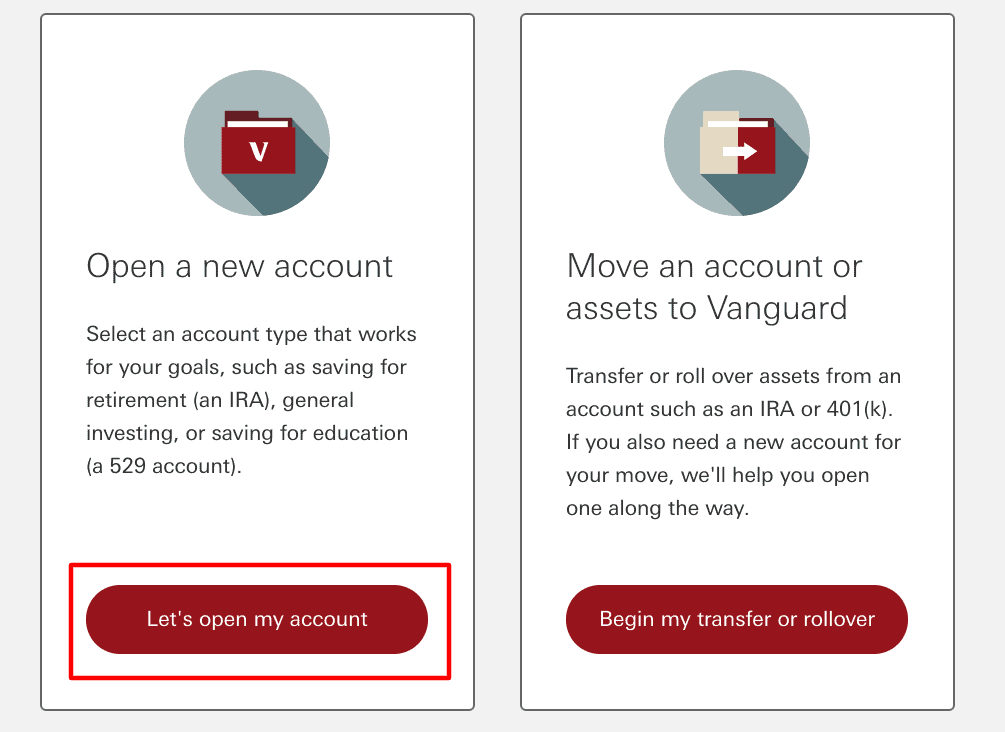
Start by visiting Vanguard’s official website. Look for prominent buttons or links labeled “Open an Account,” “Invest Now,” or similar calls to action.
- Choosing Account Type: The first crucial step is to select the type of account you wish to open. Options typically include:
- Individual Brokerage Account: For general investment goals, no contribution limits, but gains are taxable.
- Joint Brokerage Account: Similar to individual, but owned by two or more people.
- Traditional IRA: Tax-deductible contributions (for many), tax-deferred growth, taxable withdrawals in retirement.
- Roth IRA: Non-deductible contributions, tax-free growth, tax-free withdrawals in retirement (with conditions).
- SEP IRA/SIMPLE IRA: For self-employed individuals and small businesses.
- 529 College Savings Plan: Tax-advantaged savings for education expenses.
- Custodial Account (UGMA/UTMA): For minors.
Completing the Online Application
Follow the prompts to fill out the online application form:
- Inputting Personal and Financial Information: Accurately enter all the personal and financial details you gathered in the preparation phase. Double-check for any typos.
- Setting Up Beneficiaries: For retirement accounts (IRAs) and some other account types, you’ll be asked to designate beneficiaries. This ensures your assets are distributed according to your wishes in the event of your passing, bypassing probate.
- Reviewing and Agreeing to Terms and Conditions: Before submitting, carefully review all the information you’ve provided. Read and understand the terms and conditions, privacy policy, and any disclaimers.

Funding Your New Account
After your application is submitted and approved (often immediately), you’ll proceed to fund your account:
- Electronic Bank Transfer (ACH): This is the most common and convenient method. You’ll link your bank account to Vanguard and authorize a transfer. Funds typically clear within 2-5 business days.
- Rolling Over Funds: If you’re transferring an existing IRA or 401(k) from a previous employer, Vanguard will provide instructions on how to initiate a direct rollover. This typically involves coordination between Vanguard and your previous plan administrator.
- Transferring Assets from Another Brokerage: For transferring taxable brokerage accounts, Vanguard facilitates an Automated Customer Account Transfer Service (ACATS), which moves your existing investments “in kind” (i.e., you don’t sell them and repurchase).
- Checks or Wire Transfers: While less common for initial funding, these options are available if needed.
Selecting Your Initial Investments
With funds in your account, it’s time to choose your investments. This is where your pre-defined goals and risk tolerance come into play.
- Choosing Between Mutual Funds and ETFs:
- Mutual Funds: Many Vanguard mutual funds have a $3,000 minimum. They are typically bought and sold once a day after the market closes.
- ETFs: Exchange-Traded Funds trade like stocks throughout the day and can be bought for the price of a single share. Vanguard offers many ETFs that are share classes of its popular index funds, providing similar low-cost exposure.
- Consideration of Target-Date Funds: For hands-off investing, Vanguard’s Target Retirement Funds are an excellent choice. These are single, diversified mutual funds that automatically adjust their asset allocation over time, becoming more conservative as you approach your target retirement year.
- Diversification Principles: Regardless of your choice, ensure your initial investments contribute to a well-diversified portfolio, spreading your risk across different asset classes, industries, and geographies.
Beyond Account Opening: Managing Your Vanguard Investments
Opening your account is just the beginning. Effective management is key to long-term success.
Understanding Your Dashboard and Tools
Vanguard’s online platform offers a comprehensive dashboard to manage your investments:
- Monitoring Performance: Track your portfolio’s performance, view account balances, and analyze individual fund returns.
- Viewing Statements and Tax Documents: Access monthly statements, year-end summaries, and tax forms electronically.
- Making Transactions: Easily buy and sell funds, exchange funds, and adjust your asset allocation.
- Accessing Research and Educational Materials: Utilize Vanguard’s extensive library of research papers, market insights, and educational articles to stay informed.
Setting Up Automatic Investments
One of the most powerful strategies for long-term investors is dollar-cost averaging, which involves investing a fixed amount regularly, regardless of market fluctuations.
- Dollar-Cost Averaging Strategy: By investing consistently, you buy more shares when prices are low and fewer when prices are high, averaging out your purchase price over time. This reduces the risk of trying to “time the market.”
- Consistent Contribution for Long-Term Growth: Setting up automatic transfers from your bank account to your Vanguard investment ensures discipline and consistency, which are cornerstones of wealth accumulation.
Reviewing and Rebalancing Your Portfolio
Your financial situation and market conditions change, and your portfolio should adapt accordingly.
- Periodically Assessing Investment Alignment with Goals: At least once a year, review your portfolio to ensure it still aligns with your investment goals, risk tolerance, and time horizon.
- Adjusting Asset Allocation as Life Circumstances Change: Major life events (marriage, children, career changes, nearing retirement) may necessitate adjustments to your asset allocation. For instance, as you approach retirement, you might shift towards a more conservative mix of assets.
- The Importance of Staying the Course Through Market Volatility: While it’s tempting to react to market downturns, a disciplined, long-term approach with periodic rebalancing (bringing your asset allocation back to your target percentages) is typically more effective than emotional selling.
Common Questions and Troubleshooting
Even with clear instructions, questions may arise. Vanguard’s support system is designed to help.
Minimum Investment Requirements & Fund Types
- Clarifying Differences Between Mutual Fund and ETF Minimums: Remember that many Vanguard mutual funds have a $3,000 minimum, whereas ETFs can be bought for the price of a single share.
- Discussing Vanguard’s Starter Funds or ETFs: If the $3,000 minimum is a barrier, consider starting with Vanguard’s ETFs (e.g., VOO, VTI, BND) or some of their specific mutual funds with lower minimums in retirement accounts.
Customer Support and Resources
- How to Get Help with the Application Process or Account Management: Vanguard offers robust customer support. You can typically find answers in their extensive online help center or by calling their customer service number.
- Vanguard’s Online Help Center and Phone Support: Don’t hesitate to utilize these resources for any questions or issues.
Security Measures and Protecting Your Investment
Vanguard employs stringent security measures to protect your account:
- Two-Factor Authentication: Enable two-factor authentication (2FA) for an added layer of security when logging in.
- Fraud Prevention and Reporting: Be vigilant about phishing attempts and suspicious communications. Vanguard provides information on how to report suspected fraud.
Your Path to Financial Empowerment with Vanguard
Opening a Vanguard account is a foundational step toward taking control of your financial future. By understanding Vanguard’s investor-focused philosophy, diligently preparing your information, and following the clear steps for account setup, you’re positioning yourself for long-term success. Remember that investing is a journey, not a sprint. The key to financial empowerment lies in starting early, investing consistently, staying diversified, and maintaining a disciplined, long-term perspective. With Vanguard, you have a powerful partner dedicated to helping you achieve your financial aspirations.
aViewFromTheCave is a participant in the Amazon Services LLC Associates Program, an affiliate advertising program designed to provide a means for sites to earn advertising fees by advertising and linking to Amazon.com. Amazon, the Amazon logo, AmazonSupply, and the AmazonSupply logo are trademarks of Amazon.com, Inc. or its affiliates. As an Amazon Associate we earn affiliate commissions from qualifying purchases.